
Disclosure: links marked Partner are referral links. If you buy a challenge through them or use code 4V6, we earn a commission and you get 5% off. We paid for both challenges in this review ourselves, and the results below are our own trades.
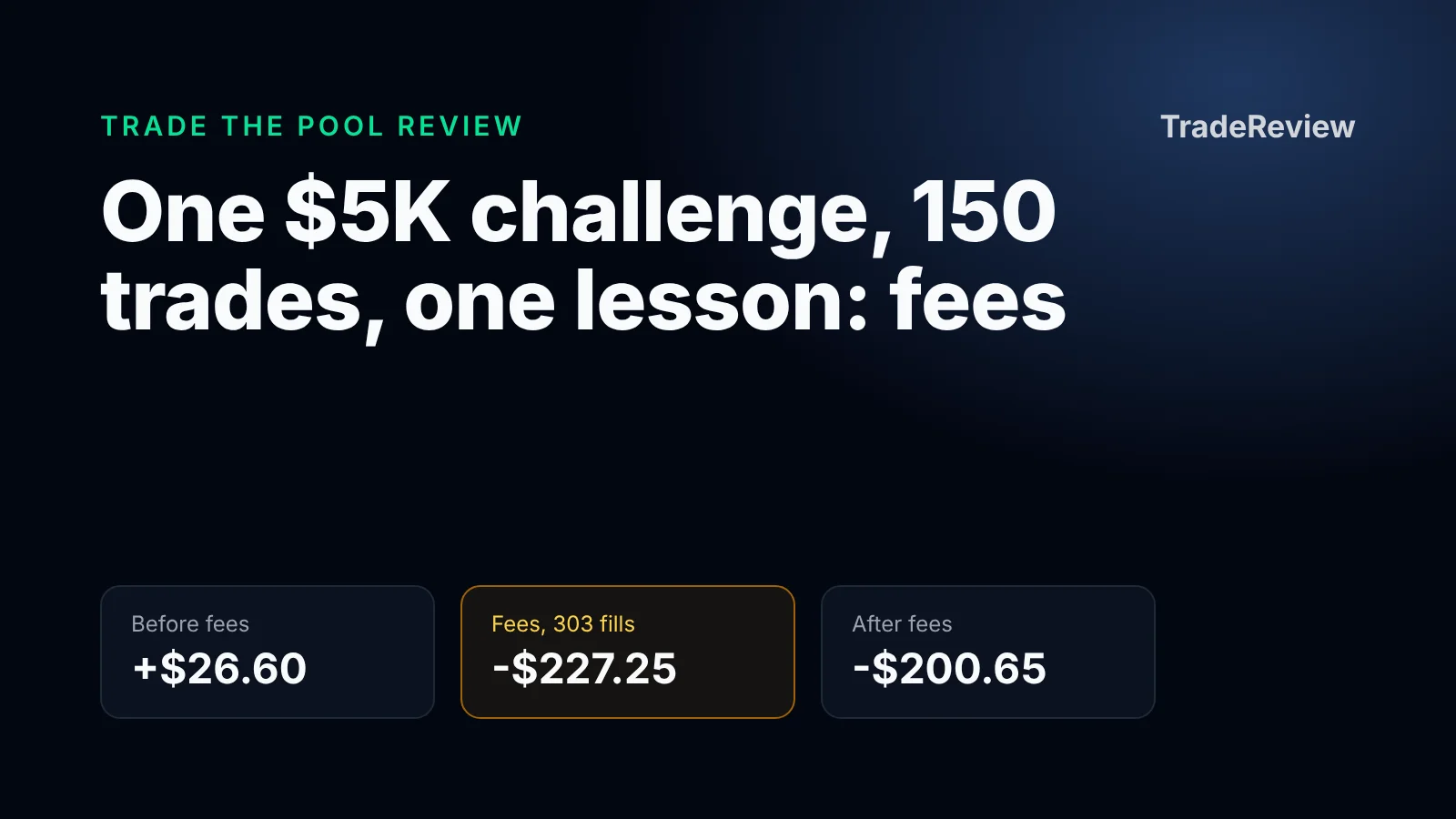
Trade The Pool is a stable stock prop firm with a wide list of US stocks, and its platform worked without problems for us. We still failed both $5,000 FLEX Day challenges on the max loss rule. Our journal shows why: across 150 trades we were +$26.60 before fees and -$200.65 after them. On a $5,000 account the per-execution fee is large next to a $200 max loss, so a strategy that only breaks even before costs will fail.
Trade The Pool at a glance
Rules and prices are from Trade The Pool’s own program overview (prices as listed on 4 October 2026). The platform and fee rows are from our own account. Check the current terms before you buy.
| FLEX Day, $5,000 account | |
|---|---|
| Markets | US stocks |
| Platform | Trader Evolution: Windows, iOS and Android apps, a web version, and TradingView |
| Price | $59 standard, $47 discounted tier |
| Profit target | 6% ($300) |
| Max loss | 4% ($200) |
| Daily pause | 2% ($100) |
| Minimum positions | 10 |
| Time limit | None |
| Consistency rule | One position can be at most 50% of profit on FLEX programs |
| Payout after passing | 70/30 split, every 14 days, minimum $150 profit on a $5,000 account |
| Fee on our account | $0.75 per execution, so $1.50 for each round trip |
What we liked and what we did not
Liked
- Stable platform. Over two challenges of active day trading, the platform worked without problems.
- A wide list of stocks. We traded 71 different tickers, from large caps like IBM and PayPal to stocks under $20.
Could be better
- Fees on small accounts. $0.75 per execution is a small number, but on a $5,000 account it comes to nearly the whole max loss over a month of day trading. Over our 24 days it was $227.25, more than the $200 limit.
- No macOS app. The Trader Evolution platform has apps for Windows, iOS and Android, a web version and a TradingView connection, but nothing native for Mac. On a Mac the web version is the option, and a macOS app would be welcome.
Our results: 150 trades on a $5,000 FLEX Day account
We exported the challenge account from the platform’s Filled orders tab and imported it into TradeReview. These are the numbers from 9 June to 15 July 2026:
| Result | |
|---|---|
| Trading days | 24 |
| Trades (round trips) | 150: 105 long, 45 short |
| Win rate | 30% (45 of 150) |
| Average win / average loss, before fees | +$23.14 / -$9.95 (3 trades were flat) |
| P&L before fees | +$26.60 |
| Fees (303 executions × $0.75) | -$227.25 |
| P&L after fees | -$200.65 |
| Best point of the equity curve | +$145.10 after fees |
| Worst day | -$98.10, just under the $100 daily pause |
The last trade, on 15 July, took the account to -$200.65, just past the 4% max loss. No single day hit the daily pause, but four days lost between $80 and $98 each, close to it, and those days did most of the damage.
Fees vs. the $200 max loss
A round trip costs $1.50. At our pace of about 6.25 trades a day, that is roughly $9.40 a day before a single trade goes wrong. Over 20 trading days the fees come to $187.50, which is 94% of the $200 max loss.
So to reach the $300 target in 20 days at that pace, a trader needs about $487.50 of gross profit, not $300. Our win rate and win/loss ratio gave a profit factor of 1.03 before fees, which is break-even. On a larger account the same fee is a smaller share of the limits, and with fewer, larger trades it matters less. If you trade the $5,000 FLEX Day, count fees in your plan from day one. Our trading profit guide shows how to work out net P&L after costs, and what is scalping has the same break-even arithmetic for short holding times.
Where the losses came from: shorts, scalps and late trades
Splitting the 150 trades in the journal pointed to three leaks. Each row is after fees:
| Group | Trades | P&L after fees |
|---|---|---|
| Short trades | 45 | -$110.95 |
| Held under 5 minutes | 60 | -$170.05 |
| Opened in the last two hours of the US session | 29 | -$125.15 |
| Entered with a limit order | 41 | -$115.15 |
| Any of the first three | 101 | -$231.65 |
| The other 49 trades | 49 | +$31.00 |
The groups overlap: a short opened late and held for three minutes counts in all three. Taken together, the 101 trades in those groups lost more than the whole $200 max loss. The other 49, all longs held five minutes or more and opened before the last two hours, made a small profit even after fees.
Forty-nine trades is too few to call that an edge: +$31 over 49 trades is within noise. The win rate guide explains why. It is still clear what to change first: fewer trades, no shorts until the long side works, and no new trades in the last two hours. You can build the same splits from your own trades with a pivot table or in a journal. For the sizing and daily-stop rules that apply to any challenge, see how to pass a prop firm challenge.
Importing Trade The Pool trades into TradeReview
TradeReview reads both exports from the Trade The Pool web platform (Trader Evolution in the browser):
- Open the Filled orders tab. It is the recommended export because it includes the execution fee.
- Set Range to the dates you want, click Export, choose CSV and keep all columns ticked.
- In TradeReview choose Trade The Pool as the broker, upload the file and pick your computer’s time zone. The platform writes times in local time.
The Orders history export also works, but it has no fees. Fills that appear in both files are imported once.
Who Trade The Pool fits
- Fits: stock day traders who want a firm with stable execution and a wide ticker list, and who trade few, deliberate positions, or larger accounts where the fee is a small share of the limits.
- Think twice: scalpers on the $5,000 account. Count the fees against the 4% max loss before you buy.
Get a Trade The Pool challenge (Partner, 5% off with code 4V6)
Frequently asked questions
Is Trade The Pool legit?
It worked as described for us: the platform was stable and both challenges ended under the rules as written. We did not pass, so we have not received a payout ourselves. Payout terms are on the firm’s program overview.
Does Trade The Pool charge commission?
Our account was charged $0.75 per execution, shown as “Execution fee” in the Filled orders export. A round trip cost $1.50.
How much is a $5,000 Trade The Pool challenge?
The firm lists $59 for the $5,000 FLEX Day account, or $47 at a discounted tier, as listed on 4 October 2026. Prices change, so check before buying.
Why did you fail?
Both challenges ended on the 4% max loss. In the exported one, the strategy roughly broke even before fees, and $227.25 of fees took the account to the limit.
Not investment advice. Our results on one account say nothing about yours. Most people who buy a prop firm challenge do not pass it; buy one only with money you can afford to lose.