

A trading plan is your personal rulebook for the markets. Think of it as a business plan for your trading — a set of comprehensive rules you create with a clear head to guide your decisions when things get chaotic. It’s the single most important document you will create as a trader.
The Blueprint That Separates Traders From Gamblers
Trading is hard. The emotional pull of the market is strong, and it’s easy to get caught up in the excitement. Far too many people jump into the markets on a whim, chasing quick profits with no map to guide them. They react to every bit of market noise, letting fear and greed call the shots.
That’s not trading; it’s gambling. A trader without a plan is like a ship captain sailing into a hurricane without a compass, a map, or even a destination in mind.
A trading plan brings order to that chaos. It creates a structured, repeatable process that draws a clear line between a professional operating a business and a gambler pulling a slot machine lever.
A trading plan isn’t about restricting you; it’s about liberating you from the emotional, in-the-moment decisions that wreck accounts. It gives you the discipline to act logically when every instinct is screaming at you to do the opposite.
This disciplined approach is what helps traders beat the odds. The hard truth is that most traders fail, not because the market is rigged, but because they skip this critical planning stage. Brokerage data consistently shows that a large percentage of traders quit within the first two years, and many who stick around still underperform the market.
A trading plan directly attacks this problem by giving you predefined rules to keep you grounded.
The goal is to build a personalized blueprint that truly reflects your:
- Personality and goals: Are you patient enough to ride long-term trends, or do you thrive on quick, intraday moves?
- Risk tolerance: How much can you actually afford to lose on one trade without losing sleep over it? Be honest with yourself.
- Lifestyle: Does your plan fit your daily schedule, or is it going to add a ton of unnecessary stress to your life?
By defining these things before you ever place a trade, you lay a foundation for consistent execution and long-term thinking. Understanding the real success rates of day traders makes it clear why this commitment to planning isn’t just a good idea — it’s essential for survival.
Anatomy Of A Bulletproof Trading Plan
Forget those 50-page novels some people call trading plans. A real, effective plan isn’t about complexity; it’s a clear, concise guide you can actually lean on when the pressure is on.
Think of it as your personal business plan for the markets. It’s the rulebook you write for yourself, designed to keep you objective and disciplined when your money is on the line. It answers every critical question before you enter a trade, leaving zero room for guesswork.
The path you take as a trader really comes down to one choice: planning or gambling.
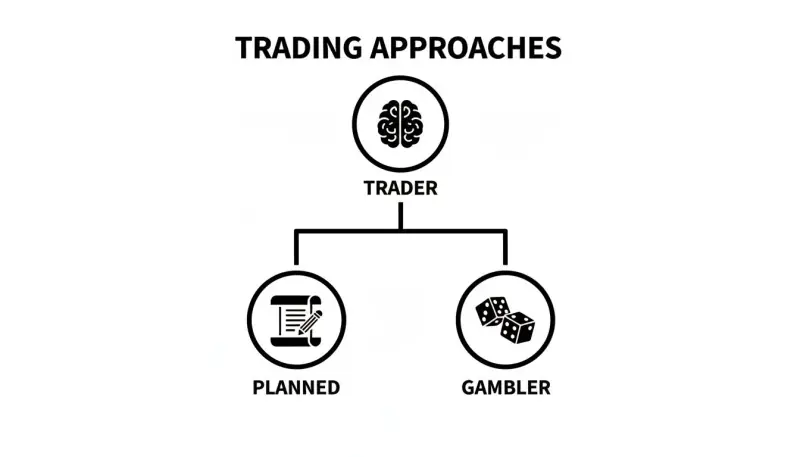
This visual says it all. You can operate with a strategic blueprint, or you can roll the dice. Building a solid plan is your first and most important step toward becoming a systematic, professional trader.
To help you get started, here’s a quick look at the core elements that every strong trading plan needs.
| Component | What It Defines | Why It Matters |
|---|---|---|
| Trading Identity | Your goals, risk tolerance, and time commitment. | Aligns your strategy with your personality and lifestyle, preventing burnout and emotional mistakes. |
| Markets & Timeframes | Which assets you trade and the chart duration you use. | Creates focus and expertise, stopping you from chasing random opportunities you don’t understand. |
| Entry & Exit Rules | The exact, non-negotiable criteria for action. | This is the engine of your plan, removing emotion and creating consistency in your execution. |
| Risk & Position Sizing | How much you’ll risk per trade and how you’ll calculate it. | Protects your capital, ensuring no single trade can wipe you out and you can survive to trade another day. |
| Review & Refinement | A set schedule for analyzing your performance. | Turns your results into actionable insights, allowing your plan to evolve and improve over time. |
Each piece builds on the last, creating a comprehensive framework for your entire trading operation.

Protect Your Capital with the 1% Rule
The single most important rule to build your framework around is the 1% Rule. It’s beautifully simple: you will never risk more than 1% of your total trading capital on any single trade.
Got a $10,000 account? Your maximum acceptable loss on one trade is just $100. That’s it.
This rule is your ultimate defense against the kind of loss that blows up accounts. Even if you hit a brutal losing streak of five trades in a row, you’ve only drawn down about 5% of your capital. You can recover from that. Without this rule, a few bad decisions could wipe you out for good.
Make Your Winners Pay for Your Losers
It’s one of the biggest myths in trading: that you need to win most of the time to be profitable. The truth is, many full-time traders are right less than 50% of the time.
Their secret? A consistently positive Reward-to-Risk (R:R) ratio. This just means your potential profit on a trade is always a multiple of what you’re willing to lose.
- 1:1 Ratio: Risking $100 to make $100. (Tough to build a profitable edge here.)
- 2:1 Ratio: Risking $100 to make $200.
- 3:1 Ratio: Risking $100 to make $300.
When you consistently target at least a 2:1 R:R, a single winning trade completely erases the losses from two losing trades. This gives you a mathematical edge that allows your account to grow, even if your win rate isn’t perfect. It’s the real engine of long-term profitability.
Calculate Your Position Size Correctly
Your risk rules dictate your position size — not the other way around. Don’t just guess how many shares to buy. Let the math do the work for you.
Here’s how you turn the 1% rule into a precise share count:
- Determine Your Max Risk in Dollars: For a $10,000 account, that’s $100 ($10,000 x 1%).
- Identify Your Trade Risk: Let’s say you want to buy a stock at $50 and place your stop-loss at $48. The distance between your entry and your stop is your per-share risk, which is $2.
- Calculate Position Size: Now, just divide your max risk by your per-share risk. $100 / $2 = 50 shares.
By buying exactly 50 shares, you guarantee that if your stop-loss gets hit, you lose $100 (or 1%), not a penny more. This calculation removes all the emotion and guesswork.
To really nail this down, check out our comprehensive guide on risk management for traders and build out this critical section of your plan.
See It In Action With Two Practical Examples
All this theory is great, but what does a trading plan actually look like when the market opens? This is where the rubber meets the road.
Let’s walk through two simplified examples for completely different trading styles. Think of these as blueprints, not as plug-and-play systems. The goal is to see how all the pieces we’ve discussed — from market filters to exit rules — snap together to form a clear, structured process.
Notice how specific everything is. There’s no room for ambiguity or emotional decisions. It’s all pure “if-then” logic.
Example 1: The Stock Swing Trader
This trader wants to catch trends that unfold over days or weeks in well-known, liquid stocks. They have a day job, so the plan is built around end-of-day analysis, requiring very little screen time during market hours.
-
Trading Identity: A patient, part-time trader aiming for capital growth over several weeks.
-
Markets & Timeframe: Large-cap US stocks on the NASDAQ and NYSE. All analysis is done on the daily chart.
-
Market Condition Filter: I will only hunt for long (buy) opportunities when the S&P 500 Index (SPY) is trading above its 50-day moving average. No exceptions.
-
Entry Setup:
- The stock must be in a confirmed uptrend (making higher highs and higher lows).
- The price needs to pull back and touch the 20-day exponential moving average (EMA).
- This pullback must happen on lower-than-average volume, which suggests selling pressure is drying up.
-
Entry Trigger: I will enter a long position near the close of the first day the price touches the 20-day EMA and closes green (above its open).
-
Risk Management:
- Stop-Loss: My line in the sand. It’s placed just below the low of the candle on my entry day.
- Position Size: I will risk no more than 1% of my total account balance on this single trade.
-
Exit Strategy:
- Profit Target: I will sell half of my position once the trade hits a 2:1 reward-to-risk ratio.
- Trailing Stop: After that first sell, I’ll move the stop-loss on my remaining shares up to my original entry price. This caps the downside on the rest of the position at roughly break-even, barring a gap through the stop.
Example 2: The Options Day Trader
This trader is after quick, intraday profits using options on a highly liquid ETF like the QQQ. Their plan demands intense focus during market hours and has much tighter risk rules because of the speed and leverage involved.
-
Trading Identity: A disciplined, full-time trader focused on capturing small, consistent daily gains.
-
Markets & Timeframe: Options on the QQQ. All the action happens on the 5-minute chart.
-
Pre-Market Prep: Before the opening bell, I identify the key support and resistance levels from the prior day and the pre-market session. These levels are my battlefield.
-
Entry Setup:
- I will only trade in the direction of the dominant trend for the morning. No counter-trend heroics.
- For a long trade, I’m waiting for the price to pull back to one of my pre-marked support levels.
- I need to see a clear bullish candlestick pattern (like a hammer or bullish engulfing candle) form right at that support level on the 5-minute chart.
-
Entry Trigger: As soon as that confirmation candle closes, I will buy a slightly out-of-the-money call option that has at least 5 days until it expires.
-
Risk Management:
- Stop-Loss: I’ll exit immediately if the underlying QQQ price closes a 5-minute candle below my support level. The option’s value itself defines my max dollar loss.
- Max Daily Loss: If my account is down 2% for the day, I shut it down. Period. I live to trade another day.
-
Exit Strategy:
- Profit Target: I’m out with my profits as soon as the price reaches the next key resistance level I identified in my prep.
- Time Stop: If the trade is just chopping around and hasn’t hit my target or stop within 30 minutes, I will close the position. Dead money needs to be put back to work.
Your Plan and Journal: The Ultimate Feedback Loop
A trading plan you don’t track is just a piece of paper. To turn it into a powerful tool for growth, you need a loyal partner — a trading journal. The two go hand-in-hand; one simply can’t work without the other.
Think of your trading plan as your core hypothesis. It’s a carefully built set of “if-then” statements about how you believe you can find a repeatable edge in the markets. But any good hypothesis is worthless until it’s put to the test.
That’s exactly what your journal is for. It’s the lab notebook where you record the results of every single experiment — every trade you take.

This simple process is what separates casual guessing from professional, data-driven analysis. Your journal gives you the hard evidence needed to answer the most important questions about your trading performance.
From Rules to Real-World Data
Without a journal, you’re basically flying blind, relying on gut feelings and a memory that loves to play tricks on you. A journal forces you to look at the unfiltered reality of your trading, answering critical questions like:
- Am I actually sticking to my rules? Your journal will show you exactly how often you bend the rules — which, more often than not, is the primary source of unnecessary losses.
- Which of my setups are truly making money? You might feel like your breakout strategy is a big winner, but the data might reveal that your simple pullback trades are far more consistent and profitable.
- What are my common mistakes? The journal brings hidden patterns to light. Maybe you take on too much risk on Tuesdays or have a habit of cutting your winning trades way too early.
Your plan acts as your North Star, defining the rules for entries, exits, risk, and position sizing that keep your emotions in check. Without one, you’re at a huge disadvantage. According to some sources, the majority of day traders may not be profitable. You can dig deeper into these numbers in this Unbiased.com article on day trading statistics. This is the exact opposite of what happens when traders use their plan as a benchmark for consistent review.
Closing the Feedback Loop for Growth
This is where a modern tool like TradeReview can make all the difference. Instead of spending hours crunching numbers in a spreadsheet, you can import or log your trades and get instant performance analytics. You can see your real win rate, profit factor, and average returns broken down by the specific strategies you defined in your plan.
Your trading plan tells you what you should do. Your trading journal tells you what you actually did and how well it worked. Together, they create an unbreakable feedback loop for continuous improvement and long-term success.
This constant cycle — plan, execute, review, repeat — is the engine of professional development in trading. It’s how you turn your losses into valuable lessons and your wins into a repeatable process. Every trade, win or lose, becomes another data point that helps you refine your plan, sharpen your edge, and build the discipline required to thrive in the markets.
Common Mistakes That Sabotage Trading Plans
Putting a trading plan on paper is a massive step forward. But the real test? That happens the moment the market opens and the pressure hits.
Even the most brilliant plans can crumble when things get real. We’re going to break down the most common mistakes that derail traders — not to judge, but to share what we’ve all learned the hard way.
Let’s be clear about the stakes. A trading plan is your survival kit in a challenging environment. As highlighted by several studies, including data from how traders perform at CurrentMarketValuation.com, consistently profitable trading is a difficult endeavor. For many, just buying an S&P 500 index fund is a far more reliable strategy.
A solid plan is what separates a disciplined process from a series of expensive guesses.
Making Your Plan Overly Complex
One of the first traps traders fall into is building a plan that’s just too complicated. If your entry checklist has 15 different criteria, you’ll get stuck in “analysis paralysis” and watch good opportunities fly by.
Your plan needs to be a quick-reference guide, not a textbook.
- The Problem: Too many indicators and convoluted rules make it impossible to make a decision when you only have a few seconds to act.
- The Solution: Keep it simple. Focus on the handful of high-conviction signals that truly define your edge. Your rules should be so clear that you can decide on a trade almost instantly.
Abandoning the Plan After a Few Losses
This is the number one plan-killer, period. You follow your rules to a T, take three trades, and all three hit your stop-loss for small, controlled losses.
Suddenly, frustration takes over. You convince yourself the plan is broken, throw it out the window, and start placing random trades to “make it back.”
Discipline isn’t about never losing. It’s about having a system to fall back on when you’re frustrated, emotional, or just plain wrong. Sticking to your plan after a loss is the ultimate test of a pro.
Losing streaks are a perfectly normal part of trading. In fact, your plan is designed to handle them by keeping those losses small. Abandoning your plan is what turns a minor drawdown into a blown-up account.
Trust the process you built. Your trading plan isn’t just a list of rules; it’s your commitment to surviving long enough to see your edge play out.
Your Trading Plan Questions Answered
Once you’ve got a trading plan down on paper, the real-world questions start to pop up. It’s one thing to write the rules, but it’s another to live by them day in and day out.
Let’s tackle some of the most common questions we hear from traders who are serious about building a professional process.
How Often Should I Review My Trading Plan?
Your trading plan isn’t a “set it and forget it” document; it’s a living guide that needs regular check-ups to stay effective.
Think of it in two layers. First, a quick weekly check-in is your discipline check. Are you actually following your rules? Or are you letting emotions creep in and bend them? This is about staying honest with yourself.
Then, you have a deeper monthly review. This is where you dig into your trading journal and let the data do the talking. Are your go-to setups still performing? Have market conditions shifted? The goal here is to make small, intelligent tweaks based on a solid sample size of trades — not to panic and rewrite everything after one bad day.
What Is the Difference Between a Trading Plan and a Trading Strategy?
This is a big one, and the confusion can be costly. A trading strategy is just one component — it’s your specific rulebook for how you enter and exit a trade.
For example, a strategy might be: “Buy a stock when it breaks above a 30-day high with a significant spike in volume.”
Your trading plan is the entire business operation. It’s the master blueprint that includes your strategy, but also your risk management rules (like the 1% rule), your pre-market routine, your mental game plan, and how you’ll track your performance. The strategy is the play; the plan is the entire playbook.
What Should I Do If My Trading Plan Is Not Working?
First off, don’t panic. A plan that isn’t delivering results isn’t a personal failure — it’s just data telling you something needs to be fixed. This is a good thing!
Instead of throwing the whole thing out, use your trading journal to diagnose the real problem. It almost always comes down to one of these three things:
- Execution Problems: You simply aren’t following your own rules. Your journal will make this painfully obvious. It’s the most common reason a plan “fails.”
- Strategy-Market Mismatch: The strategy itself might be solid, but it’s the wrong tool for the current job. A trend-following strategy, for instance, will get chopped to pieces in a sideways, range-bound market.
- Broken Risk Management: Your position sizing might be too large or your stop-losses too wide, causing a few losses to wipe out a string of wins.
The key is to isolate just one variable, adjust it based on what your data is telling you, and test the change.
A great plan is your starting point, but a journal is how you build a real edge. With TradeReview, you can stop guessing and start analyzing. Our performance analytics track your win rate, profit factor, and equity curve, turning your trade history into clear, actionable insights.
Related reading
- Trading plan template — structured template to fill in
- What is a trading journal — log trades against your plan
- Profit taking strategies — targets, stops and auditing your exits
- Why every trader needs a trading journal — measure plan vs reality
Start journaling with TradeReview for free — track whether you actually follow your plan.