
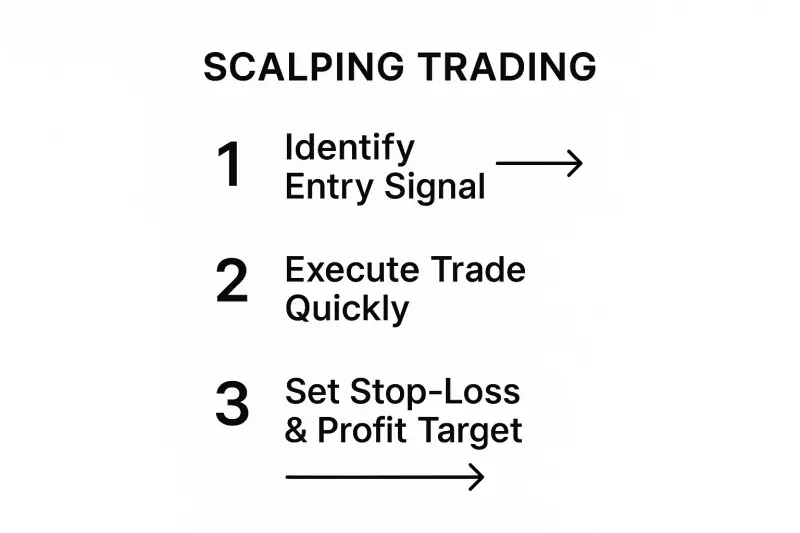
Scalping trading is a style of day trading that takes many very short trades — seconds to a few minutes — aiming for small price moves each time. A scalper might take 20 to 100 trades in a session, each targeting a few ticks or cents, with a stop just as tight.
That definition is the easy part. What decides whether scalping works for you is arithmetic: when the target is small, commissions, spreads and slippage take a large bite of every win and add to every loss. This guide explains how scalping works, does the cost math with a worked example, and shows what to track so you know whether your scalps are actually profitable. Investopedia’s scalping definition is background.
How scalping works
Scalpers trade where prices move often and cheaply:
- Liquid markets — index futures (ES, NQ), major forex pairs, large-cap stocks and ETFs. Tight bid-ask spreads are a requirement, not a nice-to-have.
- Short timeframes — tick, 1-minute or 5-minute charts, often with the order book and time and sales.
- Fast execution — hotkeys or bracket orders so the stop and target go in with the entry.
- Small, repeatable setups — a pullback to VWAP, a break of the opening range, a reaction at a level the order book shows is defended.
The edge, when there is one, comes from repeating a small positive expectancy many times. That also means a small negative expectancy repeats many times.
Scalping vs day trading vs swing trading
| Scalping | Day trading | Swing trading | |
|---|---|---|---|
| Typical hold | Seconds to minutes | Minutes to hours | Days to weeks |
| Trades per day | 10–100+ | 1–10 | A few per week |
| Target per trade | A few ticks / cents | Larger intraday move | Multi-day move |
| Cost sensitivity | Very high | Medium | Low |
| Screen time | Constant during session | Most of the session | Low |
Scalping is a subset of day trading, but tag it separately. Mixing 40 scalps with three longer day trades makes both sets of statistics meaningless. More on choosing a holding period in trading time frame.
The cost math: why most scalpers lose
Take one ES futures contract (each tick is worth $12.50). The plan: 4-tick target, 4-tick stop. Costs are illustrative — check your own broker:
- Commission and fees: about $4 per round trip
- Slippage: 1 tick ($12.50) on an average round trip
| Gross | Net of costs | |
|---|---|---|
| Winning trade | +$50.00 | +$33.50 |
| Losing trade | −$50.00 | −$66.50 |
| Break-even win rate | 50% | 66.5% |
On paper the setup is symmetric and needs to win half the time. After costs it needs to win two trades out of three. A scalper with a genuine 60% win rate — very good by most standards — still loses money here.
That is the core problem with scalping. It does not mean scalping cannot work; it means you can only judge it on net numbers, with real fills.
Pros and cons of scalping
Pros
- Short exposure: little overnight or news risk if you stay flat.
- Fast feedback: you see a large sample of trades in weeks, not months.
- Works in quiet markets where longer setups do not develop.
Cons
- Costs: fees, spread and slippage are large relative to each trade.
- Screen intensity: constant attention, fast decisions, high fatigue.
- Tilt risk: many trades per session gives many chances to revenge trade after a loss.
- Account rules: in US margin accounts, the pattern day trader rule has required $25,000 in equity for frequent stock day trading. FINRA has been reworking that rule, so check the current requirement with your broker. Futures and forex accounts are not subject to it.
Risk control for scalpers
Tight stops do not make scalping low-risk; trade count does the damage. Rules that hold up:
- Bracket every entry. Stop and target go in with the order. No mental stops at this speed.
- Cap trades per session. Pick a number. After it, you are done.
- Daily loss limit. For example, 3R. Hit it and stop for the day.
- Pause after consecutive losses. Two or three in a row — step away for ten minutes. Most blown scalping days start with a fast re-entry.
- Trade one market at a time. Splitting attention between instruments slows execution and increases slippage.
General principles are in risk management for traders and how to set stop losses.
How to journal scalping trades
Writing a note for each of 60 trades is not realistic. Import fills automatically, then add a few fields that matter for scalping:
- Setup tag —
SCALP-VWAP,SCALP-ORB. Never justDAY. - Time of day — many scalpers make money in the first hour and give it back at lunch.
- Hold time — winners held longer than losers is a good sign; the reverse is common.
- Fees and slippage — net P&L only, or the numbers lie.
- Trade number in session — expectancy by trade #1–10 vs #30+ often shows where discipline fades.
- Rule followed? — yes or no, for stop and trade cap.
Review weekly per tag. After ~30 trades in a setup, compare its net win rate with the break-even win rate after costs. Look at MFE to see whether targets are too tight or too loose. If one time window keeps losing, stop trading it. The futures journal has the market-specific fields.
Frequently Asked Questions
What is scalping trading in simple terms?
Taking many very short trades — seconds to minutes — to capture small price moves, with tight stops and strict exits. Profit comes from repeating a small edge many times.
Is scalping profitable?
It can be, but costs make it harder than most styles. A setup that breaks even at 50% before costs can need a 65%+ win rate after commissions and slippage. Only your net results over a real sample answer the question.
How much money do I need to start scalping?
It depends on the market. US stock scalping in a margin account has historically required $25,000 under the pattern day trader rule; futures and forex can be traded with less, but each loss must still be a small share of the account.
Is scalping better than day trading or swing trading?
None is better in general. Scalping needs the most screen time and is the most sensitive to costs; swing trading needs the least. Pick the one that fits your schedule, then judge it by your own numbers.
Can I scalp from my phone?
Execution speed, a full order book and fast bracket orders are hard on a phone. Most scalpers use a desktop platform with hotkeys.
Bottom line
Scalping trading is many tiny trades, and that makes costs the deciding factor. Do the break-even math after fees and slippage before you start, bracket every entry, cap trades and daily losses, and tag scalps separately from other day trades. Judge it on net expectancy per setup after a real sample — not on how busy the session felt.
When you want net P&L, hold time and expectancy per setup without a spreadsheet, open the journal and import a week of fills.
Cost figures are illustrative. Trading involves risk. This article is for education, not investment advice.