
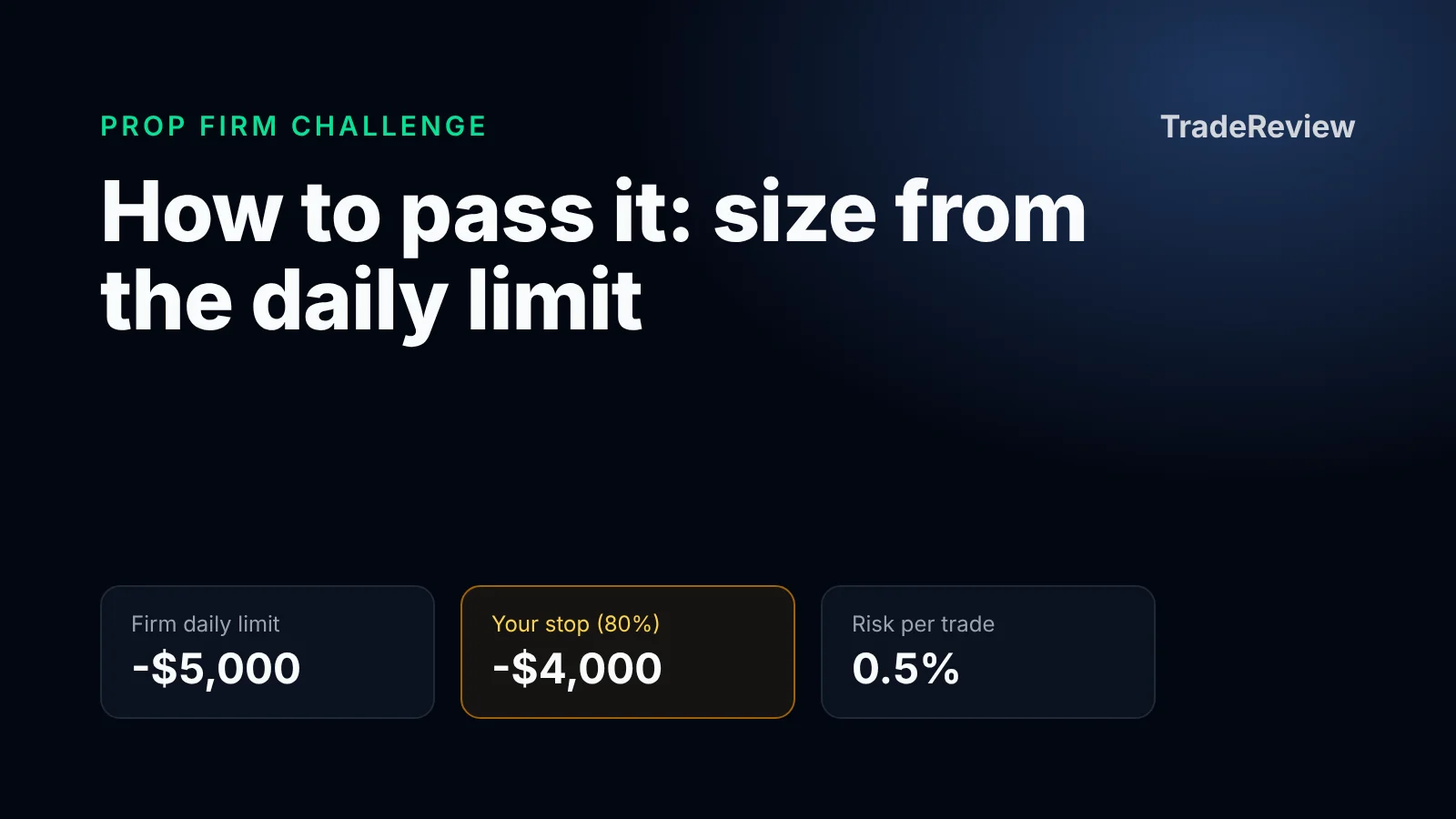
To pass a prop firm challenge, first avoid breaking its loss rules: size every trade so a full day of losses cannot reach the daily limit, set your own daily stop well before the firm’s, and judge each day by whether you followed the plan. None of this guarantees a pass; it removes the most common way to fail. The profit target only comes if your strategy makes money after costs.
Key points
- Read the daily loss rule twice: what it is measured on, and when it resets.
- At 0.5% risk per trade, the 10th straight loss reaches a 5% daily limit. At 2%, the third loss goes through it.
- Stop for the day at about 80% of the firm’s limit, not at the limit.
- Log every trade the same day, and review the rule you broke, not the money you lost.
1. Know the three rules that end a challenge
Every firm words them differently, but most failed challenges end on one of these. The figures are typical as of November 2026:
| Rule | What it is | What to check |
|---|---|---|
| Daily loss limit | A cap on one day’s loss, often 4–5% on forex and CFD challenges and lower on some stock programs. Some firms pause the day instead of failing the account, and some futures plans have no daily limit | What it is a percentage of (starting balance, or the day’s opening balance or equity), whether it counts open trades, and what time and time zone it resets |
| Max loss | The lowest the account may ever go, often 10% on forex and CFD challenges | Whether the floor is static or trailing. If it trails: whether it follows the end-of-day balance or the intraday equity high, open profit included, and whether it ever stops trailing |
| Conduct rules | Minimum trading days, consistency rules, news and weekend restrictions | Which ones apply to your phase; some apply only to funded accounts |
The difference between static and trailing max loss matters more than the headline number. On a $100,000 account with a static 10% floor, the floor stays at $90,000 whatever the balance does. On a $50,000 account with a $2,000 trailing floor measured at the end of each day, a run-up to $51,500 lifts the floor to $49,500. A pullback to $50,200 then leaves $700 of room, not $2,000.
Before you pay for a challenge, find these rules on the firm’s own site, not on a review site, and note the date you checked them. Firms change rules often.
2. Size trades from the daily limit, not the target
On a $100,000 account with a 5% daily limit and a 10% max loss, this is the loss that reaches each limit at each risk level. Treat reaching a limit as failing: fees and slippage mean a loss on the line is usually over it. The last column is an average for a strategy that makes +0.25R per trade after costs.
| Risk per trade | Loss that reaches the daily limit | Loss that reaches max loss | Average trades to +10% |
|---|---|---|---|
| 0.25% ($250) | 20th | 40th | 160 |
| 0.5% ($500) | 10th | 20th | 80 |
| 1% ($1,000) | 5th | 10th | 40 |
| 2% ($2,000) | 3rd goes through it (the 2nd leaves $1,000) | 5th | 20 |
Higher risk reaches the target faster only if nothing goes wrong first, and five losses in a row are routine for most strategies over a few hundred trades. An average of +0.25R after costs is a real edge that many traders do not have; at 0R or below the target is never reached, whatever the size. Run your own win rate and R through the equity curve simulator to see the losing streaks to expect, and size each trade from its stop-loss with the position size calculator. The risk management guide covers the rest of the sizing rules.
Count costs as part of the risk. On a small account, fees can be larger than the max loss: in our Trade The Pool review, a $5,000 account that was +$26.60 before fees ended just past its 4% ($200) max loss after $227.25 of them.
3. Set your own daily stop before the firm’s
Slippage, a gap or one more “last trade” can carry a $4,800 loss past $5,000. Give yourself a buffer and treat it as the real limit.
| Amount | |
|---|---|
| Firm daily limit | -$5,000 |
| Your daily stop (80% of the limit) | -$4,000 |
| Buffer for slippage and open trades | $1,000 |
When you reach your daily stop, close the platform for the day. Do not open a trade whose full loss would take the day past it: with a -$4,000 stop that allows 16 losses at 0.25% risk, 8 at 0.5%, 4 at 1% and 2 at 2%. 80% of the firm’s limit is the outer bound; a tighter personal limit, such as 3R, is fine. Write the daily stop into your trading plan so it is a rule decided in advance, not a decision made in the middle of a loss.
4. Check five things before the first trade
- Today’s limits. Write down the daily limit, your daily stop and how much room is left on max loss.
- News. Check the economic calendar and the firm’s news rule; skip the window if in doubt.
- Setups allowed. Only the setups in your plan, at the size in your plan.
- Trade count. A maximum number of trades for the day, decided now.
- Exit rule. What makes you stop early: your daily stop, a time of day, or two losses in a row.
5. Review every day, in R and in rules
Log each trade the same day with its setup, its result in R and whether you followed the plan. After 20–30 trades, take a first look: compare the days you kept your daily stop with the days you did not. That gap is usually larger than any difference between setups, and it is the one you can fix fastest. It is a first look, not proof: how to calculate win rate explains how many trades you need before a setup’s numbers mean anything.
You can journal a challenge account in TradeReview today: connect it with its MetaTrader 5 or cTrader server and trades sync automatically, or import the platform’s trade file. The connection is read-only. Auto Sync is on the Pro plan; manual journaling and your first file import are free. The P&L calendar shows each day’s closed result, so the large losing days are easy to spot. It does not show intraday equity, so check an equity-based limit on the firm’s dashboard. For a worked example, our Trade The Pool review splits 150 journaled challenge trades by side, holding time and time of day, and shows which groups the losses came from.
6. Decide in advance when to stop the challenge
A failed challenge costs the fee. A second one bought the same evening usually ends the same way and costs another fee. Set the rule now: after a failed challenge, paper trade or journal at least 50 trades on the same plan before you buy the next one, and only buy it if your review shows what you will do differently. What is paper trading has an evidence bar you can reuse.
Frequently asked questions
What is the most common reason people fail a prop challenge?
Breaking a loss rule, usually the daily limit after a run of losses or one oversized trade. Sizing from the daily limit and stopping at your own lower daily stop address both.
How much should I risk per trade on a challenge?
Enough that a normal losing streak cannot reach the daily limit. On a 5% daily limit, 0.25% to 0.5% per trade means the 20th or the 10th loss of the day reaches it, so you can take 19 or 9 and stay inside.
Is it better to pass fast or slowly?
Many firms no longer set a time limit, so on those there is no reason to rush. Check for a monthly fee or an inactivity rule, because either one puts a price on time. The target only comes if your strategy has positive expectancy after costs.
Can I use a trading journal during a challenge?
Usually yes. A journal only reads your trade history, on MetaTrader 5 through the read-only investor password, and cannot place trades. Check your firm’s terms on third-party tools; if in doubt, import a trade file instead.
Not investment advice. Most people who buy a prop firm challenge do not pass it; buy one only with money you can afford to lose.
Start journaling with TradeReview for free — log your challenge trades and review every trading day.