
Disclosure: links marked Partner are referral links. If you buy a challenge through them, we earn a commission. I paid for this challenge myself, and every number below comes from my own trades.
At 20:32 on 14 January, my Hash Hedge challenge closed itself. I was short ETH with a position twice the size of my $5,000 account, ETH moved 1.6% against me, and the day crossed the $250 daily loss limit. Stage 2 was over.
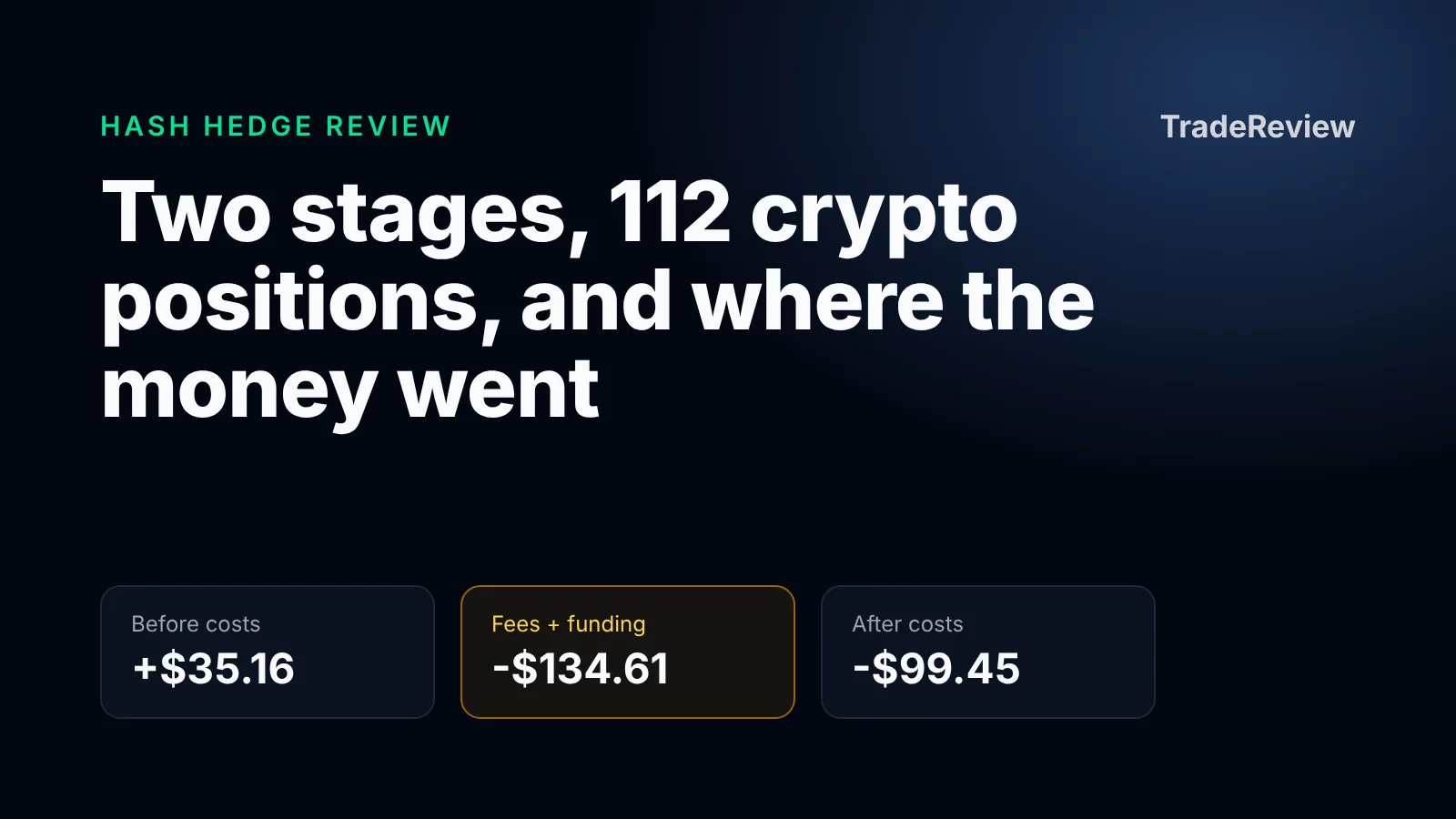
I had passed Stage 1 before that. Looking back at every trade, the platform wasn’t the problem. Three habits were, and fees and funding quietly made them worse: across both stages my trades were up $35 before costs and down $99 after them.
The short verdict
- Good for: crypto traders who want an exchange-style platform, a long list of coins and no time limit.
- Watch out for: the $250 daily limit on a $5,000 account, and funding on short positions. Both cost me.
- Price: $79 for a $5,000 2-Stage challenge, with 5% cashback.
- My result: passed Stage 1, failed Stage 2 on the daily loss rule.
See Hash Hedge challenges$79 for a $5,000 2-Stage account, 5% cashbackPartner
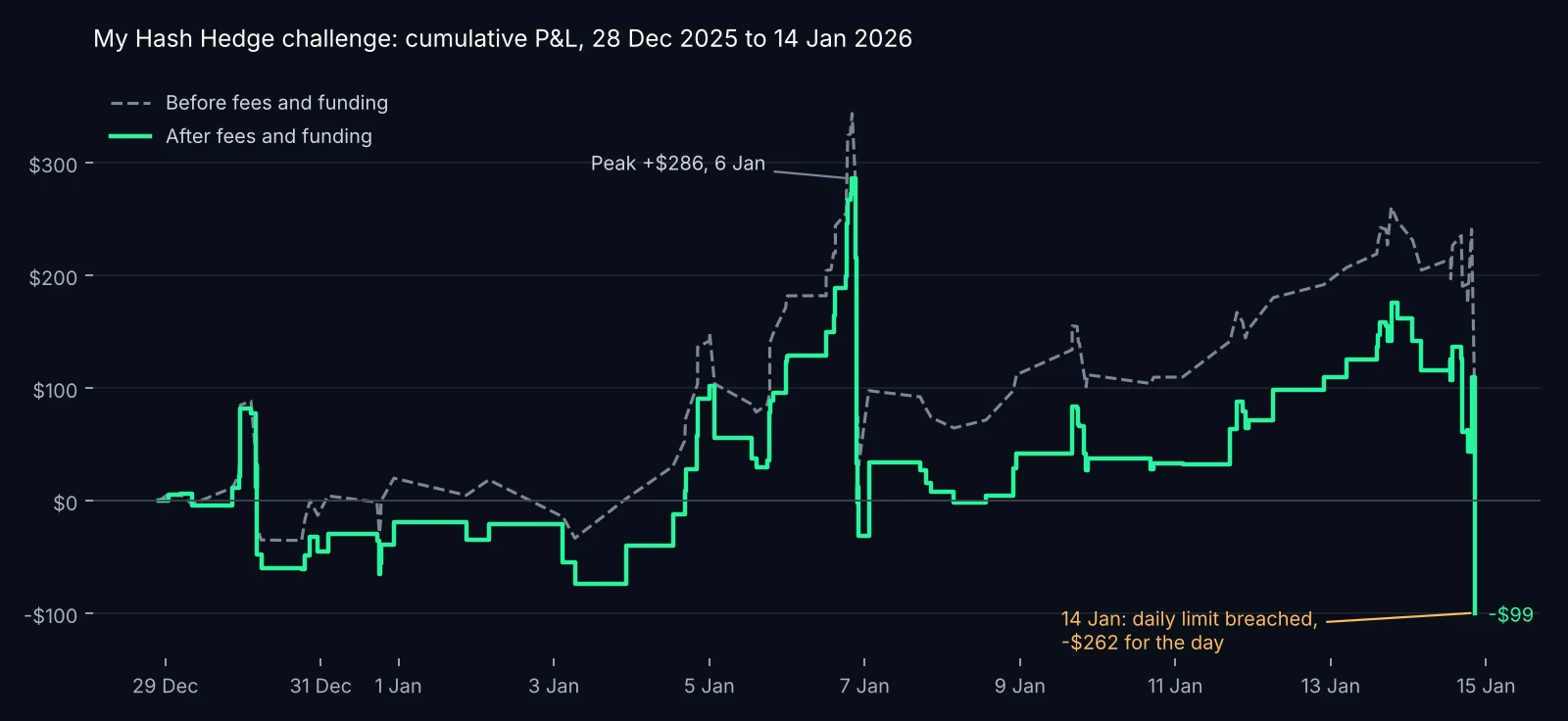
The green line is what I actually made; the dashed line is the same trades before fees and funding. The gap between them is the part I didn’t see while I was trading.
The $10,000 trade that ended Stage 2
Hash Hedge’s daily loss rule compares your equity, open positions included, with your balance at the start of the day. On a $5,000 account the limit is $250, and the day starts at midnight UTC+4.
By the evening of 14 January I was down about $53 on the day. Most of that wasn’t trading at all: two AXS shorts had paid $39 in funding. Then two positions were still open: a SOL short from the day before, and an ETH short at 3x leverage worth about $10,000.
ETH rose about 1.6%. Together with the SOL short, that was enough. Hash Hedge closed both positions at 20:32, the day ended at -$262, and the challenge was over.
The ETH trade did most of the damage, but the arithmetic is the real lesson. With a $250 daily limit, a $10,000 position needs only a 2.5% move to use up the whole day, before anything else goes wrong. ETH can move that much in a single day.
Where I was losing money
When I split the trades in my journal, three groups stood out. Each row is after fees and funding:
| Group | Positions | P&L |
|---|---|---|
| Shorts | 60 | -$242.22 |
| Held 30 minutes to 4 hours | 47 | -$321.01 |
| Closed by hand (not counting the two closed at the breach) | 19 | -$194.59 |
| Any of the three | 91 | -$369.79 |
| The other 21 | 21 | +$270.34 |
The groups overlap: a short I held for an hour and closed by hand counts in all three. The 21 trades outside them were all longs that I either closed quickly or held for hours, and left to hit their own take-profit or stop-loss. Fifteen of them won. Twenty-one trades is too few to call that an edge, as the win rate guide explains, but it showed me where to look.
The hand-closed losers hurt the most. Eight of them lost $349 between them, about $44 each, and none had a stop-loss set. The 34 trades that lost on their stop-loss cost about $19 each. Three SUI longs on the evening of 6 January, right after my best point of the challenge, account for almost $290 of it. You can see the drop on the chart.
The cost I didn’t see
My win rate was 58%, and before costs the trades were break-even: a profit factor of 1.03. The winners were simply smaller than the losers, about $17 against $26.
Then came the costs:
| Amount | |
|---|---|
| P&L before costs | +$35.16 |
| Trading fees | -$65.52 |
| Funding | -$69.09 |
| P&L after costs | -$99.45 |
Fees came to $65.52 on about $241,000 of positions, close to 0.03% of each one. My trade history shows a fee only when each position closed, while Hash Hedge’s fee page says fees are charged on open and on close, so the real cost was probably higher.
Funding was the surprise. It is charged on perpetual futures, and my shorts paid almost all of it: $68 of the $69. One AXS short paid $20 in under four hours. On a $5,000 account, $135 of fees and funding is more than half of the $250 Stage 1 target.
What I’d do differently
- Size every position from the daily limit. One stop-loss should cost no more than about a fifth of the daily limit, around $50 here. The ETH short would have been a fraction of its size. How to pass a prop firm challenge explains the method.
- Put a stop-loss on every position. My eight hand-closed losers had none, and each one cost more than twice as much as a trade that hit its stop.
- Check funding before holding a short. On some coins funding can eat a small win in a few hours. Count it in the plan, along with fees; the trading profit guide shows how to work out net P&L.
What I liked, and what could be better
Liked
- An easy platform. The web terminal works like a crypto exchange: order book, TradingView charts, market, limit and trigger orders, and take-profit and stop-loss right on the order ticket.
- A long list of coins. I traded 17 of them, from ETH and SOL to smaller ones like USTC, JASMY and STORJ. Hash Hedge lists 160+ trading pairs, and US stocks are available on separate accounts.
Could be better
- Trade history on request. I had to ask support for my trade history. They sent it as a spreadsheet, but it is one more step than exporting it yourself.
Hash Hedge rules at a glance
These are from the pricing section of Hash Hedge’s homepage as shown on 17 November 2026, with the fee and daily loss details from its user guide. I traded in December 2025 and January 2026, and rules change, so check the current terms before you buy.
| 2-Stage, $5,000 account | |
|---|---|
| Markets | Crypto perpetual futures and other assets quoted in USDT; US stocks on separate accounts |
| Platform | Hash Hedge’s own web terminal with TradingView charts |
| Price | $79 one-time, with 5% cashback |
| Profit target | Stage 1: 5% ($250). Stage 2: 6% ($300) |
| Daily loss | 5% ($250), equity against the day’s opening balance |
| Total loss | 10% in Stage 1, 8% in Stage 2 and on the funded account |
| Minimum trading days | 5 per stage |
| Time limit | None |
| Maximum leverage | 1:5 |
| Trading fee | 0.01% maker, 0.03% taker, on the full position size, on open and on close |
| Funding | Variable, paid between traders |
| Profit share | 80%, or 90% with an add-on |
The user guide also describes a one-time cash reward for passing Stage 1 and a Daily Loss Protection option that refreshes the daily limit once instead of failing the challenge.
Importing your Hash Hedge trades into TradeReview
Everything in this review comes from my journal. To do the same with your trades:
- Ask Hash Hedge support for the trade history of your account. They send an .xlsx spreadsheet.
- In TradeReview, choose Hash Hedge as the broker and upload the spreadsheet as it is.
- Pick UTC+4 as the time zone, the platform’s server time.
TradeReview converts contracts to coins and adds the trading fee and the funding you paid. Funding you received is not imported, so net P&L can be a few dollars lower than on the platform, and a position closed in parts shows as several trades. The steps are in the Hash Hedge import docs.
Who Hash Hedge fits
- Fits: crypto traders who want an exchange-style platform with a long list of coins and no time limit, and who size positions well inside the daily limit.
- Think twice: traders who hold large positions on a $5,000 account, or who short coins with high funding.
See Hash Hedge challenges$79 for a $5,000 2-Stage account, 5% cashbackPartner
Compare the rules of every firm we cover in one table: prop firm rules compared.
Frequently asked questions
Is Hash Hedge legit?
The platform worked as described for me, and my challenge ended under the daily loss rule exactly as it is written. I did not reach the funded stage, so I have not received a payout myself.
What is the Hash Hedge daily loss limit?
5% of the starting balance on the 2-Stage challenge, $250 on a $5,000 account. It compares your equity, open positions included, with your balance at the start of the day, and the day starts at midnight UTC+4.
Does Hash Hedge charge fees?
Yes. The user guide lists 0.01% for maker orders and 0.03% for taker orders on the full position size, on open and on close, and perpetual positions pay or receive funding. My fees and funding came to $134.61 over 17 trading days.
Why did you fail?
Stage 2 ended on the daily loss rule. An ETH short twice the size of my account and a SOL short took the day past the $250 limit, after funding had already used part of it.
Not investment advice. My results on one account say nothing about yours. Most people who buy a prop firm challenge do not pass it; buy one only with money you can afford to lose.