
Disclosure: links marked Partner are referral links. If you buy a challenge through them, we earn a commission; the price for you is the same. We have not traded an FTMO challenge ourselves. This page is a rules breakdown, checked against FTMO’s own pages on 16 November 2026, not a review of our results.
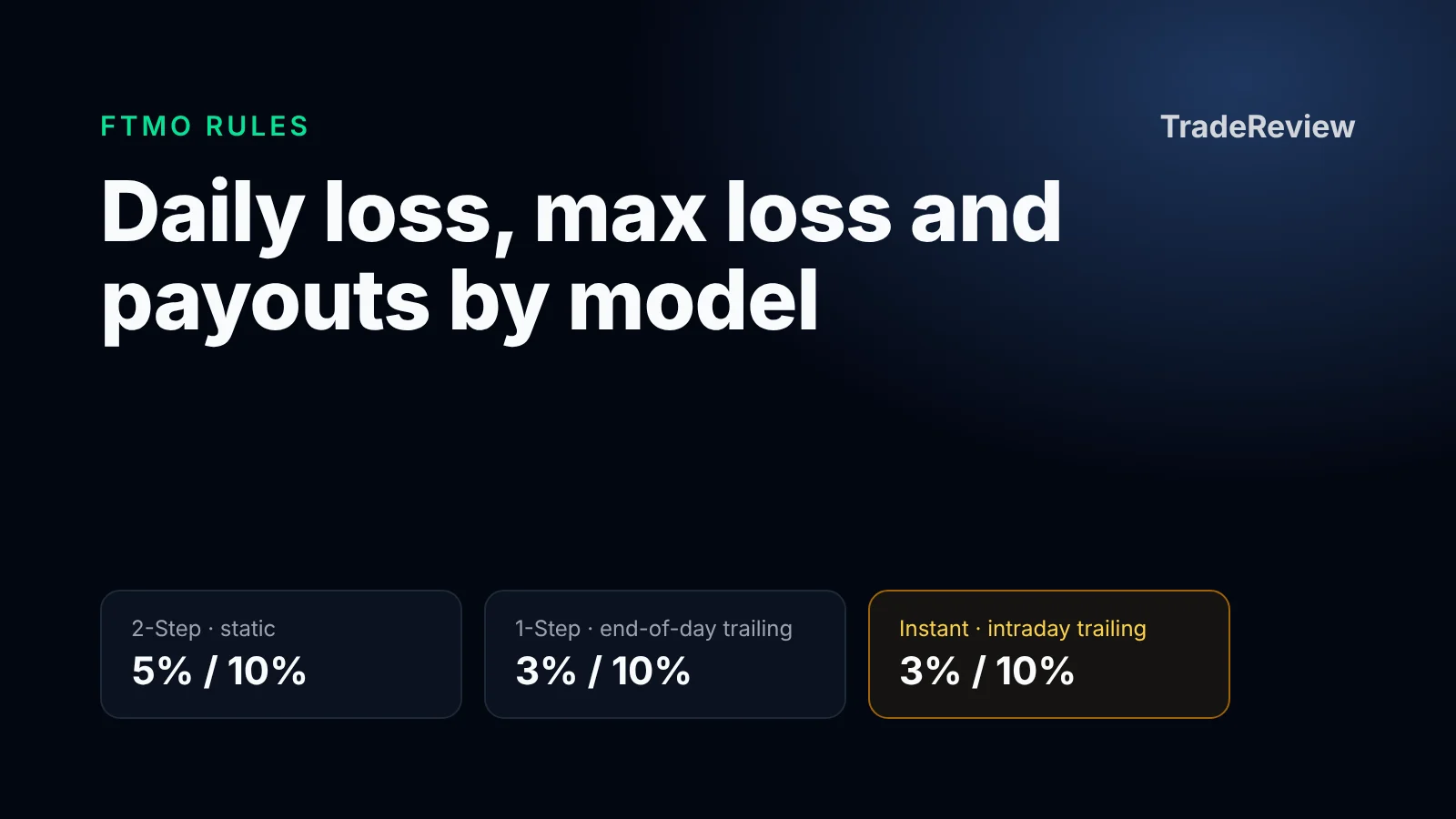
FTMO’s three CFD accounts share a 10% maximum loss but measure it in three different ways: static on the 2-Step Challenge, trailing at the end of each day on the 1-Step Challenge, and trailing with each new closed-balance high on the Instant account. The daily limit is 5% on the 2-Step and 3% on the other two. Most of this page is about how those limits move, because that is where traders get caught.
FTMO rules at a glance
The figures are from FTMO’s trading objectives, comparison table and FAQ, as shown on 16 November 2026. FTMO changes rules from time to time, so check the current pages before you buy.
| 2-Step Challenge | 1-Step Challenge | Instant account | |
|---|---|---|---|
| Profit target | 10%, then 5% in the Verification | 10% | None |
| Maximum daily loss | 5% | 3% | 3% |
| Maximum loss | 10%, static | 10%, trailing at the end of the day | 10%, trailing with each new closed-balance high |
| Minimum trading days | 4 per phase | None | None |
| Time limit | None | None | None |
| Consistency rule | None | Best day at most 50% of total profit | Best day at most 30% of total profit |
| Reward share | 80% by default, up to 90% | 90% | 90% |
| Fee refund | 100%, with the first reward | None | None |
| Starting price | From €89 | From €79 | From €169 |
Some things apply to every account:
- First reward. You can request it from the 14th day after your first trade on the account, with all positions and pending orders closed. On the Instant account, FTMO’s identity check has to be done first.
- Platforms. MetaTrader 4, MetaTrader 5, cTrader and TradingView, chosen when you buy.
Standard and Swing. The 1-Step and Instant accounts are Standard only; Swing is offered on the 2-Step only. On a Standard FTMO Account, orders can’t be executed from 2 minutes before to 2 minutes after selected news releases, and positions must be closed before the weekend and before market breaks of more than 2 hours. These restrictions don’t apply during the 2-Step or 1-Step challenge, but the Instant account is an FTMO Account from day one, so they apply to it from the start. Swing accounts have none of them but use 1:30 leverage instead of 1:100.
FTMO also runs FTMO Futures, with separate rules and monthly subscriptions. This page covers the CFD accounts only.
How the daily loss limit is measured
FTMO sets the daily limit once a day, at 00:00 CE(S)T, Prague time: the account balance at midnight minus 5% (2-Step) or 3% (1-Step and Instant) of the initial capital. During the day your equity, open trades, swaps and commissions included, may not fall below that line.
On a $100,000 2-Step account, using FTMO’s own examples:
| Balance at midnight | Daily loss line | Room for the day |
|---|---|---|
| $100,000 (day 1) | $95,000 | $5,000 |
| $102,000 | $97,000 | $5,000 |
| $101,000 | $96,000 | $5,000 |
Two consequences follow from the line being set from the midnight balance:
- The daily room is always the same amount. It is 5% of the starting capital, not of the current balance, so on a $100,000 account it is $5,000 whether the account is at $95,000 or $110,000. That is the daily limit only: if the maximum loss floor is closer, the floor ends the account first. On a 1-Step account whose highest midnight balance was $104,000, the floor is $94,000; at a $96,000 midnight balance the daily line is $93,000, but only $2,000 of room is left before the floor.
- An open loss at midnight is already counted. The line is set from the balance, which ignores open trades, but equity includes them. If you hold a trade that is $3,000 down at midnight on a $100,000 2-Step account, the line is $95,000 and equity starts the day at $97,000, so only $2,000 of room is left before you have done anything. On the 1-Step, with a 3% limit, the same trade would leave nothing.
If you hold trades overnight, check the open loss before midnight Prague time and close or reduce positions so it fits inside the next day’s limit.
How the maximum loss is measured
All three accounts allow a 10% loss, and on all three equity, open trades included, may not fall below the floor. What differs is how the floor moves:
- 2-Step: static. The floor is 90% of the initial capital and never moves. On $100,000 it is $90,000.
- 1-Step: end-of-day trailing. At midnight the floor is reset to the highest midnight balance so far (or the initial capital, if higher) minus 10% of the initial capital. It can rise but never falls. On $100,000, a midnight balance of $104,000 lifts the floor to $94,000, and it stays there until a higher midnight balance. After a reward is paid and a new account issued, the floor starts again at 90% of the initial capital.
- Instant: intraday trailing. The floor is set from the closed balance: it rises the moment a trade closes at a new balance high. On $50,000 it starts at $45,000; a closed balance of $50,600 lifts it to $45,600. It does not reset when you withdraw a reward, and FTMO notes that once the balance passes 110% of the initial capital, a withdrawal would take the account through the floor.
The trailing floors are the trap. On the 1-Step, a good day raises the floor that night, so giving the profit back the next day uses up room you thought you had. On the Instant account the same happens within the day, after every close at a new balance high.
The consistency rule on 1-Step and Instant
FTMO’s 1-Step Challenge requires that your best day is no more than 50% of your total profit. For accounts ordered on or after 12 October 2026, or merged from that date, that means total profit; older 1-Step accounts use 50% of the profit of positive days only. The Instant account uses 30% of total profit, and after a reward is withdrawn its total profit starts again from zero. FTMO’s Instant page FAQ says there are no additional consistency requirements, but its trading objectives page sets the 30% rule. Breaking it is not a rule breach: the account stays open, but you cannot pass, or take a reward, until other days make up the difference.
On a $100,000 1-Step account with a $10,000 target, a $6,000 day is 60% of $10,000, so you would need $12,000 of total profit before the challenge counts as passed. The Instant rule works the same way at 30%: one $6,000 day needs $20,000 of total profit.
Position size for each account
This is the loss that reaches each limit if every trade loses the same share of the initial capital. Treat reaching a limit as failing: commissions and swaps count toward both limits, so a loss on the line is usually over it.
| Risk per trade | 2-Step (5% / 10%) | 1-Step and Instant (3% / 10%) |
|---|---|---|
| 0.25% | 20th loss of the day / 40th overall | 12th / 40th |
| 0.5% | 10th / 20th | 6th / 20th |
| 1% | 5th / 10th | 3rd / 10th |
The “overall” column assumes the floor has not moved. On the 1-Step and Instant accounts it can only move up, so after a profitable run the real number is lower. How to pass a prop firm challenge covers sizing from the daily limit and setting your own daily stop below FTMO’s, and the position size calculator turns a risk percentage into a lot size.
What is not allowed
FTMO’s forbidden trading practices, as shown on 16 November 2026, include:
- Letting anyone else access or use your FTMO account, or having someone trade for you.
- Exploiting errors, delays or slow data feeds, and taking opposite positions across accounts, alone or with others.
- Gap trading: opening trades when major news or earnings that may affect the market are scheduled, or two hours or less before a market closes for two hours or more. This applies to Swing accounts too.
- Expert advisors that send more than 2,000 server requests a day, or tools that give an unfair advantage.
- Hedging or holding opposite positions to spread profit across days and get around the consistency rule.
- Position sizes or numbers of trades far out of line with your other trades.
Journaling an FTMO account in TradeReview
FTMO accounts on MetaTrader 5 and cTrader can sync to TradeReview automatically, or you can import FTMO’s own trade export.
Auto sync (Pro plan)
- In TradeReview open Broker Sync, click Add new broker and choose MetaTrader5 or cTrader.
- For MetaTrader 5, choose Demo as the account type, since prop firm accounts run on demo servers, then enter the server name and login from your FTMO credentials and the investor password, which is the read-only one. For cTrader, click Sign in with cTrader and authorise access.
- The first sync imports the account’s history. New trades arrive shortly after they close on cTrader and within about an hour on MetaTrader 5.
Both connections are read-only and cannot place trades. The steps are in the docs for MetaTrader 5 sync and cTrader sync.
File import from Account MetriX
- In the FTMO Client Area open Account MetriX and go to the Trading journal.
- Download it as CSV.
- In TradeReview choose FTMO as the broker and upload the file.
TradeReview reads each closed trade with its commission and charged swap, and uses FTMO’s profit figure to work out the lot size, so P&L matches MetriX. The file shares no credentials, and the first file import is free. The steps are in the FTMO import docs.
TradeReview shows closed results by day. It does not show FTMO’s limits or intraday equity, so watch them in MetriX.
How the accounts compare
- 2-Step gives the most room: 5% a day, a static 10% floor, and the fee back with the first reward. The price is two phases and an 80% default reward share.
- 1-Step is one phase with a 90% share, but the daily limit is 3%, the floor trails at the end of each day, and one big day cannot carry the challenge.
- Instant skips the challenge. In return, the daily limit is 3%, the floor trails after every close at a new balance high and does not reset after a withdrawal, the news and weekend restrictions apply from day one,, and rewards need a 30% consistency.
For firms we did trade, see our Trade The Pool review and Hash Hedge review. For another CFD firm’s rules, see FundedNext rules explained.
See FTMO’s current challenges and prices (Partner)
Compare the rules of every firm we cover in one table: prop firm rules compared.
Frequently asked questions
What is the FTMO maximum daily loss?
5% on the 2-Step Challenge and 3% on the 1-Step Challenge and Instant account, as a share of the initial capital. FTMO sets the line at 00:00 Prague time from the balance at midnight, and equity, open trades included, may not fall below it during the day.
Is the FTMO maximum loss trailing?
On the 2-Step Challenge it is static at 90% of the initial capital. On the 1-Step it trails the highest midnight balance, and on the Instant account it trails the highest closed balance during the day. Neither trailing floor can fall.
Does FTMO have a time limit?
No. The 2-Step needs at least 4 trading days in each phase; the 1-Step and Instant have no minimum.
What is the FTMO best day rule?
On the 1-Step Challenge your best day may be at most 50% of your total profit, and on the Instant account 30%. It is not a breach, but you cannot pass or take a reward until other days bring the share down.
Is FTMO legit?
FTMO has run since 2015 and publishes its rules in detail. We have not traded with FTMO or received a payout from it, so we cannot vouch for it from experience; this page reports what its own pages say.
Can I use a trading journal with FTMO?
Yes. MetaTrader 5 and cTrader accounts can sync automatically on TradeReview’s Pro plan through a read-only connection, or you can upload the Trading journal CSV from Account MetriX, which shares no credentials.
Not investment advice. Most people who buy a prop firm challenge do not pass it; buy one only with money you can afford to lose.