
A trading journal is a structured record of every trade you take — entry, exit, size, setup, outcome, and the reasons behind your decisions. It is not a generic diary; it is a feedback system that turns individual trades into patterns you can measure and improve.
How this guide differs: This article defines what a trading journal is and what to include. For why journaling matters for performance and discipline, see why every trader needs a trading journal. For how to build the daily habit, see journaling for beginners.
What is a trading journal?
Think of it as a coach that never forgets a session. You log each trade with enough detail that you can review wins and losses objectively later — without relying on memory, which almost always favors your best trades and hides your mistakes.
A journal works for stocks, options, futures, forex, and crypto. The asset changes; the process does not: record, review, adjust. If you want the wider background on the practice, Investopedia’s trading journal overview is a solid reference; this guide focuses on exactly what to capture and why.
Trading journal vs trade log vs broker statement
Most people conflate three different records. They are not the same, and the difference is the whole point.
| Record | What it captures | What it answers |
|---|---|---|
| Broker statement | Fills, quantities, prices, fees, realized P&L | What was executed? |
| Trade log | Entry, exit, size, result, setup label | What happened, organized? |
| Trading journal | The plan, context, risk, rule adherence, and a lesson — on top of the log | Why it happened, and how to improve |
Your broker already keeps a perfect record of your fills. If that were enough to make traders profitable, everyone with a brokerage account would be. What the statement cannot capture is the thinking: that you sized up because you were down on the day, or exited early because a green candle scared you. A trade log tells you what happened; a trading journal explains why — and adds the fields you need to tell a strategy problem apart from an execution problem.
What to record on each trade (minimum fields)
Use the same fields every time so reviews stay comparable. The fields below are the minimum that make analysis possible:
| Field | Example |
|---|---|
| Date / session | 2026-05-20, US morning |
| Symbol & direction | AAPL, long |
| Entry / exit | $190.50 → $192.10 |
| Size & P&L | 100 shares, +$160 |
| Initial stop / 1R | $189.50 ($1.00 = 1R) |
| Setup tag | Pullback to 20-day MA |
| Plan followed? | Yes / No |
| Emotion note | Calm entry; exited early from fear |
| Lesson | Wait for full target when trend intact |
Two of these fields do the heavy lifting. Without an initial stop, you cannot express results in R or calculate expectancy — the average amount won or lost per unit of risk. Without a consistent setup tag, you cannot break down profit and loss or profit factor by strategy, so you never learn which setup carries your account and which quietly drains it. A journal missing those two fields is really just a prettier broker statement. Tie sizing and stop placement back to your broader risk management for traders rules so the numbers stay comparable over time.
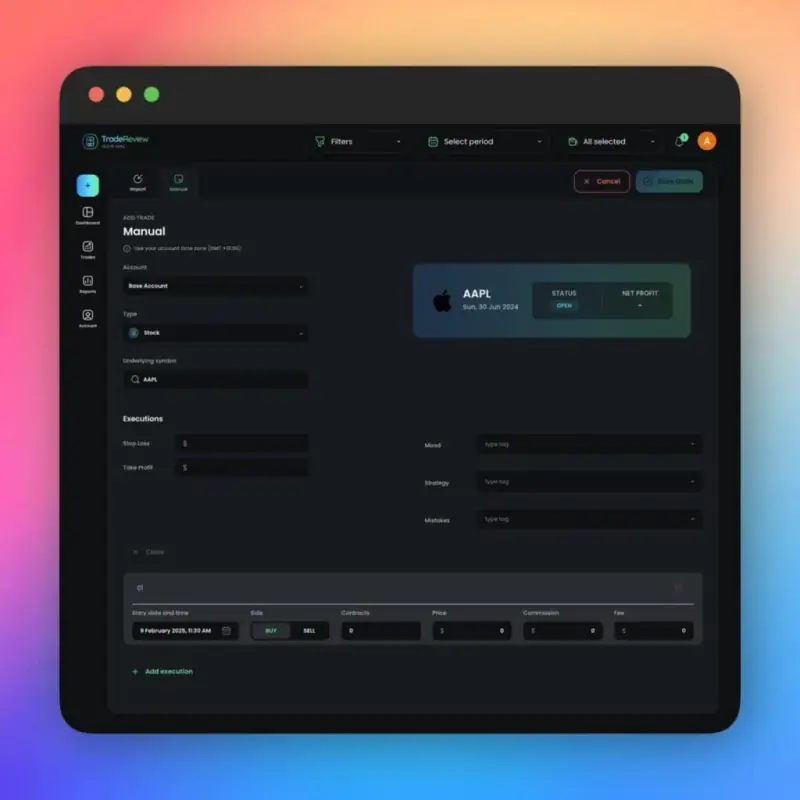
A worked example
Here is one entry that shows the difference between logging a number and journaling a decision. Notice how the plan is written before the outcome, and the lesson is written after:
- Plan (before entry): AAPL long on a pullback to the rising 20-day MA. Trigger: reclaim of $190.50 after a shallow dip. Stop below the swing low at $189.50 (1R = $1.00). Target $193.00 (2.5R). Max risk: 100 shares × $1.00 = $100.
- Execution (from the broker): Filled 100 shares at $190.50. Exited at $192.10.
- Result: +$160 gross, +1.6R. Win.
- Rule followed? Partly — the entry matched the plan, but the exit did not. I closed at $192.10 instead of the $193.00 target.
- Lesson: I exited early on a red candle while the trend was intact, leaving ~0.9R on the table. Next time, hold to target unless the 20-day MA breaks.
The broker statement for this trade would show a $160 win and nothing else. The journal shows a profitable trade that still exposed an execution leak — exactly the kind of pattern you can only fix once it is written down.
What a trading journal cannot do
A journal is a diagnostic tool, not a cure. It is worth being honest about its limits:
- It will not create an edge that does not exist. If a strategy has negative expectancy, detailed journaling only measures the losses more precisely. That is still useful — it tells you to stop — but the journal does not invent a winning setup.
- It does not improve anything on its own. Data that is logged but never reviewed is just data entry. The improvement comes from a fixed review cadence that turns entries into one or two rule changes.
- It is not an official record. A journal is for performance analysis, not taxes or compliance. Your brokerage statements are the authoritative documents there — see day trading tax deductions for what actually matters at filing time.
Paper, spreadsheet, or app?
The format matters less than consistency, but the right choice usually tracks your trade frequency:
- Paper — fine for a handful of trades a week and deliberate reflection, but it cannot calculate metrics for you.
- Spreadsheet — full control and every metric via formulas; the trade-off is manual entry that gets skipped on busy days. Start with the Excel trading journal or Google Sheets trading journal.
- App — broker auto-import fills the quantitative fields for you, so you only add the judgment fields (setup, context, lesson). Compare options in best trading journal, or pick a template for your market on the trading journal hub.
A partial journal you actually maintain beats a perfect template you abandon.
Frequently Asked Questions
Is a trading journal the same as a trade log?
No. A trade log records what happened — entry, exit, size, and P&L — and your broker usually produces it automatically. A trading journal adds why it happened: the setup, planned risk, rule adherence, and a lesson. The log confirms results; the journal explains them.
What should a trading journal include?
At minimum: date and session, symbol and direction, entry and exit, position size and net P&L, the initial stop (so results convert to R), a consistent setup tag, whether you followed your plan, and one short lesson. Those fields are what unlock expectancy and per-setup analysis later.
What is the difference between a trading journal and a trading plan?
A trading plan defines the rules before you trade — which setups qualify, how you size, where stops go. A trading journal records whether you followed those rules and what happened. The plan is the benchmark; the journal is the feedback loop that measures against it.
How many trades before journal data is useful?
Rule adherence is useful from the first week because it measures behavior, not outcomes. Per-setup metrics like expectancy and profit factor need roughly 30 trades in a setup before a single outlier stops distorting the average, and account-level trends firm up around 50–100 trades.
Is a trading journal a tax record?
No. Use it to improve performance, not to file taxes. Your brokerage statements and trade confirmations are the authoritative records for reporting; journal figures often differ due to commission handling and manual entry.
Should I use paper, a spreadsheet, or an app?
Match it to your frequency: paper for occasional trades, a spreadsheet if you want full control at low volume, and an app with broker import once manual entry starts breaking the habit. Consistency matters more than the tool.
Related reading
- Why every trader needs a trading journal — benefits and review habits
- Journaling for beginners — start and stick with the routine
- What is a trading plan — the rules your journal measures against
- Best trading journal — app and tool options
- How to calculate win rate — core performance metrics
Start your journey to smarter trading today with TradeReview — free.