At its most basic, the risk-reward ratio calculation is just a simple formula comparing how much you stand to make on a trade versus how much you could lose. By dividing your potential reward by your potential risk, you get a straightforward ratio — like 1:3 — that tells you whether a trade is even worth considering before you put a single dollar on the line.
Why Risk Reward Is Your Trading Co-Pilot
Let’s be real — trading is an emotional rollercoaster. The high of a win and the gut punch of a loss can easily push you into making impulsive decisions, like chasing a hot stock or stubbornly holding a loser way too long. We’ve all been there, watching a small red number balloon into a much bigger one because we let hope cloud our judgment.
This is exactly where the risk-reward ratio steps in. Think of it as your logical, unemotional co-pilot for every single trade.

From Gambling to Strategic Decision-Making
It’s helpful to think of the risk-reward ratio less as a math problem and more as a simple, powerful question: “Is what I could gain worth what I could lose?”
Forcing yourself to answer this question before you ever hit the ‘buy’ or ‘sell’ button is a game-changer. It instantly flips the switch from gambling to making strategic, calculated decisions. This simple framework grounds your trading in objective data, not just a gut feeling or a hot tip. A solid risk-reward calculation ensures every trade you take is part of a plan, which is the absolute bedrock of long-term survival in the markets.
“A risk-benefit analysis scrutinizes not only negative consequences but also potential positive ones. Establishing decision criteria requires a realistic appraisal of the benefits of a successful outcome as well as the costs if the decision doesn’t work out.”
This idea, often discussed in corporate risk analysis by sources like Thomson Reuters, is just as crucial for a trader. Applying this logic consistently builds the discipline you need to protect your capital and focus on just executing your strategy.
The Foundation of a Sustainable Plan
A well-defined risk-reward ratio is what helps you build a sustainable trading career. It shifts your focus from the outcome of any single trade to the process of executing a solid plan over and over again. It’s not about winning every time — nobody does. It’s about making sure your wins are big enough to more than cover your losses and still turn a profit over the long haul.
This disciplined approach helps you:
- Filter out bad trades that simply don’t offer enough upside for the risk you’re taking.
- Manage your emotions by setting clear, predetermined exit points for both profits and losses before you’re in the heat of the moment.
- Protect your trading capital, which is the most important asset you have. Without it, you’re out of the game.
Ultimately, the risk-reward ratio is the framework that holds your entire trading strategy together.
How To Calculate Your Risk Reward Ratio
Figuring out your risk-reward ratio is way easier than it sounds. At the end of the day, you only need to define three key prices before you even think about placing a trade: your entry, your stop-loss, and your profit target. That’s it. Those three numbers are all you need.
The formula itself is pretty simple — you’re just dividing your potential profit by your potential loss.
Risk Reward Ratio Formula:
(Take-Profit Price – Entry Price) / (Entry Price – Stop-Loss Price)
This quick calculation spits out a single number that tells you instantly if the potential upside is worth the downside. Let’s run through a real-world example to see it in action.
A Practical Example with AAPL Stock
Let’s say you’re looking at a chart of Apple (AAPL) and decide the time is right to go long at $170. Based on your analysis, you see a solid support level down at $165, which makes for a logical stop-loss. This means you’re putting $5 per share on the line.
At the same time, you’ve identified a key resistance area up near $185. That becomes your profit target, giving you a potential $15 per share in reward.
Now, let’s plug those numbers into the formula:
- Potential Reward: $185 (Target) – $170 (Entry) = $15
- Potential Risk: $170 (Entry) – $165 (Stop) = $5
- Risk Reward Ratio: $15 / $5 = 3
The result is a 1:3 risk-reward ratio. Put simply, for every $1 you’re risking, you have the potential to make $3. This is a solid ratio and a great starting point for building a trade plan.
What About Short Positions?
The exact same logic applies when you’re shorting a stock, you just flip the math to account for profiting from a price drop.
Imagine you decide to short Tesla (TSLA) at $180. You set your stop-loss just above a recent high at $185 (a $5 risk), and your profit target is down near a support level at $165 (a $15 potential gain).
Here’s how the calculation looks for a short trade:
- Potential Reward: $180 (Entry) – $165 (Target) = $15
- Potential Risk: $185 (Stop) – $180 (Entry) = $5
- Risk Reward Ratio: $15 / $5 = 3
Once again, we land on a clean 1:3 ratio.
Notice how the stop-loss is the most critical piece of this puzzle? It’s what defines your absolute, non-negotiable risk. Learning how to set stop-losses based on actual market structure — not just some random percentage — is one of the most important skills you can develop.
Ultimately, this simple math forces you to map out your entire trade from start to finish before you put any money at risk. It gives you clear exit points for both winning and losing trades, which helps keep emotion and guesswork out of your decision-making.
Risk Reward Ratio Calculation at a Glance
To make it even clearer, here’s a quick breakdown of the components for both long and short trades.
| Component | Definition | Example (Long Position) | Example (Short Position) |
|---|---|---|---|
| Entry Price | The price at which you buy or sell-short the asset. | Buy AAPL at $170 | Short TSLA at $180 |
| Stop-Loss Price | The price where you exit a losing trade to cap your loss. | $165 (below entry) | $185 (above entry) |
| Take-Profit Price | The price where you exit a winning trade to realize your profit. | $185 (above entry) | $165 (below entry) |
| Calculation | (Target – Entry) / (Entry – Stop) | ($185 – $170) / ($170 – $165) = 3 | ($180 – $165) / ($185 – $180) = 3 |
This table serves as a handy reference, showing how the same core principles apply no matter which direction you’re trading. It all comes back to defining your plan ahead of time.
Applying Risk Reward Ratios in Different Markets
The core concept of risk-to-reward is universal, but how you apply it is anything but one-size-fits-all. A day trader glued to a 5-minute chart has a completely different risk tolerance and profit horizon than a swing trader mapping out moves on a daily chart. This is where theory hits the real world — you have to adapt your risk-reward calculation to the specific market and timeframe you’re trading.
We’ve all felt that different sense of urgency when looking at a fast-moving chart versus a slow, grinding one. The trick is to remember that the logic stays the same; only the numbers change.
The Fast-Paced World of Day Trading Stocks
Let’s say you’re day trading a volatile tech stock like NVDA. The action is quick, and your window of opportunity might only last a few minutes. In this environment, your risk and reward parameters have to be incredibly tight and well-defined before you even think about clicking the buy button.
Imagine NVDA is trading at $905, and you spot a potential long entry based on an intraday support level.
- Entry: You decide to buy at $905.
- Stop-Loss: You place your stop just below the intraday low, maybe at $902. Your risk is $3 per share.
- Take-Profit: A nearby resistance level from earlier in the session sits at $914. Your potential reward is $9.
A quick calculation ($9 / $3) gives you a risk-reward ratio of 3, or a solid 1:3. In this kind of fast-paced trading, your decisions hinge on micro-levels of support and resistance, and your execution has to be precise. There’s little room for hesitation.
A Broader View for Swing Trading Forex
Now, let’s shift gears to a swing trade on the EUR/USD forex pair. This usually requires a much more patient approach. Here, you’re likely looking at daily charts to identify major trends and key levels that have been forming over days or even weeks.
Suppose you see a downtrend and a rejection from a key daily resistance level, prompting you to go short on EUR/USD at 1.0850.
- Entry: You sell-short at 1.0850.
- Stop-Loss: Your stop goes just above that resistance zone, perhaps at 1.0900. Your risk here is 50 pips.
- Take-Profit: You notice a major support level on the daily chart sitting down at 1.0700. Your potential reward is 150 pips.
The math here is 150 pips / 50 pips = 3. Once again, you land on a 1:3 risk-reward ratio. But notice how much wider the parameters are? This is to accommodate the slower pace and larger price swings inherent in trading on a daily timeframe. The concept is identical — only the scale has changed.
This simple flow visualizes the core steps you’d take for any trade, no matter the market.
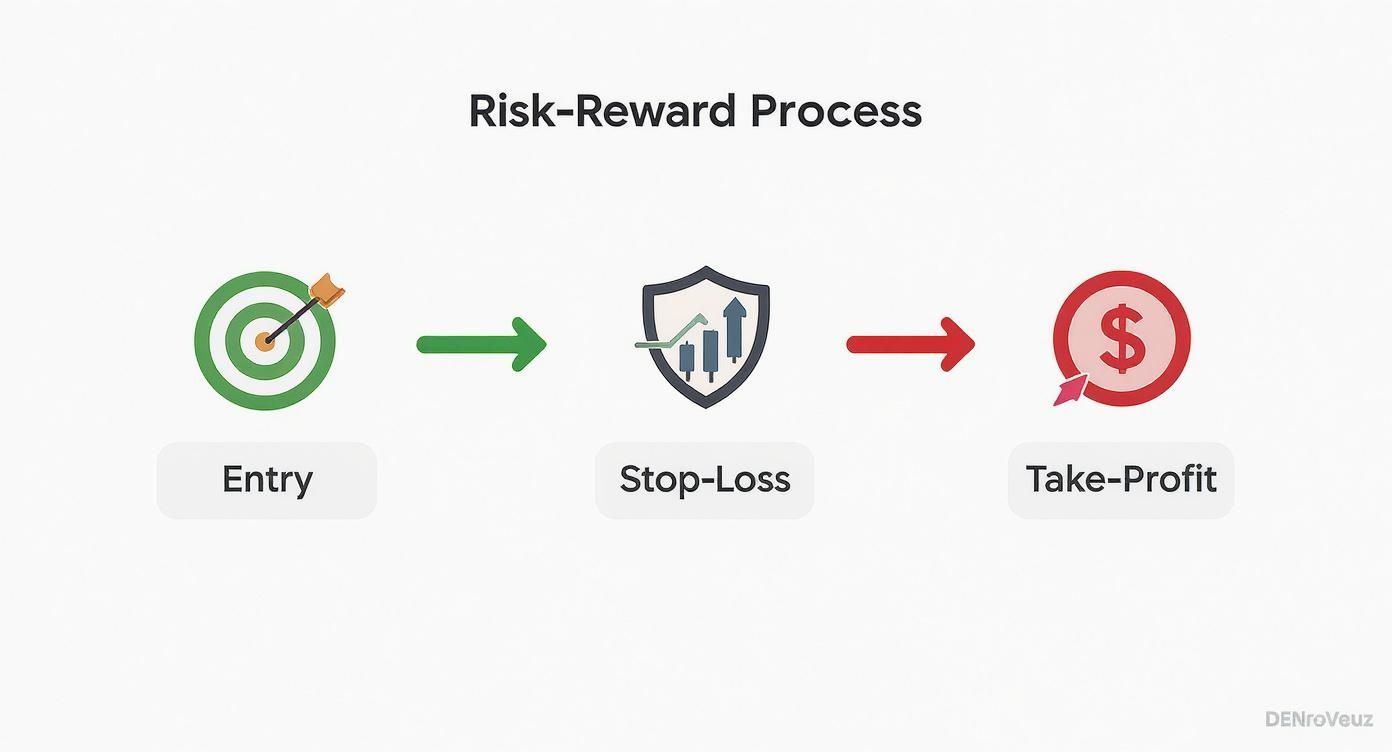
The key takeaway is that defining your entry, stop-loss, and take-profit is a linear, logical progression that must happen before you put any capital on the line.
Considering Risk on a Global Scale
It’s also important to zoom out and recognize that different markets carry inherently different risk profiles. A quick look at historical analysis of major global markets makes this crystal clear. For instance, according to an extensive analysis of market history since 1900, the U.S. stock market has delivered an annualized real return of roughly 6.9%.
In contrast, markets in other parts of the world have seen much higher volatility and lower returns, proving that geography alone can influence your risk-reward calculus. You can dig deeper into these long-term returns on Monevator.com.
A trader’s job is to manage risk, not to avoid it. The goal isn’t to find risk-free trades — they don’t exist. The goal is to find trades where the potential reward adequately compensates you for the risk you’re taking on.
Whether you’re trading for minutes or months, this fundamental balance is the key to longevity. A disciplined risk-reward framework provides a consistent, logical approach that keeps you grounded, preventing the kind of emotional decisions that so often lead to disaster. It’s all about building a sustainable process, not just chasing one-off profits.
Thinking in R-Multiples for Long-Term Success
To really level up your trading, you have to stop thinking in raw dollars and cents and start thinking like a pro. The secret? Standardizing your performance by thinking in terms of R-multiples. It’s a simple mental shift, but it’s an absolute game-changer for taking emotion out of your trading results.

So, what exactly is ‘R’? In short, ‘R’ represents your initial risk on any single trade. If you decide to risk $100 on a setup by placing your stop-loss, then for that specific trade, R = $100.
This simple concept makes evaluating your performance incredibly objective. A trade that hits your stop-loss is a -1R loss. A trade that runs to a profit target three times your initial risk is a +3R win. It doesn’t matter if you risked $50 or $5,000 — the R-multiple tells the real story.
From R-Multiples to Trading Expectancy
Thinking in R-multiples naturally leads to a powerful metric called trading expectancy. This formula tells you what you can expect to make, on average, for every single dollar you put at risk over a large set of trades. It’s the statistical proof of your edge, and it’s what separates professional traders from gamblers.
The formula pulls together two crucial metrics:
- Your average winning R-multiple and your average losing R-multiple.
- Your overall win rate.
This is where the magic really happens. A positive expectancy proves your strategy is profitable over the long haul, even if you hit a nasty losing streak. It’s the hard math that confirms your edge is real.
One of the biggest hurdles for new traders is ditching a solid strategy after just a few losses. Expectancy gives you the statistical confidence to stick to the plan, knowing that as long as you execute consistently, the odds are firmly in your favor over time.
Of course, for this formula to be meaningful, you need accurate data. That means you absolutely must know how to calculate your win rate and be diligent about logging your R-multiples for every trade in a journal.
Why a Low Win Rate Can Still Be Wildly Profitable
This is where the power of a good risk-reward ratio really shines. Let’s imagine a trading strategy that only has a 40% win rate. At first glance, losing more than half your trades sounds like a one-way ticket to a blown account.
But what if your average winning trade is +3R and your average losing trade is always a controlled -1R?
Let’s look at how that plays out over 10 trades:
- 4 wins: 4 x (+3R) = +12R
- 6 losses: 6 x (-1R) = -6R
- Net Result: A very healthy +6R
Even though you lost 60% of the time, your big winners completely dwarfed your small, managed losses. This is the heart and soul of professional trading. It’s not about being right all the time; it’s about making sure your wins are big and your losses are small.
By focusing on R-multiples and expectancy, you stop trying to predict the future and start running a business built on probabilities.
Avoiding Common Risk Management Mistakes
Knowing the risk-reward ratio calculation formula is the easy part. The real challenge — and where most traders stumble — is applying it with unwavering discipline when real money is on the line and emotions are running high.
It’s one thing to calculate a ratio in a calm moment. It’s another thing entirely to honor it when a trade starts moving against you. Understanding these common psychological traps is the first step toward overcoming them.

We’ve all been there. A trade turns sour, and that little voice in your head whispers, “Just move the stop-loss a little further. It’ll turn around.” That one decision instantly invalidates your entire pre-trade analysis and destroys your calculated risk.
The same battle happens with winning trades. Fear kicks in, urging you to snatch a small profit early, long before your price target is hit. While it feels good in the moment, this habit systematically sabotages your potential reward, ensuring your small wins can never cover your inevitable losses.
Sabotaging Your Own Success
These mistakes are incredibly common because they stem from deep-seated psychological biases. Letting a loser run is driven by hope. Cutting a winner short is driven by fear.
Another major pitfall is FOMO — the fear of missing out. This is the impulse that shoves you into a trade long after the ideal entry point has passed, forcing you to accept a terrible risk-reward setup just to be part of the action. It’s a classic recipe for disaster.
Your trading plan is your defense against your own worst impulses. The moment you deviate from your pre-defined stop-loss or profit target without a systematic reason, you are no longer trading your strategy; you are gambling.
Discipline is the only bridge between a good strategy and consistent profitability. To build it, you need a concrete system that holds you accountable and keeps emotions at bay. You can explore a variety of these in our guide to 9 proven risk management techniques for smarter trading.
Building a System for Discipline
To counter these destructive habits, you must build a framework that forces objectivity. This isn’t about willpower; it’s about creating a process that makes it harder to make emotional mistakes.
Here are three actionable steps you can take right now:
- Use ‘Set and Forget’ Orders: Once you’ve done your analysis and placed your trade with a stop-loss and take-profit order, walk away. Staring at the chart only invites tinkering and second-guessing. Let the market do its job.
- Create a Pre-Trade Checklist: Before every single trade, go through a simple checklist. It should include items like, “Is the risk-reward ratio at least 1:2?” and “Is my stop-loss based on a clear technical level?” This forces you to confirm your setup is actually valid.
- Maintain a Detailed Trading Journal: This is non-negotiable. Logging every trade — especially your R-multiple and your reasoning for the entry and exit — makes your mistakes painfully obvious. With a tool like TradeReview, you can easily track your performance and pinpoint exactly where you’re deviating from your plan, holding yourself accountable to cold, hard data.
Common Questions About Risk Reward Ratios
Even once you nail the risk reward ratio calculation, a ton of practical questions pop up. It’s one thing to understand the formula in a vacuum, but it’s a completely different ballgame to apply it with confidence when real money is on the line.
Let’s walk through some of the most common questions and sticking points we see traders grapple with.
What Is a Good Risk Reward Ratio for Day Trading
So many traders are hunting for a “magic” ratio that guarantees success, but the truth is, there isn’t one. The best ratio is the one that actually works with your specific trading strategy and its win rate.
For many, a 1:2 risk-reward ratio is a great starting point. Risking $1 to potentially make $2 is a solid benchmark because it means you can be profitable even if you only win about a third of your trades. Simple math, but powerful in practice.
But it’s not a one-size-fits-all rule. A high-frequency scalper with a very high win rate might do just fine with a 1:1 ratio. On the flip side, a trend-following strategy that only catches a few big winners needs a much higher payoff — think 1:3 or even 1:4 — to make up for all the smaller losses along the way.
Your ideal ratio is a direct reflection of your strategy’s performance. A low win rate demands high rewards, while a high win rate can tolerate smaller ones. It’s a mathematical balancing act.
How Should I Set My Stop-Loss and Take-Profit Levels
This is where the rubber meets the road. Your levels can’t be based on wishful thinking or some random dollar amount you feel comfortable losing. The most effective stops and targets are grounded in market structure. Market structure simply refers to the key support and resistance levels created by the price action itself.
- For a long trade: Your stop-loss should sit just below a clear support level or a recent swing low. That’s the logical point where your trade idea is proven wrong.
- For a short trade: Place your stop-loss just above a key resistance level or a recent swing high. If the price breaks above that, your thesis is busted.
Your take-profit target should be placed at the next logical area of opposition — the next major support or resistance zone where the price is likely to stall or reverse. Using tools like moving averages or the Average True Range (ATR) indicator can also help you find objective, data-driven points for your entries and exits.
Can I Adjust My Risk Reward Ratio Mid-Trade
This is a huge test of discipline, and the answer is nuanced.
You should never increase your risk by moving your stop-loss further away from your entry. Period. All that does is give a losing trade more room to bleed, and it completely invalidates the analysis you did before you ever placed the trade.
However, you absolutely can and should improve your ratio by actively managing a winning position. A classic technique here is the “trailing stop-loss,” where you move your stop up to lock in profits as the price moves in your favor. For example, once the trade is profitable by one unit of risk (1R), you might move your stop-loss to your entry price. At that point, you’ve created a “risk-free” trade, and any further gain only improves your final risk-reward outcome.
Ready to stop guessing and start analyzing? TradeReview provides the tools you need to log every trade, track your risk-reward ratios, and discover your statistical edge. Ditch emotional decisions and build a data-driven strategy. Get started for free at https://tradereview.app.