Let’s get one thing straight: risk management in trading isn’t about limiting your potential profits. It’s about ensuring you survive long enough to reach your potential. Many traders get wiped out by a few bad decisions before they ever find their edge. Think of risk management as your personal survival kit, the one thing that keeps you in the game when the markets inevitably turn stormy. With solid risk controls in place, your focus shifts from chasing one massive win to building a consistent, sustainable process. This isn’t about guaranteeing profits — no one can do that — but about creating a framework for longevity.
The Foundation of Successful Trading
Surviving your first major drawdown is a far more critical milestone than finding the hottest stock tip of the week. This section isn’t about restricting you — it’s about equipping you with the essential tools for a long and successful trading career. We’ve all felt the sting of a trade going wrong, and that’s precisely why these principles are so crucial.
Too many traders treat risk rules like an afterthought, something to worry about after a big loss hits. That’s backward. Instead, think of each rule as a rope and harness protecting you on a steep, unpredictable climb.
Why is this mindset so important? Because it:
- Prevents small, manageable losses from spiraling into account-wrecking disasters.
- Forces the discipline needed to follow your plan, even when your emotions are screaming at you to do the opposite.
- Supports clear, logical decision-making when the pressure is on.
- Builds the confidence you need to trust your strategy through thick and thin.
Practical Example: Imagine a trader who sets a strict 2% stop-loss on every trade with a $25,000 account. This means their maximum loss on any single idea is capped at $500. This simple rule guarantees that 98% of their account is safe, even if a position goes completely south. That simple rule is what lets you survive your mistakes, learn from them, and come back to trade another day instead of blowing up your account in a single afternoon.
Why Your Mindset Is Everything
When a trade moves against you, stress and emotion can easily hijack your brain and convince you to abandon your well-thought-out plan. We’ve all been there, feeling that knot in our stomach. Acknowledging your own fear and greed is the first step toward building the mental muscle to pause, breathe, and follow your rules.
This is where a trading journal becomes invaluable. Jotting down your rationale and your feelings for each trade builds the self-awareness you need to stay in control.
“Treat every rule as your safety gear; without it, you’re climbing blind.” – Experienced Trader
When you adopt this perspective, risk management stops feeling like a burden and becomes an empowering framework for everything you do.
Before we go any further, it’s crucial to internalize the fundamental principles that keep professional traders in business. These aren’t just suggestions; they’re the non-negotiable pillars of a sustainable trading career.
Core Principles of Proactive Risk Management
| Principle | Why It’s Critical for Your Trading Career |
|---|---|
| Position Sizing | Keeps any single loss from being catastrophic and scales with your account. It’s your primary defense. |
| Stop-Loss Orders | Provides a pre-defined, emotion-free exit to prevent runaway losses. This is your safety net. |
| Risk-Reward Ratio | Ensures your potential winners are big enough to justify the risks you take, fostering a long-term edge. |
| Emotional Discipline | Creates consistency by separating your feelings from your execution. This is the hardest, yet most important, skill. |
Embedding these principles into your process from day one gives you the resilience to handle whatever the market throws at you.
With these fundamentals in mind, we can now move on to building a personal risk framework that actually fits your trading style and long-term goals.
How A Survival Mindset Pays Off
When you start treating your risk controls as non-negotiable safety gear, your behavior naturally changes for the better. You start thinking defensively before the pressure mounts.
You automatically shrink your position sizes to a level you can sleep with at night. You find it easier to resist those impulsive, FOMO-driven bets when volatility spikes and the urge to gamble kicks in. This isn’t about being timid; it’s about being professional.
Over months and years, this approach works wonders. Your small losses stack up modestly, while your winning trades are allowed to compound, creating a much smoother and less stressful equity curve. That steady growth will always beat the wild, erratic swings that drain your account and your mental energy.
- Survivors outlast heroes. They control their downside and live to trade another day.
- Discipline is the only bridge between a great plan and consistent execution.
- Habitual risk checks turn your rules into automatic, low-stress decisions.
Next up, you’ll learn exactly how to tailor these tools into your own personal blueprint for success. Stay disciplined. Always.
How to Build Your Personal Risk Framework
Building a personal risk framework isn’t about getting bogged down in complex formulas. It’s about creating a clear, rules-based system that puts capital protection first.
Think of it like choosing the difficulty setting in a video game before you even start playing. Are you the cautious player who prefers to build strength slowly? Or are you an aggressive one, willing to take on bigger risks for a shot at faster rewards?
There’s no single “right” answer, but you absolutely must decide before you enter the market. A solid framework turns abstract ideas into concrete actions that keep you grounded when emotions are running high.
This infographic nails the ideal mindset: a good trade idea is just the start. A risk plan is the bridge that gets you to sustainable success.
Without that protective layer of risk management, even the best trade ideas can fall flat.
Defining Your Personal Risk Tolerance
Your risk tolerance is simply your personal comfort level with uncertainty and potential loss. This isn’t just one thing; it’s a mix of your financial situation, your experience in the markets, and your own psychological makeup. It’s okay to be conservative — in fact, it’s often smarter.
A seasoned trader with a large account might be perfectly fine risking 2% of their capital on a single trade. A newcomer, on the other hand, should probably stick closer to 0.5% to give themselves room to learn without blowing up their account.
To figure out where you stand, ask yourself these questions:
- How much can I actually afford to lose? Be brutally honest. What’s the dollar amount that would cause you real financial or emotional stress? Your trading capital should be money you can afford to lose.
- What’s my real experience level? If you’re new to this, your first job is survival, not getting rich. Start with a lower risk tolerance — it gives you the breathing room to learn from mistakes that won’t be catastrophic.
- What are my long-term goals? Are you aiming for slow, steady compounding over decades, or are you after more aggressive growth? Your goals have to line up with the risks you’re taking.
Answering these gives you the foundation for the rules that will govern every single trade. This isn’t a friendly suggestion; it’s the bedrock of your entire trading career.
The Holy Trinity of Risk Management
Once you know your tolerance, you can build your framework around three core pillars. These concepts work together, turning your personal risk level into specific, repeatable actions for every trade. For any professional trader, these are non-negotiable.
The goal of a successful trader is to make the best trades. Money is secondary. – Alexander Elder
This quote gets right to the heart of it. Focus on flawlessly executing your risk plan, and the profits will eventually take care of themselves. This is long-term thinking.
1. Position Sizing: Your Bets
Position sizing is just a fancy term for deciding how much to risk on a single trade. It’s the most powerful tool you have for controlling your downside. Instead of just buying a random number of shares, you calculate the exact amount based on the risk percentage you already decided on.
Here’s a practical example:
Let’s say you have a $10,000 account and you’ve set your risk tolerance at 1% per trade. That means the absolute most you’re willing to lose on one trade is $100.
You want to buy a stock at $50 and you’ve identified your stop-loss (your exit point if you’re wrong) at $48. That’s a $2 risk per share.
To figure out your position size, just divide your max risk ($100) by your per-share risk ($2). The answer is 50 shares. If the trade goes against you and hits your stop, you lose $100 — exactly what you planned for. This simple math removes all the emotion and guesswork.
2. Stop-Loss Orders: Your Eject Button
A stop-loss order is your pre-set eject button. It’s an order you place with your broker to automatically sell your position if it hits a certain price, capping your losses before they get out of hand. Think of it as your ultimate defense against a trade that goes horribly wrong. It prevents hope from taking over your decision-making.
Setting your stop-loss before you even enter the trade is critical. It eliminates the temptation to “just hold on a little longer” and hope a losing trade magically turns around. For a deeper look into specific order types, check out our detailed guide to advanced risk management techniques.
3. Risk-Reward Ratios: Ensuring Trades Are Worthwhile
The risk-reward ratio simply compares how much you stand to gain on a trade versus how much you stand to lose. A ratio of 1:3 means you’re risking $1 for the potential to make $3.
Sticking to favorable ratios is a cornerstone of long-term profitability. You can actually be a profitable trader even with a win rate below 50%, as long as your winning trades are significantly bigger than your losing ones. On the flip side, consistently taking trades with a poor risk-reward is a mathematical recipe for disaster, even if you win pretty often. This is a business of probabilities, not certainties.
How Market Volatility Impacts Your Trades
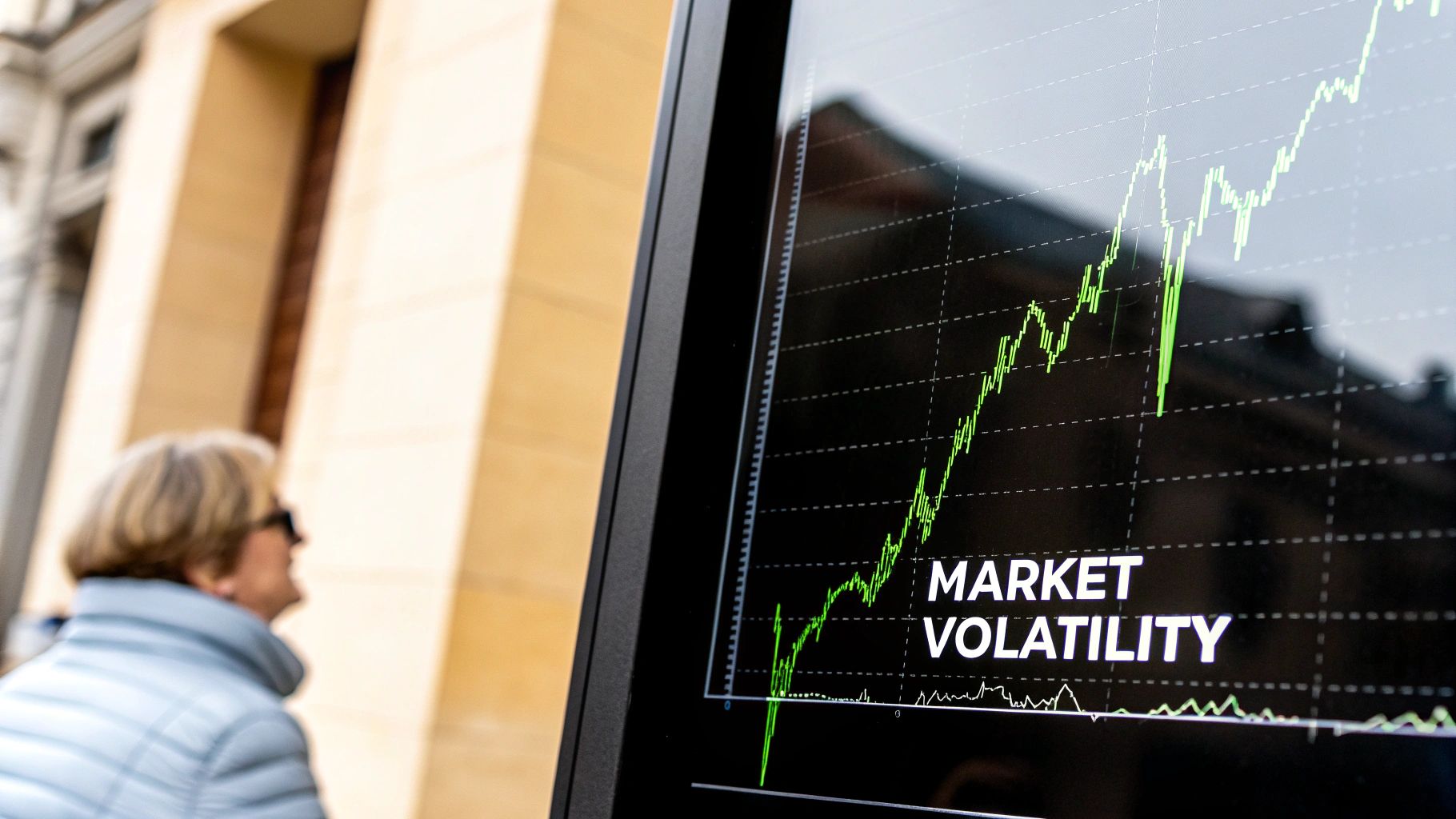
A solid risk management plan is non-negotiable, but it can’t exist in a vacuum. The market is a living, breathing thing, and its mood — its volatility (the speed and size of price changes) — directly impacts the risk of every single trade you take. Ignoring volatility is like sailing without checking the weather; you might be fine on a calm day, but a sudden storm can easily capsize you.
Understanding and respecting market volatility is a key piece of the puzzle for advanced risk management and trading. It’s not about being afraid of choppy markets; it’s about knowing how to adjust your sails when the winds change.
Reading the Market’s Heart Rate
Think of market volatility as the collective heartbeat of all traders. When everyone is calm and confident, the heartbeat is slow and steady. When fear and uncertainty take hold, that heart rate skyrockets. This is where tools like the Cboe Volatility Index (VIX) become incredibly helpful.
Often called the “fear gauge,” the VIX measures the market’s expectation of volatility over the next 30 days.
- A low VIX (below 20) generally signals a calm, lower-risk environment.
- A high VIX (above 30) tells you fear and uncertainty are high, meaning risk is cranked up.
Keeping an eye on the VIX gives you a quick, objective read on the market’s emotional state. It helps you decide whether it’s a time to be more aggressive or defensive with your capital. For a deeper dive, check out our complete guide on what is market volatility.
From News Headlines to Portfolio Risk
Big global events — geopolitical conflicts, surprise economic reports, or new trade policies — don’t just stay in the headlines. They translate directly into tangible risk in your trading account by causing sudden, sharp shifts in market sentiment and volatility. A static, set-and-forget risk plan just won’t cut it.
A real-world example makes this crystal clear. When geopolitical tensions flared on April 2nd of one recent year, the United States announced major tariffs, triggering immediate stress across the markets. The VIX index spiked above 50—a level indicating extreme fear. It’s a stark reminder of how quickly a political decision can change everything for a trader. You can find more details about these global risk behavior patterns in financial markets on cepr.org.
A trader’s job is to navigate uncertainty. High volatility isn’t a signal to panic; it’s a signal to adjust your strategy and tighten your risk controls.
This is where your risk management plan really proves its worth. It has to be flexible enough to adapt to these changing conditions on the fly.
How to Adjust Your Strategy in Turbulent Times
Respecting volatility means actively changing your game plan when the market’s “heart rate” is through the roof. Being stubborn and sticking to a rigid plan during a market storm is a recipe for disaster. A disciplined trader, on the other hand, makes deliberate, defensive adjustments.
Here are a few practical ways to adapt:
- Reduce Your Position Size: This is the simplest and most effective move you can make. If you normally risk 1% of your account, consider cutting it to 0.5% or even 0.25% during periods of high volatility. This keeps you in the game without exposing you to oversized losses from wild price swings.
- Widen Your Stop-Loss Orders: Volatile markets have much wider price swings. A stop-loss that works perfectly in a calm market might get triggered by normal “noise” in a turbulent one. You may need to place your stop further away from your entry — just remember to reduce your position size to keep your dollar risk the same.
- Be More Selective with Trades: High volatility is not the time to trade everything that moves. Focus only on your absolute best, highest-conviction setups and be patient. It’s far better to miss a few opportunities than to force trades in a chaotic environment and take unnecessary losses.
By learning to adapt to volatility, you shift from being a victim of the market’s whims to becoming a disciplined navigator of uncertainty. This proactive mindset is what separates the traders who survive and thrive from those who get washed out.
Practical Tools and Techniques for Managing Risk
Knowing the theory is one thing, but putting it into action is what really separates a struggling trader from a consistently profitable one. A solid risk framework is your game plan, but the tools you use every single day are what bring that plan to life. These are the practical, platform-level techniques that build discipline right into your trading and protect your hard-earned capital.
Great risk management and trading isn’t about nervously watching every tick. It’s about setting up smart systems that do the heavy lifting for you. This frees you up to focus on what matters most: finding quality setups, confident that your defenses are already locked in place.
Advanced Order Types Beyond the Stop-Loss
A standard stop-loss is your non-negotiable first line of defense, but most trading platforms offer far more dynamic tools to manage risk and lock in profits. Getting comfortable with these order types gives you a massive edge in flexibility and control.
The Trailing Stop-Loss
Think of a trailing stop as your automatic profit-locking assistant. Instead of staying fixed at one price, it “trails” a rising asset by a specific percentage or dollar amount you define. This helps you ride a winner while protecting your gains.
Practical Example: Imagine you buy a stock at $100 and set a 10% trailing stop. Your initial stop is placed at $90. If the stock rallies to $120, your stop automatically climbs right up with it to $108 (10% below the new high). You’ve now locked in at least $8 of profit per share while still giving the trade room to run. If the price then pulls back to $108, the order triggers, and you exit with your secured gains.
Bracket Orders
A bracket order is a powerful three-in-one command. It “brackets” your entry order with both a profit-taking limit order and a protective stop-loss order. The second your trade gets filled, your full exit plan is already working in the market.
If your profit target is hit first, the stop-loss order is automatically canceled. On the flip side, if the trade moves against you and your stop-loss is triggered, the profit target order is canceled. This is the ultimate tool for “set it and forget it” trading, as it removes the temptation to second-guess your plan in the heat of the moment.
To help you decide which tool fits your needs, here’s a quick breakdown of common order types used for risk management.
Comparing Essential Risk Management Order Types
| Order Type | Primary Function | Best Used When… |
|---|---|---|
| Stop-Loss | Sets a specific price to exit a losing trade automatically. | You want a fixed, predetermined exit point for every trade to limit potential losses. |
| Trailing Stop | Locks in profits by moving the stop-loss up as the price rises. | You’re in a strong trending trade and want to capture as much upside as possible without giving back gains. |
| Bracket Order | Places a profit target and a stop-loss simultaneously with an entry order. | You have a clear profit target and stop-loss defined before entering and want to automate the entire trade management process. |
Understanding these order types transforms your trading platform from a simple execution tool into a sophisticated risk management partner. They enforce your rules without emotional interference.
Diversification The Smart Way
You’ve heard it a million times: “don’t put all your eggs in one basket.” This is the core of diversification. By spreading your capital across different assets, you cushion the blow that any single losing trade can have on your overall portfolio.
But real diversification goes deeper. It’s not just about owning a bunch of different things; it’s about owning things that don’t all move in the same direction at the same time. This is where the concept of correlation comes in. Correlation is just a fancy word for how two assets move in relation to each other.
- High Correlation: Think of two big tech stocks. They tend to move up and down together. Owning both doesn’t spread your risk much.
- Low or Negative Correlation: These are assets that move independently or even in opposite directions, like a tech stock and a utility company, or stocks and gold.
The goal is to build a portfolio where all your baskets don’t get dropped at once.
A Real-World Diversification Scenario
Let’s look at a trader, Sarah, with a $20,000 portfolio. She decides to allocate her capital across three positions with low correlation to one another.
- $7,000 in a Technology ETF: She believes in the long-term growth of the tech sector.
- $7,000 in a Consumer Staples ETF: These companies sell everyday essentials and tend to hold up well during economic slowdowns.
- $6,000 in a Gold Trust ETF: Gold often does well when the stock market is shaky and investors are looking for safety.
A month later, some unexpected bad news hits the tech industry. Sarah’s tech ETF drops 5%, a $350 paper loss. But that same market uncertainty sends investors flocking to safe havens, causing her gold position to climb by 6% — a $360 gain. Meanwhile, her consumer staples fund remains flat.
Even though her largest holding took a hit, Sarah’s portfolio is actually slightly positive for the month. That’s the power of smart diversification in action. The loss in one area was canceled out by a gain in another, creating stability and protecting her from a nasty drawdown.
Mastering the Psychology of Risk and Discipline
You can have the most brilliant risk management plan in the world, but it’s completely worthless if you can’t stick to it when your emotions are screaming at you to do the opposite. This is one of the hardest truths in trading: the biggest enemy you’ll ever face isn’t the market — it’s the reflection in the mirror. The real war is fought between logic and emotion, and that’s where most traders ultimately lose.
Make no mistake, solid risk management and trading is a psychological game. We’ve all been there. That frantic fear of missing out (FOMO) as a stock goes parabolic, or that white-knuckled urge to “revenge trade” and claw back money after a stinging loss. These biases are hardwired into our brains, and they’re experts at convincing us to throw our carefully crafted rules right out the window.

The Most Common Mental Traps
Think about a classic scenario. A trader buys a stock and sets a disciplined stop-loss. The price starts to move against them, inching closer and closer to their exit point. Instead of just taking the small, planned hit, they start to rationalize. “It has to bounce back from here,” they tell themselves, and they move their stop-loss down. This is confirmation bias in its purest form — we hunt for any shred of evidence that supports what we want to happen, while totally ignoring the market’s clear message.
This one emotional decision is often how a small, manageable loss snowballs into a portfolio-crippling disaster. It’s a story as old as the markets themselves, and it proves that discipline isn’t some innate personality trait. It’s a skill you have to consciously build and practice, every single day.
On a massive scale, you can see this psychology play out in the global foreign exchange (FX) market. In a recent analysis, daily turnover hit an eye-watering $7.5 trillion. But what’s really interesting is the noticeable shift away from transparent trading platforms toward more private, over-the-counter methods. This suggests even the biggest institutions are adjusting their risk appetite based on market psychology. You can read more about these post-pandemic market shifts on bis.org.
“The market can remain irrational longer than you can remain solvent.” – John Maynard Keynes
This quote is timeless for a reason. Hoping a bad trade will magically turn around isn’t a strategy. Your discipline is the only thing standing between you and the market’s chaos.
Forging Discipline Through Practical Habits
You can’t just “decide” to be more disciplined, especially when you’re under pressure. It doesn’t work that way. Instead, you need to build a system of habits that makes following your rules the path of least resistance. Think of these habits as your psychological armor.
- Keep a Detailed Trading Journal: This is non-negotiable. Seriously. Logging every trade — your setup, your execution, and even how you were feeling — forces you to look at your decisions objectively. Over time, you’ll start seeing the patterns in your mistakes. That’s the first step to fixing them.
- Conduct Post-Trade Analysis: At the end of each day, review your trades. The winners and the losers. Did you follow your plan to the letter? Where did you deviate? This simple routine turns every trade into a learning experience, not just a dollar amount.
- Take Mandatory Breaks: If you take a big loss or feel yourself getting emotional, walk away. Close the laptop. Go for a walk. A short break can completely reset your mindset and stop you from making a string of impulsive decisions you’ll regret.
These habits create a powerful feedback loop that reinforces disciplined behavior. By analyzing your own data, you shift from making emotional reactions to making logical adjustments. A tool like an equity curve simulator can also help visualize how these small, consistent actions compound into massive long-term results.
Ultimately, mastering the psychology of risk is about building a repeatable process that protects you from your own worst impulses. It’s about treating your trading like a business where your number one job is to manage risk, not to chase profits. Master your mind, and you’ll give yourself the best shot at winning in the markets.
Building a Sustainable Trading Career
If you want to last in this game, you have to make a mental shift. Stop chasing the thrill of individual wins and start focusing on long-term survival. A successful trading career isn’t a sprint; it’s a marathon. It’s time to ditch the get-rich-quick fantasies and start acting like a business owner.
In this business, your top priority isn’t hunting for profits. It’s protecting your capital with relentless discipline. Profits are just the natural result of a well-run, risk-managed operation. This subtle change in perspective is what separates the pros from the gamblers.
The True Cost of a Trading Education
Every single trader takes losses. Even the legends. The trick is to reframe what those losses mean. Instead of seeing a loss as a failure, think of it as “tuition” paid to the market for a valuable lesson. Each planned, controlled loss teaches you something important about your strategy, your discipline, or the market itself.
This is a world away from the catastrophic losses that come from breaking your own rules. Those aren’t tuition — they’re just self-inflicted wounds that can take you out of the game for good. The goal is to keep your educational costs small and manageable.
The Four Pillars of Longevity
A lasting career is built on four pillars. If you neglect even one, the whole structure can come crashing down.
- A Solid Plan: Your trading plan, including your risk rules, is your constitution. It guides every move you make and saves you from emotional, impulsive decisions.
- The Right Tools: From advanced order types to diversification, these are the tools that bring your plan to life and help automate your discipline.
- Psychological Discipline: This is the mental grit to stick to your plan without caving, even when fear and greed are screaming at you.
- Continuous Learning: Markets change, and you have to change with them. Committing to reviewing your trades and adapting your approach is non-negotiable.
The moment you stop treating trading like a business is the moment you start treating it like a slot machine. A business protects its assets above all else; a slot machine just takes your money.
Risk Management as a Global Imperative
This intense focus on risk isn’t just for individual traders. The entire global financial system is built on it. In fact, the global risk management market was valued at USD 15.4 billion recently and is expected to explode to USD 51.97 billion by 2033. This massive growth just underscores how critical risk management is in an increasingly complex world. You can find more insights on this expanding market over at grandviewresearch.com.
Ultimately, your entire journey boils down to one simple idea: master your risk first. Learn to protect your capital with unwavering discipline. Once you do that, the profits will finally have a solid foundation to stand on.
Your Top Trading Risk Questions, Answered
Even with a solid game plan, the real world of trading always throws a few curveballs. Let’s tackle some of the most common questions that pop up when you’re in the trenches, trying to manage risk.
How Much Should I Actually Risk on a Single Trade?
The gold standard here is the 1-2% rule. It’s simple, powerful, and the bedrock of protecting your capital. This rule says you should never risk more than 1% to 2% of your total account on any one trade. For new traders, starting with 1% or even less is highly recommended.
Let’s make that real. If you have a $10,000 account, sticking to a 1% risk means your maximum potential loss on a single position is just $100. This feels small, and that’s the point. A string of losses is going to happen — it happens to everyone. Limiting your risk this way ensures you can survive those inevitable losing streaks, learn from them, and still be in the game when your strategy starts hitting its stride.
Is It Ever Okay to Move My Stop-Loss?
This is a tricky one, and the answer is a hard no for one scenario and a smart yes for another.
Moving your stop-loss further away from your entry price — giving a losing trade more “room to breathe” — is one of the fastest ways to blow up an account. It turns a small, calculated risk into a massive, emotionally-driven mistake. Don’t do it. We’ve all been tempted, but this is a line disciplined traders do not cross.
But what about moving it in the direction of your trade? Absolutely. This is a savvy defensive move to lock in your profits.
Think of it like this: Never move your stop to increase your risk. Always consider moving it to reduce your risk or protect what you’ve already earned.
This is exactly how a trailing stop works. Once a trade moves nicely in your favor, you can slide your stop up to your entry point (making it a risk-free trade) or even further to guarantee you walk away with a profit, no matter what happens next.
What’s the Biggest Risk Mistake New Traders Make?
Hands down, the single biggest error is getting tangled up in too much leverage and bad position sizing. New traders see leverage (borrowed money from a broker) as a golden ticket to control huge positions with a tiny account, but they forget that it magnifies losses just as powerfully as it magnifies gains.
For example, a tiny 2% wiggle in the market against a highly leveraged position can easily torch 20% or 30% of your entire account. An everyday market fluctuation suddenly becomes a catastrophic event. It’s a shortcut that almost always leads to a busted account, proving that disciplined risk management and trading isn’t just a suggestion — it’s essential for survival.
Ready to stop making emotional decisions and start building a disciplined, data-driven trading career? TradeReview offers a powerful trading journal with performance analytics, a visual trade calendar, and broker sync to help you analyze your strategy and protect your capital. Start tracking your trades for free and gain the insights you need to succeed. Get started with TradeReview today.