The inverse head and shoulders is a classic chart pattern that can signal a major trend reversal, shifting from a downtrend to a new uptrend. It’s built from three distinct troughs, where the middle one — the head — is the lowest point, with two slightly higher troughs on either side — the shoulders.
When you see this pattern forming, it’s a visual story of sellers losing their grip and buyers starting to wrestle back control. This guide is designed to help you understand this pattern, not as a guaranteed profit machine, but as a valuable tool in your analytical toolkit.
What Is the Inverse Head and Shoulders Pattern
This pattern is much more than just a shape on a chart; it’s a peek into the shifting psychology of the market. Think of it as a battle between sellers (bears) and buyers (bulls). The bears have been winning for a while, pushing the price lower and lower. The inverse head and shoulders shows you the exact moment the tide starts to turn.
At its core, the pattern reveals a methodical bottoming process. It’s not some wild, V-shaped snapback. Instead, it’s a gradual, hard-fought transfer of power. Learning to spot this structure helps you move away from emotional, reactive trading and toward a more planned, evidence-based approach for identifying a potential new uptrend.
The Anatomy of the Pattern
To really get a feel for this setup, you need to know its three main components. Each part tells a piece of the story about the struggle between supply and demand.
- The Left Shoulder: This first trough forms when sellers push the price to a new low within an existing downtrend. But then, buyers show up and trigger a small rally, showing the first signs of life.
- The Head: The sellers try again, this time with more force, driving the price to an even lower low than the left shoulder. This looks incredibly bearish at first, but the buyers respond with even more conviction, pushing the price all the way back up to the peak of the last rally.
- The Right Shoulder: Now the sellers make one last attempt to push the price down, but they’re running out of steam. They can’t even get the price back down to the low of the head, forming a higher low. This is a crucial signal of seller exhaustion and growing buyer confidence.
The final piece of the puzzle is the neckline. This is a resistance line drawn by connecting the high points of the two rallies that formed after the left shoulder and the head. The pattern isn’t officially “complete” or confirmed until the price breaks cleanly and decisively above this neckline.
Getting good at identifying these components is all about practice. If you need a refresher on the basics, our guide on how to read stock charts is a great place to start.
The inverse head and shoulders is a widely recognized bullish reversal signal, especially when the breakout is confirmed by a big spike in volume. It gives you a structured way to identify a potential market bottom.
Let’s break down what each part of the pattern represents visually and psychologically.
Key Components of the Inverse Head and Shoulders Pattern
| Pattern Component | What It Looks Like | What It Means Psychologically |
|---|---|---|
| Left Shoulder | A low point in the downtrend, followed by a small rally. | Sellers are still in control, but buyers are starting to test the waters. |
| Head | A lower low than the left shoulder, followed by a strong rally. | Sellers make a final, aggressive push, but buyers absorb it and show significant strength. |
| Right Shoulder | A higher low compared to the head. | Sellers are clearly exhausted and losing momentum. Buyers are stepping in earlier. |
| Neckline | A resistance line connecting the peaks after the shoulders. | The final barrier. A break above it signals buyers have officially taken control. |
This table helps visualize the tug-of-war happening behind the scenes. The pattern is so powerful because it doesn’t just hint at a reversal; it shows the slow, undeniable decay of bearish pressure.
While no pattern guarantees a specific outcome, historical analysis can provide context. For more data-driven insights, platforms like ChartsWatcher offer analysis on pattern reliability. The key is to use this information as part of a larger, well-rounded trading strategy, not as a standalone signal.
How to Identify High-Probability Setups
Spotting shapes on a chart is easy. The real skill is telling a high-probability inverse head and shoulders from all the other market noise. Your long-term success as a trader often boils down to how well you can filter these setups. It’s about patience and having a rock-solid checklist to separate the A+ trades from the “maybes.”
This isn’t just about finding a pattern that looks right. You need to confirm that the underlying market psychology actually lines up with what you see on the chart. By following a repeatable process, you build the discipline to wait for setups that give you a potential edge, instead of jumping at every shaky formation you see.
This visual guide breaks down the ideal flow of the pattern, from the initial downtrend all the way through to completion.
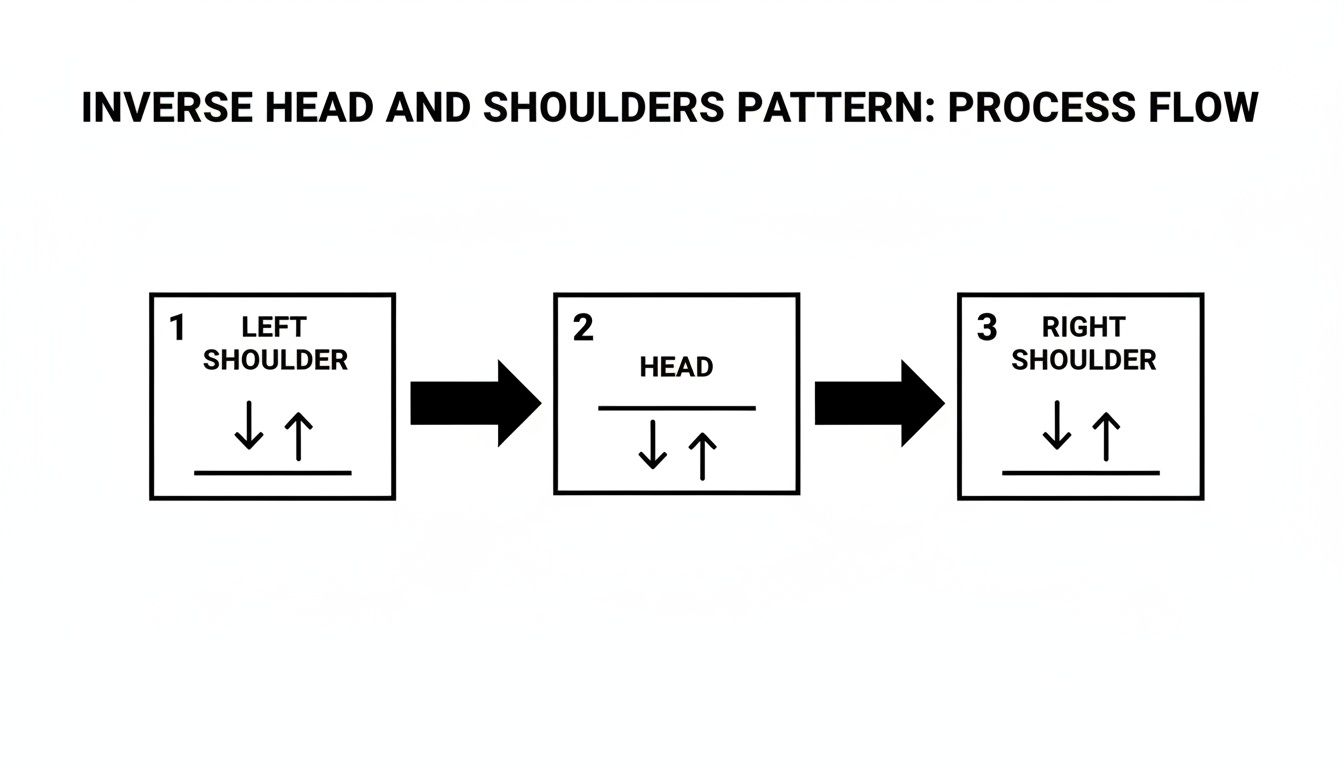
As the diagram shows, the head must be the lowest point. This structure is what signals a progressive shift in strength from sellers to buyers as the pattern takes shape.
The Non-Negotiable Prerequisite: A Clear Downtrend
First things first: an inverse head and shoulders is a bullish reversal pattern. For something to reverse, there has to be a trend to reverse in the first place. Without a clear downtrend leading into it, the pattern is completely meaningless.
Think about it like trying to make a U-turn on a perfectly straight road — it just doesn’t make sense. The pattern gets its power from signaling the end of a long period of selling pressure. Before you even look for the left shoulder, you need to see a series of lower highs and lower lows on your chart.
The Three Troughs and the Neckline
Once you’ve confirmed the downtrend, it’s time to spot the three key pieces of the puzzle: the shoulders and the head.
- Left Shoulder: This is the first significant low in the pattern.
- Head: A much lower low that represents a final, exhaustive push from the sellers.
- Right Shoulder: A higher low compared to the head, which is our first real clue that the sellers are running out of steam.
After these three troughs have formed, you can draw the neckline. It’s just a simple trendline connecting the two peaks that form after the left shoulder and the head. This neckline is the final line in the sand — the last bit of resistance. The pattern is only truly confirmed once the price breaks out above this line.
A huge mistake traders make is getting in before the neckline breaks. Until that happens, the sellers are still technically in control. Patience is your best friend here. Wait for the market to prove the buyers have taken over.
Volume: The Engine Behind the Move
Price action tells you what’s happening, but volume tells you how much conviction is behind it. Analyzing volume is what separates the home-run setups from the failures. It’s the fuel that powers a real breakout.
Ideally, you want to see a very specific volume signature as the pattern unfolds:
- Decreasing Volume: As the pattern forms from the left shoulder through to the right shoulder, the trading volume should generally be drying up. This tells you that sellers are losing interest and their momentum is fading.
- Surging Volume on Breakout: This is the big one. When the price finally punches through the neckline, you need to see a massive spike in volume. This is your confirmation that buyers have shown up in force, ready to drive the price higher.
A breakout on weak volume is a massive red flag. It suggests there’s no real buying interest behind the move and massively increases the odds of a “fakeout,” where the price just falls right back below the neckline.
Finding these A+ opportunities consistently requires a system. Building a good routine for scanning stocks for day trading helps you sift through the noise and find assets that tick all these boxes. At the end of the day, discipline and a repeatable process are what help you find the best setups.
Executing the Trade with a Clear Plan
Spotting a high-probability inverse head and shoulders pattern is a great start, but it’s only half the job. The real money — and the real test of your discipline — is in how you execute the trade. Without a rock-solid plan for your entry, stop-loss, and profit target, even the most textbook setup can fall apart.
This is where a lot of traders get tripped up. The excitement of catching a major reversal can lead to impulsive moves, like jumping the gun on an entry or setting a wild, unrealistic target. To avoid that, you need a pre-defined plan that takes emotion out of the picture. Think of it as a simple system with three core parts: your entry trigger, your safety net, and your payday.

Choosing Your Entry Strategy
There’s no single “best” way to enter a trade on this pattern; it really boils down to your personal risk tolerance and trading style. Let’s walk through three common approaches, each with its own pros and cons.
- The Aggressive Breakout Entry: This is the most direct method. You simply place a buy order as soon as the price closes above the neckline, hopefully on a big spike in volume. The main benefit here is you’re guaranteed to be in the move if it takes off like a rocket. The downside? You’re more exposed to “fakeouts,” where the price pokes its head above the neckline only to get stuffed right back down.
- The Conservative Retest Entry: This one requires a bit more patience. After the initial breakout, you wait for the price to pull back and retest the old neckline, which should now act as a new floor of support. You go long once you see the price bounce off that level and start heading up again. This gives you a much better risk-to-reward ratio since your entry is lower and your stop is tighter. The catch? Sometimes a breakout is so powerful it never looks back, and you miss the trade completely. It’s the classic trade-off.
- The Early Right Shoulder Entry: This is a more advanced and aggressive play. Some traders try to get ahead of the crowd by buying while the right shoulder is still forming, usually as it bounces off its low. The appeal is obvious — you get the best possible price. But it’s risky because the pattern isn’t confirmed yet. Until that neckline breaks, the downtrend is technically still in control. This is not a strategy for beginners.
Setting Your Stop-Loss for Capital Protection
Your stop-loss is your lifeline. It’s the line in the sand where you admit the trade idea was wrong and get out to protect your capital. Trading without one is like driving without a seatbelt — it feels fine until it suddenly isn’t.
For an inverse head and shoulders, the most logical spot for your stop-loss is just below the low of the right shoulder. This gives the trade enough room to wiggle around without getting stopped out by normal market noise, but it gets you out if the pattern’s structure actually fails. If you set it too tight, you risk getting shaken out. Too loose (like below the head), and you’re taking on way more risk than necessary.
A well-placed stop-loss isn’t about fearing a loss; it’s about defining your risk upfront. It’s a business decision, not an emotional one. Honoring your stop-loss consistently is a hallmark of a disciplined trader.
Defining Your Profit Target
Just like you have a plan for getting out when you’re wrong, you need one for taking profits when you’re right. The classic way to set a target for this pattern is the measured move technique.
It’s surprisingly simple:
- Measure the vertical distance from the bottom of the head up to the neckline.
- Take that same distance and project it upward from the breakout point on the neckline.
This projection gives you a logical, data-driven profit target. It’s based on the size and energy of the pattern itself, taking all the guesswork out of your exit. Sure, the price can run much further, but this measured move gives you a high-probability first target to aim for.
Real-World Examples in Stocks and Crypto
Theory is great, but nothing builds confidence like seeing the inverse head and shoulders pattern play out on a real chart. Analyzing historical examples is how you bridge the gap between abstract concepts and practical trading. It lets you see the battle between buyers and sellers unfold, making the pattern’s psychological story feel real.
We’re going to dissect two different examples — one from the stock market and another from the wild world of crypto. Breaking down these case studies will show you the pattern’s core principles in action across completely different assets and market conditions. This is how you sharpen your eye for spotting these setups on your own.

Stock Market Example: AMD
Advanced Micro Devices (AMD) gave us a textbook example of an inverse head and shoulders that marked a huge market bottom in late 2022. After a long, painful downtrend, the stock began carving out the exact structure that would kick off a powerful new uptrend.
Let’s break down how this formation played out:
- The Preceding Downtrend: AMD had been in a clear downtrend for months. This is a non-negotiable prerequisite for any valid reversal pattern.
- The Left Shoulder: The stock put in its first major low around the $60 level in October 2022 before popping for a brief rally.
- The Head: Sellers gave it one last, exhaustive push, driving the price to its ultimate low near $55. This lower low was the moment of peak fear, or peak bearishness.
- The Right Shoulder: After rallying off the head, sellers tried to push it down again but ran out of steam, forming a higher low around $62. This was a dead giveaway that seller exhaustion had set in.
- The Neckline Breakout: The neckline formed around the $78-$80 resistance area. In early 2023, AMD blew past this level with a very noticeable spike in volume, confirming the bullish reversal. The rally that followed was massive, proving just how predictive the pattern can be.
This AMD example really drives home the need for patience. The entire formation took several months to build out, reminding us that major trend reversals don’t happen overnight. Traders who spotted the structure and waited for that confirmed breakout were positioned perfectly for the next big leg up.
Cryptocurrency Example: Bitcoin
The inverse head and shoulders pattern shows its versatility in the crypto markets, which are notorious for their volatility and clean trend cycles. The pattern works just as well here because it’s based on universal market psychology, which is the same no matter the asset.
A fantastic real-world example unfolded with Bitcoin in early 2020. After a downtrend, BTC formed a left shoulder around the $8,000-$8,400 support zone. The head then printed a final low near $3,782 on March 9, 2020, followed by a recovery that eventually carved out the right shoulder. The breakout above the neckline was the starting gun for a legendary bull run. You can dig into more details of this classic Bitcoin pattern formation on CoinSwitch.
This Bitcoin example teaches two critical lessons. First, the pattern’s reliability can hold up even under extreme, fearful market conditions. Second, it shows that the shoulders don’t have to be perfectly symmetrical, and the neckline doesn’t need to be perfectly horizontal. It’s the underlying psychology — seller exhaustion and the shift to buyer control — that really counts.
By studying past charts, you are not just looking at old price data; you are studying a visual record of human emotion and decision-making. Each pattern tells a story of fear giving way to greed, and learning to read these stories is the essence of technical analysis.
Ultimately, these examples are your practical guide. They prove that whether you’re trading blue-chip stocks or fast-moving cryptocurrencies, the core principles remain your roadmap: identify the downtrend, spot the three-trough structure, and wait for a volume-confirmed neckline break.
Common Trading Mistakes and How to Avoid Them
Look, every trader makes mistakes. Whether you’re just starting out or have been at this for years, it’s just part of the game. We all feel the struggle of trying to stay disciplined. The real goal isn’t to be perfect; it’s to stop making the same preventable errors that eat away at your account and your confidence.
We’ve all been there — a great plan that somehow goes wrong. So let’s break down the most common ways traders trip up with the inverse head and shoulders pattern and how to sidestep them.
Mistake 1: Forcing the Pattern on a Messy Chart
One of the biggest mistakes is seeing what you want to see. In choppy, sideways markets, you can find all sorts of shapes that kind of, sort of, look like an inverse head and shoulders. This usually happens when you’re feeling impatient or have a bad case of FOMO (Fear Of Missing Out).
The Fix: Stick to the rules. No exceptions. A true inverse head and shoulders only matters if it shows up after a clear downtrend. If you have to squint to make it fit, it’s not a setup worth your capital. An A+ pattern should jump off the chart at you.
Discipline Checklist
- Is there a clear preceding downtrend? (Yes/No)
- Is the head the lowest point, clearly below both shoulders? (Yes/No)
- Is the pattern’s structure clean and obvious, not a jumbled mess? (Yes/No)
Mistake 2: Ignoring the Importance of Volume
A breakout above the neckline feels great, but if it happens on weak volume, it’s a massive red flag. Think of volume as the fuel for a move. A low-volume breakout shows that buyers aren’t truly committed, and it dramatically increases the odds of a “fakeout” where the price just collapses right back below the neckline.
The Fix: Make volume a non-negotiable part of your checklist. You need to see a clear spike in volume as the price pushes through the neckline. No significant volume, no trade. It’s that simple.
Mistake 3: Setting Your Stop-Loss Too Tight
We all want to keep risk low, but placing your stop-loss too close to your entry is a classic rookie move. Markets are noisy and they need room to breathe. Normal volatility can easily shake you out of a perfectly good trade right before it takes off, which is one of the most frustrating things in trading.
The Fix: Place your stop where the pattern is proven wrong. For an inverse head and shoulders, the most logical spot is just below the low of the right shoulder. This gives the trade enough wiggle room to work while still protecting you if the bullish idea truly fails. It’s about managing risk intelligently, not strangling your trade to death.
By turning these common errors into a simple checklist, you start building a disciplined process. It helps keep emotions out of the driver’s seat and ensures you only put your hard-earned money on the highest-probability setups.
Building Your Edge with a Trading Journal
So, what really separates professional traders from the rest of the pack? It’s not some secret indicator or a “can’t-lose” setup. It’s a relentless, almost obsessive focus on data, performance review, and continuous improvement. This long-term mindset is crucial.
Trading the inverse head and shoulders pattern — or any setup for that matter — without tracking your results is like trying to find your way through a maze blindfolded. Sure, you might get lucky once or twice, but you’ll never actually learn the route.
This is where a trading journal becomes your most important tool. It’s far more than just a diary of wins and losses; it’s the raw data you need to build a real statistical edge. It turns trading from a string of emotional guesses into a structured, data-driven business.
When you log every single trade, you create a powerful feedback loop. It forces you to look at the reality of your performance, spot your weaknesses, and double down on what’s actually working. This is how you build the kind of discipline and long-term perspective that are absolutely essential for success.
It’s not about finding a pattern that works 100% of the time — that doesn’t exist. It’s about understanding your personal performance with a specific pattern over a large sample of trades.
Transforming Theory into Personal Statistics
Reading about a pattern’s historical success rate is interesting, but knowing how it performs for you, with your rules, is what actually matters.
Some public analyses suggest the pattern can be reliable. For example, you can explore some head and shoulders strategy findings which examine the performance of its bearish cousin.
While that’s encouraging, it’s just a broad average. Your own results will be shaped by your specific entry rules, timing, and risk management. Your journal is the only thing that can tell you your actual win rate, your average risk-to-reward ratio, and which entry strategy truly clicks with your psychology.
A trading journal holds up a mirror to your decision-making. It removes ego and emotion, leaving you with cold, hard facts about your performance. This is the foundation of building a real, sustainable edge in the market.
A Practical Workflow for Logging Your Trades
To get real value from your journal, you need a consistent process. Every time you take an inverse head and shoulders trade, you should be capturing the same key pieces of information. This consistency is what makes meaningful analysis possible down the road.
While a simple spreadsheet can get the job done (we even have a guide on how to build a trading journal in Excel), a dedicated tool like TradeReview can automate and simplify a lot of this work.
Here’s a simple but effective workflow to follow for every trade:
- Tag the Setup: Right away, tag the trade with “Inverse H&S”. Over time, you can filter your journal to see performance stats just for this pattern.
- Annotate a Screenshot: Before you enter, grab a screenshot of the chart. Mark the left shoulder, head, right shoulder, and the neckline. This visual record is gold during your review sessions.
- Record Your Plan: Log your planned entry price, your stop-loss, and where you plan to take profit. This keeps you accountable to your original plan.
- Log the Outcome: Once the trade is closed, record the final P&L, why you exited (hit target, stopped out, etc.), and any emotions you felt.
- Add Notes: Was the volume confirmation strong or weak? Did you enter right on the breakout or wait for a retest? These notes add critical context that numbers alone can’t provide.
Here’s a quick look at how you can organize this data to start tracking your performance.
Tracking Inverse H&S Trades in Your Journal
A practical guide to logging key data points for each trade to analyze performance effectively.
| Data Point to Log | Example | Why It’s Important |
|---|---|---|
| Setup Tag |
Inverse H&S, Retest Entry
|
Allows you to filter and analyze the performance of this specific pattern. |
| Entry Price | $152.50 (breakout retest) |
Helps determine if breakout vs. retest entries are more profitable for you. |
| Stop-Loss Price | $148.75 (below right shoulder) |
Reinforces disciplined risk management and calculates your intended risk. |
| Profit Target | $163.75 (measured move) |
Assesses whether your profit targets are realistic and being achieved. |
| Annotated Chart | [Screenshot] |
Provides instant visual context for what you saw during your trade review. |
After a few dozen trades, this data will start to answer critical questions. You’ll learn if you trade better on certain days, with specific stocks, or using a particular entry technique. This is how you move from just trading a pattern to truly mastering it.
Still Have Questions?
Even when you feel like you’ve got a handle on a new pattern, a few questions are bound to pop up. It’s a normal part of the learning process. I’ve put together some of the most common ones I hear about the inverse head and shoulders to give you clear, practical answers and help you trade it with more confidence.
What Timeframe Is Best for This Pattern?
You’ll spot this pattern on everything from a 1-minute chart to a weekly. But here’s the thing: its reliability really shines on higher timeframes like the daily and weekly charts.
When you see it form over days or weeks, it’s not just noise — it reflects a deep, meaningful shift in market sentiment from bearish to bullish. The longer the base, the more powerful the potential move.
How Is This Different from a Triple Bottom?
Good question. They both signal a potential bottom, but the devil is in the details. While both are bullish reversal patterns with three distinct troughs, their structure tells a different story.
- A triple bottom has all three lows forming at roughly the same price level, carving out a clear horizontal support line. Think of it as the market testing the floor three times and failing to break through.
- An inverse head and shoulders is defined by its middle trough (the head) dipping significantly lower than the two surrounding shoulders. This shows a final, exhaustive push by the sellers that ultimately fails.
What If the Pattern Fails After I Enter?
It will happen. Pattern failure isn’t just a possibility; it’s an inevitable part of trading. No setup is a sure thing. The most important move you can make is to have your stop-loss order already in place before you enter and to honor it without a second thought.
When a pattern fails, it simply means the expected shift in psychology didn’t materialize. That’s it. It’s not a reflection on you; it’s just the market being the market.
The goal isn’t to avoid losses — it’s to manage them. A disciplined exit on a failed pattern protects your capital and keeps you in the game for the next high-probability setup that comes along.
Ready to stop guessing and start building a real, data-driven trading business? Begin tracking every inverse head and shoulders setup with TradeReview. It’s the best way to analyze your performance, find your edge, and build the discipline that separates pros from amateurs. Get started for free today.