The gravestone doji is one of those candlestick patterns that just looks intimidating, and for good reason. It’s a powerful signal of a potential bearish reversal, especially when it shows up after a solid uptrend. This isn’t a “guaranteed” sign of a market crash, but it’s a critical warning that a disciplined trader must respect.
This single candle tells the entire story of a trading session. It captures that moment when buyers, full of confidence, pushed prices way up, only to get completely shut down by sellers who hammered the price right back to where it started. That abrupt halt in bullish momentum is exactly what the gravestone doji visualizes.
What Is a Gravestone Doji Candle
Beyond its ominous name, a gravestone doji is a snapshot of a fierce battle between bulls and bears. The key takeaway? The bulls are showing serious signs of exhaustion, even if the session ended in a draw. We’ve all felt the pain of staying in a trade too long as momentum shifts; this candle can be an early warning.
Picture a stock that’s been climbing for days. Buyers are feeling good, pushing the price higher and higher. Then, out of nowhere, sellers step in with overwhelming force at the peak. They aggressively reject those new highs and drive the price all the way back down. By the time the session ends, the price closes right where it opened.
This intense tug-of-war leaves behind a very distinct shape on the chart: a candle with a long upper wick and almost no body. The open, low, and close are all packed together at the very bottom of the candle’s range.
This pattern is a huge red flag signaling indecision and a potential shift in market sentiment. While it’s not a crystal ball predicting a market crash, its appearance should make any trader hit the pause button and pay close attention. It’s a clear warning that the prevailing uptrend might be running out of gas.
The Anatomy of the Signal
To really get what this pattern is telling you, it helps to break down its parts. Each element tells a piece of the session’s story. If you’re new to this, you might want to check out our complete guide on how to read stock charts.
- Long Upper Shadow: This is the most obvious feature. It represents all the ground the buyers gained before the sellers took complete control. The longer this shadow, the more significant the rejection of higher prices was.
- No Real Body: The open and close prices are virtually identical. This creates a thin horizontal line, signaling a total stalemate by the close of the session.
- Little to No Lower Shadow: The low of the day is the same as the open and close. This shows that once sellers took over, they never gave up an inch of ground.
Below is a quick reference table summarizing what to look for.
Gravestone Doji Key Characteristics at a Glance
| Component | Description | What It Signals to Traders |
|---|---|---|
| Upper Shadow/Wick | Long and prominent, making up most of the candle’s height. | Bulls attempted a rally but were decisively rejected by bears. |
| Real Body | Extremely small or non-existent (a thin horizontal line). | The session ended where it began; a clear sign of indecision. |
| Lower Shadow/Wick | Very short or, ideally, completely absent. | Sellers maintained control after pushing the price back down. |
| Location | Most powerful when it appears after a prolonged uptrend. | Suggests the existing bullish momentum is fading fast. |
This combination of features paints a vivid picture of a market at a critical turning point.
The appearance of a gravestone doji after a strong uptrend is like a loud knock on the door from the bears. It doesn’t mean they’ve broken in, but it’s a clear signal that they are testing the locks.
Ultimately, a gravestone doji is an alert. It’s a moment of reflection in the market, where the momentum that drove prices up has been aggressively challenged. For a disciplined trader, this isn’t a signal to panic-sell. Instead, it’s a prompt to look at the bigger picture, wait for confirmation, and prepare for a potential change in direction.
The Market Psychology Within the Pattern
To really master the gravestone doji, you have to look past its shape and get inside the heads of the traders who created it. Every candlestick tells a story, and this one is a short, dramatic tale about a battle between bulls and bears. It’s a snapshot of market sentiment shifting right before your eyes.
Think about a stock that’s been in a solid uptrend. Buyers are in total control, feeling confident and pushing the price higher day after day. That same optimism is in the air when the next trading session begins.
As soon as the market opens, the bulls get to work. They come in strong, driving the price up and forming what looks like a powerful, healthy green candle. That big push upward is what creates the long upper wick (or shadow) of the gravestone doji. It’s a visual record of peak optimism.
The Turning Point
But then, right at the top, something snaps. The price hits a level that makes traders pause — maybe it’s an old resistance area, a big round number, or just a point where the asset starts to look way too expensive. Whatever the reason, sellers see their moment and jump in with force.
And this isn’t just a few people taking profits. It’s an aggressive wave of selling that completely overwhelms the buyers. The bulls, who were just dominating the session, are suddenly forced to retreat. This sudden shift in power is the real story behind the gravestone doji.
The gravestone doji is a powerful rejection of higher prices. It’s the market screaming, “We went up there, took a look around, and decided we didn’t like the view.” This collective change of heart is what gives the pattern its teeth.
The sell-off that follows is just as aggressive as the initial rally. Sellers slam the price all the way back down, completely wiping out all the gains the bulls fought so hard for. By the time the session closes, the price is right back where it started.
This complete reversal gives us two critical insights into the market’s mindset:
- Bullish Exhaustion: The buyers burned a lot of energy to reach those new highs, but they couldn’t hold the line. Their failure to defend that peak hints that their buying power might be running out of steam.
- Bearish Conviction: The sellers didn’t just stop the rally; they sent it packing. Their ability to drive the price all the way back to the open shows they have a strong belief that those higher prices were a mistake.
Reading the Narrative
Once you understand this story, you stop seeing a simple shape on your chart. Instead, you see a failed auction. The market tried to establish value at higher prices, but it was met with a swift and decisive “no.”
The session ends in a stalemate, with the price closing near the open. But the psychological win goes to the bears. They proved the bulls were vulnerable and successfully defended their territory. That’s why a gravestone doji, especially after a strong run-up, is such a powerful warning sign. It’s a clear signal that the balance of power might be shifting, and the trend you were riding could be in serious trouble.
A Framework for Confirming the Signal
Spotting a gravestone doji is a great start, but jumping into a trade on that signal alone can be a painful mistake. Ask any seasoned trader, and they’ll tell you that this pattern, like any other, demands a disciplined confirmation process. Think of yourself as a detective building a case — the doji is your first clue, but you need more evidence before you can act with confidence.
This mindset shifts you from being a simple pattern-spotter to a strategic analyst. It’s not about finding a “guaranteed” signal, because those don’t exist. It’s about patiently waiting for the highest-probability setups to form. We’ve all felt the sting of a trade that looked perfect but immediately went the wrong way; a confirmation framework is how you minimize those painful lessons.
Rule 1: Check the Preceding Trend
The first, non-negotiable rule is context. A gravestone doji’s bearish power is almost entirely dependent on where it appears. For this pattern to mean anything, it must form at the top of a clear, established uptrend.
Imagine a climber who’s been scaling a mountain for hours finally slips near the peak. That slip is significant. Now, imagine that same person slipping on flat ground. It’s meaningless. The same logic applies here — the uptrend provides the necessary story for the pattern’s message of bullish exhaustion to have any real weight.
Rule 2: Wait for the Confirmation Candle
This is where true discipline pays off. So many traders get excited and rush to short the market the moment a gravestone doji closes. This is a classic rookie mistake. The doji itself only signals indecision — a stalemate between buyers and sellers. The real proof comes from what happens next.
A strong confirmation is a bearish candle that closes below the low of the gravestone doji. This follow-through shows that sellers have not only won the initial battle but are now pressing their advantage. Waiting for this confirmation filters out countless false alarms where the market simply pauses before resuming its climb.
Trading a gravestone doji without a confirmation candle is like betting on a horse race before the gates have even opened. You’re acting on potential, not proof. Patience is your greatest ally.
This flow is what’s happening behind the scenes, from a strong uptrend to a seller override, culminating in the market stalemate that the gravestone doji represents.
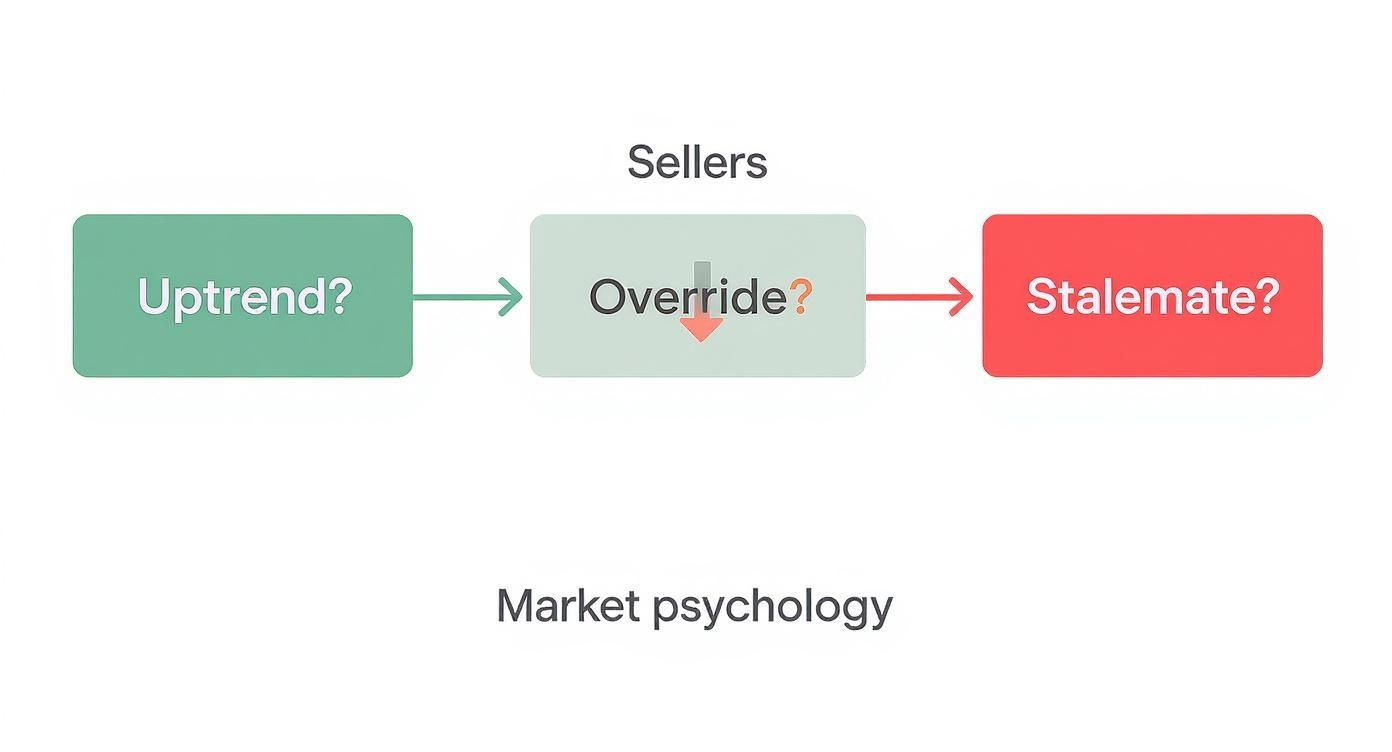
The chart visualizes how bullish momentum gets challenged and ultimately halted, giving you a clear picture of the struggle that defines this pattern.
Rule 3: Layer in Additional Evidence
Once you have the right context and a solid confirmation candle, you can build an even stronger case by layering in other technical tools. This is how you really start stacking the probabilities in your favor.
- Volume Analysis: Did trading volume spike on the day the gravestone doji formed? High volume adds serious credibility, showing that a huge number of participants were involved in the fight, which makes the rejection of higher prices that much more meaningful.
- Indicator Divergence: Look at an oscillator like the Relative Strength Index (RSI). This tool measures momentum. If the price is making a new high (the tip of the doji’s wick) but the RSI is making a lower high, you have bearish divergence. It’s a powerful clue that the underlying momentum is fizzling out.
- Key Resistance Levels: Is the gravestone doji forming right at a known resistance level from the past? A pattern appearing at a major price barrier where sellers have historically shown up is far more potent than one forming in the middle of nowhere.
Combining these elements gives you a much clearer, more reliable picture. While plenty of patterns pop up on the charts, you can learn more about the most effective ones in our overview of popular day trading chart patterns.
Practical Trading Strategies and Risk Management
Knowing what a gravestone doji is and knowing how to trade it are two completely different things. This is where the rubber meets the road. Spotting the candle is just the first step — building a disciplined plan for your entry, exit, and risk management is what separates consistent traders from gamblers.
We’ve all felt that sting of a great setup turning into a loss because of a sloppy plan. The goal here is to give you a clear, rules-based framework to avoid that pain. It’s not about chasing home runs; it’s about meticulously managing your losses so you can stay in the game long enough for your edge to play out.
Defining Your Entry Point
Once you’ve spotted a valid gravestone doji after an uptrend and — crucially — gotten confirmation from the next candle, it’s time to figure out where to get in. A common-sense approach is to place a short (sell) order just below the low of that confirmation candle.
This isn’t just a random rule. It ensures you’re not jumping the gun based on the doji alone, which really just signals indecision. By waiting for sellers to prove they mean business by pushing the price below the recent low, you’re trading based on demonstrated momentum, not just wishful thinking.
Setting Your Protective Stop-Loss
Your stop-loss is your line in the sand. It’s the most critical part of any trade, period. For a gravestone doji setup, the most logical place to put it is just a few ticks above the high of the gravestone’s long upper shadow.
This placement makes perfect sense for a couple of reasons:
- It’s Your Invalidation Point: The high of the gravestone is the absolute peak price that sellers swatted down. If the price manages to climb back above that level, your entire bearish idea is wrong. Simple as that.
- It Defines Your Risk: This gives you a hard, fixed dollar amount of risk for the trade. Now you can calculate a position size that fits your account and risk tolerance.
Nailing this part of your trade is essential. If you want to dig deeper into this, our guide offers some great insights on how to set stop losses the right way.
Establishing Sensible Profit Targets
Knowing when to take your money off the table is just as important as knowing when to cut a loss. We’ve all watched a winner turn into a loser because of greed. To avoid that, you need to identify your profit targets before you even enter the trade.
Look for logical spots on the chart where buyers might show up again. These often include:
- Previous Swing Lows: The last significant low made during the prior uptrend.
- Key Support Levels: An old price level where the stock has found a floor before.
- Major Moving Averages: A key moving average (like the 50-day or 200-day) sitting below the current price.
Picking the nearest support level gives you a realistic goal. You can also think in terms of risk-to-reward, aiming to make at least 1.5 or 2 times whatever you’re risking on the trade.
A Real-World Chart Example
Alright, let’s connect all these rules to a real chart. Theory is great, but seeing it play out is what makes it stick.
The chart below shows a textbook gravestone doji popping up right at the peak of a strong uptrend — a classic warning sign.
In this example, the trader waits for the next candle to close red (that’s the confirmation), enters a short position just below that candle’s low, and places a tight stop-loss right above the doji’s high.
A well-defined trading plan is your best defense against emotional decision-making. It turns a chaotic market environment into a structured set of “if-then” scenarios, allowing you to act with confidence and discipline.
When you follow a structured approach like this, you take the guesswork and emotion out of the equation. You have a clear entry trigger, a defined “I’m wrong” point for your stop-loss, and a logical target for taking profits. This systematic process is the bedrock of consistency.
Common Mistakes Traders Make with This Pattern

Learning to spot a gravestone doji is the easy part. The real skill is avoiding the pitfalls that trip up even seasoned traders. We’ve all been there — you see a textbook pattern, jump into a trade feeling confident, and then watch the market move completely against you.
Think of this section as a mentor guiding you past those common errors. Most mistakes boil down to impatience and trading without a solid plan. By understanding them upfront, you can approach the gravestone doji with the healthy respect it deserves and save yourself a lot of expensive lessons.
Ignoring the Bigger Picture
By far, the single biggest mistake is trading the gravestone doji in a vacuum. A trader sees that distinctive shape and instantly assumes a reversal is about to happen, forgetting to look at the broader market story. A gravestone doji without a prior uptrend is meaningless — it’s just market noise.
Always zoom out before you zoom in. Make sure the pattern appeared after a real, sustained move higher. A gravestone doji at a major resistance level is a powerful signal; one that forms in the middle of a choppy, sideways market is practically worthless.
Acting Without Confirmation
Impatience is the account killer. The gravestone doji itself is a warning sign of indecision, not a confirmed bearish reversal. Acting on the doji alone is a pure gamble, yet so many traders short the second the candle closes, hoping to nail the absolute top.
The fix is simple, but it demands discipline: wait for confirmation. A solid bearish candle closing below the doji’s low is the proof you need that sellers are actually in control. This one step will filter out a massive number of false signals where the market simply paused before rallying again.
Seeing a gravestone doji is an alert, not an instruction. It’s the market telling you to pay close attention, weigh the evidence, and wait for the sellers to prove their case before you put your capital at risk.
Overlooking Trading Volume
Another classic oversight is completely ignoring the volume behind the pattern. A gravestone doji that forms on light, anemic volume is weak. It suggests there wasn’t much conviction from either buyers or sellers, making the entire pattern unreliable.
On the other hand, a big spike in volume when the gravestone doji forms adds a huge layer of credibility. It shows a major battle took place at that price level, and the rejection of higher prices was a significant event. Always glance at your volume indicator — it gives you critical context about the strength behind the move.
Misinterpreting Data Without Context
Finally, it’s a huge mistake to think any single pattern is a magic bullet. The backtesting data paints a very clear picture. For instance, a statistical analysis by Stocksoft Research across 21 different markets found that shorting immediately after a gravestone doji and holding for one day led to an average loss of -0.27%. The win rate was only 45%.
This data is the ultimate proof of why trading the gravestone doji in isolation is a losing game. It hammers home the importance of confirmation, volume analysis, and proper market context. Those are the elements that turn a simple warning sign into a high-probability trade setup.
Wrapping Up Your Gravestone Doji Strategy
By now, you should have a solid grasp of how to spot the gravestone doji, understand its story, and trade it with a clear plan. If there’s one thing to take away, it’s this: the gravestone doji is a clue, not a command. Think of it as a piece of market evidence, not a crystal ball.
Real mastery doesn’t come from finding a single “perfect” pattern. It’s born from discipline — patiently waiting for confirmation, sticking to your risk management rules, and focusing on how your strategy performs over the long haul.
The goal isn’t to predict the future with 100% accuracy. It’s to build a system that stacks the odds in your favor, trade after trade. The gravestone doji is just one tool in that system.
Your Next Steps
The best way to get comfortable with this pattern is to put in the reps. Here’s a simple, methodical way to start.
- Step 1: Pull up some historical charts. Hunt for gravestone dojis without any pressure to trade. Just get your eyes trained to spot them in the wild.
- Step 2: Once you’re confident in identifying them, move over to paper trading. This lets you test your entry, stop, and target rules without risking a single dollar.
Focus on the process, not the outcome of any single trade. Do that, and you’ll be well on your way to making this powerful candle a reliable part of your trading toolkit. Your trading journal will be your best friend on this journey.
Frequently Asked Questions
Even when you feel like you’ve got a good handle on the gravestone doji, questions always pop up when you’re looking at live charts. We’ve all been there — staring at a pattern, second-guessing what it really means. This section is all about giving you quick, clear answers to the questions traders ask most.
What Is the Difference Between a Gravestone Doji and a Shooting Star?
This is a fantastic question because, at a glance, these two look almost identical. Both signal a potential top and a bearish reversal, but the devil is in the details — specifically, the real body.
- A gravestone doji has almost no real body. The open, close, and low are all crunched together at the bottom, forming a thin line. This is a picture of a perfect stalemate where sellers aggressively erased every single gain the buyers made.
- A shooting star has a small real body at the bottom of the candle. This just means the closing price was slightly different from the opening price.
While they’re both bearish, many traders see the gravestone doji as a slightly more potent signal. It represents a total, uncompromising rejection of higher prices, leaving the bulls with absolutely nothing to show for their efforts.
Which Timeframes Are Best for Trading This Pattern?
This is critical. The reliability of a gravestone doji skyrockets on higher timeframes. I’m talking about daily, weekly, and even 4-hour charts. When a gravestone forms on one of these charts, it represents a major battle between buyers and sellers that played out over a significant period. That makes it meaningful.
On the flip side, trying to trade these on a 1-minute or 5-minute chart is a recipe for frustration. You’ll see them constantly, but most of them are just random market “noise.” Sticking to higher timeframes is one of the easiest ways to filter out false signals and focus on high-probability setups.
A gravestone doji on a daily chart tells you the story of an entire day’s battle. A doji on a 1-minute chart tells you the story of sixty seconds of noise. Give more weight to the patterns that have stood the test of time.
Can a Gravestone Doji Appear in a Downtrend?
Absolutely, but its meaning changes completely. Context is everything in trading. When a gravestone doji shows up at the peak of a clear uptrend, it’s a powerful bearish reversal signal.
But if one forms in the middle of an established downtrend, it’s not a reversal pattern anymore. Instead, it just signals indecision. It shows that buyers tried to spark a little rally but failed, while sellers couldn’t manage to push the price to new lows either. In this context, it’s not an actionable signal — it’s just a pause. The pattern’s real predictive power comes from its position at the top of a move.
Ready to stop guessing and start analyzing? The best traders rely on data, not emotion. TradeReview is a powerful trading journal that helps you track your setups, analyze your performance, and find your edge. Log your gravestone doji trades, tag them, and see exactly how they perform over time.
Start building a data-driven trading strategy for free at https://tradereview.app.