So, what exactly is backtesting? In simple terms, it’s the process of testing your trading rules on historical market data to see how they would have performed. This simulation is the critical bridge between a promising idea and a viable, data-driven trading plan. It’s your opportunity to see potential profits, risks, and the emotional journey a strategy might take you on — all before a single dollar is on the line.
Why Backtesting Is Your Secret Weapon

Launching a new trading strategy is a mix of excitement and pure terror. You’ve got a concept you believe in, but that one big question always hangs in the air: will it actually work? This is where backtesting stops being a chore and becomes your most valuable ally.
It’s a familiar struggle for traders to trust their system when the market gets choppy. We’ve all been there. Without solid data to fall back on, it’s way too easy to let fear or greed take over, leading to those impulsive decisions we all regret later. A solid backtest gives you the evidence you need to stick to your plan with discipline when it matters most.
Uncovering Your Strategy’s True Personality
Think of backtesting as getting to know your strategy’s personality. It’s not about finding some flawless, money-printing machine — let’s be real, those don’t exist. The real goal is to understand its character traits under all sorts of market conditions. This process helps you build a long-term, resilient approach.
A well-run backtest trading strategy helps you nail down the answers to critical questions, like:
- How does this strategy perform in a raging bull market?
- What are its biggest weaknesses during a sharp downturn?
- How long are the losing streaks, and can I emotionally handle them?
By running your rules against historical data, you get a clear picture of past performance and powerful insights into its future potential. For instance, a backtesting platform can simulate thousands of trades in minutes, spitting out key metrics like total return and maximum drawdown. This is exactly the information you need to balance risk and reward. If you want to dive deeper, FinancialModelingPrep.com explains how smarter investing starts with historical data.
Backtesting gives you the objective evidence you need to execute a strategy with discipline. It replaces hope with hard data, letting you manage trades based on probabilities, not gut feelings.
Ultimately, a thorough backtest is the bedrock of long-term thinking. It shifts your focus from chasing quick wins to building a resilient system that you genuinely understand — its strengths, its flaws, and everything in between.
Sourcing Your Data and Choosing Your Tools

A backtest is only as good as the data it’s built on. This is a non-negotiable truth in trading. Using garbage data is like building a house on a swamp — the entire structure is compromised from the start, and you’re guaranteed to get misleading results that can cost you real money.
Many traders feel a bit lost here, but getting your hands on clean, reliable data is more straightforward than it sounds. The first step is figuring out what kind of data your strategy actually needs. This decision will directly influence the cost, complexity, and ultimately, the accuracy of your backtest trading strategy.
Choosing the Right Data Granularity
Let’s be clear: not all data is created equal. The right type depends entirely on how often you trade. A long-term investor holding for months and a scalper in and out in seconds live in completely different worlds, and their data needs to reflect that.
- End-of-Day (EOD) Data: This is the most basic form, giving you just one data point per day (open, high, low, close). It’s perfect for swing or position traders whose strategies play out over weeks or months. You can find it everywhere for free, but it’s completely useless for testing any kind of intraday strategy.
- 1-Minute Data: Offering a snapshot for every minute the market is open, this is a solid middle ground for most day traders. It gives you enough detail to test intraday patterns without needing a supercomputer to process massive files.
- Tick Data: This is the most detailed level, recording every single trade and quote change. For anyone serious about high-frequency or intraday strategies, access to detailed historical tick data is crucial for accurate backtesting. It captures market microstructure details that let you realistically simulate things like trade execution and slippage — something you just can’t do with aggregated data. You can get a deeper dive into the importance of tick data from LSEG.
Before you run a single test, cleaning your data is an absolute must. That means checking for missing values (gaps), adjusting for stock splits and dividends, and making sure everything is accurate. If you skip this, your backtest results will be a fantasy.
Selecting Your Backtesting Platform
Once your data is sorted, you need the engine to run your tests. The “best” tool is simply the one that fits your technical skills and strategic needs.
Don’t get bogged down trying to find the “perfect” platform. Start with a tool that matches your current coding ability and lets you test ideas quickly. The goal is to build momentum, not to become a software engineer overnight.
For traders comfortable with coding, Python libraries like backtrader or Zipline offer incredible flexibility. They let you build completely custom strategies from scratch, which is at the heart of what’s known as algorithmic trading. To get a better handle on this, you can learn more about the fundamentals of algorithmic trading in our article.
If you’d rather avoid code, platforms like TradingView or NinjaTrader have fantastic built-in backtesting features with point-and-click interfaces. These are great for quickly validating simple ideas without writing a single line of code.
At the end of the day, the right platform is the one you will actually use consistently.
Executing Your First Backtest From Scratch
Alright, you’ve got your data and your tools lined up. Now comes the fun part: turning that trading idea you’ve been thinking about into something you can actually test. It might sound a bit daunting, but running your first backtest trading strategy is pretty straightforward once you break it down.
We’ll start with a classic to get our feet wet: a simple moving average (SMA) crossover strategy. It’s a favorite for a reason — it’s easy to grasp and gives you a solid feel for the mechanics of backtesting without getting bogged down in complicated rules.
Defining Your Strategy Rules with Precision
This is non-negotiable. If your rules are vague, your backtest results will be useless. Ambiguity is the absolute enemy of a reliable backtest, so you need to define every single part of your strategy with total clarity.
Let’s build out our SMA crossover strategy using a popular ETF like SPY (SPDR S&P 500 ETF Trust).
- The Asset: We’re testing on SPY using daily data from the last 10 years.
- The Entry Signal: We’ll go long (buy) when the shorter-term 50-day SMA crosses above the longer-term 200-day SMA. This is often called a “golden cross.”
- The Exit Signal: We’ll exit the position (sell) when the 50-day SMA crosses back below the 200-day SMA. This is a “death cross.”
See how specific that is? There’s no room for guessing. The system either flags a trade or it doesn’t. That’s exactly what you’re aiming for.
The goal isn’t just to test an idea, but to build a repeatable process. Precise rules ensure that your backtest is an objective evaluation of a system, not a reflection of subjective decisions you might have made in the moment.
Factoring in Realistic Trading Costs
Okay, here’s a step a lot of new traders skip, and it almost always leads to a painful lesson later on. A strategy can look amazing in a “perfect” simulation, but trading costs can quickly eat away at profits and even turn a winning system into a loser. If you ignore them, your results will be dangerously optimistic, not a reliable forecast.
You need to bake in realistic assumptions for two main costs:
- Commissions: Even with many brokers offering zero-commission trades, you might still run into fees. For our example, let’s pencil in a modest $1.00 commission for every trade — one for the entry, and one for the exit.
- Slippage: This is the small difference between the price you expect to get and the price you actually get when your order executes. For a highly liquid ETF like SPY on a daily timeframe, a conservative slippage of 0.02% per trade is a reasonable starting point.
These little deductions seem minor, but they add up fast over hundreds of trades. By including them from the start, your backtest gives you a much more honest look at your strategy’s true potential. You can even play around with these assumptions using an equity curve simulator to visualize potential outcomes and see how sensitive your strategy is to costs.
With these crystal-clear rules and cost estimates in hand, you’re ready to go. You can now plug these parameters into your backtesting software, load up your historical SPY data, and hit “run.” The platform will crunch the numbers, executing your strategy trade-by-trade on past data and spitting out a detailed performance report — which is exactly what we’ll dig into next.
Interpreting Your Results Like a Professional
So you’ve run your backtest, and now you’re staring at a report filled with numbers and charts. It’s easy to just glance at the net profit, feel a rush of excitement, and move on. But that single number is often the least important piece of the puzzle.
The real skill lies in reading the story behind the data. A profitable backtest doesn’t automatically mean it’s the right strategy for you. We all have different appetites for risk, and the emotional rollercoaster of trading a strategy is just as critical as its bottom line. This is where we move past simple profit and loss and dig into the metrics that truly define a strategy’s character.
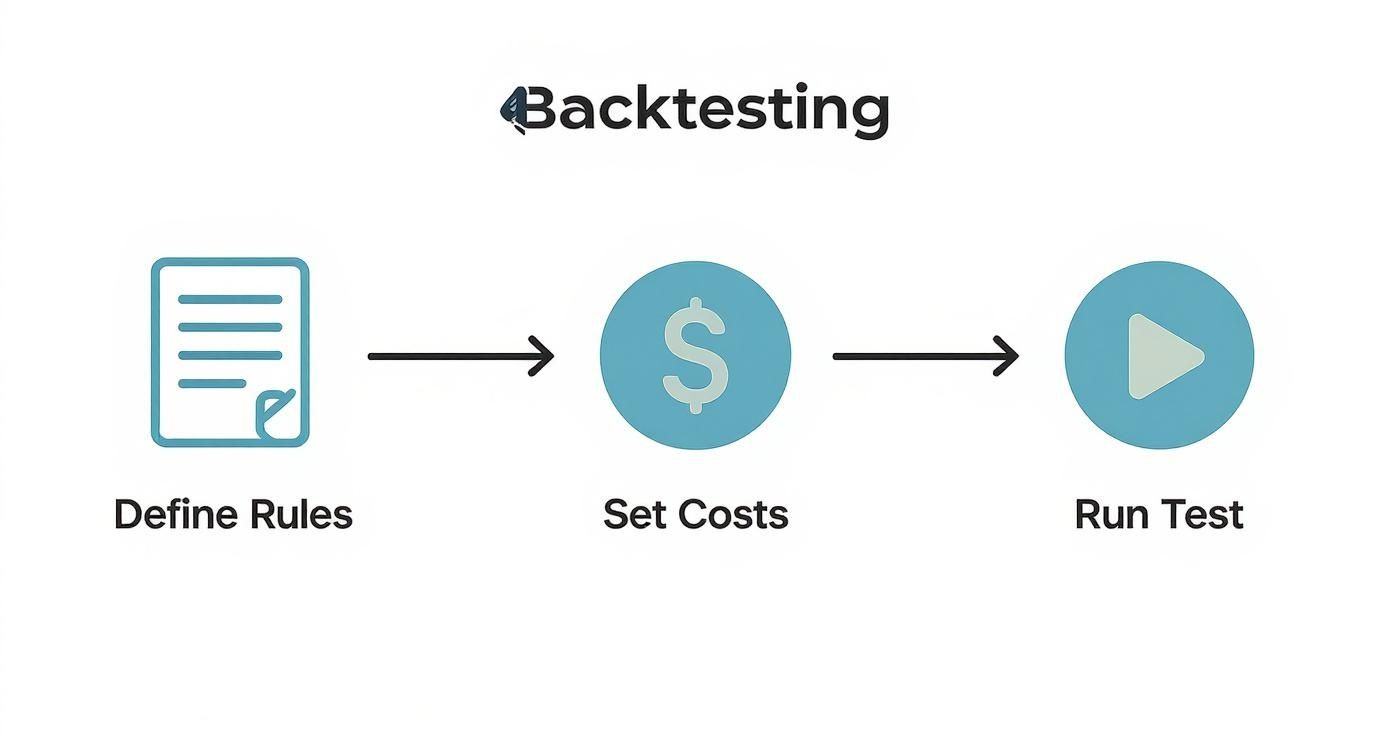
This whole process — defining rules, setting realistic costs, and testing against historical data — is a systematic loop, not a one-and-done task.
Key Metrics Beyond Net Profit
Let’s get into the numbers that reveal a strategy’s true personality. These metrics will tell you if you can psychologically stomach trading the system, especially when it inevitably hits a rough patch.
- Maximum Drawdown: This is the big one. It’s the largest peak-to-trough drop your equity curve experienced, representing the most painful losing streak. If a strategy shows a 35% maximum drawdown, you have to ask yourself: could you honestly stick with it after losing over a third of your account? For most traders, the answer is a hard no. You can learn more about why this “pain metric” is so critical in our deep dive on maximum drawdown.
- Sharpe Ratio: This metric basically asks, “Were the returns worth the risk?” A higher Sharpe Ratio (anything above 1.0 is generally considered decent) means you’re getting more return for the amount of risk you take on. A low ratio, even on a profitable strategy, might signal that the ride is way too choppy and unpredictable for your comfort.
- Profit Factor: This is calculated by dividing your total gross profit by your total gross loss. For example, a profit factor of 2.0 means you made twice as much on your winners as you lost on your losers. Anything above 1.5 suggests a solid edge, while a value under 1.0 means the strategy is losing money.
A backtest doesn’t predict the future, but it prepares you for it. By understanding the worst-case scenarios from the past, you build the discipline to navigate the inevitable drawdowns without panicking.
Key Backtesting Metrics and What They Mean
To truly understand if a strategy fits your trading style, you need to look beyond net profit. The table below breaks down the key performance indicators that give you a complete picture of a strategy’s viability.
| Metric | What It Measures | Why It Matters for a Trader |
|---|---|---|
| Maximum Drawdown | The largest percentage drop from a peak to a subsequent low. | It’s a reality check. Can you emotionally handle this level of loss without abandoning your strategy? |
| Sharpe Ratio | The risk-adjusted return of the strategy. | Tells you if your profits are a result of smart trading or just taking on huge, unsustainable risks. |
| Profit Factor | The ratio of gross profit to gross loss. | A simple measure of your edge. A high number shows your winning trades are overpowering your losing ones. |
| Win Rate | The percentage of trades that were profitable. | Helps manage expectations. A low win rate requires more psychological resilience to endure losing streaks. |
| Average Win/Loss | The average profit on winning trades vs. the average loss on losers. | Works with your win rate to define your expectancy. You can be profitable with a low win rate if your winners are big enough. |
By analyzing these metrics together, you get a 360-degree view of your strategy’s behavior, which is far more valuable than just knowing if it made money in the past.
Building Statistical Significance
A fantastic-looking report is worthless without enough data to back it up. A strategy tested over just a dozen trades might show amazing results purely due to luck.
To get meaningful conclusions, you need a large enough sample size — think 100 to 200 trades at a minimum. It’s also vital to test across different market conditions. How did it perform in a bull market? A bear market? A choppy, sideways market? Seeing how your strategy holds up in various environments tells you if it’s robust or a one-trick pony.
By focusing on these deeper metrics, you stop being a data-scanner and become a data-interpreter. This is how you find a strategy that not only works on paper but, more importantly, aligns with your personal trading psychology.
Avoiding Common and Costly Backtesting Traps

Alright, this is where we get into the stuff that can save you a ton of money and heartache. A gorgeous backtest report is completely worthless if it’s built on a shaky foundation. The traps that blow up a backtest trading strategy are usually subtle, but they are absolutely devastating to your account if you don’t know how to spot them.
We’ve all been there — staring at that perfect, upward-sloping equity curve, thinking we’ve just cracked the code. More often than not, that feeling comes from accidentally creating a strategy that’s perfect for the past but almost guaranteed to fail the moment you put real money behind it. Learning to spot these biases is what separates disciplined systems traders from hopeful gamblers.
The Dangers of Curve-Fitting
Curve-fitting, also known as over-optimization, is the most common pitfall by a long shot. It’s what happens when you keep tweaking your strategy’s parameters until they perfectly match the historical data’s random noise instead of its genuine patterns. You’ve basically forced your strategy to memorize the past, not learn from it.
Imagine you optimize a moving average crossover system and find that a 13-day and a 49-day average gave you the best results over the last five years. The problem? That specific combination is probably just a fluke. Once you go live, the market’s random chatter won’t be the same, and the strategy will quickly unravel.
To fight this, here’s what disciplined traders do:
- Keep It Simple: Strategies with fewer moving parts are almost always more robust. If your strategy relies on a dozen different variables to work, that’s a major red flag for over-optimization.
- Out-of-Sample Testing: Always set aside a chunk of your historical data (say, the most recent 20%) as a final, unseen exam. If your strategy aces the test on the data it was built on but bombs the out-of-sample portion, you’ve likely curve-fit.
A strategy that can’t survive contact with unseen data is a liability, not an asset. The goal is robustness for the future, not perfection in the past.
Unpacking Hidden Biases
Beyond just curve-fitting, there are a couple of other sneaky biases that can completely torch your results. They give you a false sense of confidence by making your strategy look way better than it actually is.
Survivorship Bias is a big one. This creeps in when your backtest uses a dataset that only includes the “survivors” — stocks that didn’t get delisted or go bankrupt. For example, testing a strategy on the current S&P 500 stocks over the past 20 years is a classic mistake. You’re ignoring all the companies that got booted from the index for poor performance, which means your results will be artificially amazing because you’ve filtered out all the losers.
Lookahead Bias is even more subtle. This happens when your backtest accidentally uses information that wouldn’t have been available at the time of the trade. A common example is using the day’s closing price to trigger a buy signal at the market open. You couldn’t have possibly known the closing price that morning. It’s a simple mistake, but one that can make a losing strategy look like an absolute home run.
A Few Common Backtesting Questions
Even with a solid plan, it’s normal to have questions when you start backtesting. We’ve all been there, wondering if we’re using enough data or getting fooled by results that look too good to be true.
Let’s clear up some of the most common hurdles traders run into.
How Much Historical Data Do I Really Need?
There’s no magic number here. The right amount of data comes down to your trading style and how often you trade.
If you’re day trading, a backtest trading strategy might only need two or three years of minute-level data. That’s usually enough to capture thousands of trades and see how your system handles different levels of volatility.
On the other hand, if you’re a long-term swing or position trader, you need a much wider view. For these strategies, you’ll want 10-20 years of daily data. This lets you see how the system weathers multiple full market cycles — the big bull runs, the recessions, and those flat, frustrating periods.
The real goal isn’t just about the time frame, but about getting a statistically significant sample size. You should aim for at least 100-200 trades across a mix of market conditions to feel confident in your results.
My Backtest Profits Are Amazing — Should I Go Live?
Hold on a second. An incredible backtest is a great starting point, but it’s definitely not a green light to start risking real money just yet. The gap between a simulated past and the live market can be surprisingly wide.
Before you do anything else, you need to forward test your strategy, which is also known as paper trading. This means you trade the system in a live market environment with a simulated account for at least a few weeks or months.
This is a critical step. It validates whether your backtested performance holds up against real-time factors like latency and true slippage — things a backtest might not fully capture. More importantly, it’s the ultimate test of your own discipline. Can you execute flawlessly when the pressure is on?
What’s The Difference Between Backtesting and Optimization?
This is a super important distinction that trips up a lot of traders.
- Backtesting is when you test a strategy with fixed, predefined rules on historical data to see how it would have performed. You’re just evaluating a single, specific idea.
- Optimization, however, involves automatically testing hundreds or even thousands of different parameter combinations (like different moving average lengths) to find the one that produced the best results in the past.
While optimization can help fine-tune a strategy, it’s a double-edged sword. If you get too aggressive with it, you can easily “curve-fit” your strategy. This means it’s perfectly tailored to past market noise but is almost guaranteed to fail in live markets. A much safer approach is to backtest the core concept first. Then, you can perform very limited optimization using out-of-sample data just to verify its robustness.
Ready to move from backtesting theory to tracking your real-world performance? TradeReview gives you the tools you need to analyze every trade with precision. Stop guessing and start making data-driven decisions by signing up for your free trading journal today.