Figuring out your profit or loss on a trade seems simple on the surface: just subtract what you paid from what you sold it for. But the real calculation — the one that actually matters to your account balance — needs to include every single cost along the way. We’re talking about commissions, fees, and other expenses that can turn a seemingly profitable trade into a loss.
Understanding this isn’t just about math; it’s about building the discipline required for long-term success.
Why Accurate P&L Is Your Most Important Trading Tool
Before we get into the nitty-gritty formulas, let’s be clear about why mastering this is a non-negotiable skill for any serious trader. This isn’t just about patting yourself on the back after a win. It’s about getting a crystal-clear picture of the true cost and reward of every single trade you take.
Think of accurate P&L not as a chore, but as the bedrock of your entire risk management and strategy development.
So many traders, especially when they’re starting out, experience that frustrating gut punch of seeing a “profitable” trade close on their screen, only to check their account balance and find a different story. That gap almost always comes down to the costs that were conveniently ignored. It’s a common struggle, but overcoming it is a critical step in your trading journey.
Gross P&L vs. Net P&L
The heart of this disconnect is the difference between Gross P&L and Net P&L.
Gross P&L is the simple, first-glance result of a trade before any costs are taken out. It’s that raw, flashy number your platform might show you the second you hit the “close” button.
But Net P&L is the only number that truly matters. It’s the actual cash that gets added to — or taken from — your account after all the dust settles and every expense is paid.
Making this distinction is critical for a few big reasons:
- You Stay Grounded: Knowing your Net P&L cuts through the false confidence of seeing a green number, only to realize later that commissions ate up all your gains.
- You Can Validate Your Strategy: A scalping strategy with lots of small, frequent wins might look amazing on a gross basis. But if trading costs consistently wipe out those tiny profits, the strategy is not viable in the long run.
- You Make Smarter Decisions: Clean, net calculations give you the real data you need to analyze what’s working and what isn’t, helping you tweak your approach with confidence.
Accurate P&L isn’t just about accounting; it’s about intellectual honesty. It forces you to confront the real performance of your strategy, stripping away the illusion of profitability that gross figures can create.
To see what a difference this makes, let’s walk through the numbers. Imagine you buy 100 shares of a stock at $50.00 and sell them moments later at $50.50. Your gross profit looks like a tidy $50.
But what if you paid a $5 commission to open the trade and another $5 to close it? Suddenly, your Net Profit is only $40. Ignoring that $10 difference over hundreds of trades will give you a completely warped view of your performance.
Gross P&L vs. Net P&L: A Quick Comparison
This table breaks down the critical difference between a trade’s surface-level profit (Gross P&L) and the actual money you make or lose after all costs (Net P&L). It’s a simple concept, but internalizing it is what separates disciplined traders from hopeful gamblers.
| Component | Definition | Impact on P&L | Example |
|---|---|---|---|
| Gross P&L | The raw profit or loss from a trade, calculated simply as (Exit Price – Entry Price) x Position Size. | Provides an incomplete, often misleading, picture of profitability. | Buying 100 shares at $10 and selling at $10.50 results in a $50 Gross P&L. |
| Net P&L | The actual profit or loss after subtracting all trading costs, including commissions, fees, and slippage. | Represents the true financial impact on your account. This is the only number that matters. | The same $50 Gross P&L becomes a $40 Net P&L after accounting for $10 in total commissions. |
Ultimately, drilling down to your Net P&L on every single trade builds the discipline required for long-term success. It ensures the feedback you get from your trading is honest, accurate, and truly useful for refining your edge.
Calculating Profit and Loss Across Different Markets
On the surface, calculating profit and loss seems pretty universal. But once you start trading different markets, you quickly realize the formulas aren’t one-size-fits-all. A simple stock trade is calculated differently than a forex pair or an options contract.
Nailing these nuances is absolutely critical. It’s the only way to accurately track your performance and avoid making some painful, costly mistakes down the line.
Let’s break down exactly how to calculate your P&L with clear, practical examples for the most common markets you’ll encounter. Think of this as your go-to guide for turning price charts and market movements into real, concrete numbers.
At its core, every P&L calculation follows the same simple journey.
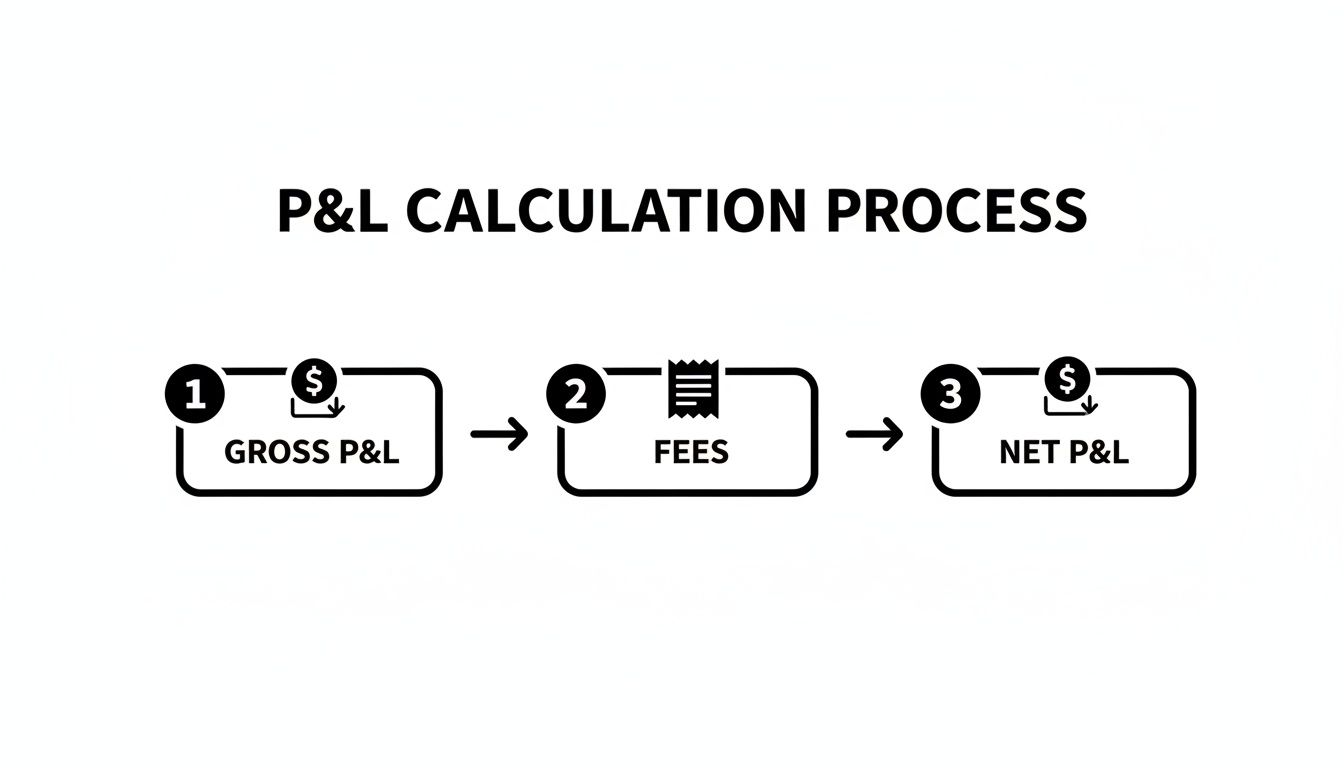
This visual is a great reminder of the process: you start with the surface-level outcome (Gross P&L) and subtract all the costs to find the true financial impact on your account (Net P&L).
Stocks P&L for Long and Short Positions
Calculating P&L for stocks is the most straightforward place to start. The math revolves around just a few things: your entry price, your exit price, and how many shares you traded. Of course, you have to account for whether you were buying (going long) or short selling.
For a standard long position — where you buy shares hoping the price goes up — the formula is simple:
Net P&L = ((Sell Price per Share – Buy Price per Share) x Number of Shares) – Total Fees
Let’s walk through a practical example. Imagine you buy 100 shares of company XYZ at $150 per share and later sell them all at $155. Your commission to get into the trade was $5, and it cost another $5 to get out.
- Gross Profit: ($155 – $150) x 100 shares = $500
- Total Fees: $5 (buy) + $5 (sell) = $10
- Net Profit: $500 – $10 = $490
For a short position — where you sell borrowed shares hoping the price drops — the logic is just flipped:
Net P&L = ((Short Sell Price per Share – Buy to Cover Price per Share) x Number of Shares) – Total Fees
Say you short 50 shares of company ABC at $80 and then buy them back (or “cover” your short) when the price falls to $75. Again, let’s assume your total fees are $10.
- Gross Profit: ($80 – $75) x 50 shares = $250
- Total Fees: $5 (sell) + $5 (buy to cover) = $10
- Net Profit: $250 – $10 = $240
In both scenarios, forgetting about that $10 in fees would give you a misleading picture of your actual earnings. Getting into the habit of always subtracting costs is a non-negotiable discipline for successful trading.
Demystifying Options P&L
Options trading brings a few new variables into the mix: the premium (the price of the contract), the contract multiplier, and whether you’re trading calls or puts. It’s vital to remember that every standard stock option contract in the U.S. controls 100 shares of the underlying stock. That detail is everything.
When you buy a call option, you’re betting the stock price will rise.
Net P&L = ((Sell Premium – Buy Premium) x 100) – Total Fees
Let’s say you buy one call option contract for a $2.50 premium. The stock moves in your favor, and you’re able to sell that same contract for a $4.00 premium. Let’s say commissions and fees for the round trip trade total $2.
- Gross Profit: ($4.00 – $2.50) x 100 = $150
- Total Fees: $2
- Net Profit: $150 – $2 = $148
When you buy a put option, you’re betting the stock price will fall. The calculation is exactly the same. If you bought a put for a $3.00 premium and it expired worthless (meaning the premium went to $0), your loss is simple to figure out.
- Gross Loss: ($0 – $3.00) x 100 = -$300
- Net Loss: -$300 – $2 (fees) = -$302
That x 100 multiplier is the single most common trip-up for new options traders. Always, always remember that the premium you see quoted is on a per-share basis. You have to multiply it by 100 to get the real dollar value of the contract.
Tackling Forex P&L
At first glance, forex P&L calculations can feel a bit intimidating with all the talk of pips, lots, and quote currencies. But the logic underneath it all is the same as any other market. A “pip” is simply the smallest price move a currency pair can make, and the dollar value of that pip depends on your trade size (your lot).
Here’s the general formula to find your P&L in the quote currency (that’s the second currency in the pair):
P&L = (Exit Price – Entry Price) x Lot Size x Contract Size
Let’s look at a trade on the EUR/USD pair. The standard contract size is 100,000 units of the base currency (EUR). You decide to buy 1 standard lot (100,000 units) at an exchange rate of 1.0750.
You close your position after the rate climbs to 1.0780. The price moved 30 pips in your favor (1.0780 – 1.0750 = 0.0030).
- Profit in USD: (1.0780 – 1.0750) x 1 x 100,000 = $300
That $300 is your gross profit. From there, you’d subtract any commissions or swap fees your broker charges to find your final net P&L. Forgetting to convert those pip movements into a concrete dollar value is a surefire way to misjudge how well you’re actually trading.
Accounting for the Hidden Costs of Trading
A profitable trade on paper can easily flip to a net loss once you factor in the small, often-overlooked fees that chip away at your gains. This is a tough lesson many new traders learn the hard way. It’s also where disciplined, professional traders separate themselves from the crowd — by meticulously accounting for every single expense, no matter how small.
Ignoring these costs is like trying to navigate without a complete map. You might be moving, but you don’t really know where you’re heading financially. Let’s break down the most common hidden costs that can eat into your true profitability.

Broker Commissions and Fees
This one’s the most obvious cost, but its impact is still frequently underestimated. Whether your broker charges a flat fee per trade or a per-share commission, these costs apply to both opening and closing a position.
Think about a scalping strategy where you’re aiming for a tiny $20 gross profit per trade. If your round-trip commission is $10, half of your profit is gone before you even see it. Over hundreds of trades, this can be the single factor that makes or breaks your entire strategy.
The Impact of Slippage
Slippage is one of the more frustrating and less obvious trading costs. It’s the gap between the price you expected when you clicked the buy or sell button and the price at which your order actually filled.
This happens all the time in fast-moving, volatile markets or with less liquid assets. You might place a buy order for a stock at $10.00, but by the time your order hits the exchange, the best available price is $10.02. That two-cent difference seems insignificant, right? But on a 1,000-share trade, that’s $20 of instant, invisible cost.
Slippage usually boils down to a few factors:
- High Volatility: Major news events can cause prices to jump so quickly that your order can’t get filled at the intended price.
- Low Liquidity: In markets with few buyers and sellers, you might have to accept a worse price just to get your order executed.
- Wide Bid-Ask Spreads: This is the difference between the highest price a buyer will pay and the lowest price a seller will accept. A wide spread is an inherent cost you pay on every single round-trip trade. To get a better handle on this, you can learn more about what the bid-ask spread is and how it affects your P&L.
The most dangerous costs are the ones you don’t see on your statement. Slippage and spreads are silent killers of profitability, turning seemingly good trades into break-even or losing ones without you even realizing it until you analyze the data.
Financing Costs for Leveraged Positions
If you’re trading with leverage — using borrowed money from your broker — you’re introducing a whole new set of costs. These are essentially interest payments for the capital you’re using.
- Margin Interest: For stock traders holding positions overnight on margin, your broker will charge you interest on the borrowed amount. While the daily rates are low, they compound over time and can become a significant drag on long-term holds.
- Swap or Rollover Fees: In forex, holding a position past the market’s closing time (usually 5 PM ET) incurs a “swap fee.” This fee is based on the interest rate differential between the two currencies in the pair and can be either a charge or a credit, depending on which way you’re trading.
Let’s put this into a practical scenario. You buy 200 shares of XYZ at $50 on margin and sell them two months later for $55. Your gross profit is a clean $1,000. But wait — your broker charges an 8% annual interest rate on the $10,000 you borrowed.
Over those two months, that interest adds up to roughly $133. Throw in $10 for commissions, and your net profit is actually $857, not $1,000. If you overlook these financing costs, you’ll get a completely warped view of how your leveraged strategy is truly performing. Mastering how to calculate profit and loss means being brutally honest about every single one of these expenses.
Realized vs. Unrealized P&L: What Really Matters
It’s easy to get mesmerized by the flashing green numbers on your screen. We’ve all been there. But it’s critical to understand the massive difference between the money you could have and the money you actually have in your account.
This is the core distinction between realized and unrealized profit and loss (P&L).
An unrealized P&L is simply the “paper” profit or loss on your open positions. It’s a hypothetical number, constantly shifting with the market, showing what you’d make or lose if you closed the trade right now. It feels real, but it isn’t yours yet.
A realized P&L, on the other hand, is the real deal. It’s the profit or loss that gets locked in once you’ve officially closed a position. This is the only number that truly matters because it’s the money that gets added to or subtracted from your account balance.
The Psychological Traps of Unrealized Gains
Fixating on unrealized P&L is a dangerous psychological game. You watch a trade go deep into the green, and that unrealized profit just keeps climbing. This is where emotion often hijacks logic.
Greed kicks in. You start thinking, “Just a little bit more,” and completely abandon your original exit plan. More often than not, this leads to watching a fantastic trade turn into a mediocre one — or even a loss — all because you got caught up in potential instead of sticking to your plan.
The flip side is just as damaging. Staring at a mounting unrealized loss can trigger raw fear, causing you to panic-sell at the worst possible moment, often right before the market was about to turn in your favor.
A profit is just a number on a screen until you hit the close button. Discipline means treating unrealized gains as part of the process, not the outcome, and sticking to your predefined exit strategy.
Developing a disciplined mindset means separating your decision-making from these fluctuating paper gains. The goal is to execute your strategy flawlessly, not to chase a fleeting number on a screen.
Practical Implications for Taxes and Analysis
Beyond the mental game, this distinction has serious, real-world consequences, especially for taxes. For the most part, tax authorities only care about your realized gains.
- Taxable Events: You only pay taxes on profits you have actually “realized” by selling an asset. An open position with a huge unrealized gain has zero tax implications until you close it.
- Strategic Exits: This allows for smart tax planning. For instance, a trader might decide to hold a winning trade until the next calendar year to defer the tax liability.
According to guidance from tax authorities like the IRS in the United States, only realized transactions affect your taxable income for the year. This is fundamental to proper tax reporting.
Ultimately, a deep understanding of realized versus unrealized P&L builds the foundation for long-term thinking. It reinforces that trading success isn’t about the momentary thrill of a winning position. It’s about the consistent execution of a strategy that generates real, tangible profits over time.
It’s about what you take home, not what the market temporarily offers. For a closer look at how these numbers fit into the bigger picture, check out our guide on how to calculate return on investment.
Using P&L Data to Refine Your Trading Strategy
Knowing how to calculate profit or loss on a single trade is just the starting point. It’s the first step on a much longer journey. We’ve all felt the sting of a losing streak or the thrill of a big win, but feelings don’t improve performance — data does. Real growth as a trader comes from stepping back and analyzing your P&L data over time to see the story it tells about your strategy.
This is the shift from being a reactive trader, swayed by every market twitch and emotion, to a proactive one who makes data-driven decisions. By turning your raw P&L numbers into meaningful metrics, you can finally see if you have a genuine edge or if you’ve just been lucky.
Key Metrics Your P&L Data Reveals
Your trading journal is an absolute goldmine. Once you’ve logged a decent sample size of trades — say, 50 to 100 — you can start digging in and calculating a few key performance indicators (KPIs) that reveal the true health of your strategy. Let’s break down the most critical ones.
Win Rate
This is the simplest metric, but it’s probably the most misunderstood. It’s just the percentage of your trades that closed for a profit.
Win Rate = (Number of Winning Trades / Total Number of Trades) x 100
A high win rate feels great, but it means very little on its own. Some traders have strategies with a 90% win rate that slowly bleed an account dry because the 10% of losing trades are catastrophic. On the flip side, some profitable trend-following systems have win rates below 40%, but they succeed because their winners are massive compared to their losers.
Average Win vs. Average Loss
This is where the story really gets interesting. This metric gives your win rate crucial context by comparing the average size of your winning trades to the average size of your losing ones.
Here’s how you get those numbers:
- Average Win: Total Profit from All Winning Trades / Number of Winning Trades
- Average Loss: Total Loss from All Losing Trades / Number of Losing Trades
This comparison is a direct reflection of your executed risk/reward ratio. If your plan is to aim for a 3:1 risk/reward on every trade (risking $1 to make $3), then your average win should be somewhere around three times your average loss. If it’s not, it’s a massive red flag. It tells you that you’re either cutting winners short or letting losers run too far — two of the most classic trading mistakes.
The goal isn’t just to be right; it’s to make more money when you’re right than you lose when you’re wrong. Analyzing your average win versus loss is the first step in diagnosing whether you’re actually doing that.
Let’s imagine after 100 trades, you have a 50% win rate. Your average winning trade is $300, and your average losing trade is $100. That’s a healthy, sustainable system. Now, what if your average win is only $110 and your average loss is $100? Your strategy is barely profitable, even though you’re right half the time. After commissions and slippage, you’re almost certainly losing money.
The All-Important Profit Factor
If you could only track one metric to gauge your strategy’s health, this would be it. The Profit Factor neatly summarizes your overall profitability in a single number by comparing total profits to total losses.
The formula is dead simple:
Profit Factor = Gross Profit (from all winning trades) / Gross Loss (from all losing trades)
Any Profit Factor above 1.0 means your strategy is profitable. A Profit Factor of 2.0, for instance, means you make $2 for every $1 you lose. Many traders look for a Profit Factor of 1.5 or higher after a solid number of trades to feel confident in a strategy’s robustness. A value below 1.0 means you’re digging a hole.
Connecting the Dots to Your Strategy
These metrics aren’t just numbers on a screen; they are direct feedback on your trading plan. If your Profit Factor is 0.8, something is fundamentally broken. Is your win rate too low for your risk/reward? Or are your average losses just wiping out all your hard-earned wins?
This is the point where you put on your analyst hat.
- Filter Your Data: Start slicing up your performance. Look at your results by setup, time of day, or asset. You might discover you’re highly profitable trading morning breakouts but give it all back trying to trade afternoon reversals.
- Review Your Risk Management: Is your actual, executed risk/reward matching what you planned? If not, why? Are you moving your stop-loss orders prematurely or snatching profits too early out of fear?
- Refine and Test: Use these insights to make small, specific tweaks to your trading plan. This analytical process is the core of what professionals do. You can learn more about this disciplined approach in our guide to backtesting trading strategies, which shows you how to use historical data to validate changes before putting real capital on the line.
Ultimately, learning how to calculate profit and loss is just the first step. The real skill lies in using that data to ask the right questions and get honest answers about your trading. This disciplined, long-term approach is what builds a lasting edge in the markets.
Common Questions About P&L Calculations
Once you get the hang of the core mechanics of calculating profit and loss, a few specific questions almost always surface. That’s totally normal. Every trader has been there, and getting these details right is a huge part of building the discipline you need for long-term consistency.
Let’s dig into some of the most common hangups traders face. We’ll give you straight answers to help you lock in your understanding and sidestep some classic mistakes.
What’s the Simplest Way to Calculate P&L for a Stock Trade?
For a straightforward stock trade, the best formula is the one that accounts for all your costs right from the start. This is a big one. Overlooking fees is probably the number one reason traders think they’re more profitable than they are, leading to that frustrating moment when their account balance just doesn’t add up.
The only formula you really need is:
Net P&L = ((Sell Price – Buy Price) x Number of Shares) – Total Fees
That ‘Total Fees’ part is everything. It has to include the commissions and any transaction costs for both buying and selling the stock. Get in the habit of thinking about “round-trip” costs, and you’ll always have a true picture of your profitability.
How Do I Figure Out My Total Portfolio P&L with Open Positions?
To get a real-time snapshot of your account’s health, you need to look at both your closed and open trades together. This combines the cash you’ve already banked with the “paper” gains or losses you’re currently sitting on.
It breaks down into two key parts:
- Realized P&L: This is the cold, hard cash. It’s the sum of profits and losses from every trade you’ve officially closed out.
- Unrealized P&L: This is the “what if” number. It’s the sum of the current profits and losses on all your currently open positions.
Your total portfolio P&L is just those two numbers added together: Total Portfolio P&L = Sum of Realized P&Ls + Sum of Unrealized P&Ls. Just remember, that unrealized part is a moving target — it changes with every tick of the market, so it’s a dynamic number, not a final one.
Your portfolio P&L gives you a great holistic view of where you stand right now. But true, repeatable success is measured by the steady growth of your realized P&L over time. That’s what proves you can execute a strategy and lock in your gains.
Why Doesn’t My Broker’s P&L Match My Own Math?
This is an incredibly common source of confusion, but there’s usually a simple explanation. It often comes down to timing, definitions, or what costs the broker chooses to display on their main screen. It’s rare for the broker to be flat-out “wrong,” but their real-time display might not be showing you the full picture you need.
Here are the usual suspects for any discrepancy:
- Timing of the Calculation: Some broker platforms calculate the daily P&L on your open trades based on the previous day’s closing price, not the live, up-to-the-second market price you might be using for your own math.
- Fees Aren’t Included Yet: Many platforms have a “real-time P&L” window that shows your gross profit or loss. It often doesn’t factor in commissions, exchange fees, or financing costs until after the trade is fully settled in your account.
- Mark-to-Market vs. Trade Price: This is especially true for options and futures. The P&L shown might be based on the “mark” price (the midpoint between the bid and ask), which isn’t necessarily the actual price you could get if you closed the position that second.
When in doubt, your official monthly and yearly statements from your broker are your source of truth. Those documents have the final, all-inclusive numbers for tax purposes and deep performance analysis because they account for every single settled transaction and fee.
Stop guessing and start analyzing. TradeReview provides the tools you need to automatically sync your trades, track every cost, and gain powerful insights into your strategy’s performance. Move from emotional trading to data-driven decision-making today by signing up for free.