Every trader starts the journey looking for that one perfect system, the so-called ‘holy grail’ that promises consistent profits. The hard truth, however, is that the best strategy for trading isn’t a universal secret formula. It’s the one that meticulously aligns with your unique personality, available time, capital, and tolerance for risk. We’ve all been there — cycling through popular strategies seen on social media, from high-frequency scalping to complex options plays, without a foundational understanding of whether the approach even fits our goals. This often leads to frustration, emotional decisions, and the painful experience of watching your capital dwindle.
This guide is designed to break that cycle. We are not here to promise “guaranteed profits” or a one-size-fits-all solution. Instead, our goal is to provide a clear, empathetic breakdown of ten distinct trading and investing methodologies. We will dissect everything from long-term value investing and systematic dollar-cost averaging to active approaches like swing trading and intraday scalping.
For each strategy, we will present the core logic, practical examples, and crucial risk management considerations. You’ll gain the necessary perspective to identify which frameworks resonate with your personal trading style. The ultimate aim is to empower you to move beyond the hype and build a disciplined, sustainable trading plan that is customized for you. By understanding the mechanics and demands of each approach, you can finally stop searching for a magic bullet and start deliberately building your own consistent edge in the market.
1. Trend Following (Momentum Trading)
Trend following is a cornerstone strategy built on a simple yet powerful premise: markets that are moving in a particular direction are likely to continue doing so. Instead of trying to predict tops or bottoms, a trend follower identifies an established trend and rides it for as long as it lasts. The philosophy is captured in the old trading adage, “the trend is your friend,” making it a popular choice for traders looking for the best strategy for trading in clear market environments. This approach relies on technical indicators to confirm the direction and strength of a trend, with the goal of capturing significant gains from major market moves.

How It Works
The core of trend following is identifying an asset in a sustained uptrend (making higher highs and higher lows) or a downtrend (lower highs and lower lows) and entering a position in that same direction. Traders often use tools like moving averages to smooth out price action and clarify the underlying trend. For example, a common signal is a “golden cross,” where a shorter-term moving average (like the 50-day) crosses above a longer-term one (like the 200-day), suggesting bullish momentum. You can learn more about how to effectively use moving averages to enhance your trend-following strategy.
Practical Implementation
- Entry Signal: For a practical example, imagine the SPY ETF (which tracks the S&P 500) has been trading above its 200-day moving average for weeks. You could enter a long position when its shorter-term 20-day moving average also crosses above the 50-day average, confirming short-term momentum aligns with the long-term trend.
- Risk Management: This is where discipline is critical. Place an initial stop-loss below a recent swing low or use a volatility measure like the Average True Range (ATR). A trailing stop is a trend follower’s best friend — it allows you to let profits run while automatically protecting gains as the trend progresses. Without it, you might exit too early and miss the biggest part of the move.
- Best For: This strategy shines in markets with strong, directional bias, such as a bull market in tech stocks or a bear market in a specific currency pair. It is less effective in choppy, range-bound markets where trends are weak, and can lead to a series of small, frustrating losses. Patience is key.
2. Mean Reversion
Mean reversion operates on the statistical principle that asset prices tend to return to their historical average or mean over time. Unlike trend following, which assumes momentum will continue, this strategy identifies extreme price movements and bets on a “snap-back” to normalcy. The core idea is that assets can become temporarily overbought or oversold, and this strategy aims to profit from the correction. Finding the best strategy for trading often involves understanding when to follow a trend and when to anticipate a reversal, making mean reversion a powerful counter-trend approach.
How It Works
The essence of mean reversion is to “buy low and sell high” by identifying when an asset has deviated significantly from its typical price range. Traders use statistical tools like Bollinger Bands (which measure price volatility around a moving average) or the Relative Strength Index (RSI, a momentum oscillator) to spot these overextended conditions. For example, a price touching the upper Bollinger Band might be considered overbought and a candidate for a short position, while an RSI reading below 30 suggests an asset is oversold and may be due for a rebound. This disciplined, data-driven method helps traders avoid chasing momentum at market peaks.
Practical Implementation
- Entry Signal: Let’s say stock XYZ, which normally trades between $45 and $55, suddenly drops to $42 after some negative news. If its RSI is below 30 and its price is below the lower Bollinger Band, a mean reversion trader might enter a long position, anticipating a return toward its average price of $50.
- Risk Management: Trading against momentum is risky, so discipline is non-negotiable. Place a tight stop-loss just outside the identified extreme (e.g., slightly below the recent low for a long trade). The greatest danger is that what looks like an overextension is actually the start of a new, powerful trend against you.
- Best For: This strategy is most effective in range-bound or sideways markets where prices oscillate without a strong directional bias. It works well on assets that exhibit clear mean-reverting behavior, such as certain currency pairs or in pairs trading scenarios. It is less suitable for strongly trending markets where “buying the dip” can become a costly mistake.
3. Swing Trading
Swing trading is a medium-term approach that aims to capture gains from price “swings” over several days to several weeks. Unlike day traders who close positions daily or trend followers who may hold for months, swing traders seek to profit from the intermediate price movements within a broader market trend. They analyze technical patterns, volatility, and market sentiment to identify opportune entry and exit points, making it a well-regarded candidate for the best strategy for trading for those who cannot monitor markets minute-by-minute. The goal is to capture a chunk of a potential price move and then move on to the next opportunity.
How It Works
The essence of swing trading is identifying probable turning points where a price swing is likely to begin or end. Traders use technical analysis tools like support and resistance levels (historical price floors and ceilings), moving averages, and chart patterns (such as head-and-shoulders or flags) to pinpoint these areas. For example, a trader might identify a stock in a long-term uptrend that has temporarily pulled back to its 50-day moving average, viewing this as a potential low-risk entry point to ride the next swing higher. The strategy relies on capturing higher probability moves rather than predicting exact market tops or bottoms.
Practical Implementation
- Entry Signal: Imagine a stock like META is in a clear uptrend but has pulled back from $500 to $470, where it finds support at its 50-day moving average. A swing trader might wait for a bullish confirmation (like a strong green candle) at that level to enter a long position.
- Risk Management: Place a stop-loss order just below the recent swing low or the key support level you used for your entry. Profit targets should be set near the next significant resistance level, aiming for a risk-to-reward ratio of at least 1:2. The discipline to take profits and not get greedy is as important as cutting losses.
- Best For: This strategy is ideal for traders with patience who can hold positions overnight and through several days of market noise. It functions well in moderately volatile markets where clear swing points are identifiable, but it can be challenging in extremely choppy or flat market conditions.
4. Value Investing
Value investing is a fundamental analysis strategy centered on identifying assets trading for less than their calculated intrinsic worth. Popularized by legendary figures like Benjamin Graham and Warren Buffett, this approach operates on the belief that market prices can temporarily deviate from a company’s true long-term value. A value investor’s goal is to purchase these undervalued securities with a “margin of safety” and hold them patiently, waiting for the market to recognize their actual worth. It’s a time-tested approach that prioritizes long-term thinking over short-term market noise.

How It Works
The core of value investing involves deep fundamental research to determine a company’s intrinsic value, independent of its current stock price. This is often done using methods like a Discounted Cash Flow (DCF) analysis, which projects a company’s future earnings and discounts them back to the present to estimate what the business is worth today. If the calculated intrinsic value is significantly higher than the market price, the stock is considered a potential buy. The difference between the intrinsic value and the purchase price provides the margin of safety, which is crucial for mitigating risk.
Practical Implementation
- Entry Signal: Suppose a financially sound company with a strong history of profits sees its stock price drop due to a short-term market panic. After analysis, you determine its intrinsic value is $100 per share, but it’s currently trading at $70. Buying at this price gives you a 30% margin of safety. This is your entry signal.
- Risk Management: The primary risk management tool is the margin of safety. Diversification across undervalued assets in different industries is also key. Unlike technical strategies, stop-losses are used less frequently; instead, the investment thesis is re-evaluated if a company’s fundamental outlook deteriorates. The biggest risk is a “value trap” — a stock that is cheap for a very good reason.
- Best For: This strategy is ideal for investors with a long-term horizon and the patience to wait for their thesis to play out, which can take years. It thrives in markets where fear or short-term thinking creates mispricing opportunities, such as during bear markets or industry-specific downturns.
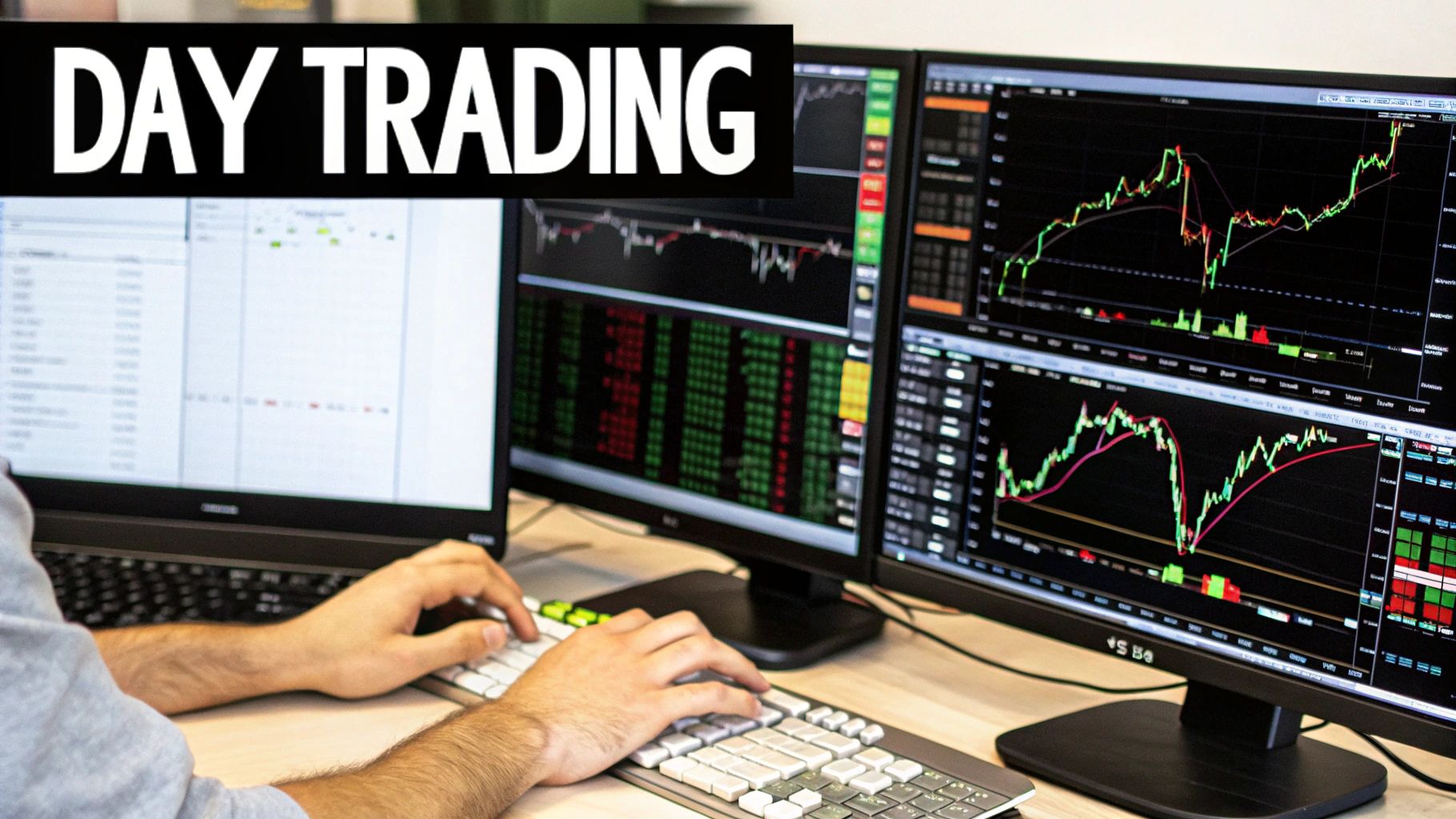
5. Day Trading (Intraday Trading)
Day trading, also known as intraday trading, is a high-frequency strategy where traders open and close all positions within the same trading day. The core objective is to capitalize on small price movements and intraday volatility, avoiding any overnight risk. This approach demands intense focus and a deep understanding of short-term market dynamics, making it one of the most challenging paths in trading. Success often hinges on extreme discipline, speed, and meticulous risk management, as the struggle against commissions and emotional pressure is constant.
How It Works
Day traders rely heavily on technical analysis, chart patterns, and real-time news to make rapid decisions. Strategies can range from scalping, where dozens of trades are made for tiny profits, to trading specific events like economic announcements or opening-range breakouts. The fundamental rule is that no position is held overnight, which eliminates exposure to after-hours news or gap risk. Traders often use lower time-frame charts (e.g., 1-minute, 5-minute) to identify entry and exit points with precision, aiming for a high win rate or a favorable risk-reward ratio on each trade.
Practical Implementation
- Entry Signal: A common setup is the “opening range breakout.” A day trader might watch a highly liquid stock like NVDA for the first 15 minutes of trading. If the price then decisively breaks above the high of that range on high volume, they might enter a long position, anticipating continued momentum.
- Risk Management: This is paramount. A hard stop-loss is placed just below the midpoint or low of the opening range. A profit target is set based on a predefined risk-reward ratio, such as 2:1. The discipline to honor the stop-loss immediately, without hope, is what separates successful day traders from the rest.
- Best For: This strategy is suited for disciplined traders who can dedicate several hours of uninterrupted focus during market hours. It thrives on assets with high liquidity and volatility, such as major forex pairs (EUR/USD), popular stocks, or index futures. It is not for the faint of heart and requires a long-term commitment to mastering one or two specific setups.
6. Breakout Trading
Breakout trading is a strategy centered on identifying key price levels, such as support or resistance, and entering a trade when the price moves decisively through them. The core idea is that a break of a significant level signifies a shift in market sentiment, often triggering a strong momentum move in the direction of the breakout. This approach is highly valued by technical analysts who use chart patterns to anticipate these explosive moves, making it a compelling candidate for the best strategy for trading in markets consolidating before a major catalyst.
How It Works
A breakout trader first identifies a consolidation pattern, like a triangle, flag, or a well-defined trading range marked by clear support and resistance. They then wait for the price to close firmly above resistance (for a long trade) or below support (for a short trade), preferably accompanied by a surge in trading volume. This volume confirmation is crucial as it suggests strong conviction behind the move, reducing the odds of a “false breakout” where the price quickly reverses. The strategy aims to capture the initial, often powerful, thrust of momentum as the new trend begins.
Practical Implementation
- Entry Signal: Imagine a stock has been trading between $90 and $100 for two months. A breakout trader would set an alert at $100. If the stock closes a daily candle at $101 on volume that is at least 1.5 times its daily average, this confirms the breakout and serves as the entry signal.
- Risk Management: Place a stop-loss just below the broken resistance level (which should now act as support), for instance, at $99. This provides a clear, logical exit point if the breakout fails — a common and frustrating occurrence. An initial profit target could be set based on the height of the preceding range ($10), projected from the breakout point to $110.
- Best For: This strategy excels in volatile markets and with assets that tend to consolidate before making large directional moves, such as high-growth tech stocks or cryptocurrencies. It is less effective in low-volatility, meandering markets where false breakouts are common.
7. Arbitrage & Statistical Arbitrage
Arbitrage is a market-neutral strategy that aims to capture profits from pricing inefficiencies between identical or related financial instruments. The core idea is to simultaneously buy and sell an asset to capitalize on a price difference, theoretically locking in a low-risk profit. While pure arbitrage opportunities are rare and fleeting for retail traders, its more complex cousin, statistical arbitrage, uses quantitative models to find probable pricing discrepancies. These strategies are highly sophisticated and rely on technology and speed.
How It Works
Traditional arbitrage involves buying an asset in one market while simultaneously selling it in another where the price is higher. For example, if a stock trades for $100.00 on the NYSE and an equivalent of $100.05 on a European exchange, an arbitrageur could buy on the NYSE and sell in Europe for a 5-cent profit per share. Statistical arbitrage, or “stat arb,” is more common today. It uses algorithms to identify historically correlated assets whose prices have temporarily diverged. A classic example is pairs trading — shorting an outperforming stock while going long on its underperforming, correlated peer, betting that their prices will eventually converge back to their historical mean.
Practical Implementation
- Entry Signal (Pairs Trading): A quant trader might notice that shares of Coke and Pepsi, which historically move together, have diverged. If Pepsi’s stock is up 5% for the month while Coke’s is flat, the model might signal to short Pepsi and buy Coke, betting the historical relationship will resume.
- Risk Management: The primary risks are execution-related and model-based. A price gap can close before your trade is filled, turning a profit into a loss. For statistical arbitrage, the main risk is that the historical relationship between assets breaks down permanently. Rigorous backtesting and strict risk controls are non-negotiable.
- Best For: These strategies are best suited for quantitative traders with access to high-speed execution platforms, sophisticated modeling software, and significant capital. They thrive on precision and speed, often in markets where pricing data is complex, such as derivatives, currencies, or large-cap equities with multiple listings.
8. Options Strategies (Covered Calls, Iron Condors, Spreads)
Options strategies offer a versatile way to trade by using contracts that give the holder the right, but not the obligation, to buy or sell an asset at a set price. Instead of just betting on direction, options allow traders to profit from time decay (theta), volatility changes (vega), or specific price ranges. This makes them a powerful tool for generating income, hedging risk, or making speculative plays with defined risk. These strategies, from simple covered calls to complex iron condors, provide a level of flexibility that pure stock trading cannot match.
How It Works
Options trading involves combining different contracts (calls and puts) with various strike prices and expiration dates to create a specific risk-reward profile. For example, a covered call involves owning at least 100 shares of a stock and selling a call option against it to generate income. An iron condor is a more advanced, non-directional strategy where a trader sells both a call spread and a put spread, profiting if the underlying asset stays within a specific price range. You can explore a variety of these setups to deepen your understanding of options trading strategies.
Practical Implementation
- Entry Signal (Bull Put Spread): Suppose you believe Apple (AAPL) stock, currently at $170, will stay above $165 for the next month. You could sell a put option with a $165 strike price and simultaneously buy a put with a $160 strike price (as protection). You receive a net credit for this trade, and as long as AAPL stays above $165, you keep the entire premium as profit.
- Risk Management: The beauty of spreads is their built-in risk management. Your maximum loss is predefined when you enter the trade. In the bull put spread example, the maximum loss is the difference between the strike prices minus the premium you received. It is crucial to manage positions before expiration to avoid unwanted assignment.
- Best For: Options are incredibly adaptable. Income strategies like covered calls and cash-secured puts work well for long-term investors. Directional spreads are great for traders with a clear market view but defined risk tolerance. Volatility strategies like iron condors are best when you expect the market to stay in a tight range.
9. Dollar-Cost Averaging (DCA)
Dollar-Cost Averaging (DCA) is a disciplined investment strategy that removes emotion and market timing from the equation. The approach involves investing a fixed amount of money at regular intervals, regardless of the asset’s price. By consistently buying, you purchase more shares when prices are low and fewer shares when prices are high, potentially lowering your average cost per share over time. This makes DCA a powerful and less stressful method for long-term investors. It’s a testament to the power of consistent, disciplined action over time.
How It Works
The core principle of DCA is consistency over timing. Instead of attempting to buy at the absolute bottom — a nearly impossible task — an investor commits to a schedule, for instance, investing $500 on the first day of every month. This systematic process mitigates the risk of deploying a large sum of capital at a market peak. Over time, the strategy smooths out the impact of volatility, turning market downturns into opportunities to acquire more shares at a discount. It transforms market fluctuations from a source of anxiety into a mechanism for building a position at an attractive average price.
Practical Implementation
- Entry Signal: The “signal” is simply the date on the calendar. An investor decides to automatically buy $200 worth of a low-cost S&P 500 index fund like VOO on the 15th of every month. The purchase is executed automatically, irrespective of market conditions. This removes the temptation to “wait for a better price.”
- Risk Management: The primary risk management is built into the strategy itself by diversifying entry points over time. Since this is a long-term accumulation strategy, traditional stop-losses are not used. The risk is managed by focusing on fundamentally sound, diversified assets and maintaining a long-term perspective through market cycles.
- Best For: DCA is ideal for long-term investors building positions in broad market ETFs, index funds, or blue-chip stocks. It is especially effective for those who receive regular income, like from a paycheck, and want to build wealth methodically. This approach is less suitable for short-term traders seeking to capitalize on rapid price movements.
10. Algorithmic & Quantitative Trading
Algorithmic and quantitative trading leverages mathematical models and automated systems to execute trades, removing human emotion and enabling high-speed, data-driven decisions. This approach treats trading as a science, using statistical analysis and computational power to find and exploit market inefficiencies. The core idea is that historical data, when analyzed correctly, can reveal patterns and relationships that predict future price movements. It’s the pinnacle of systematic, disciplined trading.
How It Works
Quantitative, or “quant,” trading begins with a hypothesis about market behavior, which is then translated into a mathematical model. This model is rigorously tested against historical data to verify its potential profitability and risk profile — a process known as backtesting. If the model proves robust, it is coded into a computer algorithm that automatically scans markets, identifies opportunities, and executes trades according to its predetermined rules. Examples range from high-frequency arbitrage algorithms that profit from tiny price discrepancies to machine learning models that analyze news sentiment.
Practical Implementation
- Entry Signal: An algorithm could be programmed to buy a cryptocurrency like ETH when its price crosses above its 20-period moving average on the 1-hour chart, but only if social media sentiment (measured by a data feed) is also positive. The computer executes the trade instantly when both conditions are met.
- Risk Management: Rules are hard-coded into the system. For instance, the algorithm might automatically close a position if it loses 1% or if market volatility, measured by the VIX index, spikes above a set level. This enforces a level of discipline that human traders often struggle to maintain under pressure.
- Best For: This strategy is suited for traders with a strong background in statistics, computer science, and finance. It thrives in liquid, electronically traded markets where massive datasets are available. Effective strategy development relies heavily on proper testing, and you can explore more about how to validate your models with proper backtesting techniques.
Top 10 Trading Strategies Comparison
| Strategy | 🔄 Implementation Complexity | ⚡ Resource Requirements | ⭐ Expected Effectiveness | 📊 Expected Outcomes | 💡 Ideal Use Cases & Key Advantages |
|---|---|---|---|---|---|
| Trend Following (Momentum Trading) | 🔄 Medium — rule-based indicators, timeframe coordination | ⚡ Low–Medium — charting tools, data feeds, possible automation | ⭐⭐⭐ in trending markets; poor in sideways markets | 📊 Large gains in strong trends; higher drawdowns in choppy conditions | 💡 Best for liquid assets and trend capture; reduces emotion with clear rules |
| Mean Reversion | 🔄 Medium — statistical measures and parameter tuning | ⚡ Medium — indicators (Bollinger/RSI), backtesting data | ⭐⭐⭐ in range-bound markets; fails in strong trends | 📊 Frequent small wins; risk of large losses during trends | 💡 Suited to sideways markets, short holding periods, clear entry/exit signals |
| Swing Trading | 🔄 Moderate — technical patterns and trade management | ⚡ Low — broker + charting, daily monitoring | ⭐⭐ Consistent if disciplined; limited in very strong trends | 📊 Moderate returns over days–weeks; overnight gap risk | 💡 Good for part-time traders; lower transaction costs than intraday |
| Value Investing | 🔄 High — deep fundamental analysis and valuation models | ⚡ Medium–High — research time, access to financials, capital | ⭐⭐⭐ Long-term if quality and margin of safety applied | 📊 Long-term capital appreciation, tax-efficient, possible long drawdowns | 💡 Ideal for patient long-term investors seeking intrinsic-value gains |
| Day Trading (Intraday Trading) | 🔄 High — fast decision-making, strict rules, heat-tested setups | ⚡ High — capital, real-time data, low-latency execution | ⭐⭐ High potential but low consistent success rate | 📊 High variance returns, many small trades, no overnight exposure | 💡 Best for full-time traders with discipline and sufficient capital |
| Breakout Trading | 🔄 Moderate — pattern identification + volume confirmation | ⚡ Low–Medium — charting, alerts, occasional automation | ⭐⭐ Effective when breakouts hold; many false breakouts | 📊 High reward on winners; frequent stop-outs on failures | 💡 Good for catching trend beginnings; use volume and pullback confirmation |
| Arbitrage & Statistical Arbitrage | 🔄 Very High — complex models, execution, risk controls | ⚡ Very High — infrastructure, co-location, large capital | ⭐⭐⭐ Market-neutral, consistent when edge exists | 📊 Low per-trade profit, scalable returns, reduced correlation to markets | 💡 Suited to institutions/quants; requires automation, execution speed |
| Options Strategies (Covered Calls, Iron Condors, Spreads) | 🔄 High — multi-legged structures and Greeks knowledge | ⚡ Medium — margin, platform, liquidity considerations | ⭐⭐–⭐⭐⭐ Varies by strategy and volatility regime | 📊 Defined-risk payoffs; income generation; leverage amplifies outcomes | 💡 Flexible for income, hedging, or directional views; start with defined-risk spreads |
| Dollar-Cost Averaging (DCA) | 🔄 Low — simple, repeatable process | ⚡ Low — automated contributions, low maintenance | ⭐⭐⭐ Over long horizons for risk-averse investors | 📊 Smoother average entry price; slower wealth build vs lump-sum | 💡 Ideal for retirement savers and passive investors; minimizes timing risk |
| Algorithmic & Quantitative Trading | 🔄 Very High — modeling, backtesting, deployment, monitoring | ⚡ Very High — data, compute, engineers, capital | ⭐⭐⭐ High potential if models robust; subject to model risk | 📊 Scalable, precise execution; performance depends on model validity | 💡 Best for teams/firms with technical expertise; use walk-forward testing and strong risk controls |
The Real Secret: From Strategy to Consistent Execution
We’ve journeyed through a comprehensive arsenal of trading strategies, from the steadfast logic of trend following to the intricate dance of options spreads. You’ve seen how momentum, mean reversion, breakout trading, and even long-term approaches like value investing offer distinct frameworks for navigating the markets. Each holds the potential for profit, but the truth is that no single one is a guaranteed path to riches. The search for the single “best strategy for trading” is often a distraction from what truly matters.
The real secret lies not in the strategy itself, but in your relationship with it. It’s about finding a methodology that aligns with your personality, risk tolerance, and lifestyle, and then committing to its disciplined execution. The most brilliant breakout strategy is worthless if you lack the patience to wait for a valid setup. Similarly, a powerful mean reversion system will fail if your emotions cause you to exit trades prematurely out of fear.
From Knowledge to Mastery: The Execution Gap
The gap between knowing a strategy and profiting from it is bridged by one thing: data-driven execution. Successful traders operate like scientists, not gamblers. They form a hypothesis (the trade setup), test it (execute the trade), and meticulously record the results to refine their approach. They don’t just remember their big wins; they analyze their small losses, their break-even trades, and the near-misses to understand their own behavior and the strategy’s true performance.
This is where most aspiring traders falter. They bounce from one strategy to the next after a few losses, blaming the system rather than examining their execution. This “strategy-hopping” is a cycle of frustration that prevents the development of true mastery.
The ultimate best strategy for trading is not found in a book or an article; it is forged through the disciplined process of executing, journaling, and analyzing your chosen method until it becomes an extension of your market perspective.
Building Your Professional Edge
To break this cycle and build a professional edge, you must shift your focus from finding a perfect strategy to perfecting your process. This involves several critical steps:
- Strategy Specialization: Instead of trying to master all ten strategies we’ve discussed, select one or two that resonate most with you. Perhaps you’re a patient person suited for swing trading, or maybe you have the quantitative skills for algorithmic approaches. Go deep, not wide.
- Objective Measurement: For every trade you take, you need to know the ‘why’ and the ‘what’. Why did you enter? What was the specific setup (e.g., ‘RSI divergence mean reversion’)? What was your profit target and stop-loss? What was the outcome?
- Performance Analysis: The most crucial step is turning this raw data into insight. You must analyze your performance not as a whole, but per strategy. Is your breakout strategy actually profitable after commissions? Is your win rate on iron condors high enough to offset the occasional large loss?
Answering these questions objectively is impossible with memory alone. It requires a dedicated system, a professional-grade journal where you can tag, filter, and analyze every aspect of your performance. By logging each trade and tagging it with the specific strategy used, you transform your trading from a series of isolated bets into a coherent, analyzable business operation. This analytical process is what uncovers your true edge and reveals which strategy is genuinely the best for you. It removes the emotional guesswork and replaces it with cold, hard data, which is the foundation of long-term consistency in the markets.
Ready to stop guessing and start building your real trading edge? A dedicated trading journal is the single most important tool for turning strategic knowledge into consistent profit. TradeReview provides the powerful analytics you need to tag, track, and analyze each strategy in your playbook, helping you discover what truly works. Start your data-driven trading journey with TradeReview today.