At its core, calculating profit and loss is simple: you subtract your total costs from the total revenue you made on a sale. That basic formula — Revenue minus Expenses equals Net Profit — is the engine behind all P&L analysis, telling you in black and white whether a trade made money or lost it.
But for a trader, this isn’t just an accounting exercise. It’s the moment of truth.
Why P&L Calculation Is Your Most Important Trading Skill
Let’s be honest — nobody gets into trading for the accounting. The thrill is in the market action, in seeing your strategy play out exactly as you planned. But mastering your profit and loss calculation is the one skill that truly separates hopeful beginners from disciplined, long-term traders. It’s the foundation you build everything else on.
We’ve all been there: staring at a sea of red or green numbers, feeling the emotional pull of a trade. This is where the struggle lies for so many traders. Without a clear, unemotional understanding of your P&L, you’re flying blind. This isn’t just about crunching numbers; it’s the bedrock of solid risk management and keeping your emotions in check.
Building Your Foundation as a Trading Business
You’ve probably heard the advice to “treat your trading like a business,” and there’s a good reason for that — it works. No business owner would ever operate without a crystal-clear picture of their financial performance. For you as a trader, your P&L statement is your income statement. It’s the ultimate measure of your performance, free from ego or hope.
Adopting this mindset helps you:
- Objectively Measure What Works: Get past gut feelings and see which strategies are actually making you money.
- Spot the Hidden Costs: See exactly how much commissions, fees, and slippage are eating into your profits.
- Manage Risk with Confidence: Make smarter decisions about position sizing and know precisely when to cut a losing trade.
- Keep Emotions Out of It: Let data, not fear or greed, guide your trading decisions. This discipline is what builds a sustainable career, not a single lucky win.
Before we dive into the nitty-gritty of the formulas, it helps to get comfortable with the language. You’ll see these terms pop up again and again, so let’s break them down into plain English.
Key Terms in Your P&L Calculation
Here’s a quick reference table to define the core components you’ll encounter when calculating your trading profit and loss.
| Term | What It Means in Plain English | A Quick Trading Example |
|---|---|---|
| Gross P&L | Your profit or loss before any fees or commissions are taken out. Think of it as the “sticker price” of your trade’s outcome. | You buy 10 shares at $50 and sell them at $60. Your gross profit is $100. |
| Net P&L | The final, real profit or loss after all trading costs are subtracted. This is what actually hits your account balance. | Your gross profit was $100, but you paid $5 in commissions. Your net profit is $95. |
| Commissions | The fee your broker charges for executing a trade (buying or selling). | Your broker might charge $2.50 to open a position and $2.50 to close it. |
| Slippage | The difference between the price you expected to trade at and the price you actually got. It’s a common occurrence in fast-moving markets. | You placed a buy order at $50.00, but the market moved fast and your order filled at $50.05. That $0.05 difference is slippage. |
| Cost Basis | The total amount you paid to acquire an asset, including the purchase price and any fees. This is your “all-in” price. | You bought 10 shares at $50 each ($500) and paid a $2.50 commission. Your cost basis is $502.50. |
Think of this table as your cheat sheet. Understanding these terms makes the whole process of tracking your performance much clearer and less of a headache.
The goal of a successful trader is to make the best trades. Money is secondary. — Alexander Elder
Ultimately, learning how to calculate profit and loss consistently and accurately builds the discipline you need to navigate the markets with confidence. It turns trading from a gamble into a structured business, setting you on a path toward sustainable growth from your very first trade.
The Simple Math Behind Every Trade’s P&L
At its core, the math behind your trading performance is refreshingly simple. You don’t need a degree in finance to figure it out. Every single trade, whether you’re in stocks, forex, or crypto, boils down to a few key numbers. Let’s break down the essential formulas you need to understand precisely where your money is going.
First up is the big-picture number: Gross P&L. Think of this as your profit or loss before any of the real-world costs get factored in. It’s a clean, straightforward calculation that shows the raw outcome of a price move.
The formula is just: (Exit Price – Entry Price) x Position Size = Gross P&L
This number tells you how much money the trade generated based purely on the price change. It’s a great starting point, but it doesn’t tell the whole story. What really matters is the money you actually get to keep.
This visual shows the simple journey from a sale to your final P&L, highlighting how costs are a critical middle step.
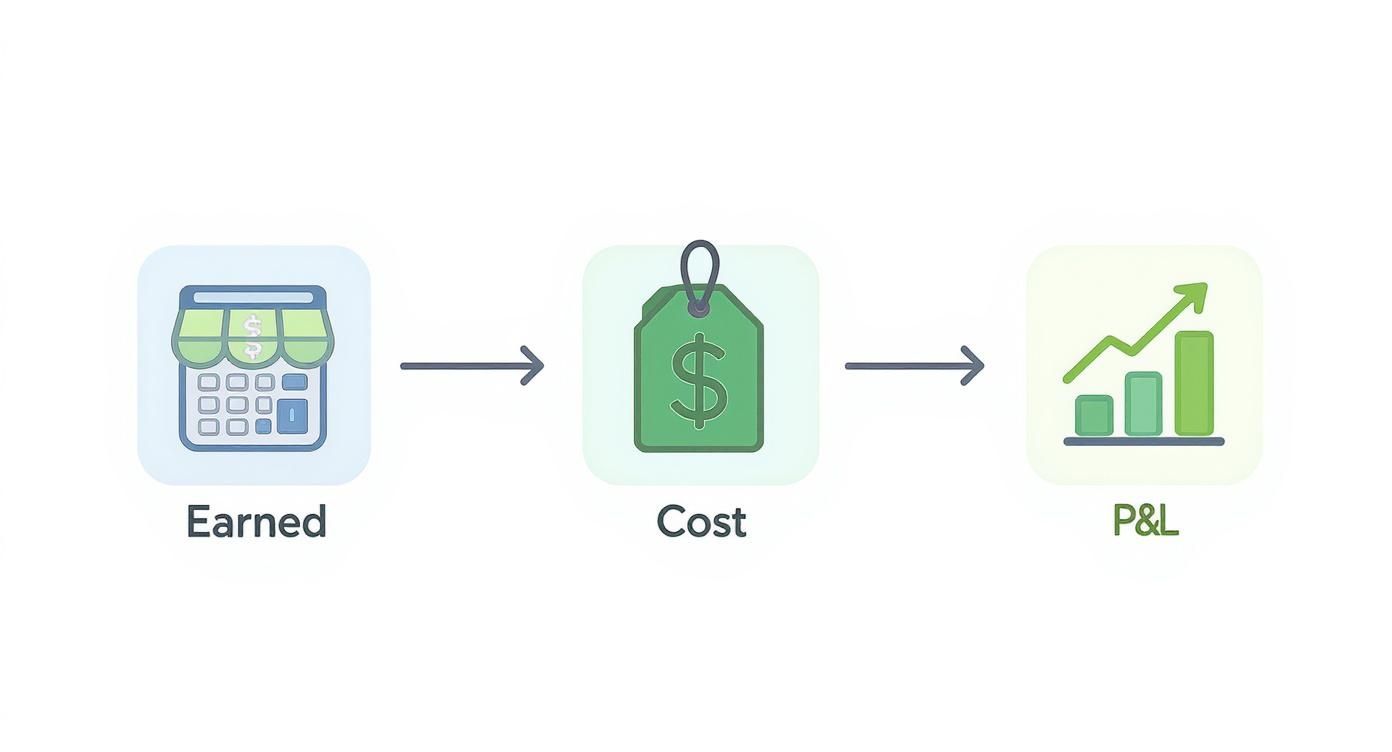
As the infographic makes clear, you have to account for the costs that stand between your gross earnings and your actual profit to get an accurate picture of your performance.
The Number That Actually Matters: Net P&L
To find out what you really made or lost, you need to calculate your Net P&L. This is your Gross P&L minus all the trading costs that came with it. This is the figure that directly impacts your account balance and, frankly, it’s the only one that should guide your strategy decisions.
The formula for Net P&L is: Gross P&L – Total Trading Costs = Net P&L
So, what are “Total Trading Costs”? They’re the little things that can quietly eat into your profits if you aren’t tracking them.
- Commissions: These are the fees your broker charges for executing your buy and sell orders.
- Exchange Fees: You’ll also find smaller fees charged by the exchanges themselves.
- Slippage: This is the small price difference between what you expected to pay and what you actually paid. It happens all the time in fast-moving markets and can absolutely add up.
Forgetting these costs is one of the most common mistakes new traders make. It’s easy to think you had a profitable day, only to realize that fees turned your small wins into net losses. This discipline of tracking every single cost is non-negotiable if you’re thinking long-term.
Focusing on Net P&L forces you to be honest with yourself about a strategy’s true performance. It’s the difference between a paper gain and actual, spendable cash.
Putting It All Together: A Practical Example
Let’s walk through a quick, practical example. Imagine you buy 100 shares of a stock at $20. A little while later, you sell all 100 shares at $22.
Your Gross P&L would be:
($22 – $20) x 100 shares = $200
Looks good on paper. But now, let’s say your broker charged a $5 commission to buy and a $5 commission to sell, for a total of $10 in costs.
Your Net P&L would be:
$200 (Gross P&L) – $10 (Total Costs) = $190
That $190 is your real, take-home profit. This basic calculation is the foundation for more advanced metrics. In fact, our guide on how to calculate return on investment shows how you can take this number even further to analyze your performance. Consistently applying these simple formulas is what builds the financial awareness you need to thrive.
Applying P&L Formulas to Real-World Trades
Theory is great, but let’s be real — the concepts don’t truly click until you see them play out in actual trades. The numbers on your screen only tell you what happened; understanding the why and how behind them is what separates disciplined traders from the rest. Let’s walk through a few examples that every trader will eventually run into.
We’ll look at a clean stock win, a crypto trade that went sideways, and a tricky options play that highlights just how much hidden costs can sting. For each one, we’ll break down both the gross and net P&L to show you exactly how to calculate profit and loss down to the last cent.
Example 1: The Profitable Tech Stock Trade
Let’s say you’ve been eyeing a tech company, “Innovate Corp” (ticker: INVT). After a strong earnings report, you feel it’s undervalued and decide to jump in.
Here’s the trade breakdown:
- Entry: You buy 50 shares of INVT at $150.00 per share.
- Exit: Two weeks later, the stock rallies. You sell all 50 shares at $165.00.
- Costs: Your broker hits you with a $2.50 commission on the buy and another $2.50 on the sell.
First, the simple part — the Gross P&L:
($165.00 Exit Price – $150.00 Entry Price) x 50 Shares = $750.00
That feels good. But that’s not what actually hits your account. Now, let’s factor in those pesky costs to get the Net P&L:
$750.00 (Gross P&L) – ($2.50 Buy Commission + $2.50 Sell Commission) = $745.00
Final Outcome: A clean net profit of $745.00. In this case, the costs were pretty small, but ignoring them would give you an inflated sense of your performance. Every dollar counts.
Example 2: The Losing Cryptocurrency Short Trade
Now for a tougher scenario. We’ve all been here. You see a popular altcoin that looks overextended and decide to short it, betting on a correction. Remember, shorting means you profit if the price goes down.
Here’s how it played out:
- Entry: You short 10 coins at $300.00 per coin.
- Exit: The market rips against you. To cut your losses, you close the position by buying back the 10 coins at $320.00.
- Costs: You paid $10 in total exchange fees and got hit with $15 in slippage because of the volatility.
The Gross P&L calculation for a short is inverted:
($300.00 Entry Price – $320.00 Exit Price) x 10 Coins = -$200.00
The negative number confirms a gross loss before we even touch the fees. Now for the true damage — the Net P&L:
-$200.00 (Gross P&L) – ($10 Fees + $15 Slippage) = -$225.00
Final Outcome: A net loss of $225.00. This one stings. The slippage and fees didn’t just add to the loss; they compounded it, showing how quickly extra costs can pile on when a trade goes wrong. Facing these numbers is tough, but it’s a critical part of the learning process.
Example 3: The “Break-Even” Options Trade That Wasn’t
Let’s look at an options trade that seems like a wash but tells a different story once you account for everything. You buy a call contract, expecting the underlying stock to rise.
- Entry: You buy 1 call option contract (which controls 100 shares) for a premium of $2.00 per share. Total cost: $200.
- Exit: The stock stalls. Just before expiration, you dump the contract for a premium of $2.10 per share, getting $210 back.
- Costs: Your broker charges a $5.00 commission to open the trade and another $5.00 to close it.
Let’s calculate the Gross P&L:
$210 (Sale Price) – $200 (Purchase Price) = $10.00
A tiny $10 win, right? Not so fast. Time for the Net P&L:
$10.00 (Gross P&L) – ($5.00 Buy Commission + $5.00 Sell Commission) = $0.00
This particular trade was a true break-even. But in more complex scenarios, especially where direct data is spotty, many pros go a step further. They use industry benchmarks and quantitative analysis to build a more objective P&L model. You can get a deeper look into how experts use industry data on meadenmoore.com.
Final Outcome: The trade ended with a net P&L of $0.00. This is a perfect example of how commissions can wipe out a small gain, turning a “winner” into a whole lot of nothing but churn.
Moving Beyond Single Trades to Track Performance
A single winning trade delivers an incredible rush, but we both know that long-term success isn’t built on one lucky break. It’s built on consistency and discipline over months and years.
Once you’re comfortable with the basics of how to calculate profit and loss for each trade, the next step is to zoom out and look at the bigger picture. This is where your trading journal becomes your most powerful tool.
Individual P&L numbers tell you what happened, but aggregated performance metrics tell you why it happened. They reveal the true health of your strategy, exposing strengths to double down on and weaknesses you need to fix.
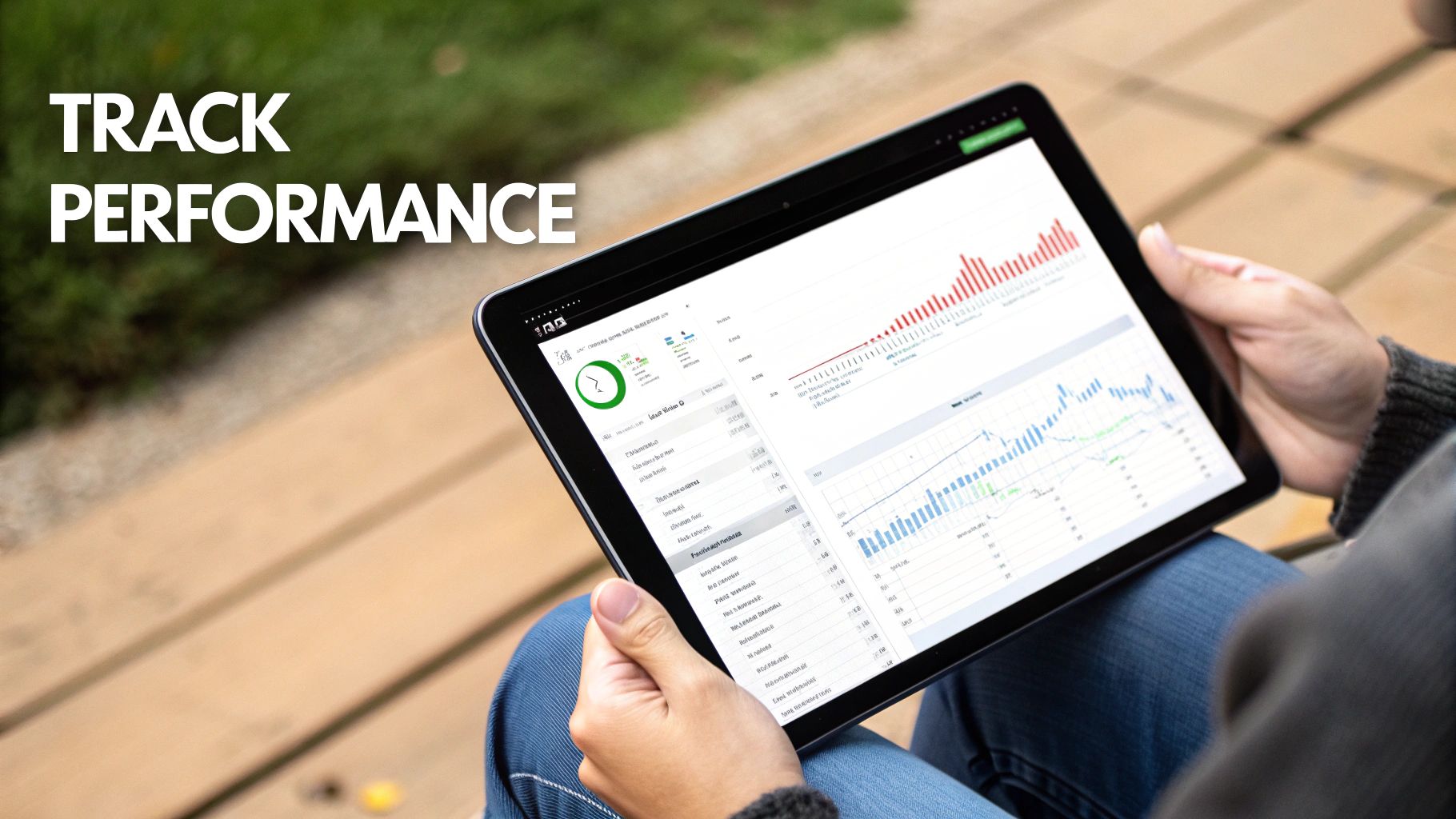
This kind of dashboard view automatically calculates critical metrics, giving you an immediate, data-driven look at your strategy’s effectiveness over time.
Key Metrics for Strategy Health
Tracking your trades consistently allows you to calculate a few simple but incredibly insightful numbers. These metrics move you from just counting dollars to truly understanding your performance edge — or lack thereof.
- Win Rate: This is the percentage of your total trades that were profitable. It’s calculated as (Number of Winning Trades / Total Number of Trades) x 100. While a high win rate feels good, it doesn’t guarantee profitability on its own.
- Average Win vs. Average Loss: This ratio is crucial. It compares the average dollar amount of your winning trades to the average dollar amount of your losing trades. A healthy ratio — ideally above 1.5:1 — means your winners are significantly larger than your losers, which can make up for a lower win rate.
- Profit Factor: This is a powerful test of a strategy’s viability. It’s your Total Profits divided by your Total Losses. A Profit Factor greater than 1.0 indicates your strategy is profitable. The higher the number, the more robust your edge.
Calculating these manually can be a chore, but it’s essential for building discipline. You can find a helpful profit and loss template for Google Sheets to get started with manual tracking and see how these numbers come together.
The Power of Automated Tracking
Let’s be honest — manual data entry is tedious. It’s easy to make mistakes or, even worse, skip logging a painful loss because you don’t want to face it. This is where modern trading journals like TradeReview make a massive difference.
Discipline is the bridge between goals and accomplishment. — Jim Rohn
By automatically syncing with your broker, these platforms eliminate the manual work and the emotional friction. Every trade is logged, and every metric is calculated for you in real time.
This frees up your mental energy to focus on what actually matters — analyzing the data and refining your strategy.
Instead of spending hours in a spreadsheet, you can instantly see your win rate on Tuesdays versus Thursdays, or your profit factor on long trades versus short trades. This level of insight is what turns good traders into great ones. It fosters the long-term thinking and discipline needed to navigate the markets successfully, moving you beyond the emotional highs and lows of single trades.
Common P&L Calculation Mistakes and How to Fix Them
Every trader messes up their profit and loss calculations at some point — it’s practically a rite of passage. What matters is that you learn from these slip-ups and build disciplined habits to avoid them in the future. It’s not about being perfect, but about being consistently accurate.
Let’s walk through some of the most common pitfalls I see and, more importantly, how to fix them for good.
One of the biggest traps is focusing only on gross profit. It’s easy to get excited about the big number on a winning trade, but that figure is pure fantasy until you subtract the real-world costs. Commissions, exchange fees, and other charges aren’t just minor details; they are a fundamental part of every single transaction and can seriously eat into your returns.
Another silent account-killer is overlooking slippage. Especially in fast-moving markets, the price you actually get filled at can be slightly different from the price you clicked. A few cents might not seem like a big deal on one trade, but over hundreds or thousands of trades, that “small” difference adds up to a significant drain on your account.
Creating a System for Accuracy
To sidestep these common errors, you need a system. The goal is to stop reacting to surprise costs after a trade is closed and start planning for them proactively. You should know a trade’s true potential before you even click the buy button.
A simple but incredibly effective tool is a pre-trade checklist. Before you place any order, just run through these quick questions:
- What is my total commission for the round-trip (getting in and getting out)?
- Are there any other platform or data fees I need to account for?
- Based on how the market is moving right now, what’s my realistic potential slippage?
This small act of discipline forces you to see the real numbers upfront, giving you a much clearer picture of your actual net P&L. If you want to get a better handle on this, check out our guide on what slippage in trading is and how to manage it.
Building good habits from the start is way easier than trying to unlearn bad ones later. Treat every single cent like it’s part of your business capital—because it is.
This idea of accurately measuring performance isn’t new. In business, a common way to calculate lost profits is the ‘Before-and-After’ method, where you compare performance before and after a key event. That same principle applies directly to trading. A consistent, stable process for calculating your P&L is non-negotiable for understanding your performance and building a sustainable career.
Turning these frustrations into learning moments is what separates consistently profitable traders from the rest. It’s how you build a solid foundation for the long haul.
Still Have Questions About P&L?
We’ve walked through the formulas, dissected a few real-world trades, and highlighted some common missteps. But a few questions always pop up when traders start digging into their P&L. Let’s clear up any lingering confusion with some quick answers.
What’s the Difference Between Realized and Unrealized P&L?
Think of it this way: realized P&L is the cash you’ve actually pocketed (or lost) after closing a position. It’s done, dusted, and reflected in your account balance.
Unrealized P&L, on the other hand, is the “on paper” profit or loss for a trade you still have open. It’s a moving target, constantly fluctuating with the market, and it doesn’t mean a thing until you hit that close button.
Key Takeaway: Serious traders build their performance analysis around realized P&L. An unrealized gain can disappear in a heartbeat, so it doesn’t count until the trade is officially over.
How Do Taxes Factor Into My Trading Profit?
The calculations we’ve covered in this guide are for your pre-tax net profit. When it comes to taxes on trading gains, things can get complicated fast. The rules often depend on your location, income, and how long you held an asset (short-term vs. long-term gains can be taxed very differently).
This is one area where you absolutely want to talk to a qualified tax professional. But here’s a tip: keeping a detailed, accurate record of your realized P&L throughout the year will make tax season infinitely less painful.
Why Does My Broker’s P&L Sometimes Differ From Mine?
Ever notice a small discrepancy between your P&L math and what your broker’s statement says? Don’t panic — it’s pretty common and usually comes down to a few things:
- Your broker might be calculating P&L based on the live bid/ask spread, while you’re using the last traded price.
- They could be including overnight financing fees (swaps) that you haven’t accounted for.
- Other small costs like currency conversion fees or platform-specific charges can also create minor differences.
If you spot a gap you just can’t explain, pull up your trade confirmation statements. If it still doesn’t add up, don’t hesitate to reach out to your broker for clarification.
Stop guessing and start analyzing. TradeReview syncs directly with your broker to automatically track every trade, calculate your performance metrics, and give you the data-driven insights needed to sharpen your edge. See what you’ve been missing.