At its core, the simple profit or loss formula is your selling price minus your buying price, less any trading costs. This calculation is the ultimate scorecard for every decision you make in the markets, telling you whether a trade ended in the black or the red.
Why Your Trading Journey Starts Here
Welcome to the single most important calculation in your trading career. It’s easy to get lost in complex strategies and exciting market moves, but if you don’t have a firm grip on your real profitability, you’re flying blind.
We’ve all been there. It’s a common struggle for traders to shift from hopeful guesses to methodical measurement. Many overlook the small costs that silently eat away at their gains, feeling frustrated when their account balance doesn’t match their perceived wins. This is a journey we all go through, and it’s completely normal to face these challenges at the start.
The profit or loss formula is way more than just simple math; it’s the clearest lens for viewing your performance. Don’t think of it as a complex equation, but as your most honest feedback mechanism.
By consistently tracking your P&L, you replace emotion with evidence. It’s the first step toward building the discipline that separates professionals from amateurs — and sets the foundation for long-term thinking.
Mastering this one concept helps you do a few critical things:
- Gain True Clarity: See how you’re actually performing after all the costs are factored in.
- Spot Hidden Patterns: Figure out which strategies are working and which ones are quietly draining your account.
- Build Lasting Discipline: Shift from speculating to making sharp, data-driven decisions.
Ultimately, this isn’t about chasing guaranteed profits — which don’t exist in trading — it’s about taking control. By understanding exactly how each trade impacts your bottom line, you start the transformation from a speculator into a strategic trader who is fully in command. Every successful trader starts right here, with this fundamental building block.
Understanding the P&L Building Blocks
To get a real handle on the profit or loss formula, you have to know what it’s made of. Think of it like putting together a high-performance engine; every single part has to be right for it to run properly. If you miss even one small piece, it can throw off your entire performance analysis and lead you to the wrong conclusions about your strategy.
Every trade you make is decided by just a few key variables. When you get a firm grasp on these, you’ll know not just what you made or lost, but why. For any trader serious about long-term success, this is fundamental stuff.
The Core Variables of Your P&L
Let’s start by breaking down the essential numbers that go into every single trade calculation. These are the inputs you’ll need to track to get a clear, honest picture of your performance.
Below is a simple breakdown of the essential components you need to get your P&L calculation right every time.
| Component | Description | Example |
|---|---|---|
| Entry Price | The price where you bought shares (long) or sold them to open a position (short). This is your starting line. | You buy 100 shares of AAPL at $150.00. |
| Exit Price | The price where you closed your position by selling (long) or buying back (short). This is the finish line. | You sell those 100 shares of AAPL at $155.00. |
| Position Size | The total number of shares, contracts, or units you traded. This is the multiplier for your gains or losses. | In this trade, your position size was 100 shares. |
These three numbers give you the raw, unfiltered result of your trade. But that’s not the whole story. The next part is what separates amateur guesswork from professional analysis.
Why Trading Costs Matter More Than You Think
So many new traders get a painful wake-up call when they see that their gross profits don’t line up with what’s actually in their account. The culprit? Trading costs. These are the small, relentless expenses that can quietly eat away at your net results.
We often feel the sting of a big loss, but it’s the slow drain from untracked costs that can do the most damage over time. Discipline means accounting for every single cent, not just the big wins and losses.
These costs pop up in a few different ways:
- Commissions: The fee your broker charges for placing the trade.
- Fees: Small regulatory or exchange fees that often get bundled with commissions.
- Slippage: This is the difference between the price you expected to get and the price you actually got. It happens all the time in fast-moving markets and can add up without you even noticing. For example, you might place a market order to buy at $10.50, but by the time it executes, the best available price is $10.52. That extra $0.02 per share is slippage.
Ignoring these is like trying to run a business without tracking any of your expenses. Your net P&L — what’s left after you subtract all these costs — is the only number that truly matters at the end of the day.
Getting Practical With the P&L Formula
Alright, enough with the theory. Let’s roll up our sleeves and see how the profit or loss formula actually works in the real world of trading. We’ll walk through a couple of common scenarios to get you comfortable with the calculation.
This simple infographic is a great visual reminder of the P&L flow — from identifying your entry and exit to subtracting those all-important costs.
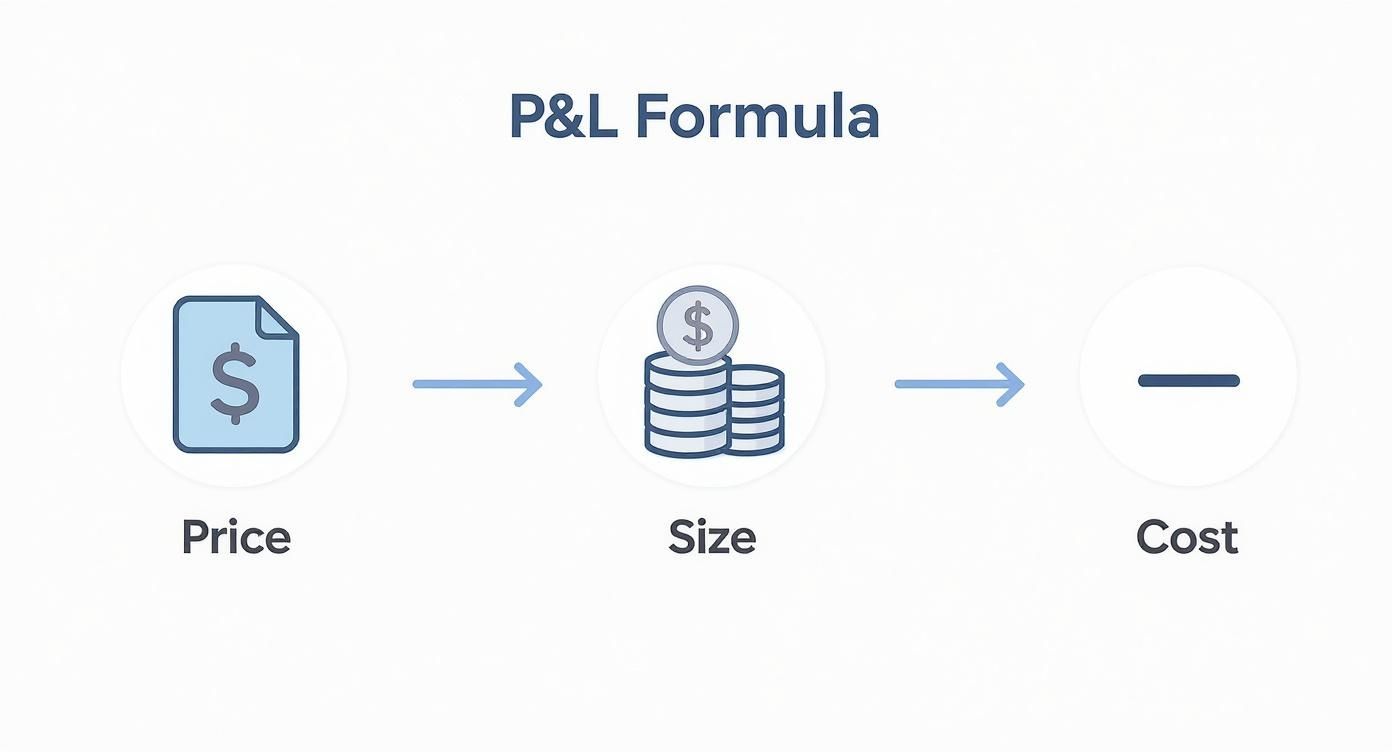
It really drives home the point that your true net profit isn’t known until every last trading cost is factored in.
Example 1: A Simple Long Position
Let’s imagine you’re bullish on a stock, XYZ Corp. You decide to buy 100 shares at an entry price of $50 per share. A week goes by, your hunch pays off, and you sell all 100 shares at an exit price of $55 per share. For the whole trade, your commissions and fees add up to $10.
Here’s how the math breaks down:
- Calculate Gross Profit: ($55 Exit Price – $50 Entry Price) x 100 Shares = $500
- Subtract Trading Costs: $500 Gross Profit – $10 Costs = $490
- Final Net P&L: You’ve locked in a $490 profit.
That’s the basic calculation, but trading is rarely that clean. While the U.S. stock market has historically averaged around 9-10% in annual returns, that includes wild years with over 33% gains and brutal losses like the -36.61% drop during the 2008 financial crisis. These swings are exactly why you need to calculate your P&L accurately — it tells you how you’re really performing, no matter what the market is doing.
Example 2: A Basic Short Position
Now, let’s flip the script. You think ABC Inc. is overvalued and due for a fall. You short 50 shares at an entry price of $120 per share. A few days later, the price drops as you predicted, and you close your position by buying back the 50 shares at $110 per share. Your total costs for this trade are $8.
For a short sale, the formula is reversed. You profit when your exit price is lower than your entry price.
Let’s run the numbers:
- Calculate Gross Profit: ($120 Entry Price – $110 Exit Price) x 50 Shares = $500
- Subtract Trading Costs: $500 Gross Profit – $8 Costs = $492
- Final Net P&L: A solid $492 profit.
Getting comfortable with both long and short scenarios is fundamental to building discipline. While P&L is great for seeing the outcome of a single trade, it becomes truly powerful when you pair it with other metrics. For instance, you can check out our guide on how to calculate your win rate to start building a more complete picture of your trading performance.
Using P&L as Your Strategic Edge
Figuring out the P&L on a single trade is one thing, but that’s just scratching the surface. The real power of the profit or loss formula kicks in when you start using it as a diagnostic tool to sharpen your entire trading strategy.
It’s easy to feel like you’re just along for the ride, with wins and losses feeling completely random. Many traders experience this emotional rollercoaster. The secret to getting off that ride is to stop seeing P&L as a final score. Instead, start treating it as a feedback loop.
This mindset shift is what separates reactive traders from proactive ones. It’s about developing the discipline to see your performance not as a string of one-off events, but as a collection of data points that reveal your unique edge in the market.
Turning Data Into Decisions
All that raw P&L data holds the clues to your biggest strengths and most nagging weaknesses. The goal is to look past the net dollar amount and start asking better questions. When you do this consistently, you’ll spot patterns that are totally invisible when you’re just looking at one trade at a time.
To get started, focus on these key analytical points:
- Win/Loss Ratio: What percentage of your trades are actually profitable? This is a quick check on your consistency.
- Average Profit vs. Average Loss: Are your winning trades significantly bigger than your losing ones? This is absolutely critical for staying profitable long-term.
- Performance by Setup: Which chart patterns or market conditions consistently deliver your best results?
This kind of breakdown shows you where to press your advantage and where you need to pull back or improve. It’s a direct line to smarter risk management.
The goal isn’t to win every trade — that’s a fool’s errand. It’s to build a system where your good decisions systematically outweigh your mistakes over hundreds of trades.
This need to understand profitability isn’t just a trader’s problem; it’s a fundamental principle of the global economy. For example, the fluctuation and general decline of the global profit rate over the last 60 years show just how hard it is for even massive companies to maintain consistent returns. It often comes down to how efficiently they use their capital.
By digging into your own numbers, you build an evidence-based foundation for every decision you make. If you want to take this a step further, you can also learn more about how to calculate return on investment to get an even broader view of your capital’s performance.
Put Your P&L Analysis on Autopilot
Sure, running your profit or loss numbers by hand is a great way to build discipline. It forces you to get intimate with the results of every single trade. But let’s be honest — it’s also tedious and time-consuming.
Thankfully, modern trading journals and analytics platforms can handle the heavy lifting for you. These tools instantly log the P&L for every trade, track your performance over time, and serve up powerful insights on easy-to-read charts and dashboards. It’s not a shortcut to easy profits; it’s about working smarter and reinforcing a data-driven mindset.
Go From Manual Spreadsheets to Instant Insights
By automating your P&L tracking, you can finally ditch the endless spreadsheet maintenance and spend your time where it really matters: refining your actual strategy. This shift helps you spot patterns in your trading — the kind you’d almost certainly miss if you were buried in manual calculations.
A good dashboard gives you a clean, visual summary of your most important metrics.
In a single glance, you can see your total P&L, win rate, and other key stats. This makes it far easier to make quick, informed decisions about what’s working and what isn’t.
The goal here is simple: move from data entry to data analysis. Let technology handle the math so you can focus on the story the numbers are telling you.
It’s the same core formula that drives decision-making at the highest levels. When BP reported losses of over $20 billion after the 2010 Deepwater Horizon disaster, that staggering figure was calculated using the same fundamental principle of revenues minus costs and losses. The scale is different, but the math is the same.
Using tools to automate this process builds a powerful feedback loop. It’s a lot like when you learn how to backtest trading strategies; you’re just using technology to accelerate how quickly you can learn from your own trading history.
Still Have Questions About the Profit or Loss Formula?
Even once you get the hang of the basics, a few specific questions tend to pop up when you start applying the profit or loss formula to your own trading. Nailing down the answers is the key to building confidence, tracking your performance accurately, and making smarter, data-driven decisions.
Let’s clear up some of the most common points of confusion.
How Do You Calculate Profit or Loss for a Short Position?
For a short position, you’re essentially flipping the script on a typical “buy low, sell high” trade. Here, you’re betting on the asset’s price to drop, so you make a profit when your exit price is lower than your entry price.
The formula just reverses the prices: (Entry Price – Exit Price) x Position Size – Trading Costs.
What Is the Difference Between Gross and Net P&L?
This is a big one, and it trips up a lot of traders early on. It’s a critical distinction to make.
- Gross P&L is your profit or loss before you factor in any trading costs like commissions, fees, or slippage. Think of it as the raw result.
- Net P&L is your actual, take-home result after all those costs have been subtracted from your gross result. This is what actually hits your account balance.
Always, always focus on your Net P&L. It’s the only number that gives you a true picture of your trading performance. Ignoring it is a fast track to thinking your strategy is more effective than it really is.
Why Is Position Sizing So Important in the Formula?
Think of position size as the great multiplier in the profit or loss formula — it magnifies everything, for better or for worse. It can turn a small win into a great one, but it can also turn a small loss into a disaster.
Even with a fantastic strategy that has a high win rate, a single oversized position that goes against you can cause a catastrophic, account-altering loss. That’s why discipline in position sizing isn’t just a suggestion; it’s a cornerstone of long-term risk management. It ensures that no single trade can ever take you out of the game.
Stop guessing and start analyzing. TradeReview provides a powerful, free trading journal to automatically track your P&L, analyze your performance, and discover your strategic edge. Get started for free at TradeReview.