At its core, the risk reward ratio is a simple metric that compares how much you stand to win on a trade versus how much you stand to lose. It’s not a magic formula for guaranteed profits, but it is one of the single most important tools for survival in the markets, forcing you to make calculated decisions instead of just gambling on outcomes.
The Most Important Rule for Trading Survival
Let’s be honest — most traders obsess over finding that one big winning trade. We hunt for the perfect entry and chase those exhilarating profits. But the real secret to lasting success isn’t your win rate. It’s how well you manage your losses when you’re inevitably wrong.
This is where the emotional rollercoaster of trading really kicks in. We’ve all been there: a huge win can make you feel invincible, while a string of losses can breed frustration and lead to impulsive “revenge trading.” That cycle is exhausting and, more importantly, it’s a fast track to draining your account.
The key is to shift your mindset from that of a gambler to a strategist. The risk reward ratio is your most powerful tool for making that change. It’s not some complex jargon; it’s a foundational concept that injects discipline into every single decision you make. By clearly defining what you’re willing to lose before you even enter a trade, you protect your capital and start building a real, sustainable edge for the long term.
By consistently applying a favorable risk reward ratio, you can be profitable even if you lose more trades than you win. This is the mathematical edge that separates professional traders from hobbyists.
Understanding this concept is a critical first step in a much broader strategy. For a deeper look into protecting your capital, our guide on essential risk management techniques for traders is a great next step.
Ultimately, mastering the risk reward ratio helps you nail three crucial goals:
- Protect Your Capital: It ensures no single trade can wipe out a significant chunk of your account.
- Remove Emotion: It forces your trading decisions to be based on logic and math, not fear or greed.
- Build Long-Term Consistency: It creates a framework that can withstand losing streaks and still grow your account over time.
How to Calculate Your Risk Reward Ratio
At its core, the risk reward ratio is a beautifully simple concept. Look, successful trading isn’t about the impossible goal of being right every single time. It’s about making sure that when you are right, your wins are significantly bigger than your losses. This one calculation brings that powerful idea to life.
To figure out your ratio for any potential trade, you only need three key numbers. Think of these as the pillars of your trade plan — numbers you decide on before you ever put a dollar on the line.
The Three Core Components
- Your Entry Price: Simple enough. This is the price where you plan to buy or sell an asset. It’s the starting line for your trade.
- Your Stop-Loss Price: This is your non-negotiable exit point if the trade goes south. It represents the maximum loss you’re willing to accept and is absolutely critical for protecting your capital. Our guide on how to effectively set stop-losses digs much deeper into the strategies for this.
- Your Take-Profit Target: This is the price where you plan to cash out and lock in your profits. It’s your reward.
Once you have these three values, the math is incredibly straightforward. You just calculate the distance from your entry to your stop-loss (your risk) and the distance from your entry to your profit target (your reward).
The formula is: Risk Reward Ratio = (Take-Profit Price – Entry Price) / (Entry Price – Stop-Loss Price)
This simple division gives you a clear, objective measure of what a trade is worth. Let’s walk through a quick, practical example to see it in action.
A Real-World Calculation Example
Imagine you’re eyeing a stock, let’s call it “ABC Corp,” which is currently trading at $100 a share. Your analysis tells you it has room to run.
- Entry Price: You decide to buy at $100.
- Stop-Loss: You place your stop-loss at $95. This means you’re willing to risk exactly $5 per share on this trade ($100 – $95).
- Take-Profit: You set your profit target at $115, meaning you’re aiming for a $15 profit per share ($115 – $100).
Now, let’s plug these numbers into our formula:
- Your potential reward is $15 per share.
- Your potential risk is $5 per share.
So, the ratio is 15:5. To simplify, you just divide both sides by the risk amount (5), which gives you a risk reward ratio of 3:1.
What does this mean? It means that for every $1 you are risking, you stand to gain $3. This is often written as a 1:3 risk/reward ratio. The simple act of quantifying potential gains against possible losses is central to disciplined, long-term trading. By defining these terms before you trade, you replace gut feelings and emotion with a clear, mathematical plan.
Choosing a Ratio That Fits Your Trading Style
It’s a common trap: traders hunt for that single, magical risk reward ratio they believe will unlock consistent profits. But the truth? There’s no such thing.
The “best” ratio isn’t some universal number. It’s a deeply personal metric that has to sync up with your specific trading strategy, your time horizon, and even your personality. What works wonders for a rapid-fire scalper would absolutely crush a patient trend follower, and the other way around.
Finding your sweet spot begins with an honest look at your trading style. Are you trying to grab small, quick profits all day long, or are you hunting for those big, multi-day moves? The answer completely changes the math behind your profitability. A scalper, for instance, might do just fine with a 1:1 risk reward ratio because their strategy relies on a high win rate. They win often, so those smaller profits stack up.
This infographic gives you a simple way to picture risk and reward from your entry point.
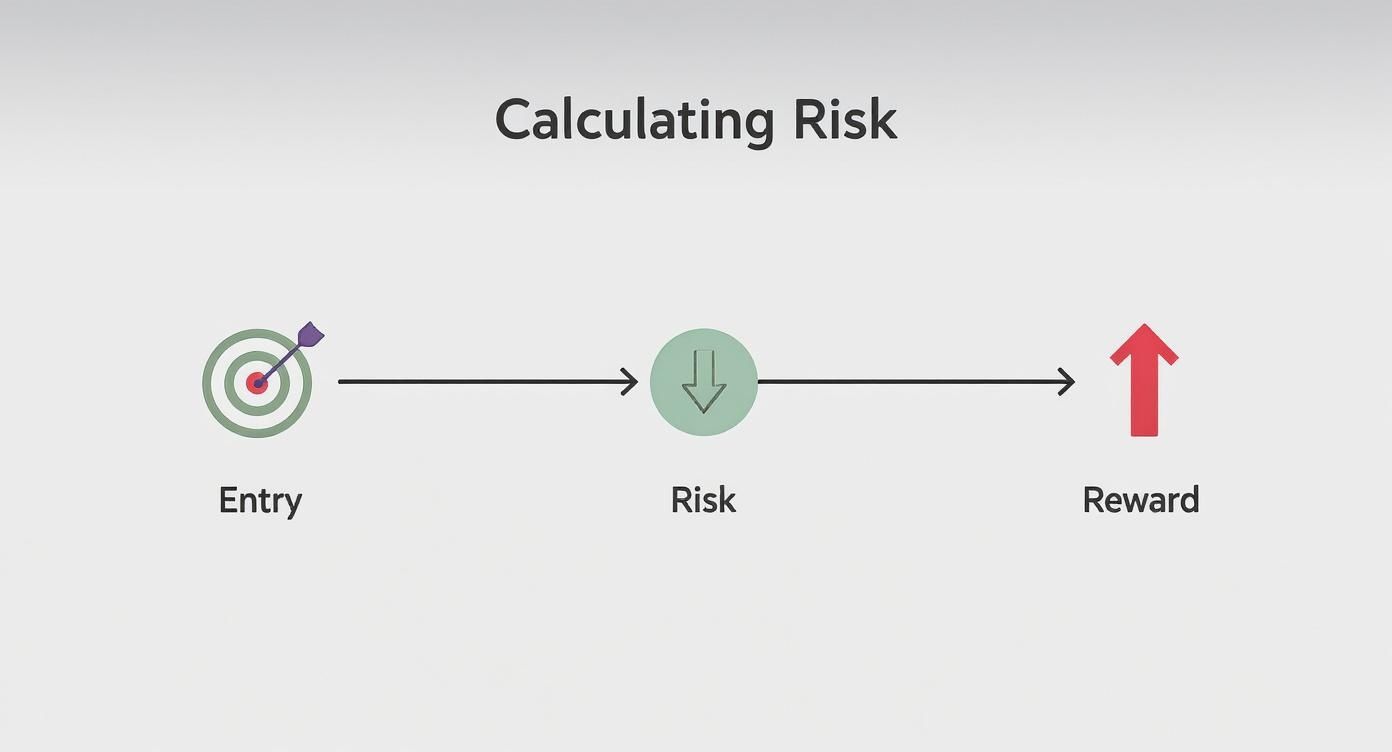
It’s a great reminder that every trade is a deliberate bet with a defined potential loss (your risk) and a target gain (your reward), both measured from where you get in.
The Win Rate and Ratio Connection
Now, think about a swing trader. They’re trying to catch much larger, less frequent market swings, so they need a much bigger risk reward ratio to survive. Their strategy might only win 40% of the time. For them to stay profitable, their winners have to be significantly larger than their losers.
A 1:3 ratio becomes essential — one single winning trade needs to cover the cost of three losing ones.
This brings us to the most important relationship in your entire trading plan: the dance between your win rate and your risk reward ratio. They are two sides of the same coin, and you can’t focus on one while ignoring the other.
You cannot choose a risk reward ratio without knowing your strategy’s approximate win rate. A high ratio with a very low win rate is just as unprofitable as a low ratio with a mediocre win rate.
Getting this balance right is what separates disciplined traders from gamblers. It’s all about building a system with a positive expectancy — a term for a strategy that, over a large number of trades, is mathematically designed to make money. This is the puzzle every trader has to solve: finding that sweet spot between being right often and getting paid well when you are right.
Matching Your Risk Reward Ratio to Your Trading Style
To bring this out of the clouds and into the real world, let’s look at how different trading styles demand different risk reward profiles. These aren’t rigid rules, but they offer a solid starting point for building your own strategy. The goal is to be realistic about how often you expect to win and then set a ratio that gives you a genuine mathematical edge.
The table below breaks down a few common trading styles, their typical risk reward ratios, and the win rate required just to break even. Pay close attention to how the required win rate drops as the potential reward goes up.
| Trading Style | Typical Risk Reward Ratio | Example | Required Breakeven Win Rate |
|---|---|---|---|
| Scalping | 1:0.5 to 1:1 | Risking $10 to make $5 or $10 on a quick price flick. | 67% to 50% |
| Day Trading | 1:1.5 to 1:2 | Risking $50 to make $75 or $100 on an intraday trend. | 40% to 34% |
| Swing Trading | 1:2 to 1:4 | Risking $200 to make $400 to $800 over several days. | 34% to 20% |
| Position Trading | 1:5+ | Risking $1,000 to make $5,000+ over weeks or months. | 17% or less |
As you can see, there’s a clear trade-off. Scalpers need to be right most of the time to make their small wins count, while position traders can afford to be wrong far more often, as long as their winners are massive. Your job is to find the column that feels most like home for you.
Thinking Like an Investor, Not Just a Trader
Managing your risk/reward ratio on a single trade can feel like a small, isolated act. But when you zoom out, you realize this same logic is the engine that drives long-term wealth.
Successful investors and portfolio managers aren’t just making one-off bets; they’re applying these risk-adjusted principles over years, not minutes.
This shift in perspective is everything. A trader often gets caught up in the immediate outcome of one position. An investor, on the other hand, thinks about how a collection of assets will perform over an entire market cycle. The goal is to build a portfolio where the potential for steady, compounding growth outweighs the inevitable downturns.
It’s the risk/reward ratio applied on a macro scale. Consistently applying a sound risk/reward strategy is what bridges the gap between the day-to-day volatility of trading and the stability of sustainable financial growth.
From Individual Trades to a Balanced Portfolio
An investor doesn’t just look at one stock’s potential. They construct a portfolio designed to weather storms. A classic example is the global 60/40 portfolio, which allocates 60% to equities and 40% to bonds.
Even with major market crises, research shows the 10-year rolling returns for this model have remained remarkably stable, averaging 6.8% since 1997. This highlights how a balanced approach helps manage risk while still capturing competitive returns over the long haul. You can learn more about this in Vanguard’s research demonstrating this portfolio’s stability.
This long-term view smooths out the terrifying drops that can wipe out an undisciplined trader. It’s about building a financial structure that can bend without breaking.
The core principle remains the same whether you’re setting a stop-loss on a day trade or rebalancing a retirement account: ensure your potential for reward justifiably compensates you for the risk you are taking on.
This mindset transforms the risk/reward ratio from a simple trading calculation into a powerful philosophy for building wealth. It encourages patience and a focus on the bigger picture, recognizing that consistent, disciplined decisions are what truly compound over time.
Every trade you take with a defined risk and reward is a building block for a more resilient financial future. It’s not about avoiding losses entirely — it’s about making sure your system is designed to survive them and thrive in the long run.
Why Discipline Is More Important Than Being Right
You can have the most brilliant trading strategy on the planet and a perfect risk reward ratio on paper, but none of it means a thing without discipline. This is, hands down, the toughest part of trading — not mastering charts or indicators, but mastering your own mind.
The market is a battlefield of emotions, and your biggest enemy is often staring back at you in the mirror.
The urge to be right on every single trade is a deeply human impulse. In trading, however, it’s a catastrophic flaw. It’s what causes traders to commit the cardinal sin of risk management: widening a stop-loss on a losing trade. You tell yourself, “It’s just a small dip, it’ll come back,” as you give a bad trade more room to breathe.
But in that moment, your plan is out the window. You’ve just completely destroyed your carefully calculated risk reward ratio, turning a small, manageable loss into a potentially devastating one. That single emotional decision can wipe out the profits from five, ten, or even more winning trades.
The Two Most Destructive Habits
Fear and greed are the twin demons that sabotage even the best-laid plans. They usually show up in two common, destructive ways that directly attack your risk/reward strategy:
- Letting Losers Run: This is pure ego. It’s the refusal to accept you were wrong. You cling to a losing position, hoping it will turn around, which effectively multiplies your risk far beyond your initial plan.
- Cutting Winners Short: This is pure fear. As soon as a trade moves into profit, you get anxious about it reversing. You snatch a tiny gain, falling far short of your original profit target and crippling the “reward” side of your ratio.
Both of these habits come from focusing on the outcome of one trade instead of the long-term process. Professional traders understand their job isn’t to be right; it’s to flawlessly execute their plan, over and over again.
The goal is not to predict the future or win every trade. The goal is to consistently follow your rules, manage your risk, and let your mathematical edge play out over time.
This mental shift is the hardest, yet most important, step in a trader’s journey. You have to learn to be okay with being wrong and taking small, planned losses. These aren’t failures; they are the expected and accepted cost of doing business in the market.
Building an Unbreakable Mindset
So, how do you actually build this discipline? It starts with detaching your self-worth from the outcome of any single trade. Your success is defined by your ability to stick to your rules, not by whether your last trade was a winner or a loser.
Practical Steps to Enforce Discipline:
- Use Hard Stop-Loss Orders: Don’t just have a mental stop. Place a physical order in your trading platform the second you enter a trade. This removes the temptation to second-guess yourself in the heat of the moment.
- Define Your Exit Before You Enter: Never, ever enter a trade without knowing exactly where you will take a loss and where you will take a profit. Write it down in your journal.
- Review Your Trades Weekly: Look for patterns of emotional decision-making. Did you move your stop? Did you exit too early out of fear? Recognizing the habit is the first step to breaking it.
Ultimately, a trader with an average strategy but iron-clad discipline will always outperform a genius trader who constantly breaks their own rules. Your risk reward ratio is your shield, but only discipline allows you to hold it up, trade after trade, without wavering. That is the true path to consistency.
Common Questions About Risk Reward
Knowing the math behind the risk/reward ratio is one thing. Sticking to it when your own money is on the line? That’s a whole different ballgame. It’s totally normal for questions to pop up once you start applying this concept to live trades.
We’ve rounded up some of the most common questions we hear from traders. Think of this as your quick-reference guide to help bridge the gap between theory and disciplined, real-world execution.
What Is a Good Risk Reward Ratio for Beginners?
If you’re just starting out, a risk/reward ratio of at least 1:2 is a fantastic place to begin. Put simply, this means for every dollar you’re willing to lose, your goal is to make at least two dollars.
This simple rule gives you a powerful psychological edge. With a 1:2 ratio, you can actually be profitable even if you lose more than you win. In fact, you only need a 34% win rate to break even. For new traders, learning to manage your downside first is the key to surviving long enough to get good.
How Does My Win Rate Affect My Risk Reward Ratio?
Your win rate and your risk/reward ratio are two sides of the same coin — you can’t look at one without considering the other. They work together to determine if your trading strategy has a real, mathematical edge over the long run.
A high-win-rate strategy, like some scalping methods, might be profitable with a lower ratio like 1:1. But a low-win-rate strategy, like trend following, absolutely needs a much higher ratio — often 1:3, 1:5, or even more — to have any chance of success. The first step to finding your ideal balance is learning how to calculate your win rate properly.
The goal isn’t just a high win rate or a great risk/reward ratio. It’s finding the combination of the two that gives your strategy a positive expectancy, ensuring it’s built to be profitable over hundreds of trades.
Should I Ever Adjust My Stop Loss During a Trade?
This question cuts right to the heart of trading discipline. Let’s be crystal clear: moving your stop-loss further away from your entry to give a losing trade “more room” is one of the fastest ways to blow up an account. It completely destroys your original risk/reward plan and turns a calculated risk into an emotional gamble.
But there is one major exception. Moving your stop-loss in the direction of your winning trade is not only acceptable, but it’s a smart professional tactic. This is often called a “trailing stop,” and it’s used to lock in profits or get your trade to a break-even point, eliminating the initial risk entirely.
The golden rule is simple: never increase your initial risk on a trade. But protecting your profits as a trade goes your way? That’s just smart, defensive trading.
Ready to stop guessing and start analyzing? TradeReview gives you the analytics you need to understand your true performance, track your risk/reward on every trade, and build the discipline required for long-term success. Sign up for your free trading journal today at https://tradereview.app.