Ever noticed how a stock seems to have two prices listed at the same time? That’s not a glitch — it’s the bid-ask spread, and understanding it is one of the first major hurdles every trader faces. It’s a fundamental, unavoidable cost of trading.
Think of it like the currency exchange counter at an airport. They’ll buy your dollars for one price but sell them back to you for a slightly higher price. That little gap is their profit. The bid-ask spread works the same way; it’s a small transaction cost built into every single trade you place. Forgetting about it is a common mistake that can slowly drain an account, but recognizing it is a huge step toward disciplined, long-term thinking.
Your First Look at the Bid Ask Spread
When you pull up a quote for any asset, you’re not just seeing one price. You’re seeing two.

The bid price is what buyers are currently willing to pay, which means it’s the price you get if you sell. The ask price is what sellers are demanding, so it’s the price you pay if you buy. The ask is always a touch higher than the bid.
This gap isn’t there by accident. It’s how market makers — the institutions that provide liquidity to the market — get paid for their service. They’re the ones ensuring you can almost always find someone to take the other side of your trade, and the spread is their fee for taking on that risk.
Many new traders get tripped up here, wondering why their position is instantly in the red the moment they open it. The spread is the answer. Don’t let this discourage you; every experienced trader went through this exact same realization.
Acknowledging and understanding the spread is the first step toward disciplined trading. It’s a small but constant cost that, over time, significantly impacts your long-term performance.
To get this locked in, it helps to see the key terms side-by-side.
Key Terms at a Glance
This table breaks down the core concepts into a simple format, using our currency exchange analogy to make it stick.
| Term | What It Represents for a Trader | Currency Exchange Analogy |
|---|---|---|
| Bid Price | The price where you can sell your asset. | The rate the exchange booth buys your dollars. |
| Ask Price | The price where you can buy an asset. | The rate the exchange booth sells you dollars. |
| The Spread | The difference between the bid and ask — your cost. | The profit margin for the exchange booth. |
Once you start seeing the spread not as some mysterious market quirk but as a clear, calculable cost of doing business, you’re on the right track. It’s a small detail, but mastering the small details is what separates traders who build sustainable habits from those who don’t.
Why the Spread Is a Hidden Cost of Trading
That tiny gap between the bid and ask price isn’t just a quirk of the market; it’s the invisible fee you pay every time you trade. Think of it as the commission earned by market makers — large financial institutions that keep the markets running smoothly. They take on the risk of holding assets so you can always find a buyer or seller, and the spread is how they get paid for that service.

This “hidden cost” is exactly why a trade often starts slightly in the red. You buy at the higher ask price, but the moment you own it, its market value is the lower bid price. Right out of the gate, your trade has to climb just to get back to zero. It’s a frustrating reality for every trader, but one you must account for in your strategy.
What Determines the Spread’s Size
The size of that spread isn’t random. It’s a direct reflection of two major market forces: liquidity and volatility. Once you get a feel for these, you’ll understand why some assets are way cheaper to trade than others.
- Liquidity: This is simply how easy it is to buy or sell something without affecting its price. High liquidity means there are tons of buyers and sellers ready to go.
- Volatility: This measures how much an asset’s price is jumping around. High volatility means more risk and uncertainty for everyone, including market makers.
Let’s look at a practical example. A major stock like Apple (AAPL) has incredible liquidity, with millions of shares trading all day. Because of this, the spread is usually just a penny. There’s almost no risk for the market maker, so their fee is tiny.
Now, imagine a small-cap stock that few people have heard of. It might have very few active traders (low liquidity) and its price could be swinging wildly (high volatility). This is a much riskier situation for a market maker, so they will demand a wider spread to make it worth their while.
The bid-ask spread directly reflects an asset’s market health. A tight spread signals a stable, liquid market, while a wide spread often warns of risk, low volume, or uncertainty.
This cost might seem small on any single trade, but it adds up over hundreds or thousands of trades. It’s a crucial number you have to account for. Our guide on calculating trading profit shows you exactly how to factor this into your results. If you ignore it, you’re not seeing the true cost of your trading.
How to Calculate the Bid Ask Spread
Figuring out the bid-ask spread is a simple but critical skill. It’s what takes the spread from an abstract idea to a practical cost you can account for on every single trade.
The formula itself couldn’t be easier.
Ask Price – Bid Price = Spread
That quick subtraction tells you the raw cost in dollars and cents — the instant hurdle you must overcome the second you open a position. But while knowing the dollar amount is useful, turning it into a percentage is where the real power lies. That’s how you compare costs across totally different assets.
Calculating the Spread in Dollars
Let’s start with a practical example using a well-known stock, Microsoft (MSFT). It’s incredibly liquid, with millions of shares changing hands daily, so its spread is almost always razor-thin.
You might see a quote that looks like this:
- Bid Price: $410.50
- Ask Price: $410.51
The math is simple: $410.51 – $410.50 = $0.01. The spread is just a single penny per share. This is what high liquidity looks like — a tiny, almost unnoticeable transaction cost.
Now, let’s look at something on the other end of the spectrum, like a less-traded, more speculative stock. Its quote could be:
- Bid Price: $5.25
- Ask Price: $5.35
Here, the spread is $5.35 – $5.25 = $0.10. That ten-cent gap is a whole different ballgame. It’s a clear signal of lower trading volume and higher risk. Just to break even, your position would need the stock’s bid price to rise by ten cents.
Finding the Spread Percentage
To get a true sense of your trading costs, you need to calculate the spread as a percentage. This lets you make an apples-to-apples comparison, whether you’re trading a $5 stock or a $500 one.
(Ask Price – Bid Price) / Ask Price x 100 = Spread Percentage
Let’s plug in our examples:
- For MSFT: ($0.01 / $410.51) x 100 = 0.0024%. The cost is practically negligible.
- For the speculative stock: ($0.10 / $5.35) x 100 = 1.87%. Now that’s a significant cost.
Putting it in percentage terms makes the impact crystal clear. That 1.87% cost on the less liquid stock is a serious hurdle you have to clear before you even start thinking about profits. Getting into the habit of running this quick calculation for every potential trade is one of those small disciplines that separates traders who are mindful of their costs from those who let hidden fees eat away at their returns.
How Spreads Behave in Different Markets
The bid-ask spread isn’t some fixed, universal cost. It’s a dynamic force, behaving very differently from one market to another. Getting a handle on these nuances is absolutely crucial for managing your trading costs and sticking to your plan, no matter what you trade. The cost structure for a popular stock, for instance, is a world away from that of an obscure bond.
For a lot of traders, especially those who get into scalping trading, the stock market is their first stop. And for good reason. Stocks, particularly from large, well-known companies, often have incredibly tight spreads. This is a direct result of fierce competition among market makers and the massive leap in technology over the last few decades.
Spreads in the Stock Market
The evolution here is pretty remarkable. If you look at historical data from the early 1990s, the average spread was sitting around 60 basis points (0.60%). Fast forward to today, and that has shrunk to an average of just 1-2 basis points (0.01% to 0.02%). That’s a tightening of over 90% in about 30 years. Technology has completely changed the game for trading costs.
This infographic breaks down how to calculate the spread in the simplest terms, which is the first step to understanding its impact on your bottom line.
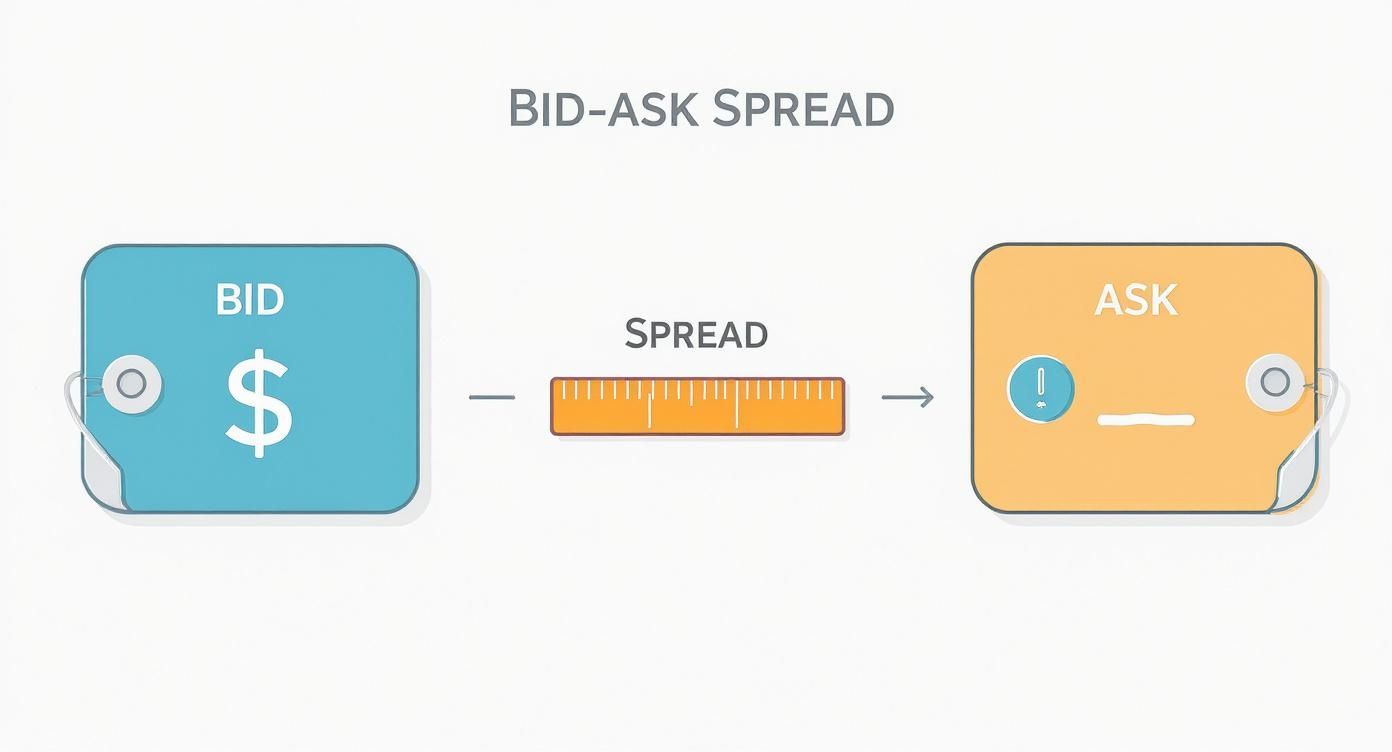
As you can see, it’s just the difference between the price you can buy at (the ask) and the price you can sell at (the bid). Simple, but powerful.
Options and Fixed Income Spreads
Things get more complex in the options market, and that complexity usually means wider spreads. You’ve got factors like time decay (also called “theta”) and implied volatility creating more risk for market makers. To compensate, they need a bigger premium for providing liquidity. A deep-in-the-money option on a popular ETF might have a tight spread, but an illiquid, far out-of-the-money contract is going to have a much wider one.
The less transparent and liquid a market is, the wider the bid-ask spread will be. This is a fundamental principle that applies to all asset classes.
Fixed income markets, like corporate or municipal bonds, often have the widest spreads of all. These markets are generally less transparent and see much lower trading volumes compared to stocks. Lower liquidity makes it harder to match buyers and sellers, forcing market makers to widen the spread to cover the risk of holding the bond on their books.
Knowing these differences isn’t just academic — it’s vital for any trader who wants to manage costs and protect their capital.
Practical Ways to Manage Spread Costs
Knowing what the bid-ask spread is is one thing. Actively managing its impact on your bottom line is what separates disciplined traders from those who let hidden costs slowly bleed their accounts dry.
The good news is, you have more control over this than you might think. This isn’t about some secret formula for guaranteed profits, but rather about building smart, sustainable trading habits. We’ve all been burned by wide spreads early in our trading journeys; the key is to learn from it.
It all starts with simple awareness. Before you even think about hitting the “buy” button, just glance at the spread. Is it wide? Is it narrow? Asking this one question can stop you from jumping headfirst into a trade that starts with a huge built-in loss.
From there, you can start using a few specific tactics to keep those costs in check. These aren’t complicated strategies — they’re just disciplined ways to execute your trades.
Stick to Liquid Assets and Prime Hours
One of the most effective ways to keep spreads tight is to trade where the action is. Think major stocks, popular ETFs, and the big currency pairs. These markets have enormous trading volume, and all that activity naturally keeps the gap between the bid and ask prices incredibly narrow.
Timing is just as important. Spreads tend to widen during pre-market and after-hours sessions simply because there are fewer buyers and sellers. They can also expand significantly during major news events or economic data releases when volatility spikes. Sticking to peak market hours, like the first and last hour of the U.S. stock market session, generally gives you the best chance at getting a fair price.
Use Limit Orders for Price Control
When you place a market order, you’re telling your broker to buy or sell at whatever the best available price is right now. That means you’re paying the ask and accepting the spread, no matter how wide it is. This is often how traders get a much worse price than expected.
A limit order, on the other hand, puts you in the driver’s seat. You set the absolute maximum price you’re willing to pay or the minimum you’re willing to sell for.
With a limit order, you’re essentially telling the market, “I will only trade at this price or better.” This gives you total control and stops you from accidentally paying a much wider spread than you intended.
This technique becomes absolutely critical when you’re trading less liquid assets where spreads can be unpredictable. It’s a simple but powerful tool for enforcing discipline and protecting your capital.
Of course, your trading platform plays a big role here. Different brokers offer different execution quality and order types. Our trading platform comparison can help you find one that aligns with your strategy and needs.
Common Questions About the Bid Ask Spread
Once you get the basics down, a few common questions always seem to pop up about the bid-ask spread. Let’s tackle them head-on so you can trade with more confidence and discipline.
Is a Wider or Narrower Spread Better?
When it comes to the spread, narrower (or tighter) is always better for traders. No exceptions.
A narrow spread is a sign of a healthy, liquid market. It means your transaction costs are low, and you’re not giving up too much just to get in and out of a trade. On the flip side, a wide spread signals low liquidity and higher costs, which can eat into your potential profits before you even have a chance to get going.
Can the Spread Change During the Day?
Absolutely. The bid-ask spread is anything but static; it’s constantly shifting with the real-time ebb and flow of supply and demand.
You’ll often see the spread widen out during periods of high volatility — think major news events or company earnings. It also tends to be wider when liquidity is thin, like in pre-market or after-hours sessions. The spread is usually at its tightest when the market is most active, right in the middle of the main trading session for popular stocks.
A trader’s long-term success often depends on respecting these small details. Acknowledging that the spread can change prepares you to pick the right moments to execute your trades, avoiding unnecessarily high costs.
How Does the Spread Relate to Slippage?
The bid-ask spread is a direct cause of slippage, especially if you’re using market orders. Slippage is simply the difference between the price you expected to get and the actual price where your trade executes.
Imagine you hit “buy” on a stock with a wide spread. Your market order is going to fill at the higher ‘ask’ price, which might be a good bit away from the last price you saw on your screen. That gap is negative slippage, and it means you started the trade at a disadvantage. It’s a frustrating experience we all face, but using limit orders is one of the best ways to fight back against it.
Mastering concepts like the bid-ask spread is what separates disciplined traders from the rest. To put this knowledge into practice, you need to track every detail of your performance.
TradeReview is a free trading journal built to help you analyze your costs, refine your strategy, and make data-driven decisions. Sign up for free at https://tradereview.app and take control of your trading journey.