The Volume-Weighted Average Price (VWAP) is more than just another line on a chart; it’s a vital tool used by institutional traders to gauge a security’s fair value throughout a trading session. For retail traders, mastering VWAP can feel like gaining a behind-the-scenes look at market dynamics, offering a clearer perspective on price action relative to trading volume. However, many traders struggle to move past the basics, often getting caught in whipsaws and false signals that lead to frustration and avoidable losses.
This guide is designed to cut through that noise. We’re not here to offer a “holy grail” indicator that promises guaranteed profits, because such a thing doesn’t exist in trading. Instead, this listicle is built on a foundation of empathy for the real challenges traders face. We will move beyond generic advice and dive deep into seven distinct and actionable VWAP trading strategies.
Each strategy presented is a complete framework, including:
- Clear Entry and Exit Rules: Know exactly when to get in and out.
- Practical Chart Examples: See how the theories apply in real-world scenarios.
- Essential Risk Management Principles: Learn how to protect your capital.
Our objective is to equip you with a disciplined, long-term perspective. You’ll learn how to integrate these powerful VWAP trading strategies into a robust trading plan, helping you make more informed, data-driven decisions. Let’s explore how to use this institutional benchmark to enhance your trading edge, focusing on consistency and process over the impossible pursuit of perfection.
1. VWAP Reversion Strategy
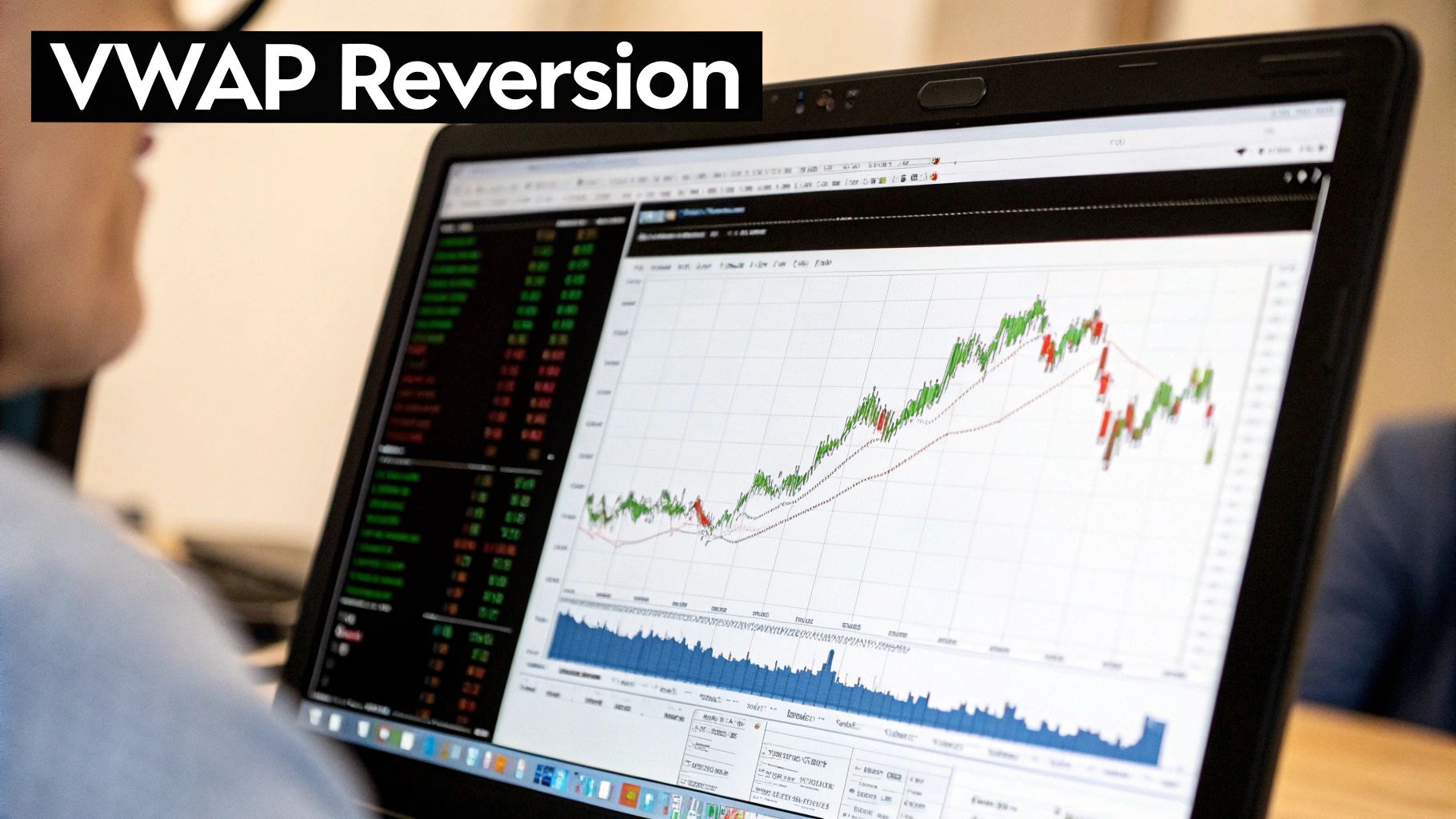
The VWAP Reversion Strategy is a cornerstone for many day traders, operating on a simple yet powerful premise: price acts like it’s on an elastic band, and the VWAP is its anchor. When the price stretches too far from this anchor, either above or below, it has a high probability of snapping back toward it. This “reversion to the mean” concept is one of the most reliable phenomena in financial markets.
This strategy capitalizes on overextensions. Traders look for assets that have made a rapid move away from their volume-weighted average price. The underlying assumption is that the move is unsustainable and lacks the volume participation to continue, making a return to the VWAP line likely. It is a counter-trend approach that requires discipline, as you are often buying into weakness or selling into strength, which can feel uncomfortable.
Core Principles and Implementation
The goal is to identify points of maximum extension where the “elastic band” is tightest. Traders often use standard deviation bands plotted around the VWAP to quantify these overextensions. A move to two standard deviations below VWAP might signal a prime buying opportunity, while a similar move above suggests a potential short entry.
Entry Rules:
- For a Long (Buy) Trade: Wait for the price to drop significantly below the VWAP line, ideally touching a lower standard deviation band. Look for signs of deceleration, such as smaller bearish candles or a bullish hammer candle, before entering.
- For a Short (Sell) Trade: Wait for the price to rally significantly above the VWAP, touching an upper standard deviation band. Look for signs of exhaustion, like a shooting star candle, to initiate a short position.
Exit Rules:
- Profit Target: The primary profit target is the VWAP line itself. A practical approach is to scale out portions of your position as price approaches VWAP, leaving a small piece to see if it can push through to the other side.
- Stop Loss: Place a tight stop loss just beyond the entry candle’s high (for shorts) or low (for longs). A move that continues to extend is a clear sign the reversion thesis is wrong, and it’s time to exit without hesitation.
Actionable Tips for Success
This is one of the VWAP trading strategies that demands precise timing and risk management.
- Practical Example: Imagine stock XYZ is in a sideways channel for the day. It suddenly drops 2% in 15 minutes, hitting the lower 2nd standard deviation band on low volume. You see a small doji candle form, showing indecision. This is your cue to enter long, placing a stop just below the doji’s low and aiming for the VWAP line as your target.
- Mind the Market Context: This strategy performs best in range-bound or consolidating markets. Avoid using it during strong, one-directional trending days, as these can cause sustained deviations from the VWAP that will stop you out.
- Discipline is Paramount: It feels unnatural to buy a falling stock. Your emotions will scream “Don’t do it!” This is where your written trading plan and discipline must take over to execute the strategy correctly.
2. VWAP Cross Strategy
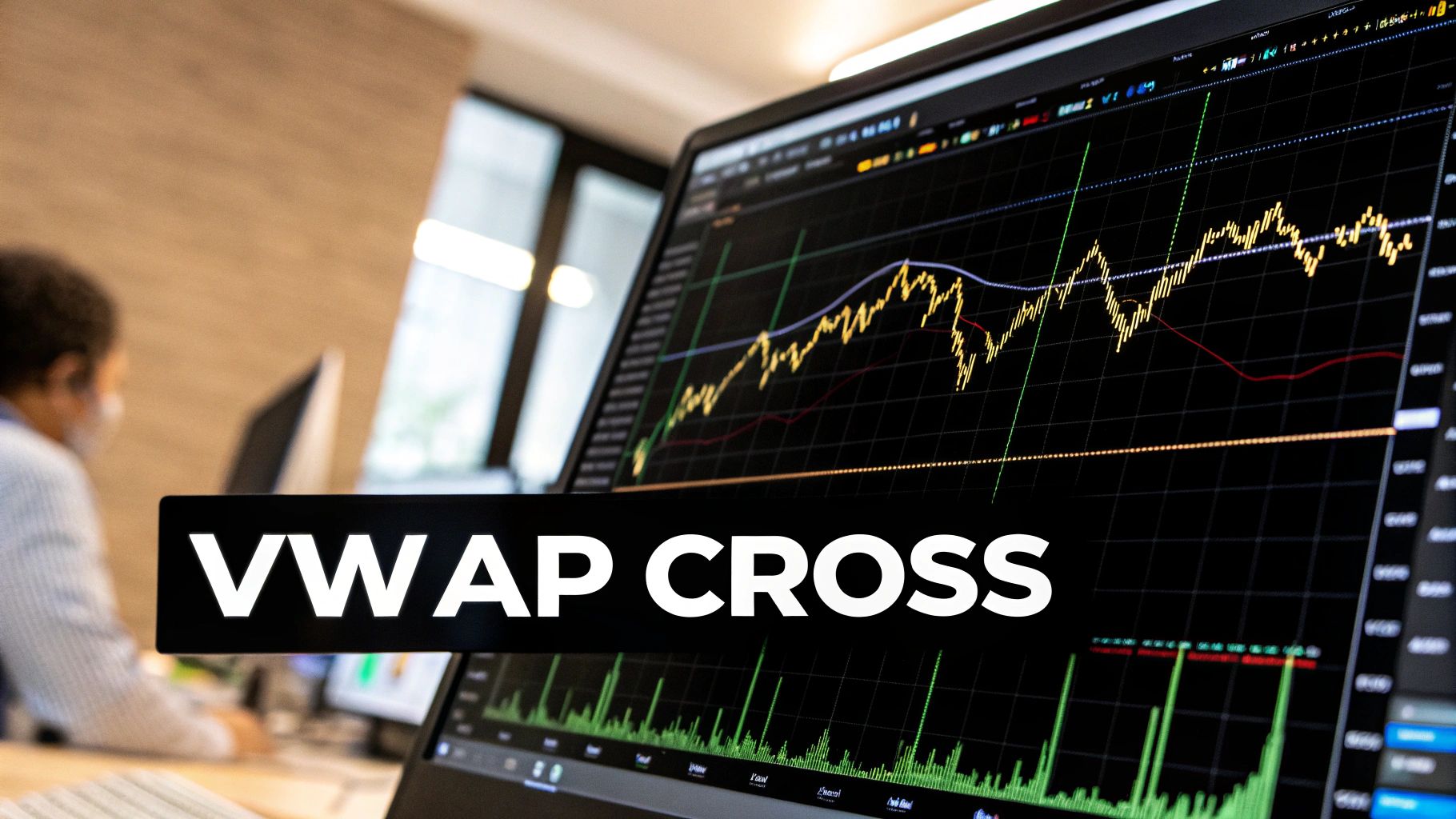
The VWAP Cross Strategy is a classic momentum-based approach that treats the VWAP line as a dynamic battlefield between buyers and sellers. Unlike the reversion strategy that bets against the trend, this method aims to ride the wave of a newly established trend. The core idea is that a price crossing over the VWAP signals a potential shift in market sentiment.
This strategy is favored by traders who want to confirm a change in intraday control. A cross above VWAP suggests that buyers are becoming more aggressive, indicating bullish momentum. Conversely, a cross below VWAP implies that sellers are gaining the upper hand, signaling bearish momentum. It’s one of the most direct VWAP trading strategies for capturing intraday trend shifts, but it is prone to false signals, or “whipsaws.”
Core Principles and Implementation
The goal is to enter a trade as a new intraday trend gains traction, using the VWAP line as the trigger. The challenge is distinguishing a genuine crossover from a fakeout. This requires patience and confirmation before committing to a position.
Entry Rules:
- For a Long (Buy) Trade: Wait for the price to cross and, crucially, close a full candle above the VWAP line. This confirmation is vital. The entry is taken on the open of the next candle.
- For a Short (Sell) Trade: Wait for the price to cross and close a full candle below the VWAP line. A confirmed close adds conviction that sellers have taken control.
Exit Rules:
- Profit Target: A common profit target is a key prior high (for longs) or low (for shorts). Alternatively, traders can use a risk-to-reward ratio, such as 2:1, or trail their stop loss until the price crosses back over the VWAP in the opposite direction.
- Stop Loss: Place the stop loss on the other side of the VWAP line, just below the low of the entry candle (for longs) or above the high (for shorts). If the price fails to hold the crossover and reverses, the trade thesis is invalidated.
Actionable Tips for Success
Successfully trading the VWAP cross is less about speed and more about confirmation and context.
- Confirm with a Volume Surge: A genuine crossover is almost always accompanied by a significant spike in volume. A cross on low volume is a red flag and has a higher probability of being a trap.
- Wait for the Candle Close: This cannot be stressed enough. Entering a trade the moment price touches the other side of the VWAP is a recipe for getting caught in whipsaws. A confirmed candle close above or below the line is a much stronger signal.
- Filter with a Moving Average: Add a longer-term moving average (e.g., the 200-period SMA) to the chart to define the overarching trend. Only take long VWAP crosses when the price is above the 200 SMA and short crosses when it’s below. This keeps you trading in the direction of the bigger picture.
3. Anchored VWAP Breakout Strategy
The Anchored VWAP Breakout Strategy ties the indicator to a specific, significant event rather than a fixed session. This approach creates a dynamic support and resistance level that reflects the volume-weighted average price from a moment that fundamentally changed market perception, offering a continuous, event-driven benchmark.
This strategy is built on the idea that market psychology shifts at key moments, such as earnings reports, major news events, or the formation of a significant high or low. By anchoring the VWAP to that specific candle, traders can visualize the “fair value” from that point forward. When the price breaks decisively above or below this anchored line, it signals a powerful shift in control.

Core Principles and Implementation
The goal is to use the anchored VWAP as a dynamic trend line. When price is above the line, the sentiment from the anchor point is considered bullish, and the line often acts as support. When price is below, sentiment is bearish, and the line acts as resistance. The breakout is the key signal.
Entry Rules:
- For a Long (Buy) Trade: Identify a significant event (e.g., strong earnings). Anchor the VWAP to this point. Wait for the price to consolidate near the anchored VWAP and then break convincingly above it on increased volume.
- For a Short (Sell) Trade: Anchor the VWAP to a negative catalyst (e.g., missed earnings). Wait for the price to rally back to the anchored VWAP line, fail to break above it, and then break down below a recent support level.
Exit Rules:
- Profit Target: A common target is a measured move based on the height of the prior consolidation range, or a key resistance (for longs) or support (for shorts) level on a higher timeframe.
- Stop Loss: Place a stop loss just below the anchored VWAP line after a long entry, or just above it after a short entry. A decisive close back across the anchored VWAP invalidates the breakout thesis.
Actionable Tips for Success
This is one of the more versatile VWAP trading strategies, as it can be applied across any timeframe.
- Choose Meaningful Anchors: The strategy’s effectiveness hinges on the significance of the anchor point. Use pivotal moments like earnings releases, Federal Reserve meeting dates for ETFs like SPY, or all-time highs. A random date will not provide a meaningful level.
- Practical Example: A company reports stellar earnings, and its stock gaps up at the open. Anchor a VWAP to the 9:30 AM opening candle. For the next three days, the stock pulls back to test this anchored VWAP line and bounces each time. The fourth test is your entry, showing institutional support remains strong.
- Use Multiple Anchors: Plot several anchored VWAPs from different significant events on the same chart. When price breaks through multiple anchored VWAPs, it signals a much stronger and more reliable trading opportunity.
4. VWAP and Moving Average Confluence Strategy
The VWAP and Moving Average Confluence Strategy elevates trade confirmation by layering two distinct but complementary indicators. This approach is built on the principle of confluence, where multiple, independent technical signals point to the same conclusion. When the session-based, volume-weighted VWAP aligns with a key price-based moving average, it creates a powerful zone of support or resistance.
This method effectively combines the “what” of price action (moving averages) with the “who” of market participation (VWAP’s volume weighting). A bounce from a 50-period moving average is significant, but a bounce from a level where the 50 MA and the VWAP are perfectly aligned signals that both price-action and volume-based traders see value at that level. This confluence acts as a high-probability filter.
Core Principles and Implementation
The primary goal is to identify price points where the VWAP and a significant moving average (like the 20 or 50 EMA) intersect. This creates a “confluence zone” that acts as dynamic support or resistance. A test and rejection of this zone provide a strong signal to enter a trade in the direction of the prevailing trend.
Entry Rules:
- For a Long (Buy) Trade: In an established uptrend, identify a zone where the VWAP and a key moving average are converging. Wait for the price to pull back and test this confluence zone. Enter after a bullish confirmation candle, like a pin bar, forms at this level.
- For a Short (Sell) Trade: In a clear downtrend, find where the VWAP and a moving average are aligned. Wait for the price to rally into this zone and show signs of rejection, such as a bearish candlestick pattern. Enter the short trade on this confirmation.
Exit Rules:
- Profit Target: A logical first target is the nearest significant swing high (for long trades) or swing low (for short trades). Traders can also use a risk-to-reward ratio, such as 1:2, to set profit targets.
- Stop Loss: Place the stop loss just below the confluence zone and the entry candle’s low for a long trade, or just above the zone for a short trade. If this fortified level breaks, the trade idea is invalidated.
Actionable Tips for Success
Of all the VWAP trading strategies, this one excels at confirming trend continuation.
- Use Exponential Moving Averages (EMAs): EMAs react more quickly to recent price changes. Using a 20 EMA or 50 EMA with VWAP can provide more timely signals. For more information, explore guides on how to use moving averages.
- Patience is Key: The highest probability trades occur when the price clearly tests the confluence zone and respects it. Wait for the confirmation candle to close before entering to avoid false breakouts.
- Practical Example: A stock is in a strong uptrend above its 50 EMA. It pulls back to the 50 EMA, which happens to be at the same price as the daily VWAP. The price touches this zone and a strong green candle forms. This is a high-probability long entry.
5. Volume Profile and VWAP Combination Strategy
Pairing the VWAP with a Volume Profile is like giving a trader a topographical map of the market’s terrain. While VWAP shows you the “fair price” based on volume, the Volume Profile reveals the specific price levels where the most significant trading has occurred. This combination offers a powerful, three-dimensional view of market dynamics.
This advanced strategy is used to pinpoint high-probability support and resistance zones based on historical volume concentration. The core idea is that levels with high trading volume (High-Volume Nodes or HVNs) represent areas of stability, while levels with low volume (Low-Volume Nodes or LVNs) represent rejection. When the VWAP line intersects with one of these key volume-derived levels, it creates a powerful confluence.
Core Principles and Implementation
The primary goal is to identify zones where both VWAP and a significant Volume Profile level align. The Volume Profile’s Point of Control (POC), the single price with the highest traded volume, is particularly important. A test of the VWAP that coincides with a test of the session’s POC is a very high-conviction setup.
Entry Rules:
- For a Long (Buy) Trade: Look for price to pull back to the VWAP line. The signal is strongest when the VWAP is also located within a High-Volume Node (HVN). This confirms buyers previously stepped in, making a bounce more likely.
- For a Short (Sell) Trade: Wait for price to rally up to the VWAP. An ideal entry occurs when the VWAP aligns with an HVN, indicating a price level the market has previously accepted as resistance.
Exit Rules:
- Profit Target: A logical first profit target is the nearest significant opposing level on the Volume Profile. For a long trade, the target might be the session POC or the next HVN above.
- Stop Loss: Place the stop loss on the other side of the high-volume structure. If entering long at an HVN confluent with VWAP, the stop should go just below that node, as a break would invalidate the support thesis.
Actionable Tips for Success
This is one of the more nuanced VWAP trading strategies, requiring a deeper understanding of market structure.
- Focus on Confluence: The power of this strategy comes from confluence. A trade where price tests the daily VWAP, the weekly VWAP, and a session POC simultaneously is an A+ setup. Do not trade based on just one of these signals in isolation.
- Watch for Volume Gaps (LVNs): Low-Volume Nodes act like a vacuum. If price breaks below an HVN/VWAP support level, it will often accelerate through the next LVN. These gaps make excellent profit targets.
- Practical Example: The S&P 500 futures are trending up. Price pulls back towards the VWAP, which is sitting right in the middle of a large High-Volume Node from the previous day. This is a prime area to look for a long entry, as both current and historical volume agree it’s a support zone.
6. Multi-Timeframe VWAP Strategy
The Multi-Timeframe VWAP Strategy elevates your market analysis by layering VWAP indicators from different time periods onto a single chart. This approach provides a powerful, three-dimensional view of the market, allowing traders to see how short-term price action aligns with larger, more dominant institutional trends.
This methodology is based on the principle of confluence. A stock trading above its daily VWAP is bullish for the session, but if it’s also holding above its weekly and monthly VWAP, it signals a powerful, institutionally-backed uptrend. This alignment provides a much stronger directional bias than relying on a single timeframe, helping traders avoid false signals and stay on the right side of the market’s true momentum.
The following infographic highlights the distinct role each VWAP timeframe plays in this strategy, from tactical entries to strategic trend assessment.
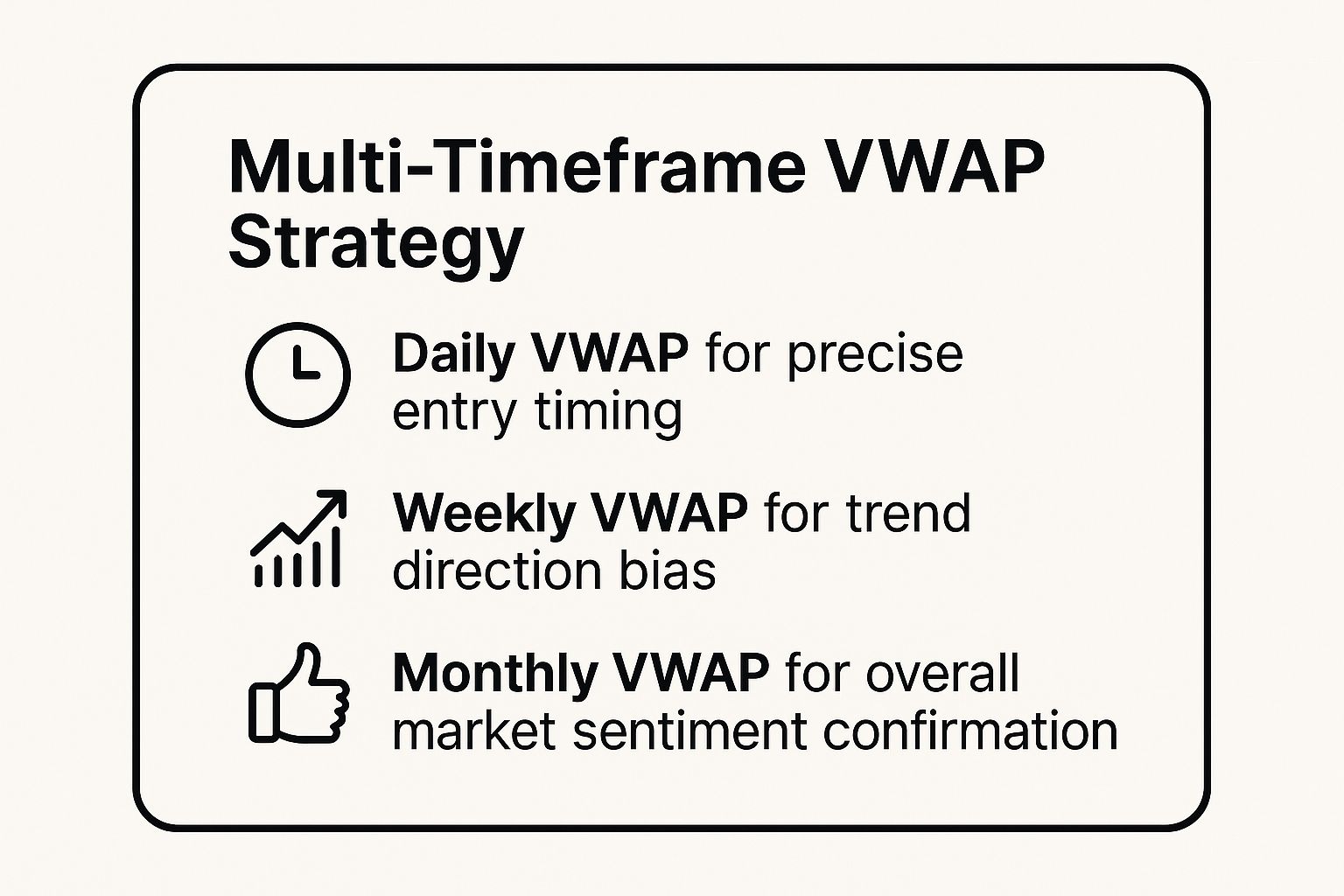
This hierarchy allows a trader to use longer-term VWAP levels as a compass for overall direction while using the shorter-term VWAP as a map for precise navigation.
Core Principles and Implementation
The goal is to trade in the direction of the higher-timeframe VWAP while using the lower-timeframe VWAP for entry triggers. This filters out counter-trend noise and positions you alongside the dominant market flow. This long-term thinking helps build a sustainable approach.
Entry Rules:
- For a Long (Buy) Trade: The price must be trading above the higher-timeframe VWAPs (e.g., weekly and monthly). Enter when the price pulls back to the daily VWAP and shows signs of support.
- For a Short (Sell) Trade: The price must be trading below the higher-timeframe VWAPs. Enter when the price rallies up to the daily VWAP and shows signs of resistance.
Exit Rules:
- Profit Target: Set initial profit targets at nearby resistance levels. A more dynamic exit is to trail the stop loss under the rising daily VWAP, staying in the trade as long as the short-term trend remains intact.
- Stop Loss: Place a stop loss below the recent swing low (for longs) or above the recent swing high (for shorts) that formed around the daily VWAP entry point.
Actionable Tips for Success
Among VWAP trading strategies, this method requires patience and a top-down analytical approach.
- Establish a Clear Hierarchy: Always define the role of each VWAP. For a day trader, the daily VWAP is the entry trigger, the weekly VWAP is the trend filter, and the monthly VWAP is the “big picture” context.
- Look for VWAP “Stacking”: The most powerful signals occur when VWAPs from different timeframes are stacked on top of each other and all trending in the same direction. For instance, in a strong uptrend, you’ll see the daily VWAP above the weekly VWAP, which is above the monthly VWAP.
- Integrate with Algorithmic Systems: The objective rules of this strategy make it well-suited for automation. Learn more about how these principles can be applied in automated trading systems.
7. VWAP Pullback Strategy
The VWAP Pullback Strategy is a classic trend-following technique that allows traders to join an established trend at a high-probability entry point. Instead of chasing a fast-moving price, this method requires patience, waiting for the price to temporarily pull back to the VWAP. In a strong trend, the VWAP often acts as a dynamic level of support (in an uptrend) or resistance (in a downtrend).
This strategy is built on the principle that trends don’t move in straight lines; they ebb and flow. A pullback to the VWAP represents a moment of temporary profit-taking or consolidation before the dominant trend resumes. By entering at the VWAP, traders position themselves at a value area, improving the odds of the trend continuing in their favor. It’s a disciplined approach that prevents buying at the top or shorting at the bottom.
Core Principles and Implementation
The primary objective is to identify a clear, established trend and then wait for a lower-risk entry as the price revisits the VWAP. This differs from the reversion strategy because you are trading with the prevailing momentum, not against it.
Entry Rules:
- For a Long (Buy) Trade: First, confirm a clear uptrend (price making higher highs and lows). Wait for the price to pull back and touch the VWAP. Enter long once you see a bullish confirmation candle, like a hammer, forming at the VWAP.
- For a Short (Sell) Trade: Confirm a clear downtrend. Wait for the price to rally back up to the VWAP. Enter short after a bearish confirmation candle forms, signaling rejection of the VWAP as resistance.
Exit Rules:
- Profit Target: A common profit target is the previous swing high (for long trades) or swing low (for short trades). More advanced traders might use a trailing stop.
- Stop Loss: Place the stop loss just below the recent swing low that formed during the pullback (for longs) or just above the recent swing high (for shorts). If the price breaks this structure, the trend may be failing.
Actionable Tips for Success
Successfully trading pullbacks requires more than just watching one line; it demands an understanding of trend strength and confirmation.
- Confirm with Oscillators: Use indicators like the RSI or Stochastics. In an uptrend, a long entry is stronger if the RSI is turning up from an oversold condition as the price tests the VWAP.
- Trend Confirmation is Key: Do not attempt this strategy in a choppy, range-bound market. The trend should be well-established. Look for multiple tests of the VWAP holding as support/resistance to validate the trend’s strength.
- Practical Example: After a strong opening drive, stock ABC has been making higher highs and higher lows for an hour. It then slowly drifts down and touches the VWAP line. A bullish engulfing candle prints right at the VWAP. This is a classic pullback entry to rejoin the uptrend. Validating this and other approaches requires a systematic approach; you can learn more about backtesting trading strategies on TradeReview to refine your entry and exit rules.
7 VWAP Trading Strategies Comparison
| Strategy | Implementation Complexity 🔄 | Resource Requirements 🔄 | Expected Outcomes 📊 | Ideal Use Cases 💡 | Key Advantages ⭐⚡ |
|---|---|---|---|---|---|
| VWAP Reversion Strategy | Medium – needs real-time VWAP and monitoring | Moderate – real-time data and quick execution | High probability in range-bound markets 📊 | Intraday scalping, sideways markets | Clear signals, effective risk management ⭐ |
| VWAP Cross Strategy | Low – simple price-VWAP cross signals | Low – basic VWAP and volume data | Good for trending markets 📊 | Swing trading, trending markets | Easy implementation, captures early moves ⭐⚡ |
| Anchored VWAP Breakout Strategy | Medium-High – requires event selection and analysis | Moderate – needs event data & VWAP from anchors | Clear trend change signals 📊 | Swing trading around earnings/major events | Institutional relevance, strong risk levels ⭐ |
| VWAP and Moving Average Confluence Strategy | Medium-High – monitoring multiple indicators | Moderate to High – multiple MA and VWAP | Higher probability trades 📊 | Trend-following and reversal trades | Reduces false signals, adaptable ⭐ |
| Volume Profile and VWAP Combination Strategy | High – complex volume and price analysis | High – advanced charting & volume profile | Deep market insights, high-probability zones 📊 | Day & swing trading with institutional focus | Sophisticated, excellent market structure insights ⭐⚡ |
| Multi-Timeframe VWAP Strategy | Medium-High – analyze multiple VWAP timeframes | Moderate – requires multiple timeframe VWAP data | Comprehensive market perspective 📊 | Swing and position trading | Aligns with longer trends, multiple confirmations ⭐ |
| VWAP Pullback Strategy | Medium – trend identification + VWAP timing | Moderate – VWAP and momentum indicators | Better risk-reward entries 📊 | Day and swing trading in established trends | Superior entry timing, works across markets ⭐ |
From Strategy to Execution: The Role of Discipline and Data
Throughout this article, we’ve dissected seven distinct vwap trading strategies. We’ve explored how combining VWAP with tools like Moving Averages or Volume Profile can create powerful confluence, and how a Multi-Timeframe approach adds a crucial layer of context to your analysis. Each strategy offers a unique lens through which to view market dynamics.
However, knowing the rules is only the first step. The true path to consistent trading lies not in finding a “perfect” system, but in mastering your execution. The most significant differentiator between a struggling trader and a successful one is often not the strategy itself, but the discipline to follow it flawlessly and the diligence to analyze performance objectively.
The Unspoken Truth: Discipline Overcomes Flawless Strategy
It’s a reality every trader must face: you will have losing trades. A strategy might look perfect on paper, but volatile markets or simple statistical probability will inevitably lead to drawdowns. This is the moment where your trading psychology is tested.
Do you abandon your VWAP Reversion rules after two consecutive losses, only to watch the third setup work perfectly without you? Do you widen your stop-loss on an Anchored VWAP trade based on hope rather than a pre-defined plan? These emotional decisions, not the strategy itself, are the primary cause of blown accounts.
The ultimate goal is not just to follow a set of VWAP trading strategies, but to build a system of execution and review that turns you into a disciplined, data-driven trader. Your edge is forged in consistency, not in the hunt for a flawless indicator.
Transforming Knowledge into Actionable Edge
The transition from a theoretical understanding of vwap trading strategies to practical mastery requires a structured, deliberate approach. The key is to treat your trading like a business, and every trade is a piece of inventory that provides valuable data.
Here are the actionable next steps to turn this article’s insights into a tangible edge:
- Focus on One, Master One: Instead of trying to implement all seven strategies at once, choose the one that most resonates with your trading style. Backtest it, then forward-test it in a demo account to build confidence.
- Define Your Plan in Writing: For your chosen strategy, write down every single rule. What constitutes a valid entry signal? Where is your initial stop-loss placed? What are your exact profit targets? Having this document removes ambiguity in the heat of the moment.
- Meticulous Record-Keeping: This is non-negotiable. Every trade you take — win or lose — must be logged. But don’t just record the numbers. Note the specific VWAP strategy used, your emotional state, and why you took the trade. This journal becomes your personal performance playbook.
- Systematic Weekly Review: Set aside time each week to analyze your trades. Did you follow your rules? Where did you deviate? Are certain strategies performing better on specific assets? This data-driven feedback loop is how you systematically identify weaknesses and reinforce strengths.
By committing to this process, you move beyond simply “using” an indicator. You begin to build a robust, personalized trading system where the VWAP is a tool, but your discipline and analytical rigor are the true engine of your long-term success. You start making decisions based on evidence from your own performance, not on emotion or impulse. This is the cornerstone of a sustainable trading career.
Ready to transform your trading data into actionable insights? The best vwap trading strategies are only as good as your ability to track, analyze, and refine them, and TradeReview is the professional-grade tool built for exactly that. Start your journey toward data-driven discipline and discover your true edge by journaling your trades with TradeReview today.