The conversation around high-paying careers often orbits around tech startups and corporate ladders, leaving a massive, lucrative world unexplored: the skilled trades. Many mistakenly believe these roles offer limited income, but the reality is quite different. The demand for specialized, hands-on expertise is surging, and compensation is rising to match. In fact, according to a 2023 report from Angi, 77% of trade businesses report challenges in finding skilled workers — a factor that directly impacts earning potential for qualified professionals.
If you’re asking, “What trades make the most money?” you’re on the right track to a stable, high-earning, and fulfilling career path. This guide moves beyond assumptions to provide a clear, data-backed look at the trades that not only build our world but can also build significant wealth for those who master them. We are not just listing jobs; we are breaking down the specific roles and specializations that command the highest salaries and offer the most robust career growth.
This comprehensive list will explore the top-earning skilled professions, from electricians and HVAC technicians to highly specialized roles like elevator mechanics and commercial divers. For each trade, we will detail:
- Realistic Income Potential: What you might expect to earn from apprentice to master levels, keeping in mind that there are no guarantees of profit.
- Required Skills and Training: The specific certifications and education needed to build a successful long-term career.
- Career Trajectory: How to advance and maximize your earnings over time through discipline and strategic choices.
This article is your roadmap to understanding where the real money is in the skilled trades. We’ll show you exactly how these hands-on careers can provide a financially secure future, often without the need for a traditional four-year degree and the debt that comes with it.
1. Electrician
Electricians are the highly skilled professionals responsible for designing, installing, maintaining, and repairing the electrical systems that power our world. They work in a variety of settings, from residential homes and commercial office buildings to large-scale industrial factories and renewable energy facilities. This trade consistently ranks as one of the answers to “what trades make the most money” due to its critical importance, rigorous licensing requirements, and the high level of technical expertise and safety knowledge required.

The path to becoming a master electrician involves years of apprenticeship and on-the-job training, culminating in state-mandated licensure that commands premium pay. A career as an electrician is not just a job; it’s a commitment to a lifelong learning process involving new technologies, updated safety codes, and specialized skills. It can be a tough journey, but the rewards are there for those who persevere.
Paths to High Earnings
Success as an electrician often involves strategic specialization and business acumen. While general residential work provides a steady foundation, significant income potential lies in niche, high-demand areas.
- Commercial & Industrial: Electricians wiring new data centers, hospitals, or manufacturing plants command higher wages due to the complexity and scale of the projects. For example, a commercial electrician might spend months on a single project wiring a new office tower, a role that demands deep knowledge of complex blueprints and high-voltage systems.
- Renewable Energy: Specializing in the installation and maintenance of solar panel systems, wind turbines, or electric vehicle charging stations places an electrician at the forefront of a rapidly growing sector.
- Self-Employment: Many experienced electricians start their own contracting businesses. This path offers the highest earning potential but also requires strong business management skills. Just as a trader must meticulously track every transaction, a self-employed electrician needs to manage project bids, material costs, labor expenses, and client invoicing with precision. The principles of diligent record-keeping and analysis are universal keys to profitability.
Key Insight: The highest-paid electricians often combine elite technical skills with entrepreneurial drive, managing teams and large-scale projects as electrical contractors. Success in this field, much like in trading, requires a solid understanding of both the craft and the principles of long-term planning and risk management.
2. Plumber
Plumbers are the essential tradespeople who install, maintain, and repair the complex piping systems for water, drainage, and gas in our homes, businesses, and industrial facilities. This trade is consistently a top earner because it is a critical, non-negotiable service. When a pipe bursts or a sewer line backs up, it’s not an optional repair; it requires immediate, skilled intervention. This constant, recession-resistant demand is a primary reason plumbing is a reliable answer to the question “what trades make the most money.”
The journey to becoming a licensed plumber requires a rigorous apprenticeship, extensive on-the-job training, and a deep understanding of state and local building codes. This high barrier to entry ensures that qualified professionals are well-compensated for their expertise, problem-solving skills, and ability to work in challenging conditions.
Paths to High Earnings
Maximizing income as a plumber often comes down to specialization and operational efficiency. While general residential service provides a solid income stream, the highest earnings are found in specific, high-value niches.
- Emergency Services: Plumbers who are available for after-hours and weekend emergency calls can command premium rates. This high-stress, high-reward work is a significant income driver. Think of the homeowner with a flooded basement on a holiday weekend — they need an expert, and they need one now.
- Specialized Commercial Work: Focusing on areas like medical gas piping in hospitals, backflow prevention systems, or large-scale installations for new commercial construction requires advanced certification and commands top-tier wages.
- Business Ownership: Like electricians, many experienced plumbers become independent contractors. Running your own plumbing business offers the highest ceiling for earnings. Success here hinges on meticulous management of job scheduling, material inventory, and client billing. A well-structured business plan is just as vital for a plumbing contractor as it is for a professional trader, outlining goals, operational strategies, and financial targets.
Key Insight: The most profitable plumbers often operate their own businesses, focusing on high-margin emergency services or specialized commercial contracts. Their success is built on a foundation of technical mastery combined with sharp business acumen and a strong reputation for reliability.
3. HVAC Technician
HVAC (Heating, Ventilation, and Air Conditioning) technicians are the essential experts who install, maintain, and repair the complex climate control systems that keep us comfortable and safe. They work in every type of building, from single-family homes and sprawling commercial complexes to critical environments like hospitals and data centers. This trade is a consistent high-earner because its services are non-negotiable necessities, requiring specialized certification and a blend of mechanical, electrical, and problem-solving skills.
The journey to becoming a master HVAC technician involves formal training, apprenticeship, and crucial certifications, such as the EPA Section 608 certification for handling refrigerants. A career in HVAC is not static; it demands continuous learning to keep pace with smart home technology, energy-efficient systems, and evolving environmental regulations, making it a dynamic and rewarding field.
Paths to High Earnings
Maximizing income as an HVAC technician means moving beyond standard residential service calls and into more profitable, specialized areas. While residential work offers stability, the highest salaries are found in technically demanding and large-scale applications.
- Commercial & Industrial: Servicing large-scale systems in office buildings, factories, or hospitals is more complex and lucrative than residential work. These roles often come with higher base pay and more opportunities for overtime. A practical example is an HVAC tech specializing in data center cooling, where uptime is critical and specialized knowledge is a must.
- Energy Efficiency & Green Technology: Specializing in retrofitting older buildings with modern, high-efficiency systems or installing geothermal and other green HVAC technologies positions a technician in a high-demand, premium market.
- Starting an HVAC Business: Entrepreneurial technicians can achieve the highest earning potential by starting their own contracting company. This path requires a sharp understanding of business fundamentals like bidding, managing overhead, and marketing. A successful owner must accurately project costs and profitability for each job, similar to how a trader must calculate the return on investment for every trade to ensure long-term growth.
Key Insight: Top-earning HVAC professionals combine deep technical expertise with a strong customer service reputation, often leveraging that into a successful business. Much like a disciplined trader analyzing market conditions, a successful HVAC contractor must manage seasonal demand, project costs, and client relationships to maximize profitability.
4. Welding Specialist
Welding specialists are the highly skilled artisans and technicians who fuse metal components together, creating the strong, seamless joints that are the backbone of modern industry. They work in diverse and often demanding environments, from skyscraper construction sites and automotive manufacturing floors to deep-sea oil rigs and aerospace facilities. This trade is a consistent answer to “what trades make the most money” because it requires immense precision, physical dexterity, and certifications for specialized, high-stakes applications.

The journey to becoming a top-tier welder involves extensive hands-on training and a commitment to earning advanced credentials. Master welders must understand metallurgy (the science of metals), blueprint reading, and various complex welding processes. A career in welding is not just a manual job; it’s a craft that demands continuous skill development to work with new materials and advanced techniques.
Paths to High Earnings
Maximizing income as a welder requires moving beyond basic fabrication into specialized, high-consequence fields. While general welding provides a stable career, the highest earning potential is found in niches that demand expert-level skill and a willingness to work in challenging conditions.
- Pipeline & Energy: Welders working on oil and gas pipelines often travel to remote locations and command high salaries due to the critical nature and difficulty of the work. This path requires discipline and resilience but can be very rewarding.
- Aerospace & Defense: Specializing in welding exotic alloys like titanium for aircraft or spacecraft components requires meticulous precision and extensive certifications, leading to premium compensation.
- Underwater Welding: This is one of the most dangerous yet lucrative specializations. Commercial divers with elite welding skills who maintain underwater structures like oil rigs and bridges can earn some of the highest incomes in any skilled trade.
Key Insight: The most financially successful welders build a reputation for flawless work in high-demand specialties. Similar to a trader who focuses on a specific market or strategy, a welder who masters a niche like TIG welding for aerospace or underwater hyperbaric welding can command exceptional pay for their rare and critical expertise.
5. Carpenter
Carpenters are the foundational builders of our environment, responsible for constructing, installing, and repairing the wooden structures and fixtures that define our homes and commercial spaces. They work across a vast spectrum, from the rough framing of a new building to the intricate detail of custom cabinetry. This trade consistently earns a spot on lists of “what trades make the most money” because it rewards precision, specialized skill, and entrepreneurial initiative in a perpetually in-demand field.
The journey from an apprentice to a master carpenter involves extensive hands-on experience, learning to translate blueprints into tangible structures. A career in carpentry is a commitment to craftsmanship, problem-solving, and continuous learning as new materials, tools, and building techniques emerge.
Paths to High Earnings
Achieving top-tier income as a carpenter depends heavily on moving beyond general labor into specialized niches or business ownership. While general construction provides a solid career, the highest earnings are found in areas requiring a master’s touch.
- Finish & Custom Carpentry: Finish carpenters who install custom trim, elegant built-ins, and high-end cabinetry can command premium rates for their meticulous work. A practical example is a carpenter who builds a reputation for creating custom entertainment centers or kitchen islands, often securing work through word-of-mouth in affluent neighborhoods.
- Restoration & Preservation: Specializing in the restoration of historic buildings requires unique knowledge of traditional techniques and materials. This niche skill set is rare and highly valued, leading to lucrative contracts on preservation projects.
- Independent Contracting: The most direct path to significant earnings is by starting a carpentry or general contracting business. This move requires sharp business skills to manage project bids, material procurement, labor costs, and client relationships effectively. A successful contractor must track every financial detail with precision to ensure profitability and growth.
Key Insight: The highest-paid carpenters are often business owners who have cultivated a reputation for exceptional quality and reliability. Their success stems from combining mastery of their craft with the strategic acumen to run a profitable enterprise.
6. Elevator Mechanic/Technician
Elevator and escalator mechanics install, maintain, and repair the complex vertical transportation systems that are essential to modern life. They work on everything from residential elevators to the high-speed systems in skyscrapers and the escalators in shopping malls and airports. This trade is a consistent frontrunner for “what trades make the most money” because of its highly specialized skill set, rigorous safety standards, and the limited pool of qualified professionals.
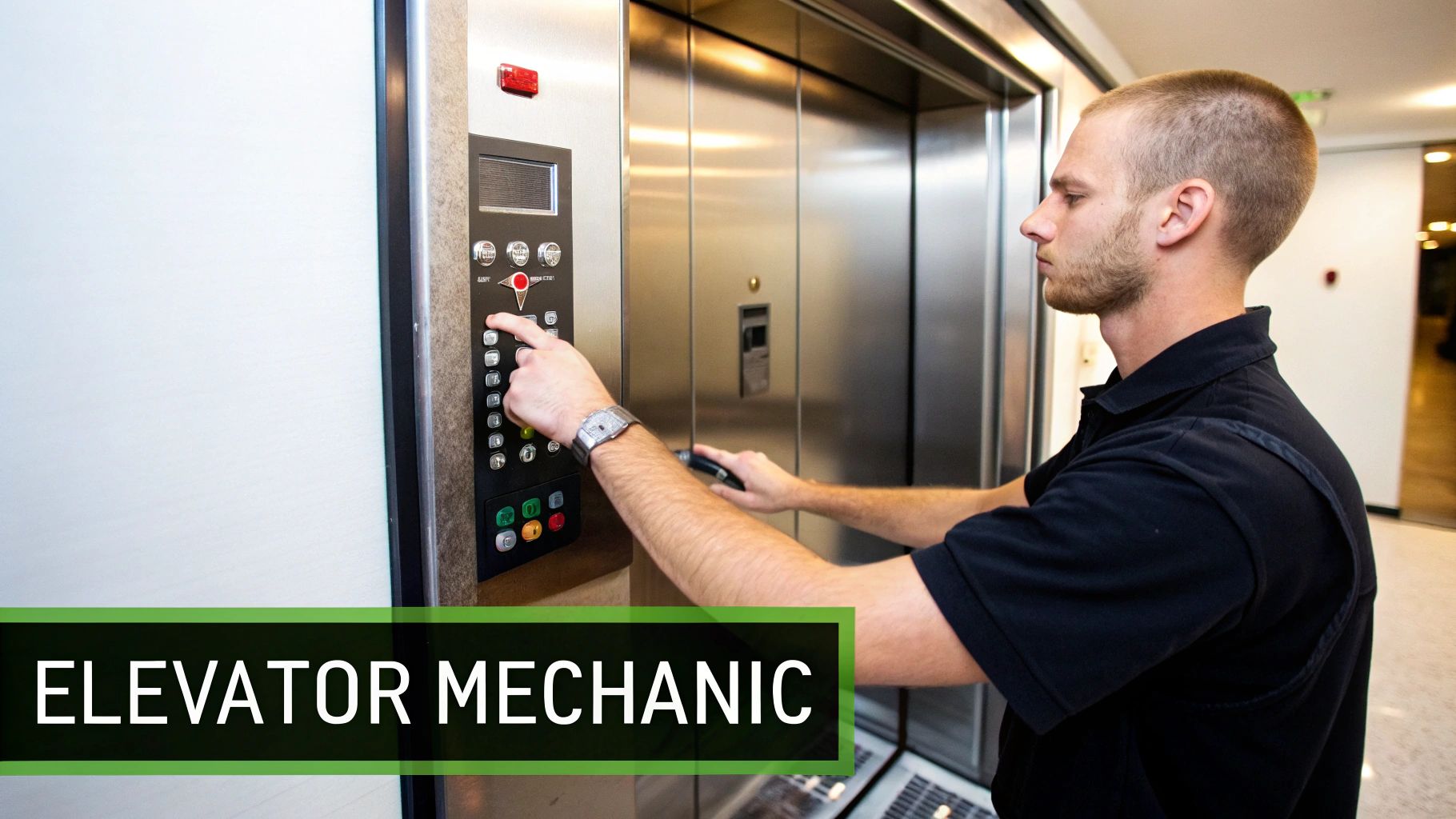
The journey to becoming a qualified elevator mechanic involves a demanding multi-year apprenticeship, extensive on-the-job training, and passing certification exams. The non-negotiable emphasis on public safety means that these technicians command some of the highest wages in the skilled trades, often backed by strong union representation that negotiates excellent pay and benefits.
Paths to High Earnings
Maximizing income as an elevator mechanic often depends on location, specialization, and career advancement. While standard maintenance roles provide a lucrative and stable career, certain paths offer even greater financial rewards.
- Union Apprenticeship: The most direct route to top-tier earnings is through a union-sponsored apprenticeship, such as those offered by the International Union of Elevator Constructors (IUEC). These programs provide structured training and place graduates into high-paying roles.
- Major Metropolitan Areas: Technicians working in major cities with numerous high-rise buildings, like New York or Chicago, typically earn the highest wages due to high demand and higher costs of living.
- Specialization & Advancement: Focusing on new construction installations for major projects or modernizing older systems can lead to higher pay. With experience, advancing to a supervisory, inspector, or management role provides another significant boost in earning potential.
- Emergency & On-Call Work: Technicians available for emergency, after-hours, or weekend repair calls can substantially increase their income through overtime pay and specialized rates, which is a common requirement in this field.
Key Insight: The exceptional earnings of an elevator mechanic are a direct result of the high barrier to entry and the critical, life-safety nature of the work. Similar to a trader executing a complex options strategy, the role requires deep technical knowledge, precision, and an unwavering commitment to risk management protocols where mistakes are not an option.
7. Crane Operator
Crane operators are the highly skilled professionals responsible for controlling heavy machinery used to lift, move, and position massive objects and materials. They are indispensable figures on large construction sites, in busy ports, manufacturing plants, and mining operations. This trade is a consistent answer to the question of “what trades make the most money” due to the immense responsibility, specialized skill set, and critical safety awareness required to operate multi-million dollar equipment.
The journey to becoming a proficient crane operator involves extensive training, rigorous certification processes like those from the National Commission for the Certification of Crane Operators (NCCCO), and countless hours of hands-on experience. A career as a crane operator is not just a job; it is a commitment to precision, safety, and operational excellence, where a single miscalculation can have significant consequences.
Paths to High Earnings
Success as a crane operator often depends on specialization in high-demand equipment and building a reputation for reliability and safety. While general mobile crane operation offers a solid career, the highest income potential lies in niche, complex roles.
- Tower Crane Specialization: Operators who control tower cranes on high-rise building projects are among the highest-paid, as this requires working at extreme heights and demonstrating exceptional spatial judgment.
- Heavy-Lift & Specialized Cranes: Proficiency with heavy-lift mobile or crawler cranes for infrastructure projects like bridges, wind turbines, or industrial plant construction commands premium wages due to the complexity and value of the lifts. For example, an operator certified to place massive wind turbine blades is a highly sought-after specialist.
- Port Operations: Operating gantry cranes to load and unload massive container ships is a high-pressure, high-reward specialization vital to global trade and supply chains. Getting certified on multiple crane types significantly increases an operator’s versatility and earning power.
Key Insight: The highest-paid crane operators often possess elite certifications for the most complex machinery and have an impeccable safety record. Much like a trader analyzing market volatility, a crane operator must constantly assess variables like wind, load balance, and ground stability to manage risk and execute flawlessly.
8. HVAC Service Manager/Commercial Refrigeration Specialist
HVAC and refrigeration specialists are the experts responsible for the complex climate control and cooling systems that are vital to modern life. They install, maintain, and repair everything from standard heating and air conditioning units to the large-scale commercial refrigeration systems used in supermarkets, restaurants, and industrial cold storage facilities. This trade is a consistent high-earner because it requires specialized knowledge of thermodynamics, electrical systems, and refrigerant handling, all governed by strict safety and environmental regulations.
Becoming an expert in this field involves extensive apprenticeship, hands-on training, and mandatory certifications, such as the EPA Section 608 certification for handling refrigerants. The non-negotiable need for these systems to be operational 24/7 means that skilled technicians who can solve complex problems under pressure are always in high demand and can command significant pay.
Paths to High Earnings
The highest incomes in this field are found by moving beyond residential work and into specialized commercial niches or management roles. Strategic focus and a commitment to ongoing education are key differentiators.
- Commercial & Industrial Specialization: Technicians who service restaurant chains, supermarket refrigeration systems, or industrial cold storage facilities earn premium wages. These systems are more complex and their failure results in costly business interruptions, making expert service invaluable.
- Emergency Response Services: Building a reputation for rapid and reliable emergency repair is highly lucrative. Businesses will pay a premium for after-hours or weekend service to prevent thousands of dollars in spoiled inventory, turning urgent problems into profitable opportunities.
- Management & Business Ownership: Transitioning into an HVAC Service Manager role or starting an independent contracting business represents the highest earning potential. This requires managing service calls, technician schedules, inventory, and client relationships. Just as a trader analyzes market patterns, a successful owner must track service call profitability and customer data to optimize pricing and resource allocation.
Key Insight: The most successful professionals in this trade often specialize in high-stakes commercial refrigeration where system uptime is critical. Like a trader managing a volatile portfolio, they must possess deep technical knowledge and the ability to make correct, high-pressure decisions when failure is not an option.
9. Power Plant Operator/Nuclear Plant Technician
Power plant operators and nuclear technicians are the highly trained professionals who manage, control, and maintain the complex systems that generate electricity. They work in critical infrastructure settings, from traditional fossil fuel and nuclear facilities to modern renewable energy farms, ensuring a stable power supply for millions. This trade is a definitive answer to “what trades make the most money” because of the immense responsibility, specialized technical knowledge, and rigorous safety protocols involved.
The path to becoming a qualified operator involves extensive education, apprenticeships, and passing strict certification exams, especially for nuclear roles which require federal licensing and security clearances. This high barrier to entry ensures that skilled operators are always in demand and can command significant salaries. A career in power generation is a long-term commitment to precision, safety, and continuous learning in a technologically advancing field.
Paths to High Earnings
Maximizing income in this trade involves specialization in high-stakes environments and a clear path toward leadership. While all operator roles are well-compensated, certain areas offer a significant financial advantage.
- Nuclear Facilities: Technicians and control room operators in nuclear power plants are among the highest-paid in the industry due to the complexity of reactor systems and the stringent safety and regulatory requirements.
- Renewable Energy Management: As the world shifts to green energy, operators skilled in managing large-scale solar fields, wind turbine farms, or hydroelectric dams are becoming increasingly valuable.
- Advancement to Management: A common career progression is moving from an operator to a shift supervisor and eventually a plant manager. These leadership roles come with a substantial increase in responsibility and compensation. A successful manager must analyze system performance data just as a trader analyzes market data, making informed decisions to optimize output and prevent costly downtime.
Key Insight: The most lucrative careers in power generation are found in highly regulated sectors like nuclear energy or in leadership roles. Success hinges on a combination of deep technical expertise, unwavering adherence to safety protocols, and the ability to manage complex systems under pressure, similar to a trader managing a high-stakes portfolio.
10. Commercial Diver (Underwater Welding/Inspection)
Commercial divers are elite tradespeople who perform complex construction, inspection, repair, and welding tasks in underwater environments. They work on critical infrastructure like offshore oil rigs, subsea pipelines, dams, and bridges. This physically demanding trade is consistently one of the most lucrative answers to “what trades make the most money” because it combines high-risk conditions with an exceptionally rare and specialized skill set, commanding premium compensation.
The journey to becoming a commercial diver involves rigorous training, multiple certifications, and maintaining peak physical fitness. It is a career that operates at the extremes, requiring immense technical proficiency, mental fortitude, and a deep commitment to safety protocols. It’s a challenging path, and not for everyone, but those who succeed are rewarded with some of the highest incomes available in the skilled trades.
Paths to High Earnings
Maximizing income as a commercial diver hinges on specialization and gaining experience in the most challenging and in-demand sectors. While general inland diving provides a solid career, the highest pay grades are found in specialized offshore and saturation diving roles.
- Underwater Welding: Achieving certification as a welder-diver, particularly in “wet” or hyperbaric welding (welding in a dry, pressurized environment underwater), opens the door to the highest-paying jobs. Repairing offshore oil platforms or subsea pipelines is a critical and highly compensated skill.
- Saturation Diving: This advanced field allows divers to live and work at extreme depths for weeks at a time, eliminating the need for daily decompression. Saturation divers working on deep-sea oil and gas projects often earn top-tier salaries due to the immense risks and technical demands.
- Offshore Infrastructure: Focusing on the installation and maintenance of offshore wind farms or communication cables positions a diver within a growing and technologically advanced industry, securing long-term high-earning potential.
Key Insight: The most successful commercial divers are masters of a specific underwater skill, like welding or non-destructive testing, and possess an unwavering commitment to safety and physical conditioning. Their earnings reflect the extreme environment and the critical importance of their work on global energy and communication infrastructure.
Top 10 Highest-Paying Trades Comparison
| Trade | 🔄 Implementation complexity | ⚡ Resource & training requirements | 📊 Expected outcomes (salary & demand) | 💡 Ideal use cases | ⭐ Key advantages |
|---|---|---|---|---|---|
| Electrician | 🔄 Moderate–High: long apprenticeship; code-intensive | ⚡ Apprenticeship 4–5 yrs; state license; specialized tools | 📊 Median pay for electricians was $60,240/year in 2022 (BLS); strong, consistent demand | 💡 Residential, commercial, industrial, renewables; contracting | ⭐ Reliable income; multiple specializations; self-employment potential |
| Plumber | 🔄 Moderate–High: code knowledge; troubleshooting in tight spaces | ⚡ Apprenticeship 4–5 yrs; licensing; plumbing tools & emergency readiness | 📊 Median pay for plumbers was $60,370/year in 2022 (BLS); recession-resistant demand | 💡 Emergency repairs, new construction, high-margin niches (backflow/septic) | ⭐ Steady demand; premium emergency rates; contractor opportunities |
| HVAC Technician | 🔄 Moderate: technical systems with seasonal peaks | ⚡ EPA cert + manufacturer training; 6 months–5 yrs depending on role | 📊 Median pay for HVAC/R mechanics was $57,460/year in 2022 (BLS); year-round demand | 💡 Residential/commercial service, energy-efficiency retrofits | ⭐ Growing demand; tech integration; varied career paths |
| Welding Specialist | 🔄 High: precision work with strict quality standards | ⚡ AWS or equivalent certifications; 6 months–2 yrs entry, advanced for specialties | 📊 Median pay for welders was $47,540/year in 2022 (BLS), but highly specialized roles pay much more | 💡 Structural, pipeline, aerospace, underwater/exotic materials | ⭐ High pay for certified specialists; portable skills; fast basic entry |
| Carpenter | 🔄 Low–Moderate: skill-based trade with varied niches | ⚡ On-the-job training/apprenticeship; tool investment moderate | 📊 Median pay for carpenters was $51,390/year in 2022 (BLS); demand tied to construction | 💡 Framing, finish carpentry, cabinetry, restoration, custom work | ⭐ Flexible work settings; visible results; contractor scalability |
| Elevator Mechanic/Technician | 🔄 Very High: safety-critical, technical complexity | ⚡ 4–5 yr union apprenticeship common; strict certifications & safety training | 📊 Median pay for elevator installers/repairers was $99,000/year in 2022 (BLS); strong job security | 💡 High-rise installations, building maintenance, union jobs | ⭐ Top pay; excellent benefits/pensions; limited competition |
| Crane Operator | 🔄 Moderate: high responsibility; precise operation | ⚡ NCCCO or equivalent certification per crane type; simulator/equipment training | 📊 Median pay for crane operators was $61,550/year in 2022 (BLS); project-based with premium rates | 💡 Tower/mobile/overhead crane work on large construction or port projects | ⭐ Premium pay for certified operators; advancement opportunities |
| HVAC Service Manager / Commercial Refrigeration Specialist | 🔄 High: combines HVAC complexity with refrigerant safety | ⚡ EPA Section 608 (all types); commercial refrigeration training | 📊 Higher than general HVAC; potential for $60k–$95k+ with experience | 💡 Supermarkets, restaurants, cold storage, industrial refrigeration | ⭐ Premium pricing; essential business-critical services; recurring contracts |
| Power Plant Operator / Nuclear Tech | 🔄 Very High: technical, regulatory, and safety complexity | ⚡ Extensive employer training, licenses, security clearances; shift readiness | 📊 Median pay for nuclear technicians was $101,590/year in 2022 (BLS) | 💡 Fossil, nuclear, and renewable generation control rooms and operations | ⭐ High compensation; strong job stability; comprehensive benefits/pensions |
| Commercial Diver (Underwater Welding/Inspection) | 🔄 Extremely High: hazardous, specialized underwater work | ⚡ Commercial diving certs (200+ hrs), welding/inspection qualifications, high fitness | 📊 Pay varies widely by project, from $60k to potentially over $200k for saturation divers | 💡 Offshore welding/inspection, pipeline work, salvage, offshore wind foundations | ⭐ Exceptional earnings; limited competition; high-demand offshore skills |
Building Your Future: The Next Step in Your Skilled Trade Journey
Navigating the landscape of skilled trades is about more than just finding a job; it’s about architecting a durable and profitable career. Throughout this guide, we’ve explored the core question of “what trades make the most money,” moving from electricians and plumbers to highly specialized roles like elevator mechanics and commercial divers. The journey has revealed a clear and empowering truth: while certain fields offer higher earning potential from the outset, your ultimate success is not solely determined by the trade you choose. Instead, it is forged by your commitment to mastery, strategic specialization, and continuous professional development.
The highest-paid professionals in any trade share common traits. They don’t just perform a task; they solve complex problems. They don’t just have a skill; they have a deep understanding of the systems they work on, whether it’s the intricate wiring of a commercial building or the high-stakes environment of an underwater welding project. They consistently invest in new certifications, stay ahead of technological advancements, and understand the business side of their work.
Key Takeaways for Maximizing Your Earning Potential
As you map out your next steps, remember these core principles that separate the average earner from the top-tier professional:
- Specialization is Your Economic Moat: General skills provide a foundation, but specialized expertise creates demand. An HVAC technician who masters commercial refrigeration or a welder who earns certifications for exotic materials and complex pipe-fitting commands a significantly higher income. Identify a niche within your chosen trade that is both in-demand and aligns with your interests.
- Continuous Learning is Non-Negotiable: The tools, technologies, and regulations within the skilled trades are constantly evolving. The most successful tradespeople are lifelong learners. They actively seek out new certifications, attend industry workshops, and master emerging equipment. This commitment not only makes you more valuable to an employer but also opens doors to supervisory, management, or business ownership opportunities.
- Business Acumen Amplifies Skill: Understanding project management, client communication, budgeting, and quoting is a powerful income multiplier. Whether you aim to become a foreman, a service manager, or launch your own contracting business, developing these “soft skills” is just as critical as honing your technical abilities. They are the catalyst that transforms a skilled worker into a successful entrepreneur.
Your Actionable Path Forward
The path to becoming a high-earning tradesperson is built on deliberate action. It requires a strategic mindset, much like a successful investor analyzing their portfolio. You must treat your skills as assets and your career as a business to be managed and grown.
Think of your career progression in terms of a feedback loop. Every job you complete, every new skill you acquire, and every challenge you overcome provides valuable data. Where did you excel? Which types of projects were most profitable or satisfying? What new certifications would open up the next level of opportunities?
Just as a professional trader meticulously documents every trade to find patterns and refine their strategy, you must be the chief analyst of your own career. Keep a detailed record of your projects, certifications, and accomplishments. This “career journal” will help you identify your most valuable skills and guide your decisions on where to invest your time and energy for the greatest return. By adopting this analytical approach, you move from simply working in a trade to strategically building a highly profitable and resilient career. The answer to “what trades make the most money” is ultimately defined not just by the field, but by the dedicated professional who masters it.
Just as a master tradesperson analyzes every detail to perfect their craft, top traders analyze every trade to maximize their profits. TradeReview provides the powerful, intuitive tools you need to track your performance, identify winning patterns, and refine your strategy with data-driven insights. Stop guessing and start building a more profitable trading future by visiting TradeReview today.