In trading, slippage is the difference between the price you expected to pay for a trade and the price you actually paid. It all happens in that tiny fraction of a second between you hitting the “buy” or “sell” button and your order actually being filled by the market, especially when prices are moving fast.
The Price You See vs. The Price You Get
Ever tried to buy a hot concert ticket online, only to have the price jump the moment you click “confirm”? That frustrating feeling is a perfect real-world example of slippage. It’s the gap between the price blinking on your screen and the final execution price that lands in your account.
We’ve all been there, and it’s easy to feel like the market is working against you. But this isn’t a sign you did something wrong — it’s just a natural part of how dynamic, live markets work.
Many traders think of slippage as a purely negative thing, a sneaky cost that eats into profits. But it’s actually more neutral than that. The market doesn’t just move against you; sometimes, it moves in your favor during that execution delay. This means slippage can occasionally be a pleasant surprise.
Understanding The Core Concept
At its heart, slippage is a direct result of market mechanics. An asset’s price is constantly shifting based on supply and demand, and that can change in a millisecond. Getting a handle on what slippage is and why it happens is one of the first steps toward building a solid, long-term trading strategy. It’s about moving from reacting emotionally to planning strategically.
Here’s what you need to remember:
- It’s a Measurement: Slippage measures the difference between your planned entry/exit and the real one.
- Caused by Delay: It exists because there’s a tiny time lag between placing and executing an order.
- Market-Driven: High volatility (fast price changes) and low liquidity (not enough buyers/sellers) are its main drivers.
Slippage isn’t an error or a mistake; it’s a cost of doing business in a live market. The goal isn’t to eliminate it — which is impossible — but to understand, measure, and manage it with discipline.
To help you get a quick grasp on these concepts, here’s a simple breakdown.
Quick Guide to Slippage Concepts
| Concept | Simple Definition | Impact on a Trader |
|---|---|---|
| Slippage | The difference between your order’s expected price and its actual execution price. | Can either reduce your profit (negative slippage) or increase it (positive slippage). |
| Negative Slippage | Your buy order fills at a higher price, or your sell order fills at a lower one. | Unfavorable. You pay more or receive less than you anticipated, cutting into your P/L. |
| Positive Slippage | Your buy order fills at a lower price, or your sell order fills at a higher one. | Favorable. You pay less or receive more, giving your P/L an unexpected boost. |
| Volatility | The speed and degree to which a market’s price changes. Think of it as market “energy.” | High volatility increases the likelihood and potential size of slippage. |
| Liquidity | How easily an asset can be bought or sold without affecting its price. It’s the number of buyers and sellers available. | Low liquidity often leads to wider spreads and greater slippage. |
Understanding these terms helps reframe slippage from a random, frustrating event into a predictable market behavior you can plan for.
This price difference is also closely tied to another key market concept. If you want to dig deeper into the nuts and bolts of pricing, check out our guide on the bid-ask spread, which is a major factor here.
Accepting slippage as a natural part of the game — rather than a personal setback — is crucial for building the resilience you need for a long trading career. It shifts your focus from frustration to strategic planning, letting you account for it before you even place a trade.
Why Slippage Happens in Trading
Slippage isn’t some random penalty or a weird technical glitch. It’s a natural and direct result of how markets actually work. Getting a handle on what causes slippage is the first real step toward managing it. At its core, two powerful forces are almost always responsible: volatility and liquidity.
Think of it this way: the price you see on your screen is just a momentary snapshot. In the tiny fraction of a second it takes for your order to zip from your computer to the exchange and get filled, that price can — and often does — change. If the market is jumping around (high volatility) or if there aren’t enough buyers and sellers lined up at your price (low liquidity), that change can be pretty significant.
This simple concept map shows how your trade flows from the price you intended to the price you actually got.
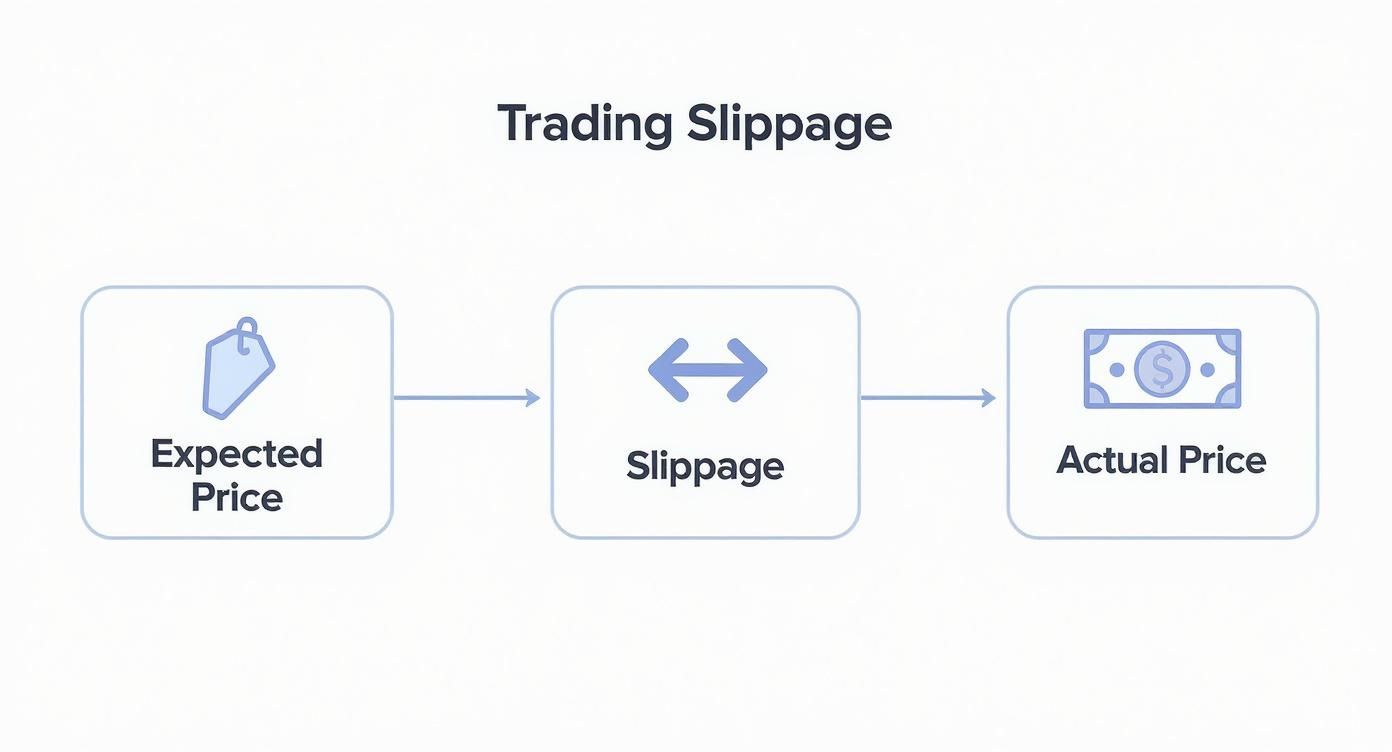
As you can see, slippage is really just the variable that fills the gap between the price you expected and the final price you received.
The Role of Market Volatility
Volatility is just a simple term for how fast and how much prices are changing. When a big news event breaks — like an earnings surprise or a central bank announcement — prices can swing wildly in a matter of seconds.
Practical Example: Imagine you want to buy a stock right after a company reports better-than-expected earnings. The price is flying upward. You place a market order to buy at $50, but in the half-second it takes to execute, demand has surged, and the cheapest shares available are now at $50.25. That 25-cent difference is slippage caused by high volatility.
Placing a trade during one of these moments is like trying to step onto a moving train. The faster the market is moving, the bigger the potential gap between your intended entry and where you actually get on board. You can dive deeper into how traders handle these situations and learn how to deal with slippage on HedgeNordic.
Understanding Market Liquidity
Liquidity boils down to how easily you can buy or sell something without moving its price. It all comes down to the order book — the real-time list of all buy and sell orders waiting to be filled at different price levels.
- High-Liquidity Markets: In a market with tons of liquidity (like a major stock like Apple or a currency pair like EUR/USD), the order book is deep. There are loads of buyers and sellers stacked up at every price point, so your order is likely to get filled instantly with almost no price change.
- Low-Liquidity Markets: In a thinly traded market (like a small-cap stock or an obscure crypto coin), the order book is shallow. There are far fewer participants, which creates wider gaps between the buy and sell prices.
Trying to execute a large order in a low-liquidity market is like trying to sell a rare painting at an auction. You might have a price in mind, but if there aren’t enough willing buyers in the room right at that moment, you’ll have to accept a lower price to get the deal done.
This lack of available orders at your desired price forces your trade to “slip” down to the next best available price, which could be worse than what you were hoping for. Acknowledging these market realities is a crucial part of building a disciplined and realistic trading plan.
Positive and Negative Slippage
Most traders hear the word “slippage” and immediately think of losing money. It’s an understandable reaction, but it’s not the whole story. The reality is that slippage is a totally neutral part of trading — sometimes it works against you, and sometimes, it can give you a pleasant surprise.
The trick is to get comfortable with both sides of the coin: negative and positive slippage. Once you do, you can trade with a more balanced and disciplined mindset, turning fear into calculated awareness.
When Slippage Hurts: Negative Slippage
Negative slippage is the one everyone knows and dislikes. It happens when the market ticks against you in that tiny gap between when you hit the “buy” or “sell” button and when your order actually gets filled.
Here’s how it plays out:
- For a buy order: The price you actually pay is higher than the price you intended.
- For a sell order: The price you actually get is lower than the price you intended.
Practical Example: You’re trying to buy 100 shares of XYZ Corp at $100.00. But the market is moving fast, and by the time your order goes through, the best available price is $100.05. That extra five cents per share is negative slippage. It cost you an extra $5.00 on your position ($0.05 x 100 shares). It might not sound like much, but those little costs can quietly eat away at your returns over hundreds of trades if you don’t keep an eye on them.
When Slippage Helps: Positive Slippage
On the flip side, you have positive slippage — the unexpected bonus every trader loves to see. This occurs when the market moves in your favor during that same brief execution window, locking in a better price than you even asked for.
- For a buy order: The price you pay is lower than you expected.
- For a sell order: The price you receive is higher than you expected.
Practical Example: Let’s go back to that XYZ Corp trade. You place your buy order for 100 shares at $100.00, but just as it hits the market, a wave of selling pressure pushes the price down. Your order gets filled at $99.95 instead. That happy accident is positive slippage, giving you an instant $5.00 paper profit on your position.
Understanding both positive and negative slippage is crucial for long-term success. It shifts your perspective from seeing slippage as an “enemy” to viewing it as a natural, measurable market characteristic — a cost of doing business that can sometimes even pay you back.
And this isn’t just some rare occurrence. Data from one major broker showed that over a full year, 25.64% of all orders actually got positive slippage, while only 12.18% were hit with negative slippage. You can dig into more of these slippage statistics and their implications on FXCM. These numbers prove that slippage isn’t just a one-way street. By embracing its dual nature, you can build a more resilient and objective trading plan.
Practical Strategies to Reduce Slippage
Knowing what slippage is and actively managing it are two different things. This is where you move from theory to building a more resilient trading practice. You can’t get rid of it completely, but you can create a tactical playbook to minimize its impact and protect your hard-earned capital. It’s not about finding a magic bullet — it’s about discipline and making smarter choices.
The first step is realizing you have more control than you think. By being strategic about when you trade, what you trade, and how you place your orders, you can seriously cut down on those nasty surprises when your trade gets filled.

Choose Your Battles Wisely
One of the simplest yet most powerful ways to manage slippage is to be picky about your trading environment. Some market conditions are just begging to create price gaps.
- Avoid Major News Events: Trading right before or after a big economic announcement — like an interest rate decision or jobs report — is like stepping into a hurricane. Volatility goes through the roof, liquidity dries up, and slippage becomes almost a certainty. A disciplined trader knows when it’s best to just sit on the sidelines and protect their capital.
- Stick to High-Liquidity Markets: Focus on assets with deep order books and tons of trading volume. Major currency pairs, large-cap stocks, and popular ETFs typically have tighter spreads and more buyers and sellers waiting at every price level. This makes it much easier for your order to get filled at or very close to the price you expected.
Master Your Order Types
Your single most powerful tool for controlling slippage is your choice of order type. It’s a fundamental trade-off: do you want to guarantee your price, or do you want to guarantee your execution? Understanding this difference is absolutely critical for managing risk.
A market order tells your broker to buy or sell right now at the best available price. Its main advantage is speed and certainty of execution — you will get into the trade. But it offers zero protection against slippage. In a fast-moving market, that “best available price” could be a lot worse than the one you saw when you clicked the button.
A limit order, on the other hand, lets you set the absolute maximum price you’re willing to pay (for a buy) or the minimum price you’re willing to accept (for a sell).
The Golden Rule of Orders: A market order guarantees you’ll get into the trade, but not what price you’ll get. A limit order guarantees your price, but not if you’ll get into the trade.
Of course, that control has its own risk. If the market zips past your limit price before your order gets filled, your trade might not execute at all. You could miss out on a great move. This is a trade-off every trader must weigh.
Aligning Orders with Your Strategy
So which order is “better”? Neither. It’s about which one is right for your goal and your risk tolerance in that specific moment.
This choice is huge in futures markets, for example. Market orders are quick but can lead to terrible fills, while limit and stop-limit orders are essential for managing costs during wild periods, like right after economic data drops or during thin holiday trading. Your strategy, paired with your broker’s execution quality, directly shapes how well you can handle these situations. You can find more practical tips on how StoneX explains managing slippage in futures.
In the end, it all comes back to discipline. By choosing liquid markets, sidestepping predictable volatility spikes, and using order types that match your strategy, you give yourself the power to trade with more precision and confidence.
How Your Broker and Tools Can Make or Break Your Trades
Your best strategies for dodging slippage are only as strong as the infrastructure you’re trading on. Think of it like this: a world-class race car driver can’t win in a family sedan. Their skill is critical, but they need a high-performance engine and a finely-tuned machine to compete. For traders, that machine is your broker and your personal toolkit. They’re your first line of defense against those nasty execution surprises.
Choosing the right broker is one of the biggest decisions you’ll make in your trading career. It’s easy to get drawn in by flashy ads and sign-up bonuses, but what really matters under the hood is execution quality. A great broker gives you lightning-fast, reliable order fills, shrinking the window where slippage can sneak in. They also plug you into deep pools of liquidity, which means more buyers and sellers are on standby, ready to fill your order right at — or very close to — your intended price.
What to Look For in a Broker
Beyond pure speed, you need transparency. A reputable broker won’t hide how they handle orders or what their slippage policies are. This isn’t just about trust; it’s about understanding the battlefield you’re trading on. You’re looking for a partner whose tech and policies are built to minimize costs for their clients.
So, when you’re sizing up your options, cut through the noise and focus on these critical factors:
- Execution Speed: How fast do they process orders? In this game, milliseconds can mean real money.
- Liquidity Access: Are they connected to multiple liquidity providers, or just one? More is better.
- Transparent Policies: Can you easily find and understand their policies on slippage and order execution?
- Platform Stability: Does the platform crash or freeze right when the market gets wild? Stability is non-negotiable.
Picking the right one can feel like a huge task, but zeroing in on these execution-focused details is what counts. For a deep dive, our trading platform comparison can help you match a broker to your specific trading style.
The Power Is in Your Own Hands (and Tools)
While a solid broker is your foundation, your personal tools are what let you actually measure, analyze, and tighten up your performance. The most important tool in that box? A ridiculously detailed trading journal.
It’s so easy to shrug off a few cents of slippage here and there. But those tiny amounts are like a leaky faucet, constantly dripping away at your profits over hundreds or thousands of trades. Many traders who struggle with profitability don’t realize how much these hidden costs are holding them back.
Slippage is an invisible tax on your trading. Without meticulous tracking, you’ll never know how much you’re truly paying to enter and exit the market.
By logging every single trade, you can drag slippage out of the shadows and turn it into a number you can manage. A purpose-built journal like TradeReview lets you track not just your profit and loss, but the exact slippage on every entry and exit.
That data is pure gold. It helps you spot patterns you’d otherwise miss. Maybe you discover that you get hit with way more negative slippage during the first 15 minutes of the market open. Or perhaps a specific stock always seems to slip against you.
This is the kind of insight that lets you make smart, data-driven changes. You might decide to avoid trading that chaotic opening bell or switch to using limit orders on that one tricky stock. It’s a disciplined, long-term approach that shifts you from being a passive victim of market chaos to an active manager of your trading costs.
Building a Slippage-Aware Trading Plan
Mastering trading isn’t about discovering some magic formula for easy profits. It’s about learning to manage the messy realities of the market with skill and discipline, and slippage is one of those realities.
The goal isn’t to eliminate it entirely — that’s impossible. It’s to understand it, measure it, and build a trading plan that accounts for it from the start.
When you embrace this long-term mindset, everything changes. Instead of getting frustrated over a bad fill and seeing it as a personal failure, you start to see it for what it is: a predictable cost of doing business. This mental shift is a game-changer for building the resilience you need for a sustainable trading career.
From Frustration to Empowerment
Ultimately, this all comes down to control. By applying the strategies in this guide and consistently tracking your results, you take back control of your trade execution. You can’t control what the market does, but you can absolutely control how you respond to it.
True trading discipline is built by turning unpredictable market behaviors into measurable data points. Slippage stops being a surprise and becomes just another variable in your strategy.
This is where your own analysis becomes your greatest asset. Tools like a trading journal help you connect the dots between market conditions, your actions, and your results. This analytical process is very similar to the discipline it takes when you learn how to backtest trading strategies, because both rely on solid data to sharpen your edge.
By truly understanding slippage, you get rid of costly surprises and build a more professional, robust approach to your entire trading journey.
Answering Your Questions About Trading Slippage
Even after you get a handle on the concept of slippage, a few common questions always seem to pop up. Let’s tackle them head-on, so you can approach these scenarios with the right mindset.
What Is Considered Normal Slippage in Forex?
There’s no single “right” answer here. The idea of “normal” slippage is a moving target that depends entirely on the market’s mood.
When you’re trading a major pair like EUR/USD in the middle of a quiet session, a few pips of slippage is pretty standard. But during a major news event like an interest rate announcement? That same pair could see slippage widen dramatically. The real key is understanding what’s normal for the specific conditions you’re trading in, not trying to find some universal number that doesn’t exist.
Can Slippage Be Completely Avoided?
In a word: no. It’s just not possible. Slippage is a fundamental part of how live markets work — it’s the natural result of the constant tug-of-war between buyers and sellers. Every single trader, from the greenest rookie to the most seasoned fund manager, deals with it.
The goal isn’t to chase the impossible dream of eliminating slippage. It’s to manage it intelligently. Think of it as a cost of doing business and focus your energy on minimizing its impact.
Getting this mindset right is a huge step in building a long-term trading career. It shifts your focus from getting frustrated to taking strategic control.
Is Slippage Worse in Crypto or Stocks?
The mechanics are the same across all markets, but the severity of slippage can definitely vary. Crypto markets, for example, are famous for their wild volatility and sometimes thin liquidity, which is a perfect recipe for more frequent and larger slippage.
But don’t think stocks get a free pass. Low-volume penny stocks can be just as treacherous, and even larger stocks can get hit with serious slippage around an earnings report or other big news. At the end of the day, it always comes back to two main drivers: volatility and liquidity.
Turning unpredictable slippage into a measurable data point is the first step toward mastering your trade execution. With TradeReview, you can meticulously track slippage on every trade, identify patterns, and refine your strategy with data-driven insights. Stop guessing and start analyzing — sign up for TradeReview for free and take control of your trading costs today.