If you’ve ever found yourself asking, “what does PNL stand for?” the short answer is Profit and Loss. Think of it as the ultimate scorecard for any trader — it tells you in black and white whether your strategies are actually making money or just spinning their wheels.
Quick Answer PNL Explained
Before we dive deeper, let’s get a clear, simple overview. PNL stands for Profit and Loss, and here’s a quick breakdown of what that really means for you as a trader.
| Concept | Simple Explanation |
|---|---|
| PNL | The net financial result of your trading activities over a specific period. It’s the bottom line that shows if you’re winning or losing. |
| Realized PNL | The profit or loss from trades you have already closed. This is money that has been added to or subtracted from your account balance. |
| Unrealized PNL | The potential profit or loss on your open, active trades. This number constantly changes with the market until you close the position. |
This table gives you the basics, but truly understanding how these concepts work together is what separates disciplined traders from the rest.
What PNL Really Means for Your Trading Journey
Your PNL is the bottom line for your trading business. Just like a shop owner has to track every sale and expense to know if they’re profitable, you need to track your PNL to measure your performance. It’s the raw, unfiltered truth of your trading results, stripped of all the emotion and hope that can cloud your judgment.
It’s so easy to get caught in the emotional rollercoaster of trading. A big win brings a rush of euphoria, while a sudden loss can trigger frustration and self-doubt. That’s completely normal, but letting those feelings dictate your next move is a surefire way to blow up your account. This is where a deep understanding of your PNL becomes your most critical tool.
The Foundation of Disciplined Trading
Your PNL isn’t just a number; it’s a powerful feedback loop. It tells the real story of your trading habits and whether your strategy holds up over time. By tracking it consistently, you can finally shift from making impulsive, gut-feeling decisions to smart, data-driven ones.
PNL gives you an honest, objective picture of your trading outcomes. Monitoring it closely is the first step toward managing risk properly and building a consistent strategy.
This shift is everything in trading. Instead of getting rattled by a single loss or overconfident after a win, you start seeing each trade for what it is: one data point in a much larger picture. A disciplined trader uses their PNL to ask the important questions:
- Is my strategy actually working? Does my plan generate positive results consistently over weeks and months?
- Where am I bleeding money? Am I losing on a specific setup, or maybe trading at a certain time of day that doesn’t work for me?
- Is it time to hit the brakes? Does a string of losses signal that I need to step back, reassess the market, and protect my capital?
Ultimately, mastering your PNL is about building consistency. It’s the bedrock you need to develop the discipline to stick to your plan, learn from your mistakes, and navigate the markets with a cool, professional mindset.
Realized vs. Unrealized PNL: Unlocking the Difference
To really get what PNL stands for, you have to understand the difference between money in your hand and money that’s still on the table. This is the core of realized vs. unrealized PNL — a concept that trips up way too many traders and leads to emotionally-driven mistakes.
Put simply, realized PNL is the actual profit or loss you’ve locked in. It’s the cash that hits your account after you close a position. On the flip side, unrealized PNL is the “paper” profit or loss on your open trades, bouncing around with every tick of the market.
This simple visual breaks down PNL to its core — profit versus loss — reminding us that performance always comes back to this basic equation.
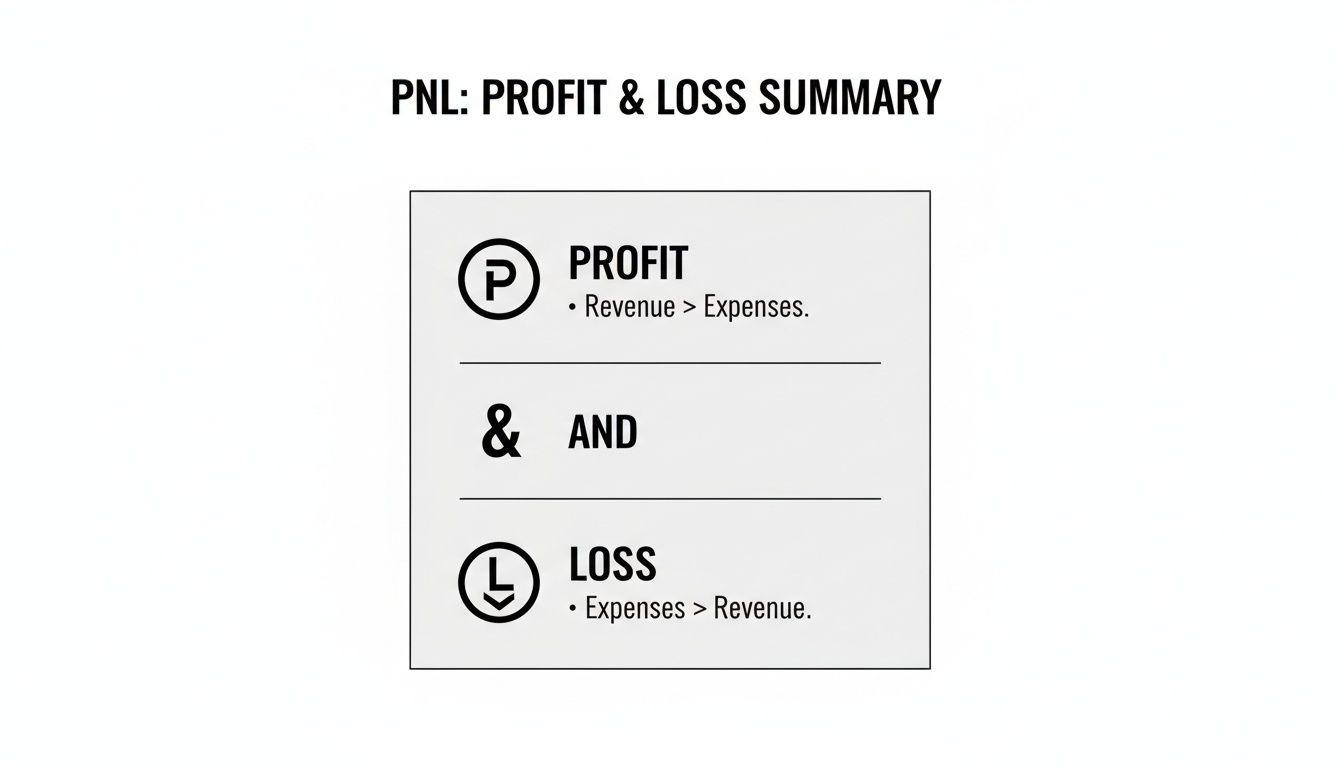
Let’s quickly compare the two side-by-side to make the distinction crystal clear.
Realized vs. Unrealized PNL At a Glance
| Attribute | Realized PNL | Unrealized PNL |
|---|---|---|
| Status | Profit/loss is final | Profit/loss is potential |
| Position State | The trade is closed | The trade is open |
| Impact on Account | Directly affects your cash balance | Does not affect cash balance yet |
| Emotional Impact | Done deal, provides closure | Can cause anxiety or greed |
| Tax Implications | Is a taxable event | Not a taxable event until closed |
As you can see, the key difference is whether the trade is still live. Until you hit that close button, it’s all just on paper.
A Practical Example: Realized vs. Unrealized PNL
Let’s walk through a scenario to see this in action.
Imagine you buy 10 shares of Company XYZ at $100 per share, for a total investment of $1,000.
- Day 1: The stock price climbs to $105. Your position is now worth $1,050. You have an unrealized profit of $50. It’s exciting, but it’s not yours yet.
- Day 2: Some bad news hits, and the stock drops to $98. Your position is now worth $980. That paper profit vanished, and you now have an unrealized loss of $20.
- Day 3: The stock recovers to $110. You decide to sell all 10 shares, pocketing $1,100. At that exact moment, you lock in a realized profit of $100 ($1,100 sale – $1,000 cost).
Until you clicked “sell,” your PNL was just potential. This distinction is so important for emotional discipline. A tempting unrealized gain can make you close a trade too early, while a scary unrealized loss can cause you to hold on, hoping for a turnaround — a truly dangerous habit. You can find more details about how PNL tracking impacts performance on PocketOption.com.
How to Calculate Your Trading PNL
You don’t need a math degree to calculate your Profit and Loss. The formulas are actually pretty simple, but it’s the details behind them that separate successful traders from everyone else.

The basic math just depends on whether you’re buying (long) or selling (short).
- For a long (buy) position: PNL = (Exit Price – Entry Price) x Position Size
- For a short (sell) position: PNL = (Entry Price – Exit Price) x Position Size
This first step gives you your Gross PNL — the raw profit or loss from the trade before any costs are taken out. But this is not the number that hits your bank account.
Gross PNL vs. Net PNL: What You Actually Keep
This brings us to the most important part of the equation: Net PNL. This is your true bottom line after you subtract all the trading costs. These sneaky expenses can easily flip a winning trade into a losing one if you aren’t paying close attention.
Net PNL is your Gross PNL minus all associated costs, like commissions, platform fees, and overnight swap fees. This is the only number that truly reflects your real-world performance.
Let’s run through a quick example. Imagine you buy 100 shares of a stock at $50 and sell them at $51. Your gross profit looks great at ($51 – $50) x 100 = $100.
But wait — your broker charges a $10 commission for the trade. Now, your net profit is only $90. If you held the position overnight and paid a $5 swap fee, your net profit shrinks to $85. Always, always focus on your Net PNL. It’s the only way to know what you’re really making. Meticulous calculation of Net PNL isn’t just good practice; it’s a hallmark of a disciplined trader.
For a deeper dive, check out our guide on calculating trading profit accurately.
Why Your PNL Is More Than Just a Number
It’s easy to get fixated on a single trade’s PNL. That one big win feels amazing, and that painful loss stings. But true success in trading isn’t built on isolated events — it comes from analyzing your Profit and Loss data over the long haul.
Your PNL history tells the real story of your trading. It’s the ultimate source of truth, showing you what’s working, what’s not, and even revealing the psychological habits holding you back. A consistently growing PNL is obviously the goal, but every loss is a priceless data point.
Seeing your account in a drawdown is frustrating, we get it. But the best traders learn to reframe these periods as learning opportunities. Every loss contains a lesson if you’re willing to look for it.
What Your PNL Data Reveals
When you zoom out from a single number, your PNL history uncovers the patterns that define you as a trader. Digging into the data helps you answer the tough questions about your performance.
Your PNL is the foundation for several key metrics:
- Win Rate: Simply, what percentage of your trades are profitable?
- Profit Factor: How much you make for every dollar you lose (gross profits / gross losses).
- Average Gain vs. Average Loss: This is a huge one. How big are your winners compared to your losers?
These metrics quickly expose common trading mistakes. Maybe you’re cutting winners short out of fear or letting losers run in the hope they’ll turn around. A high win rate, for instance, means very little if your average loss is five times bigger than your average gain. You might even discover you’re consistently losing money on Fridays or during the first hour of the trading day.
Analyzing these patterns helps you understand the why behind your numbers and build a sustainable edge. For a deeper look into managing downturns, you can learn more about what is maximum drawdown.
How to Track Your PNL for Better Results
Knowing what PNL stands for is a great start, but the real magic happens when you use that data to become a better trader. A lot of traders begin by manually tracking every position in a spreadsheet. While it feels disciplined, it’s also tedious, easy to mess up, and almost impossible to get any deep insights from.

It’s easy to get lost trying to connect the dots between dozens, or even hundreds, of individual trades. A simple list of wins and losses doesn’t tell you why you’re getting those results. This is where a dedicated trading journal becomes an absolute game-changer for long-term growth.
Moving Beyond Manual Spreadsheets
Modern trading journals are built to do all the heavy lifting for you. Many can automatically sync with your broker, importing your entire trade history without you lifting a finger. This immediately gets rid of the risk of typos that could completely throw off your performance metrics.
A trading journal transforms raw PNL data into actionable intelligence. It helps you shift your focus from simply knowing your PNL to understanding the behaviors and patterns that drive it.
Instead of a static spreadsheet, a powerful journal turns your trading history into dynamic, visual insights that help you see your trading with total clarity.
Turning PNL Data into Actionable Insights
The right system helps you move past just looking at a final PNL number and lets you understand the story behind it. It visualizes your progress and shines a light on patterns you’d otherwise miss completely.
Look for a journal with features like these:
- Visual Equity Curve: A simple chart of your account growth over time, instantly showing you the impact of your winning and losing streaks.
- Performance Dashboards: An at-a-glance view of crucial metrics like your win rate, profit factor, and average PNL per trade.
- Trade Calendars: A quick way to spot if your performance is better or worse on certain days of the week or at specific times of the day.
This level of analysis is what separates amateur guesswork from a professional, disciplined approach. To find a tool that fits your needs, check out our guide on the best trading journal apps available today.
A Few Common Questions About PNL
To wrap things up, let’s tackle some of the most common questions traders ask about their Profit and Loss. Think of this as a quick reference guide to help these key ideas stick and clear up any confusion you might still have.
Is PNL the Same as Return on Investment (ROI)?
Nope, but they’re close cousins. They both tell you about your performance, just in different ways.
PNL is the raw, absolute dollar amount you made or lost. For example, a +$500 profit. It’s the cash in (or out) of your pocket.
ROI, on the other hand, measures how efficiently you used your capital. It’s the percentage gain or loss relative to what you put in — like a +10% return. Both are critical, but PNL shows the cash result, while ROI shows how well you put your money to work to get that result.
How Often Should I Check My PNL?
This really comes down to your trading style. A day trader might be glued to their unrealized PNL all day because every tick matters for their next move. A swing or position trader? They might only check in daily or even just once a week.
The most important thing is discipline. The goal is to avoid letting those short-term PNL swings drive you to make emotional decisions that break your own rules. Constantly watching your PNL can feed anxiety and lead to impulsive moves, so find a rhythm that keeps you informed without making you jumpy.
Your PNL is a tool for analysis, not a trigger for emotional reactions. Use it to review performance with a clear head after the market closes, not to second-guess your strategy mid-trade.
Can My Realized PNL Be Negative While My Account Is Up?
Absolutely. This scenario is totally possible and it’s a perfect example of why you need to see the whole picture.
You could have a negative realized PNL from closing out a string of losing trades. At the same time, your overall account balance might be higher because you’re sitting on a big unrealized (paper) profit in a position you’re still holding.
This is exactly why you have to track both metrics. Just looking at your account balance can give you a false sense of security, while only looking at realized PNL might make you feel like you’re failing when a winning trade is still quietly working in the background.
What Is a Good Profit Factor Based on PNL?
Your profit factor is a powerful little metric you can calculate by dividing your total gross profits by your total gross losses. Anything greater than 1.0 means your strategy is profitable over time. A profit factor of 2.0, for instance, means you make $2 for every $1 you lose.
While there’s no single magic number, many pro traders aim for a profit factor of 1.5 or higher. This suggests you have a healthy, sustainable edge in the market. If your profit factor dips below 1.0, it’s a huge red flag that your strategy is losing money and needs a serious rethink.
Stop guessing and start analyzing. With TradeReview, you can automatically sync your trades, visualize your equity curve, and get the data-driven insights you need to build discipline and improve your results. Start journaling for free at tradereview.app.