Scanning for day trading isn’t just about running software. It’s the disciplined process of sifting through thousands of stocks to find a handful of real opportunities that fit your specific strategy. It’s how you replace random “hot tips” and gut feelings with a methodical, data-driven approach to the trading day.
Cutting Through the Noise with Smart Stock Scanning
Let’s be honest — finding the right stocks to trade each day can feel like looking for a needle in a haystack. With thousands of tickers, it’s easy to get overwhelmed by information or, even worse, chase random momentum plays that fizzle out. This is a common struggle that leaves many traders feeling reactive instead of proactive.
A well-built stock scanner completely changes the game. It’s not some magic money machine that promises guaranteed profits, but it is a precision tool. Its job is to cut through all the market noise, letting you focus your limited time and energy on high-potential setups that actually align with your trading plan. Instead of getting caught in the chaos, you can systematically pinpoint real opportunities.
Why Scanning Is a Non-Negotiable Skill
Day trading is brutally competitive. You’re up against some serious players, and profitability is incredibly elusive. While precise, current statistics are hard to pin down, older industry studies have suggested that a significant majority of aspiring day traders do not end up profitable in the long run. That skewed reality is exactly why having an efficient system is critical for survival and long-term thinking.
A scanner gives you a much-needed edge by helping you:
- Find Volatility: It flags stocks with unusual price movement and volume — the absolute lifeblood of any day trading strategy.
- Save Time: Manually flipping through hundreds of charts is impossible. A scanner does the heavy lifting in seconds.
- Enforce Discipline: By setting strict criteria, you force yourself to only consider setups that meet your rules, which is a huge step in curbing impulsive trades.
- Discover Hidden Gems: Scanners can uncover opportunities in stocks that aren’t blowing up on social media or making headlines.
Shifting from Gambling to a Repeatable Process
Without a scanner, it’s easy to fall into the trap of following alerts from chat rooms or chasing stocks that have already run up 20%. That approach is completely unpredictable and usually leads to frustration and losses. The entire point of scanning stocks for day trading is to build a methodical, repeatable process you can rely on day in and day out.
A scanner doesn’t find trades for you; it finds potential setups for you to analyze. The real skill lies in validating those alerts, managing risk, and executing your plan flawlessly.
This distinction is fundamental. The scanner is just the first step in a professional workflow, not the last. It brings potential plays to your attention, but your expertise as a trader determines the outcome. Understanding how to adapt to different market environments is also key; check out our guide on what market volatility is and how it impacts your strategy.
By building this disciplined foundation, you move away from the frantic search for tips and toward a structured, professional operation.
How to Build Your Core Day Trading Scans
Alright, enough with the theory. It’s time to roll up our sleeves and build the actual scans you can use tomorrow morning. The secret isn’t just copying someone else’s settings; it’s understanding the why behind each filter so you can build scans that perfectly match your trading style.
We’ll start with three foundational scans every trader should have: one for spotting unusual activity, one for nailing morning opportunities, and one for catching intraday momentum. Think of these as proven templates — solid starting points for you to test, tweak, and make your own.
This is how we turn the chaotic noise of the market into a focused, actionable list of opportunities.
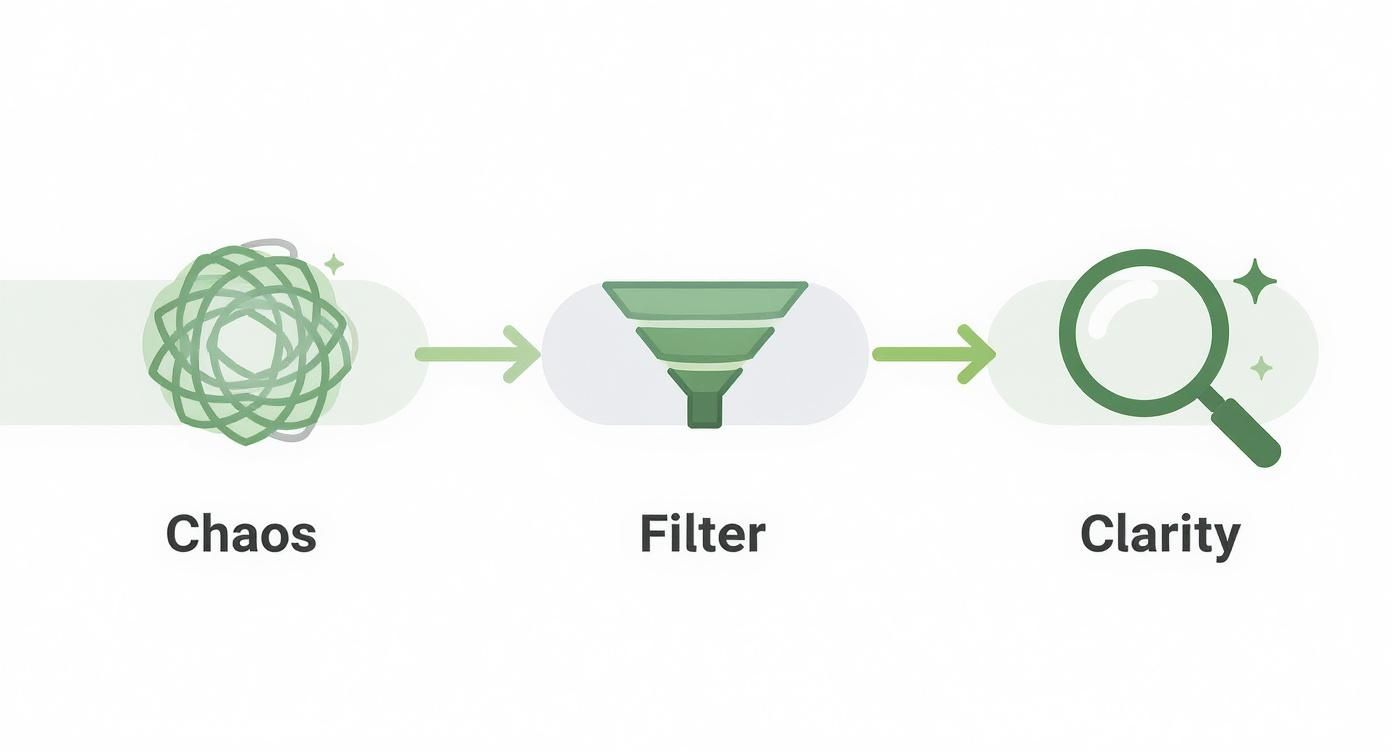
The image above perfectly captures what we’re trying to do. A good scanner takes that overwhelming flood of market data, applies your specific rules, and presents a watchlist that’s clear and ready for action.
Foundational Scan: High Relative Volume
The first scan every day trader needs is one that flags stocks with unusually high relative volume, or RVOL. This metric compares a stock’s current trading volume to its average volume for the same time of day. If a stock has an RVOL of 3.0 at 10 AM, it means it’s trading at three times its normal volume for that specific time.
So, why do we care? Because big volume often signals one thing: institutional interest. The “big money” is making moves, either buying or selling, and that’s the fuel behind the powerful intraday trends we want to catch.
Here’s a practical filter setup to get you started:
-
Relative Volume:
Greater than 2.0(Finds stocks trading at least double their usual pace.) -
Price:
Between $10 and $100(Filters out the wild penny stocks and the pricey names that tie up too much capital.) -
Average Daily Volume (30-day):
Greater than 500,000(Ensures the stock is liquid enough to get in and out without trouble.) -
Share Float:
Less than 50 Million shares(Lower float stocks are often more volatile and can make bigger moves on high volume.)
This scan will be your workhorse, constantly feeding you tickers throughout the day that are genuinely “in-play” with a real reason to move.
Morning Opportunities: The Pre-Market Gapper Scan
The first hour is often a goldmine of volatility and opportunity. A pre-market gapper scan is designed to find stocks making a big move before the opening bell, usually thanks to overnight earnings, news, or some other catalyst.
These gaps create an instant imbalance between buyers and sellers, often leading to powerful, directional moves right at the open. The goal is to have a list of these potential runners ready to go before 9:30 AM EST.
A classic rookie mistake is assuming every big gap is a great trade. A gapper scan is just step one; the real work is analyzing the pre-market action to find a clean setup with a solid risk-to-reward.
Let’s build a sample pre-market scan:
-
Percent Change from Previous Close:
Greater than +4%ORLess than -4%(This catches stocks gapping up and down.) -
Pre-Market Volume:
Greater than 100,000(Weeds out stocks gapping on just a handful of shares.) -
Price:
Between $5 and $150(A wider range to capture more potential plays.) -
Market Cap:
Greater than $300 Million(Helps you avoid tiny, easily manipulated micro-cap stocks.)
Run this about 15-30 minutes before the market opens. It will give you a focused watchlist for an opening range breakout or a gap fade strategy.
Intraday Momentum: The Bull Flag Breakout Scan
After the morning chaos dies down, you need a way to find stocks that are setting up for another push. The bull flag is a classic pattern where a stock makes a sharp move up (the pole), then pulls back or consolidates sideways (the flag). A breakout scan helps you catch it right as it starts its next leg higher.
This is where technical indicators — mathematical calculations based on price, volume, or open interest — come in handy. For instance, using a moving average can confirm the stock is in a healthy short-term uptrend.
Here’s how you could structure a bull flag scan:
-
Price vs. 20-period Simple Moving Average (SMA):
Price is above the 20 SMA(Confirms the short-term uptrend.) -
5-Minute Percent Change:
Less than 1%(Looks for stocks that are consolidating, not already mid-flight.) -
1-Minute Volume:
Greater than 50,000(This acts as an early warning for a volume surge that often signals a breakout.) -
Relative Volume (RVOL):
Greater than 1.5(Ensures the stock still has above-average interest for the day.)
Tools like Trade Ideas are indispensable here. Their software can process millions of data points every day, using hundreds of alerts and filters to spot these patterns in real-time. With market volume hitting billions of shares daily, having that processing power is a massive edge.
By setting up these core scans, you’re no longer just hoping a good trade finds you. You’re building a system to actively hunt for high-probability setups with precision.
Aligning Your Scans with the Market’s Rhythm
Running the perfect scan at the wrong time is a classic self-sabotage move. I’ve seen it countless times. You might have a killer breakout scan, but if you run it during the sleepy midday session, you’re just asking for false signals and a boatload of frustration.
The market has a distinct personality, and it changes throughout the day. Your scanning stocks for day trading strategy has to adapt to its rhythm. Thinking of the day in phases isn’t just a mental trick; it’s a framework for survival. Each period has its own character, driven by different players and news flow. What works in the high-volume chaos of the open is almost always useless during the lunch hour lull.
When you align your scans with these phases, your scanner transforms from a blunt instrument into a precision tool. It’s about finding the right setups at the right time. Nail this, and you’re well on your way to building a trading approach that can actually last.
Pre-Market Prep: The Calm Before the Storm
The pre-market session (from 4:00 AM to 9:30 AM EST) is all about intelligence gathering. This is where the action for the day is born. News drops, earnings reports get digested, and institutional orders start to pile up, creating the price gaps that can lead to explosive opening moves.
Your scanning here should be focused on one thing: finding the catalyst.
- Hunt for Gappers: Your go-to should be a ‘Pre-Market Gapper’ scan, like the one we built earlier. You’re looking for stocks gapping up or down on real volume — think over 100,000 shares as a starting point.
- Find the “Why”: As soon as a stock hits your gapper scan, your immediate next step is to figure out why it’s moving. Is it an earnings beat? A surprise FDA approval? A big product announcement? A stock moving without a clear story is a gamble, not a trade.
- Build Your Hit List: The goal isn’t to trade yet. It’s to build a small, curated watchlist of 3-5 stocks that you will watch like a hawk when the opening bell rings.
The Opening Bell: Chaos and Opportunity
The first 30-60 minutes after the open is pure, unadulterated chaos. Volume and volatility are cranked to the max, which means the potential for profit — and loss — is absolutely massive. Your scans need to be tighter and more focused to cut through the noise.
So many new traders feel this immense pressure to jump in the second the market opens. Don’t. Discipline is your best friend here. Let the market settle for a few minutes, watch your pre-market list, and wait for a clean, A+ setup to present itself.
A ‘High Relative Volume’ scan is still your ally here, but you might want to crank up the criteria. Instead of a simple 2.0 RVOL, maybe you’re looking for stocks with RVOL over 5.0 and a price change of over 3% in the first five minutes. This helps you ignore the random chop and zero in on stocks with true, explosive momentum.
The Midday Lull: Finding Setups in the Quiet
From around 11:30 AM to 2:30 PM EST, the market takes a breather. Volume dries up as New York traders head to lunch and European markets wind down. This is where many traders get chopped to pieces, forcing trades that simply aren’t there.
A smarter approach is to adapt. Your scans should shift from hunting raw momentum to finding patterns of consolidation. You’re looking for stocks that are coiling up, building energy for a potential late-day move. A ‘VWAP Reclaim’ scan, for example, can be incredibly effective here. You’d scan for stocks that sold off earlier, dipped below the Volume-Weighted Average Price (VWAP), and are now starting to push back above it on increasing volume. It’s often a great signal that buyers are quietly stepping back in.
The Power Hour and Closing Auction
The last hour of the day, from 3:00 PM to 4:00 PM EST, is called the ‘power hour’ for good reason. Volume floods back into the market as big institutions square up their positions. According to a report from the U.S. Securities and Exchange Commission (SEC), a substantial portion of daily trading volume can occur during closing auctions, highlighting the importance of this period.
High-volume names like Tesla (TSLA) can become prime hunting grounds. For a deeper dive on this, check out the insights on day trading stock selection on tradethatswing.com.
During this final stretch, ‘End of Day Breakout’ scans can be very effective. You’re looking for stocks that have been consolidating in a tight range all day and are now finally breaking out through their daily highs on a big surge of volume. These moves can be fast and clean as they catch short-sellers off guard, often triggering a powerful squeeze right into the close.
Turning a Scan Alert into a Viable Trade
An alert from your scanner isn’t a signal to trade. It’s a knock on the door, a reason to get up and see who’s there.
This is where so many traders trip up. They see an alert, their heart starts pounding, and they jump into a trade without a second thought. That’s a recipe for impulsive entries, frustration, and a drained account.
The reality is, a scan alert is just the beginning. The real work of scanning stocks for day trading starts after the alert fires. This next step is what separates pros from amateurs — it’s about having a repeatable process to validate every single alert before risking a dime.
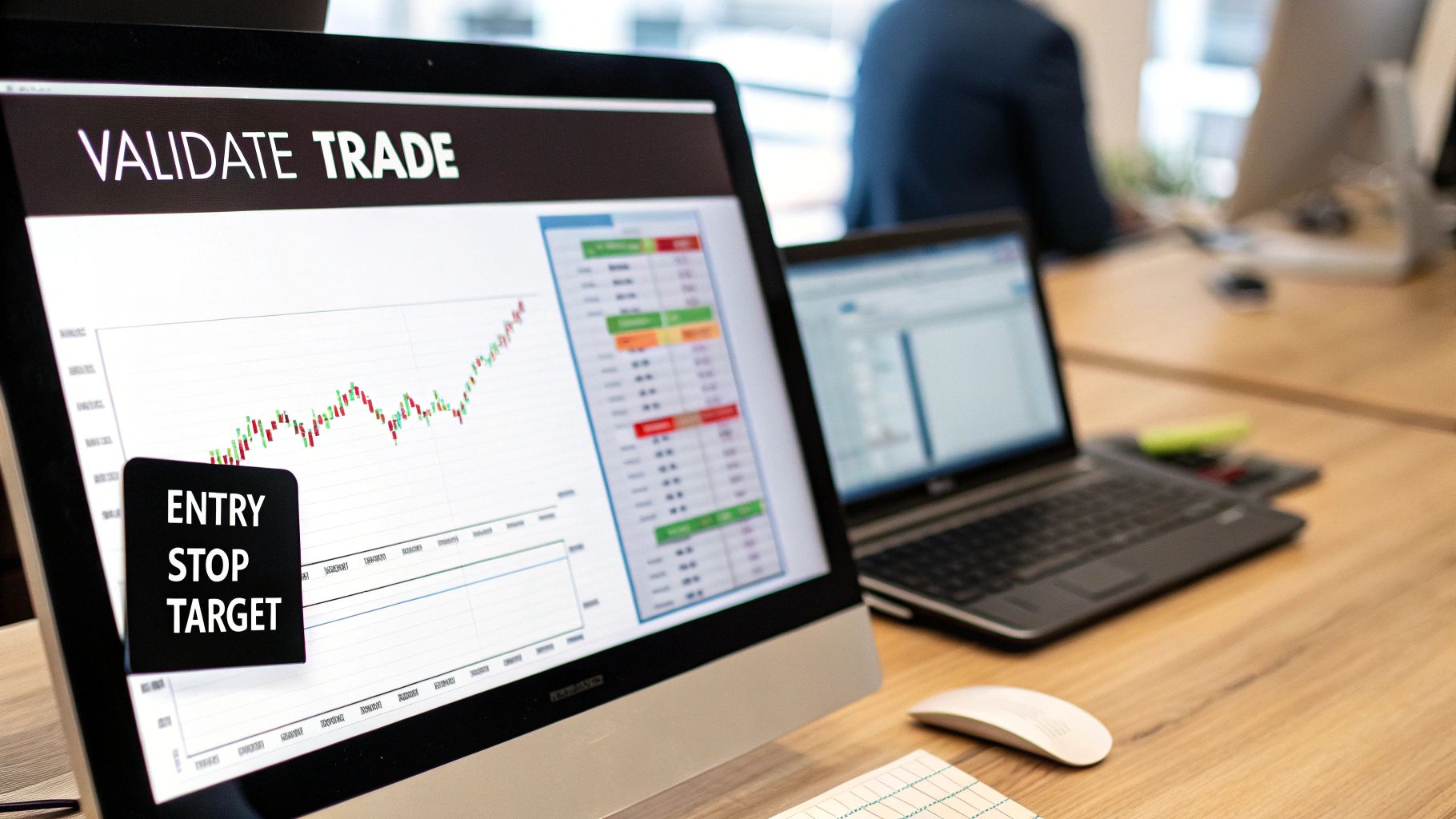
From Alert to Action Plan: A Validation Checklist
Let’s say your scanner flags stock ‘XYZ’ breaking out. The price is ripping, and FOMO (Fear Of Missing Out) is kicking in hard. This is the moment that matters. Instead of mashing the buy button, you need to slow down and run it through a quick mental checklist.
This disciplined approach is how you turn raw data into a structured trade.
- Check the Daily Chart: Before anything else, zoom out. Is the stock breaking into open space, or is it about to slam into a major resistance level from a month ago? A breakout on the 5-minute chart is worthless if it’s running straight into a wall of sellers on the daily.
- Analyze the Intraday Chart: Now, zoom back into your trading timeframe. Does the pattern look clean? A powerful move is usually preceded by a tight consolidation or a classic pattern like a bull flag. If the chart is choppy and all over the place, it’s a sign of indecision. It is likely best to skip it.
- Confirm the Volume: Is the volume backing up the move? A real breakout needs a massive surge in volume — ideally, the biggest volume candle of the day so far. If a stock is trying to break out on weak, pathetic volume, it’s far more likely to fail. Volume is the fuel in the tank.
Defining Your Trade Before You Enter
Okay, the setup passed your visual inspection. You’re still not ready to trade. The final, and most critical, step is defining your exact trade plan. This has to be done before you enter, while your mind is still clear and objective.
Your pre-trade plan must nail down three things:
- Your Precise Entry: Where, exactly, are you getting in? Are you buying the cross of a specific price? Waiting for a small pullback to a key moving average? Never just “buy it around here.”
- Your Logical Stop-Loss: Where will you get out if you’re wrong? A good stop isn’t just a random number. It’s placed at a technical level that invalidates your trade idea, like below the recent consolidation or under a key support level.
- Your Initial Profit Target: Where are you planning to take profits? This could be the next key resistance level on the daily chart or a measured move based on the pattern. Having a target helps you actually book wins instead of getting greedy and giving profits back.
This structured validation process is your best defense against emotional trading. When you have a clear plan for entry, stop, and target before you’re in the trade, you’re operating like a professional, not gambling on a whim.
This whole process can take as little as 30-60 seconds once you get the hang of it, but it’s the most valuable minute of your trading day. It’s what transforms a simple alert from a tool like MOMO Pro or Trade Ideas into a high-probability, well-managed trading opportunity.
Refining Your Scans with a Feedback Loop
Let’s get one thing straight: there’s no secret, foolproof scan that works forever. The best traders aren’t hiding one. Instead, the most consistently profitable traders are the ones who relentlessly refine their approach.
They treat trading like a business, and every single trade is a piece of data. This is where a powerful feedback loop becomes your greatest asset. It’s the process of reviewing your results to systematically sharpen your edge over time.
Without this loop, you’re just guessing, hoping for a different outcome while repeating the same mistakes. Creating one is simpler than it sounds, and it all starts with a detailed trading journal.
Building Your Data-Driven Review Process
To get started, you need to log every trade with a few key pieces of information. I know it can feel tedious at first, but this habit is absolutely non-negotiable if you’re serious about improving your scanning stocks for day trading efforts.
For every trade you take, make sure to track:
- The Scan Source: Which specific scan found this stock? Label it clearly, like “Pre-Market Gapper” or “RVOL Breakout.”
- The Setup Trigger: What specific pattern or reason made you pull the trigger? (e.g., “5-min bull flag,” “Opening range breakout,” “VWAP reclaim“).
- Profit or Loss (P&L): The final outcome, whether in dollars or, even better, in R-multiples (your risk units).
Once you’ve logged around 20 to 30 trades from a particular scan, you’ll have a meaningful sample size to start digging in. This is where the magic happens. Export your data or use your journal’s analytics to filter your trades by the “Scan Source.”
Now you can start asking the tough, objective questions. Is that reversal scan just a consistent source of small losses? Are your gapper scans actually delivering the home runs you expected? The data will give you honest answers, free from emotion or bias.
A feedback loop isn’t about judging your past performance; it’s about methodically improving your future results. Your trading journal is the tool that makes this possible, turning every trade into a lesson.
By ruthlessly analyzing this data, you can start doubling down on the scans that consistently produce profitable setups and cut the ones that don’t. This isn’t about finding a single “perfect” scan but about building a collection of scans that have a proven, positive expectancy for you.
From Logging to Actionable Insights
Identifying your most and least effective scans is only half the battle. The next step is to take action. This is how you close the feedback loop and turn those insights into better performance.
Let’s say your review shows that your “Low Float Momentum” scan leads to huge wins but also some gut-wrenching losses. The data is telling you the scan has potential but needs tweaking. Maybe you need to add a market cap filter to avoid the wildest, most unpredictable names. Or perhaps you need stricter entry rules for these specific setups.
On the other hand, if your “Dip Buy” scan has produced ten small losses in a row, it might be time to shelve it entirely. It’s easy to get emotionally attached to a strategy you think should work. The data gives you the permission to be objective and cut what’s bleeding you dry.
This entire review process is a form of personal backtesting. You’re using your own real-world trading data — not just historical charts — to validate and refine your strategies.
This hands-on approach is often more powerful than a pure software backtest because it reflects your actual execution, your psychology, and your decision-making in live market conditions.
Remember, the market is always changing. A scan that works brilliantly in a raging bull market might fall apart in a choppy, sideways environment. Your feedback loop should never stop. Plan to review your scan performance monthly or quarterly to ensure your methods stay aligned with the current market personality. This commitment is the true secret to long-term success.
Common Questions About Stock Scanners
Even with the best scanner setup, questions are going to pop up. That’s a totally normal part of the learning curve, especially when you’re dialing in something as specific as day trading scans. Let’s tackle some of the most common questions I hear from traders to clear up any confusion and get you on the right track.
One of the biggest struggles I see is traders feeling completely overwhelmed by a flood of alerts. It’s a common mistake that leads to chasing too many different setups, which is almost always a recipe for disaster.
How Many Stock Scanners Should I Run at Once?
Less is more. Seriously. Running 2-4 highly specific scans is worlds more effective than trying to watch ten generic ones. The whole point of a scanner is to deliver quality, not a firehose of alerts that just gives you analysis paralysis.
You want to build scans that pinpoint your absolute A+ setups. A solid starting point could look something like this:
- One scan built just for your favorite pre-market gap plays.
- Another one dedicated to hunting for high relative volume breakouts.
- Maybe a third for a specific pullback pattern you know you trade well.
Should I Pay for a Stock Scanner or Use a Free One?
If you’re serious about day trading, a paid, real-time scanner isn’t a luxury — it’s a necessary tool of the trade. Free scanners like Finviz are fantastic for swing trading or doing research after the market closes, but they almost always run on delayed data. In day trading, a delay of even a few seconds can be an eternity.
Think of a professional, real-time scanner like Trade Ideas or Scanz as a non-negotiable business expense. The edge you get from instant data and the ability to build complex, multi-layered filters is invaluable when you’re trying to act fast on intraday opportunities.
My Scanner Finds Good Stocks, but I Still Lose Money. Why?
This is easily one of the most frustrating hurdles for new and developing traders. It’s crucial to remember what a scanner’s job is: to find potential opportunities. That’s it. It doesn’t manage the trade for you. More often than not, the problem isn’t the scan — it’s what happens after the alert fires.
A scanner is a powerful flashlight, not an autopilot system. It illuminates potential setups in the dark, but you still have to be the one to navigate the terrain, manage the risks, and pilot the trade to its destination.
If you’re getting good alerts, your scanner is likely doing its job. The next step is to turn the focus inward. Dig into your trade execution, your risk management rules, and your emotional discipline. Your trading journal is the single best tool for uncovering and fixing those patterns.
The key to turning scanner alerts into consistent profits is relentless review and analysis. With TradeReview, you can log every trade, tag the scan that found it, and use powerful analytics to see exactly which strategies are working for you. Stop guessing and start building a data-driven edge. Create your free journal today at https://tradereview.app.