Let’s be real — most new traders are on a quest for the holy grail. They hunt for that one perfect indicator or chart pattern that promises to unlock flawless entries, thinking that’s the secret to making it big. We’ve all been there, searching for a shortcut to profitability.
The hard truth? Your longevity in this game has almost nothing to do with how often you’re right. It’s all about how you manage being wrong. Trading is a game of probabilities, not certainties, and even the best strategies will have losing trades. It’s a tough lesson, but a crucial one.
This is where risk trading management comes in. It’s not just a dry, academic concept; it’s the bedrock of a sustainable trading career. Think of it as the safety net that protects your single most important asset: your trading capital. It’s what allows you to survive the inevitable losing streaks and stay in the game long enough to succeed.
Why Risk Trading Management Comes First
From Playing Offense to Building a Defense
New traders almost always play a game of pure offense. Their focus is singular: how much money can I make on this trade? Professionals, on the other hand, know that a rock-solid defense is what keeps them in the game day after day, year after year. They think about what they could lose before they even dream about the potential gains.
This mental shift is everything. It takes you from a gambler’s mindset, hoping for a jackpot, to a business owner’s mindset — managing costs and protecting assets. This isn’t about being timid; it’s about being strategic and thinking for the long term.
A well-defined risk management plan isn’t a set of rules meant to hold you back. It’s a framework designed to empower you. It pulls emotion out of the equation so you can execute your strategy with confidence and consistency.
Winning the Emotional Battle
Trading is an emotional minefield. We all know the feeling. FOMO (fear of missing out) tempts you into sloppy trades, while the sting of a recent loss can make you gun-shy on a perfect setup. Without a system, you’re completely at the mercy of these powerful feelings.
A solid risk management plan is your structure for navigating this emotional rollercoaster. By pre-defining your risk on every single trade, you remove the guesswork and the heat-of-the-moment panic. You know your worst-case scenario before you ever click the buy or sell button. This clarity is a game-changer for your mental state.
This isn’t just a concept for individual traders, either. The entire global risk management market has exploded, reaching US$ 10.5 billion recently and projected to hit US$ 23.7 billion by 2028. It’s a clear sign that professionals everywhere prioritize protection first.
The Three Pillars of Protection
At its core, risk management in trading boils down to three essential components. If you’re serious about long-term success, mastering these isn’t optional.
- Position Sizing: This answers the question, “How much should I trade?” It’s a calculation based on your account size and the specific risk of a setup, ensuring that no single loss can cripple your account.
- Stop-Loss Orders: This is your non-negotiable exit plan if a trade goes sour. It caps your loss at a level you decided was acceptable before you were emotionally invested in the trade.
- Risk-Reward Ratios: This ensures that the potential profit of a trade is worth the risk you’re taking. Over time, this simple math is what puts the odds in your favor.
By weaving these three pillars into your trading, you build a robust system that turns speculative gambling into a calculated business. For a deeper dive into these concepts, check out our comprehensive guide on risk management for traders. This framework is what will help you survive the inevitable drawdowns and stay in the game long enough for your edge to play out.
Calculate Your Position Size Like a Pro
How many shares should you buy for your next trade? If your answer involves a gut feeling or how confident you feel, it’s time for a major reset. This one decision, known as position sizing, is probably the single most powerful tool in your entire risk management toolbox.
Guessing your trade size is like driving on the highway with your eyes closed — you might get away with it for a bit, but a disaster is just a matter of time. Proper position sizing isn’t about predicting the future; it’s about controlling your exposure so that no single trade can ever knock you out of the game.
It’s a mechanical process that strips ego and emotion out of the equation. The core idea is simple: you size your trade based on how much you’re willing to lose, not how much you hope to win. This is a huge mental shift that separates professional risk managers from gamblers.
The 1% Rule and Why It Matters
A time-tested guideline in the trading world is the 1% Rule. It’s straightforward: you should never risk more than 1% of your total account equity on any single trade. It sounds simple, but this concept is what forces discipline and ensures you stick around for the long haul.
Let’s say you have a $10,000 trading account. The 1% rule means the absolute most you can lose on one trade is $100. That might not sound like much, but its power is in its defensive strength. Even if you hit a brutal losing streak of five trades in a row, you’ve only lost 5% of your capital. You’re bruised, not broken. You live to trade another day.
Risking a small, fixed percentage of your capital ensures your survival is never dependent on the outcome of a single trade. This is the bedrock of sustainable trading.
Putting Position Sizing Into Practice
So, how does this work in the real world? Let’s walk through a practical example. You’ve spotted a potential long trade in NVIDIA (NVDA) and have your entry and exit points planned out before you put a single dollar on the line.
Your Trading Plan:
- Account Size: $10,000
- Max Risk Per Trade (1% Rule): $100
- Planned Entry Price for NVDA: $905.00
- Planned Stop-Loss Price: $895.00
First, figure out your risk on a per-share basis. This is simply the dollar amount you’ll lose for each share if the trade moves against you and hits your stop-loss.
Per-Share Risk = Entry Price – Stop-Loss Price
$905.00 – $895.00 = $10.00 per share
Now you know two critical pieces of information: you can risk a total of $100 on this idea, and you’ll lose $10.00 for every share you own if you’re wrong. From here, calculating your position size is easy.
Position Size = Max Risk Per Trade / Per-Share Risk
$100 / $10.00 = 10 shares
That’s it. The correct position size for this specific setup is exactly 10 shares of NVDA. It doesn’t matter if you feel incredibly confident or if an analyst just upgraded the stock. The math — based on solid risk management — dictates your size.
To make it even clearer, here’s a table breaking down the calculation step-by-step.
Example Position Size Calculation
| Variable | Example Value | Description |
|---|---|---|
| Account Size | $10,000 | The total equity in your trading account. |
| Risk Percentage | 1% | The maximum percentage of your account you’ll risk. |
| Maximum Risk ($) | $100 | Your Account Size multiplied by your Risk Percentage. |
| Entry Price | $905.00 | The price where you plan to buy the stock. |
| Stop-Loss Price | $895.00 | The price where you’ll exit if the trade fails. |
| Per-Share Risk ($) | $10.00 | The difference between your Entry and Stop-Loss. |
| Position Size | 10 Shares | Your Maximum Risk divided by your Per-Share Risk. |
Following this mechanical approach is your best defense against emotional trading. When a trade is working, it stops you from getting greedy and buying too much. More importantly, when a trade goes south, it contains the financial damage to a level you already decided was acceptable. This protects both your capital and your sanity.
Mastering the Art of the Stop Loss
Let’s be honest, for many traders, a stop loss feels like admitting you were wrong. It’s that moment of truth when your trade idea officially fails, and the sting can be a real blow to the ego. But looking at it that way is a costly mistake that many of us have made.
A stop loss isn’t a failure; it’s a pre-planned business expense. Think of it as the insurance policy you take out on every single trade, the one thing that protects your capital from catastrophic damage. The moment you shift your mindset and see stops as a strategic tool — not a negative outcome — is a game-changer for becoming a consistent trader.
This isn’t about just dropping an order at some random price below your entry. It’s about a disciplined process where you define your maximum acceptable loss before you ever put money on the line. Doing this takes the emotional struggle out of cutting a loser, which is exactly where most traders get into deep trouble.
Going Beyond Basic Stop Placement
Just setting a stop at 1% below your entry price isn’t a strategy. Effective stop-loss placement is an art, one that respects the unique personality and behavior of whatever you’re trading. A stop that’s too tight will get you knocked out by normal market noise, while one that’s too wide leaves you exposed to far too much risk.
The key is finding that sweet spot where your trade has room to breathe, but your exit gets triggered the moment the logic behind your setup is truly broken. Let’s dig into a few practical strategies that professional traders rely on every day.
- Structure-Based Stops: This is probably the most logical approach. You simply place your stop loss on the other side of a significant technical level on the chart. For a long trade, that might be just below a clear support level, a prior swing low, or a key moving average. The logic is simple: if the price breaks that structure, your original reason for the trade is probably gone.
- Volatility-Based Stops: Markets have different moods; some days are quiet, and others are wild. A volatility-based stop adapts to the current market environment. The most common tool for this is the Average True Range (ATR) indicator, which measures the average price movement over a set period. For example, you might place your stop at 2x the current ATR value away from your entry price. This gives the trade room to move based on its recent behavior.
- Time-Based Stops: Sometimes a trade doesn’t go against you, but it doesn’t go anywhere, either. It just sits there, tying up capital and mental energy. A time stop is an exit rule based on how long you’ve been in the trade. For example, a day trader might have a rule to close any position that isn’t profitable within two hours, assuming the initial momentum has faded.
Stop Loss Strategy in Action
To see how this works in the real world, let’s look at two different traders and how they might apply these ideas to manage their risk.
Scenario 1: The Swing Trader
A swing trader spots a stock that has pulled back to a key daily support level around $150. They decide to go long, but where does the stop go?
- Entry: $152.00
- Invalidation Level: The support level at $150.00 and a recent swing low at $149.50.
- Stop Placement: The trader sets their stop loss at $149.40. This tucks it just below that key structural support. If the price breaks down there, the bullish thesis is broken, and it’s time to get out with a small, controlled loss.
Scenario 2: The Day Trader
A day trader is looking to short a fast-moving tech stock after it showed weakness right at the market open. The stock is choppy and volatile, so a fixed percentage stop probably won’t cut it.
- Entry: $45.50
- Analysis: The 5-minute ATR is currently $0.25. To avoid getting stopped out by random noise, the trader decides to place their stop at 2x ATR above their entry.
- Calculation: 2 * $0.25 = $0.50.
- Stop Placement: The trader sets their stop loss at $46.00 ($45.50 + $0.50). This stop is based entirely on the stock’s current volatility, not some arbitrary price level.
The most important rule of the stop loss is that it should never be moved further away from your entry. Moving your stop to give a losing trade more room is gambling, not trading. It is the single fastest way to turn a small, manageable loss into an account-destroying disaster.
Ultimately, your choice of stop-loss strategy will depend on your trading style, timeframe, and what you’re trading. The one constant is the discipline to define it, place it, and honor it. Every. Single. Time. This is the absolute cornerstone of effective risk management.
Leveraging Risk Reward Ratios for an Edge
So many traders get stuck in a frustrating loop. They think they need to win most of their trades to be profitable, which leads them to snatch tiny profits but let their losers run wild — a recipe for disaster.
Here’s the thing: you don’t need a sky-high win rate to make it in this business. You just have to make sure your winners are big enough to more than cover your losers. It’s a simple concept, but incredibly difficult to execute in the moment.
This is where the risk-to-reward ratio comes in, and it’s the simple math that can completely change your trading game. It’s a cornerstone of professional risk trading management because it shifts your focus from how often you win to how much you win.
What is the Risk-to-Reward Ratio?
It’s just a simple comparison of what you’re willing to risk on a trade (the distance from your entry to your stop loss) versus what you stand to gain (the distance to your profit target).
For example, if you risk $50 on a trade with the potential to make $150, your risk-to-reward ratio is 1:3. For every single dollar you put on the line, you’re aiming to bring back three. This is what we call an asymmetric edge, where your potential upside dwarfs your potential downside.
The Math That Sets You Free
Once this concept clicks, it’s liberating. You no longer feel that immense pressure to be right all the time. Taking a loss is just part of the job, we all know that. But when your winning trades are three, four, or even five times bigger than your losing ones, a few setbacks don’t just sting less — they become mathematically insignificant in the long run.
This mindset shift helps build the discipline you need for long-term success. Instead of panicking at the first sign of a losing streak, you can trust your edge to play out over a large sample size of trades. You start to operate like a casino: you know you’ll pay out on some bets, but the odds are stacked in your favor over time.
A positive risk-to-reward ratio is your mathematical safety net. It ensures that your strategy can handle a string of losses and still be profitable, which is absolutely critical for surviving the market’s natural ebbs and flows.
How Risk-Reward Ratios Impact Your Bottom Line
Let’s look at how this plays out with a practical example.
Imagine two traders. Both start with a $10,000 account and risk $100 per trade (which is 1% of their account).
- Trader A has a high win rate but a terrible risk-reward ratio.
- Trader B wins less than half the time but is incredibly disciplined with their risk-reward.
The table below breaks down their hypothetical results over 10 trades. The outcome might surprise you.
Profitability Scenarios With Different Risk-Reward Ratios
This table shows just how powerful asymmetric risk can be, even with a lower win rate.
| Win Rate | Risk-Reward Ratio | Net P/L Over 10 Trades ($100 Risk) |
|---|---|---|
| 70% (Trader A) | 1:0.5 (Risk $100 to make $50) | – $50 (7 wins x $50 = +$350; 3 losses x $100 = -$300) |
| 40% (Trader B) | 1:3 (Risk $100 to make $300) | + $600 (4 wins x $300 = +$1200; 6 losses x $100 = -$600) |
The difference is stark. Trader A, who was right an impressive 70% of the time, actually lost money. Their small wins were consistently wiped out by their larger losses. This is a very common trap for new traders.
Meanwhile, Trader B — who was wrong on six out of ten trades — walked away with a $600 profit. This trader understood that being right isn’t nearly as important as how much you make when you are right. Their discipline is what made them profitable. That’s the core of smart risk management.
For a deeper dive into this crucial topic, check out our complete guide on the risk-reward ratio.
Building Your Personal Risk Management Plan
All the theory we’ve talked about — position sizing, stop losses, and risk-to-reward ratios — is great. But without a plan you can actually follow, it’s just noise that goes out the window the second a trade gets heated. This is where you take those abstract ideas and turn them into a concrete rulebook that guides your every move.
This isn’t about creating some rigid, one-size-fits-all document. Your personal risk management plan is a living, breathing framework. It has to reflect your trading style, your risk tolerance, and your account size. Its only job is to build the discipline that separates traders who last from those who burn out.
Defining Your Core Risk Parameters
Before you even think about placing another trade, you need to set your non-negotiable limits. These are the hard numbers that act as a firewall between your capital and your emotions, preventing one bad day from spiraling into a disaster. Think of this as the constitution for your trading business.
Start by locking in three critical numbers:
- Maximum Risk Per Trade: This is the absolute most you are willing to lose on a single trade, always expressed as a percentage of your total account. For most of us, especially when starting out, this should be 1% or less. On a $10,000 account, that’s a $100 max loss. No exceptions.
- Maximum Daily Drawdown: This is your daily “circuit breaker.” If your account drops by a certain percentage in one day, you’re done. A common limit is 3%. This forces you to walk away, clear your head, and stop the bleeding before you start revenge trading.
- Rules for a Losing Streak: Every single trader hits a losing streak. It’s inevitable. Decide now how you’ll handle it. For example, after three consecutive losses, you could cut your position size in half. After five, you might just shut it down for the day completely.
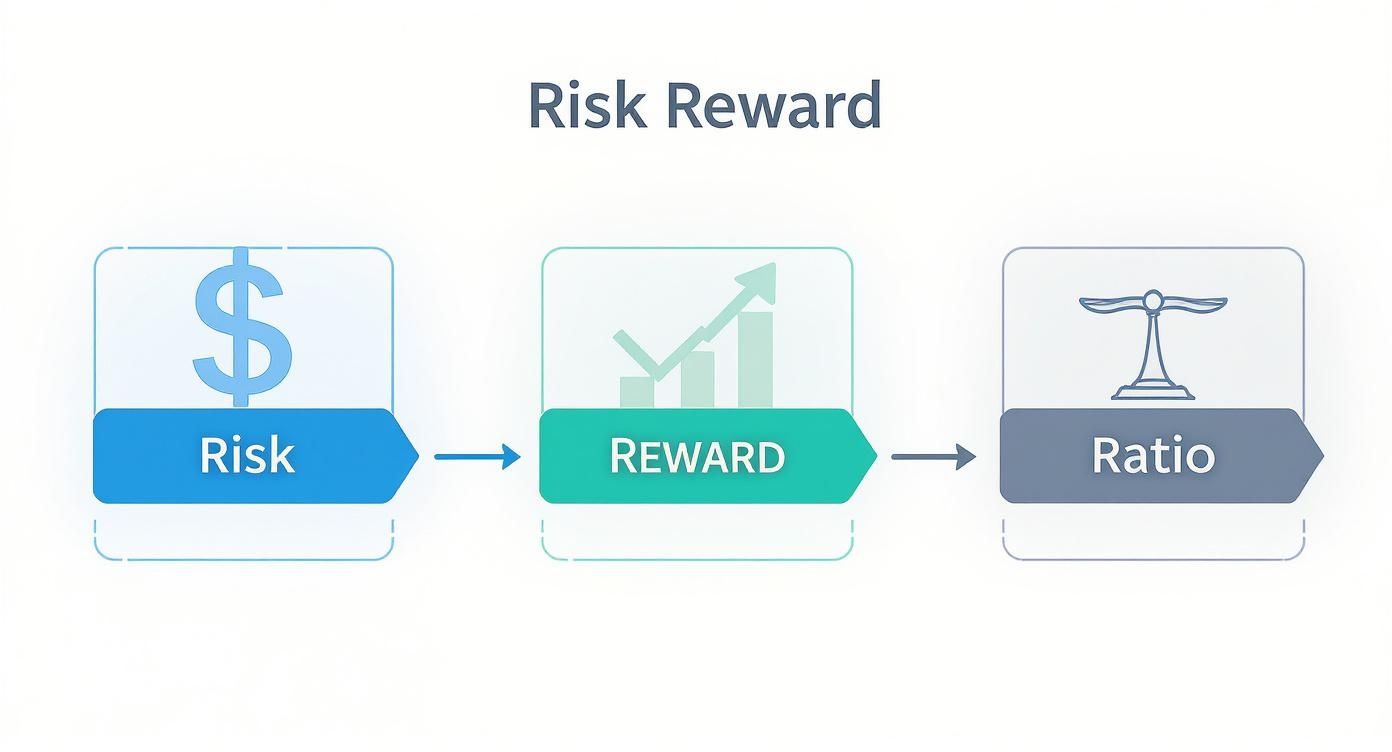
This simple flow reinforces the core idea: every trade has to be weighed by what you could lose versus what you could gain. It’s all about the math.
Creating Your Pre-Trade Checklist
Discipline isn’t something you’re born with; it’s a habit you build. A pre-trade checklist is an incredibly simple but powerful tool that forces you to slow down and make sure every single trade aligns with your plan. It’s your best defense against impulsive, emotional decisions.
We’ve all felt that FOMO, that urge to jump on a fast-moving stock without thinking. Your checklist is what stops you. It forces a moment of pure objectivity, making sure you’re trading your plan, not your feelings.
Your trading plan is your roadmap in a chaotic market. A pre-trade checklist ensures you never leave home without looking at the map first. It’s your final check for discipline before capital is put on the line.
Here are a few must-have questions for your own checklist:
- Does this trade fit my strategy’s criteria? Is this a valid setup according to my written rules?
- Are my entry, stop loss, and profit target clearly defined? Do I know exactly where I’m getting in, where I’m getting out if I’m wrong, and where I’m taking profits?
- Is my position size calculated based on the 1% rule? Is my trade size based on math, or is it just a guess?
- Does this trade offer a favorable risk-to-reward ratio? Is my potential reward at least double my potential risk?
The Role of a Trading Journal
Finally, none of this matters if you aren’t tracking your performance. A trading journal is the ultimate accountability partner in risk trading management. It’s where you log every trade — not just the P&L, but why you took it and, more importantly, how well you followed your plan.
This is exactly what platforms like TradeReview are built for. By logging your trades, you can instantly see hard data like your win rate, average risk-to-reward, and how you perform during a losing streak. This is where you see, in black and white, where you’re sticking to your rules and where your emotions are getting the best of you.
When you review your journal, the patterns become obvious. Are you constantly blowing past your daily drawdown rule? Are your biggest losses coming from trades where you skipped your checklist? Answering these questions with data is how you truly refine your edge and build the unshakable consistency that defines a professional trader.
Common Questions on Trading Risk Management
Knowing the principles of risk management is one thing. Actually applying them when your money is on the line and the market is moving against you? That’s a whole different ball game.
It’s completely normal to feel uncertain when you’re starting out. We’ve all been there. The trick is to tackle these common questions head-on, so you can build the discipline and confidence to execute your plan without hesitation.
How Much of My Account Should I Risk Per Trade?
This is probably the most important question you’ll ask, and the answer is almost always less than you think. Most seasoned traders will tell you to risk between 1% and 2% of your total account on any single trade.
If you’re just getting started, I’d strongly recommend sticking to 1% or even less. It might feel painfully slow at first, but it’s your single best defense against an early exit from this game.
This small percentage ensures that a string of losses — and trust me, they will happen — doesn’t gut your account. It gives you the space to learn, make mistakes, and survive long enough to figure things out, all without the constant fear of blowing up.
Should I Ever Move My Stop Loss?
This one trips up a lot of traders, and there’s a very clear do and don’t.
First, the big “don’t”: You should never, ever move your stop loss further away from your entry just to give a losing trade more room to breathe. That’s not trading; it’s hoping. It’s an emotional decision that turns a small, defined risk into a potentially massive, uncontrolled loss. It’s one of the fastest ways to wreck an account.
However, moving your stop in the direction of a winning trade? That’s just smart trade management.
Moving your stop loss to lock in profits or get to break-even is a tool for managing a winning position. Moving your stop to avoid a planned loss is a recipe for disaster. Knowing the difference is absolutely crucial.
This is often called a “trailing stop.” For instance, once a trade is in profit by a decent amount (maybe equal to your initial risk), you could move your stop to your entry price. At that point, you’ve essentially created a risk-free trade. The worst that can happen is you get stopped out for a scratch.
What if My Strategy Has a Low Win Rate?
It can be tough psychologically to be wrong more often than you’re right. But in trading, a low win rate doesn’t automatically mean you have a losing strategy. In fact, many highly successful trend-following systems have win rates well below 50%.
How do they stay so profitable? Their winning trades are monumentally larger than their losing ones. This is the power of asymmetric risk-reward in action. The math just works out in their favor over hundreds of trades.
The key is knowing your own numbers. If your average winner is 3, 4, or even 5 times the size of your average loser, you can absolutely build a profitable system with a lower win rate. It all comes back to a core risk management principle: make your winners count and keep your losers small.
Ready to stop guessing and start building a trading plan based on your own data? TradeReview gives you the tools to track every metric, analyze your performance, and build the discipline of a professional trader. Log your trades, understand your edge, and take control of your risk management today.