Welcome, trader. Let’s be honest — the market is a tough place to make a living. Real success isn’t about that one unicorn trade; it’s built on the back of consistent, disciplined decisions, day in and day out. At the heart of that discipline is a rock-solid understanding of your numbers, especially your profit and loss. We’ve all felt the sting of a losing streak or the frustration of a strategy that just isn’t working. This guide is here to cut through the noise and give you the essential profit and loss formulas every single trader needs to know.
The Bedrock of Disciplined Trading
To make it in this game, you have to start thinking like a business owner. A shopkeeper wouldn’t dream of running their business without tracking every single sale and expense, right? The same goes for you. Every position you take is a business decision, and you have to measure its outcome with total clarity.
This isn’t just about keeping score. It’s about building a sustainable career based on hard data, not gut feelings or emotional swings. The formulas we’re about to cover are the tools that let you manage risk effectively, fine-tune your strategy, and build genuine, data-driven confidence. Without them, you’re just flying blind, and that’s a recipe for burning out your account and your motivation.
From Old-School Ratios to Modern Metrics
The idea of calculating profit has been around forever, evolving right alongside the markets themselves. For decades, many old-school businesses used a simple ‘operating ratio’ — basically just sales minus the direct costs. But this simplistic view often hid some serious problems bubbling under the surface.
Take the Youngstown steel mills back in the late 1970s. In 1979, they reported a gross operating profit of $32.57 million using this outdated method. A year later, even though they were projecting a similar profit, the mills were shut down. Why? Because more modern metrics, like return on capital, showed they were actually bleeding money operationally. This is a perfect example of why surface-level numbers are never enough for serious analysis.
That shift — from a basic “buy low, sell high” mindset to a more nuanced, cost-inclusive calculation — is exactly the journey every trader has to make. Moving beyond simple gross profit to a net, risk-adjusted view is what separates the hobbyists from the pros. It’s a long-term commitment to discipline over impulse.
A trader’s P&L is more than just a score; it’s a diagnostic tool. Each number tells a story about your decisions, your discipline, and the viability of your strategy over the long term.
To really understand that story, you need a system for recording and analyzing your performance. This is where keeping meticulous records becomes non-negotiable. By documenting every trade, you build a rich dataset that reveals the hidden patterns in your behavior and shows you what’s actually working.
For a deeper dive on this, check out our guide on why every trader needs a trading journal. It’s the foundational habit that makes all the other analysis possible.
The Core P&L Formulas Every Trader Must Know
If you want to build a lasting trading career, you have to start with a solid foundation. That means getting past guesswork and gut feelings and moving toward clarity and precision. The essential profit and loss (P&L) formulas are your toolkit for getting there, turning abstract market moves into hard data you can actually use.
Let’s break down the three fundamental calculations that every single trader — from day-one rookies to seasoned pros — needs to know by heart. These aren’t just for acing a finance quiz; they are the bedrock of solid trade analysis and long-term strategy. Mastering them is a non-negotiable step toward building consistency.
The path to sustainable trading is simpler than you think: accurate data leads to a better strategy, which can lead to better outcomes.
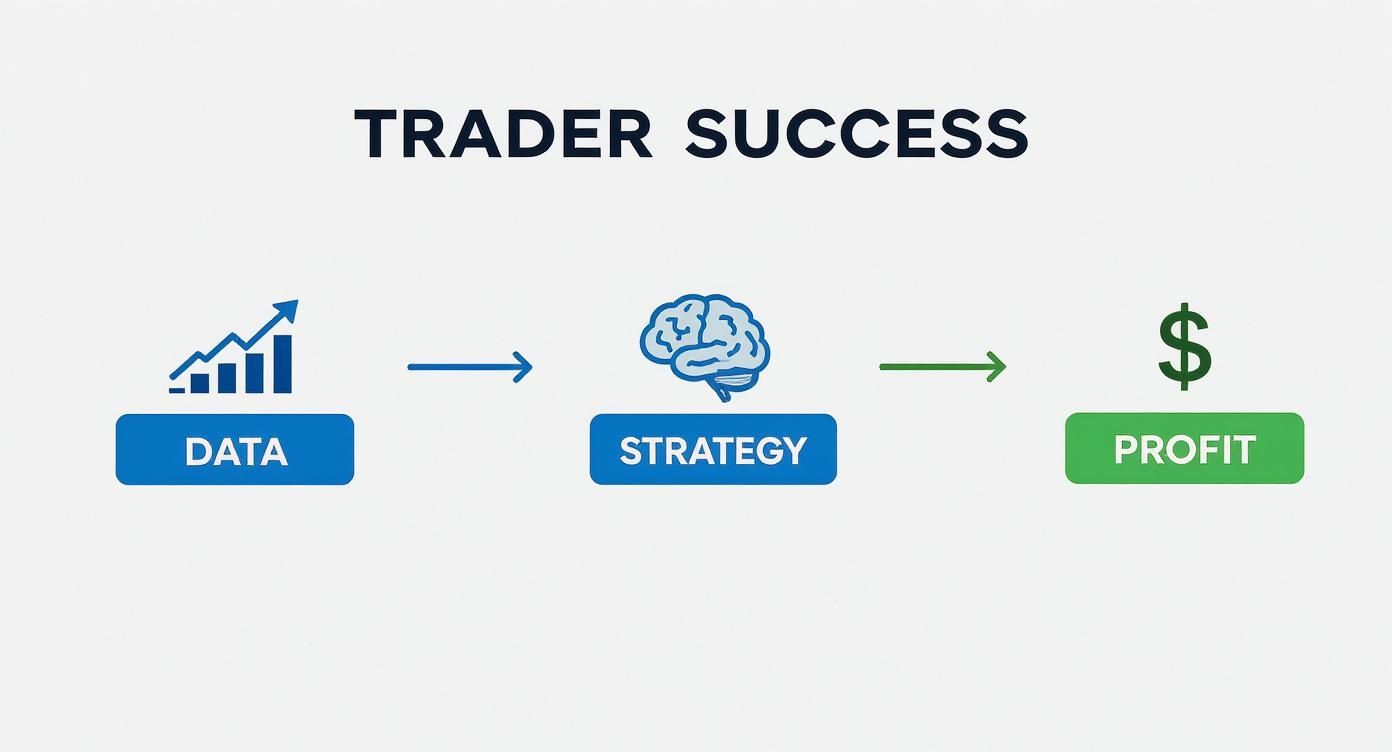
This really drives home a critical truth: without a firm grasp of your numbers, your strategy is built on shaky ground, making consistent performance an uphill battle.
Gross Profit and Loss: The Quick Snapshot
The first and most basic calculation is your Gross Profit or Loss (P&L). Think of this as the raw, unfiltered outcome of a trade before any costs like commissions or fees are factored in. It gives you an immediate look at whether your core trading idea was right or wrong.
The formula is straightforward:
Gross P&L = (Exit Price – Entry Price) x Position Size
This works for anything you trade, whether it’s shares of a stock, futures contracts, or crypto. A positive result is a gross profit, and a negative result is a gross loss.
A Practical Example:
Imagine you buy 100 shares of XYZ Corp at $50 per share and sell them later at $55 per share.
- Gross P&L = ($55 – $50) x 100 shares
- Gross P&L = $5 x 100
- Your Gross Profit is $500.
While it’s a simple number, it’s powerful. It tells you exactly how much your market read was worth before external factors muddy the water.
Percentage Return: Comparing Apples to Apples
Knowing you made $500 is great, but context is everything. Was that $500 earned on a $1,000 investment or a $100,000 one? This is the question Percentage Return answers, making it one of the most vital P&L formulas for comparing your performance across different trades.
It standardizes your results, letting you see which strategies are truly the most effective relative to the capital you put at risk.
The formula for Percentage Return is:
Percentage Return = (Gross P&L / Total Cost of Position) x 100
This metric is essential for long-term thinking. A strategy that consistently grinds out 5% returns on smaller positions might be far more sustainable and scalable than one that produces a huge dollar win once in a blue moon but barely breaks even the rest of the time. Discipline in strategy evaluation is key.
Let’s look at our example again:
With the XYZ Corp trade, your total initial cost was 100 shares x $50/share = $5,000.
- Percentage Return = ($500 / $5,000) x 100
- Percentage Return = 0.10 x 100
- Your Percentage Return is 10%.
A 10% return gives you a much clearer picture of your performance than the raw $500 figure ever could.
Per-Share P&L: The Granular View
Finally, looking at your profit or loss on a per-unit basis helps you dial in on profitability at the most granular level. Per-Share (or Per-Contract) P&L strips away the influence of position size to show you the pure price movement you captured.
This is incredibly useful for fine-tuning your entry and exit timing. The formula couldn’t be simpler:
Per-Share P&L = Exit Price – Entry Price
For our XYZ trade, the math is just $55 – $50 = $5 per share. This tells you that for every single share you held, you captured $5 of the stock’s move. Analyzing this metric over time can reveal if you’re consistently getting out too early or if your exits are well-timed.
For a quick reference, here are the core formulas we just covered. Keep this handy until they become second nature.
Fundamental Trading P&L Formulas at a Glance
| P&L Metric | Formula | Primary Use Case |
|---|---|---|
| Gross P&L | (Exit Price – Entry Price) x Position Size | Quick, unfiltered result of a trade’s outcome. |
| Percentage Return | (Gross P&L / Total Cost) x 100 | Standardizes performance to compare trades of different sizes. |
| Per-Share P&L | Exit Price – Entry Price | Isolates profit/loss per unit to analyze entry/exit efficiency. |
Mastering these three calculations is the first step toward treating your trading like a business. They provide the clear, objective feedback you need to stop guessing and start building a real edge in the market.
Advanced Calculations for Nuanced Trading Scenarios
Once you’ve nailed down the basic metrics, it’s time to add a few more specialized profit and loss formulas to your toolkit. The market rarely serves up clean, simple trades, so you need the right calculations to navigate the messy reality of different trading instruments and smarter account management.
These formulas give you a much deeper, more honest look at your true performance.
We’ll start by clearing up one of the most common areas of confusion for new and experienced traders alike — options. From there, we’ll tackle the critical difference between paper profits and actual money in your account.
Demystifying Options Profit and Loss
Trading options adds a new layer to the P&L equation: the premium. This is simply the price you pay to buy an option or the cash you receive for selling one. Unlike a straightforward stock trade, the premium is a core part of the math and directly shapes your final profit, loss, and even your break-even point.
Let’s break down the P&L for the two basic types of options trades.
-
For a Call Option (Long): You make money when the underlying stock price climbs past your strike price, but you have to clear the hurdle of the premium you paid first.
- P&L Formula: ((Stock Price at Sale – Strike Price) – Premium Paid) x 100
-
For a Put Option (Long): You’re betting on a drop. You profit when the stock price falls below your strike price by more than the premium you paid.
- P&L Formula: ((Strike Price – Stock Price at Sale) – Premium Paid) x 100
Practical Example of a Long Call Option P&L
Let’s say you buy one call option for stock ABC with a $100 strike price. You pay a premium of $2 per share. Since one options contract controls 100 shares, your total cost to enter the trade is $200.
Now, imagine the stock rallies to $105, and you decide to sell the option (or exercise it and sell the shares).
- P&L = (($105 – $100) – $2) x 100
- P&L = ($5 – $2) x 100
- Your net profit is $300.
Forgetting to factor in the premium is a common mistake that can be costly. For any options strategy, it’s a non-negotiable part of figuring out whether a trade was actually profitable.
Realized vs. Unrealized P&L: A Crucial Distinction
This concept trips up so many traders, but getting it right is fundamental to both your accounting and your trading psychology. The difference is simple, yet it has a massive impact.
Realized P&L is the profit or loss from trades you have actually closed. This is real money that has been added to or taken from your account balance. The deal is done.
Unrealized P&L is the “paper” profit or loss on your open positions. It’s that number that flashes on your screen, constantly changing with every market tick. It only becomes real when you hit the “close” button.
It’s dangerously easy to get sucked into the emotional rollercoaster of watching your unrealized P&L swing from green to red and back again. We’ve all been there — feeling like a genius as a position soars, then feeling sick to our stomach as it pulls back.
The key is discipline. Your trading plan should dictate your actions, not the flickering unrealized P&L number. Making impulsive decisions based on paper profits is one of the fastest ways to get inconsistent, frustrating results.
Thinking Like a Business: Your Net P&L
To really treat your trading like a business, your P&L calculations need to mirror how successful companies think about their finances. A business doesn’t just look at revenue minus the cost of its products; it accounts for every single expense to find its true bottom line.
This comprehensive approach is standard practice in the financial world. The formula businesses use is extensive, subtracting everything from operating costs to interest and taxes from total revenue. As financial reporting guides explain, this gives a far more accurate picture of a company’s health. You can discover more about how businesses use P&L statements on prnfunding.com.
As a trader, this means adopting a Net P&L mindset. Your gross P&L is just the starting point. To find your real net profit, you have to subtract all of your trading-related costs, which we’ll cover in detail next. This disciplined, business-like approach is what separates amateurs from the pros who build lasting careers in the market.
Calculating Your True Net Profit
It’s a tough lesson every trader learns, often the hard way: a trade that looks profitable on paper can flip to a loss once real-world costs kick in. The gap between your gross profit and your true net profit is where wishful thinking dies and a sustainable business begins. To last in this game, you have to get obsessive about the hidden variables that chip away at your bottom line.

Let’s shift the focus from celebrating flashy gross gains to meticulously tracking what you actually keep. Mastering these adjustments is the mark of a pro who treats trading like a business, not a slot machine.
Accounting for Fees and Commissions
The first and most obvious costs you’ll run into are trading fees and commissions. They might look tiny on a single trade, but they add up fast and can take a serious bite out of your profits, especially if you’re an active trader. Every broker is different, so you need to know your fee structure inside and out.
- Per-Share Commissions: Common for stock traders, you might pay a tiny fee like $0.005 for every single share you buy or sell.
- Per-Trade Commissions: Here, you pay a flat fee per transaction, no matter the size. Think $4.95 to get into a position and another $4.95 to get out.
- Percentage-Based Fees: You see this a lot in crypto. The exchange takes a small percentage of the total value of your trade.
These costs come directly off your gross P&L. That $100 winner might only be an $85 gain after commissions are paid — a 15% haircut you absolutely can’t afford to ignore.
The Hidden Cost of Slippage
Slippage has to be one of the most frustrating hidden costs in trading. It’s the difference between the price you expected when you clicked the button and the price you actually got. This all happens in the blink of an eye, in the milliseconds it takes for your order to get filled.
In a fast-moving or thin market, slippage can be a real killer. You try to buy a stock at $20.00, but your order fills at $20.05. That’s $0.05 of slippage per share. On a 1,000-share position, you’ve just been hit with a $50 unplanned expense before the trade even has a chance to breathe.
Slippage is a tax on speed and a penalty for trading in chaotic markets. While you can’t eliminate it completely, you can minimize it by avoiding low-liquidity assets and not chasing runaway price moves.
This gets to the heart of tracking your performance. Gross P&L is just the starting point. To truly know if you’re profitable, you have to subtract all these costs, just like a business does. This is closely related to how businesses calculate their return on investment. You can dive deeper into this topic in our guide on how to calculate return on investment, which breaks down comprehensive performance metrics.
Margin and Interest Costs
Using leverage can be a powerful tool, but margin isn’t free. When you trade on margin, you’re borrowing money from your broker, and they’re going to charge you interest on that loan. These charges are usually calculated daily and billed to your account monthly.
If you hold a leveraged position for weeks or months, those interest costs can pile up and quietly eat away at your profit. This is a huge deal for swing traders or anyone holding positions overnight. You have to bake these financing costs into your profit and loss formulas to see the real net outcome. Ignoring them is like a business owner ignoring their loan payments — a surefire recipe for disaster.
Using P&L Formulas for Smarter Risk Management
Calculating your profit and loss isn’t just about looking back at your account balance. It’s about building a real, predictive edge for the future. When you understand the math behind your performance, you can make smarter, more calculated decisions that protect your capital and set you up for long-term growth. This is where your P&L data stops being a simple scoreboard and turns into a powerful risk management tool.
This shift in thinking is what separates traders who get lucky for a while from those who build a lasting career. You move from emotional guesswork to a disciplined, rules-based approach where every trade is grounded in your own personal statistics.
From Raw P&L to a Statistical Edge
Once you’ve logged a decent number of trades, you can use your P&L data to find two crucial metrics: profit factor and expectancy. These aren’t just buzzwords; they give you a clear, statistical picture of whether your trading system has a positive edge over time.
- Profit Factor: This is simply the ratio of your total gross profits to your total gross losses. If your profit factor is above 1.0, it means your winning trades are bringing in more money than your losing trades are costing you — a good sign.
- Expectancy: This metric tells you what you can expect to make (or lose) on average for every single dollar you put at risk. It’s a powerful number that combines your win rate with the size of your average win and average loss.
Calculating these forces you to look at the unfiltered reality of your trading. A high win rate feels great, but if your average loss is much bigger than your average win, your expectancy could still be negative. And if that’s the case, you may eventually bleed your account dry, no matter how often you “win.”
Defining Your Risk Before the Trade
The single biggest psychological leap a trader can make is knowing their maximum potential loss on a trade before even hitting the buy or sell button. This is done by setting a maximum risk-per-trade, usually as a small percentage of your total trading capital.
A time-tested rule of thumb among professional traders is the 1% Rule: consider risking no more than 1% of your account equity on any single trade. This isn’t just a suggestion; it’s a survival mechanism that helps ensure one bad trade can’t knock you out of the game.
Once you’ve defined your maximum dollar risk (for example, 1% of a $25,000 account is $250), you can use that number to figure out the correct position size for any given setup. This moves you away from random sizing and into a calculated, risk-first approach.
Tying It All Together with Position Sizing
Position sizing is the bridge that connects your trade idea to your risk management plan. It answers the simple but critical question, “How many shares or contracts should I actually trade?” The formula links your maximum risk to your trade’s specific stop-loss.
The Position Sizing Formula:
Position Size = Maximum Dollar Risk / (Entry Price – Stop-Loss Price)
Let’s walk through a practical example:
- Your Account Size: $25,000
- Your Maximum Risk per Trade: 1% (which is $250)
- Your Trade Idea: Buy stock ABC at $50.00
- Your Stop-Loss: Placed at $48.50 (a $1.50 risk per share)
Now, you can calculate your position size:
- Position Size = $250 / ($50.00 – $48.50)
- Position Size = $250 / $1.50
- Position Size = 166 shares (it’s often wise to round down to be safe)
By following this simple process, you enter the trade with full knowledge that your maximum loss is capped at $250. This drastically reduces fear and builds the discipline needed for a successful career. For a more detailed breakdown, check out our comprehensive guide on essential risk management techniques.
Got Questions About P&L? We’ve Got Answers.
Even after you’ve nailed down the basics, trading always finds a way to throw a curveball. We’ve all been there — a specific scenario comes up that doesn’t quite fit the textbook examples, leaving you scratching your head. This is where we tackle those common sticking points.
Think of this as your practical guide to the nuances of P&L. Let’s clear up the confusion so you can calculate your performance with confidence, no matter what the market does next.
How Do I Calculate P&L for a Short Sale?
This one trips people up, but it’s simpler than it sounds. Calculating profit on a short sale is just the reverse of a normal long trade. Instead of “buy low, sell high,” you’re aiming to “sell high, buy low.”
Your gross profit is your entry price (where you sold short) minus your exit price (where you bought to cover), all multiplied by the number of shares.
For instance, if you short 100 shares of a stock at $50 and cover your position at $45, your gross profit is ($50 – $45) x 100 = $500. Don’t forget to subtract commissions and any stock borrowing fees to get your true net profit.
What’s the Difference Between ROI and Percentage P&L?
These two sound almost identical, but they’re measuring your performance on completely different scales. It’s a subtle but crucial distinction.
- Percentage P&L is all about a single trade. It tells you the gain or loss relative to the capital you risked on that specific position.
- Return on Investment (ROI) is the big-picture metric. It’s usually calculated over a longer period (like a quarter or a year) and measures your total net profit against the entire capital in your account.
You could nail a trade with a fantastic 20% P&L, but the ROI on your account for the year could be much lower (or higher!), reflecting your overall performance across all trades. Both metrics are valuable for a complete picture.
Why Should I Bother Tracking Unrealized P&L?
It’s so easy to dismiss unrealized P&L as “paper profits” or “monopoly money,” but ignoring it is a massive mistake. Tracking the real-time value of your open positions is fundamental to active risk management.
Sure, the profit or loss isn’t locked in until you close the position, but it directly impacts your account’s margin and available buying power.
A large unrealized loss can quickly trigger a margin call, forcing you to liquidate at the absolute worst time. On the flip side, watching unrealized gains helps you manage the trade intelligently — like deciding when to move a stop-loss to break-even or scale out of a winner. It’s a live health check for every single position you hold.
How Can I Automate P&L Tracking and Save Time?
Let’s be honest: manually punching trades into a spreadsheet is not just a drag; it’s a recipe for disaster. A single typo can completely skew your performance analysis, leading you to make bad decisions based on faulty data. Many of us have been there, and it’s a frustrating, time-consuming process.
The best way to handle this is with a dedicated trading journal platform.
These tools sync directly with your broker to automatically import every detail of your trades. They do all the heavy lifting — calculating realized and unrealized P&L, percentage returns, and even advanced stats like your profit factor and win rate — with zero manual entry. This automation frees you up to focus on what actually matters: analyzing your performance, not just logging it.
Stop wasting hours updating spreadsheets and start making data-driven decisions. TradeReview automates your P&L tracking by syncing directly with your broker, giving you a crystal-clear view of your performance metrics on our intuitive dashboard. Sign up for free and turn your trading data into your greatest asset. Get started at https://tradereview.app.