For anyone new to journaling, the whole process starts with one simple, powerful idea: getting your thoughts out of your head and onto a page. This isn’t just about keeping a diary; it’s a proven method for gaining mental clarity, cutting down on stress, and getting to know yourself a whole lot better.
Why Your Brain Needs a Journal
Let’s be honest — the phrase “Dear Diary” can feel a bit cringe-worthy. But modern journaling is a far cry from a simple log of your day. It’s a practical, powerful tool for navigating life’s complexities, especially in high-stress fields like trading where emotional discipline is paramount.
For traders, a disciplined journaling practice isn’t a suggestion; it’s a foundational pillar for long-term growth. We’ve seen many traders struggle with the same mistakes repeatedly, not because they lack knowledge, but because they lack a system to learn from their actions. If you want to dive deeper, check out our guide on why every trader needs a trading journal.
The real benefit appears when you create a bit of distance between yourself and your thoughts. When ideas, worries, and plans are just swirling around in your head, they can feel overwhelming and chaotic. The act of writing them down forces you to articulate them, turning that mental mess into something you can analyze objectively.
The Psychology of Writing It Down
So, what’s really going on when you journal? It’s not magic — it’s psychology. The act of externalizing your thoughts actually engages different parts of your brain, allowing you to process emotions and events with more objectivity.
Instead of just feeling anxious after a losing trade, you start to pinpoint why. For example, you might write: “I felt anxious because I held onto that losing position, hoping it would turn around, even though my strategy told me to cut my losses.” That small shift takes you from just reacting to your emotions to actively diagnosing the behavior behind them.
Journaling is the difference between being caught in a storm and watching it from a safe distance. It gives you the perspective needed to navigate, rather than just endure.
This is exactly why so many people make journaling a non-negotiable part of their routine. It’s not about crafting a literary masterpiece. It’s about having a consistent, private conversation with yourself that leads to tangible, real-world benefits. Progress in trading isn’t about finding a secret indicator; it’s about disciplined self-review, and a journal is your primary tool for that.
From Blank Page to Clear Mind
One of the biggest obstacles for beginners is the fear of the blank page. The pressure to write something brilliant can be paralyzing. But here’s the secret: the quality of your writing doesn’t matter one bit. What matters is the habit of showing up consistently, day after day, even when it feels pointless.
Thankfully, modern tools have made this easier than ever. You don’t need a fancy pen and an intimidatingly beautiful notebook anymore. Digital apps offer prompts, reminders, and secure platforms to capture your thoughts wherever you are. Whether you love the old-school feel of paper or the convenience of an app, the goal is the same: find something that makes it easy to be consistent.
A journal gives you a dedicated space to:
- Gain Mental Clarity: Untangle complicated thoughts and see situations for what they really are.
- Reduce Anxiety: By giving your worries a place to live, you stop them from taking over your mind 24/7.
- Solve Problems Effectively: Writing about a challenge often shines a light on solutions you hadn’t even considered.
- Track Your Progress: Seeing how your perspective and feelings change over time is incredibly insightful and motivating.
Ultimately, journaling isn’t just another task to cram into your to-do list. It’s a foundational practice for self-awareness and intentional living — a quiet space to make sense of all the noise.
Choosing Your First Journaling Tool
The age-old debate of paper versus digital can stop you in your tracks before you even write a single word. It’s a classic case of analysis paralysis. But here’s the secret: the best journal for a beginner isn’t about picking the “perfect” tool — it’s about choosing the one you’ll actually use.
The most beautiful leather-bound notebook or the sleekest new app is worthless if it just gathers dust. Let’s break down the options so you can find a starting point that feels natural. Consistency beats perfection every time, and your tool should make it easy to show up.
The Appeal of Pen and Paper
There’s something uniquely satisfying about putting a real pen to real paper. The physical act of writing can feel more intentional, almost meditative. It forces you to slow down your thoughts and connect more deeply with what you’re trying to express.
This isn’t just a feeling; the market for physical journals remains strong. Despite our screen-filled lives, people still crave that tangible connection.
If you go this route, picking a journal is a personal choice. Think about:
- Size: Does it need to fit in a bag for on-the-go thoughts, or will it live on your desk? An A5 size is a great all-rounder.
- Paper: Good quality, thick paper is a game-changer. It prevents ink bleed-through and just makes the experience more pleasant.
- Binding: Do you want a notebook that lays completely flat for easy writing, or do you prefer a classic spiral-bound style?
The right physical journal is one that feels good in your hands. It should be an invitation to write, not an intimidatingly perfect object. Don’t be afraid to get it messy — that’s a sign it’s being used.
The Convenience of Digital Journaling
On the other side, you have digital journaling apps, and their main selling point is pure convenience. Your journal is always with you, right on your phone, tablet, or laptop. The moment an idea strikes, you can capture it.
This accessibility is huge for beginners. It removes the friction of having to find your notebook and a pen. You can just open an app and start typing in seconds, which can make all the difference when you’re trying to build a consistent habit.
If you ever feel stuck wondering what to write, a simple decision tree can help guide your session based on what you need in that moment.
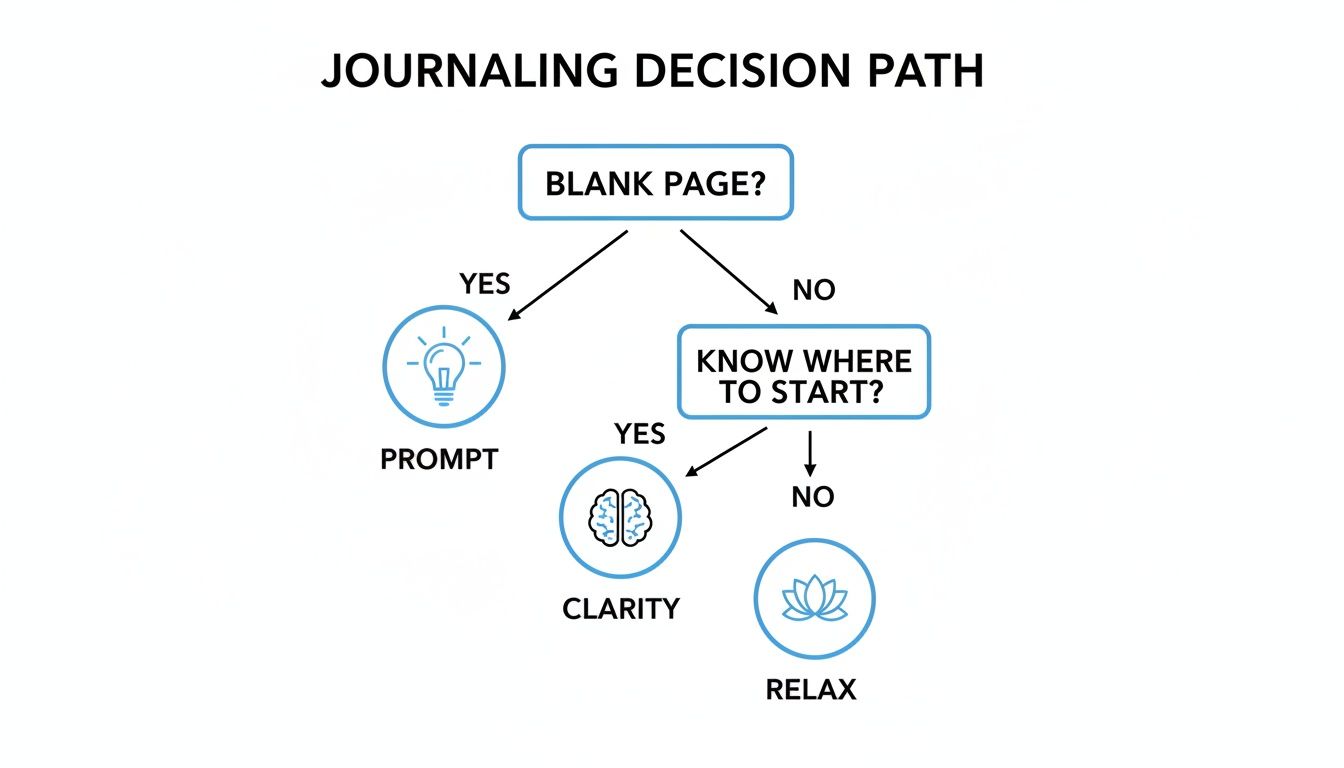
As the chart shows, your starting point can be as simple as deciding if you need a creative prompt, a moment of clarity, or just a space to unwind.
Digital tools also offer powerful features that paper just can’t. You can instantly search past entries, tag them by topic or emotion, and easily add photos or voice notes to create a much richer log of your experiences. For a closer look at what’s out there, check out our guide on the best free trading journal tools.
Paper vs Digital Journaling: Which Is Right for You?
So, how do you decide? It really comes down to your personality, your lifestyle, and what you want to get out of journaling. There’s no wrong answer. This table breaks down the key differences to help you see what might be a better fit.
| Feature | Paper Journal | Digital Journal |
|---|---|---|
| Accessibility | Requires carrying a physical notebook and pen. | Always available on your phone, tablet, or computer. |
| Experience | Tangible, meditative, and screen-free. Offers complete creative freedom. | Fast, convenient, and easy to use anywhere, anytime. |
| Organization | Relies on manual systems like tabs or indexes. Can be harder to search. | Powerful search, tagging, and filtering make finding past entries effortless. |
| Security | Private by nature, but can be lost, stolen, or damaged. | Often includes password protection and cloud backups for security and peace of mind. |
| Cost | One-time purchase, with a wide range of prices. | Many free options are available; premium versions often require a subscription. |
| Multimedia | Limited to what you can physically add (doodles, photos, clippings). | Easily incorporate photos, videos, voice notes, and links. |
Ultimately, the best tool is the one that removes the most friction from your process.
If you crave a screen-free ritual, a physical journal is probably your best bet. If you’re always on the move, an app ensures you never miss an opportunity to write. And if you love analyzing patterns, the search and tag functions of a digital tool are invaluable.
Don’t overthink it. Just start with what feels easiest. You can always switch later if your needs change. The most important step is simply to begin.
Finding a Journaling Method That Clicks
So, you’ve picked a tool. Now for the big question: what on earth do you actually write?
Good news — there’s no single “right” way to journal. The best journaling method for a beginner is simply the one that fits your personality and helps you achieve your goals.
Think of it like exercise. Some people get a huge rush from running, while others prefer the quiet, steady focus of yoga. You’re not looking for the universally “best” workout, just the one that feels right and keeps you showing up. Journaling is exactly the same.
Let’s walk through a few popular methods, looking not just at what they are, but who they’re for.
For the Person Craving Order and Clarity
If your mind ever feels like a browser with way too many tabs open, Bullet Journaling might be your answer. This method, often called “BuJo,” is a super flexible system for wrangling tasks, notes, and goals all in one place. It’s less about long, free-form paragraphs and more about structured, easy-to-scan lists.
Instead of writing a long entry about a stressful day, you might:
- Create a simple To-Do list with clear, actionable items.
- Log appointments and deadlines in a monthly or weekly spread.
- Use a Habit Tracker to monitor goals like reviewing your trades daily or meditating.
A practical example for a trader might be a daily log:
- Market Open: Noted key support/resistance levels.
- 10:15 AM: Took a long position in XYZ based on my setup criteria.
- 11:30 AM: Exited with a small loss; I followed my stop-loss rule. Good discipline.
- EOD: Review performance. Realized I was hesitant on my entry.
This approach turns your journal from a passive space for reflection into an active tool for managing your life and improving your performance.
For the Person Seeking a Positive Mindset
Feeling weighed down by negativity or stuck focusing on what’s going wrong? Gratitude Journaling is a simple but incredibly powerful practice designed to shift your perspective. The idea is straightforward: you just regularly write down things you’re thankful for.
This isn’t about pretending problems don’t exist. It’s about intentionally training your brain to notice the good that’s also there, which is especially important in trading, where losses can easily overshadow wins.
Your entry could be as simple as, “I’m grateful for the warm cup of coffee I had this morning, for sticking to my trading plan even when it resulted in a small loss, and for the funny text from a friend.” Over time, these small observations build a real foundation of positivity.
By consistently focusing on what you appreciate, you create a mental habit of seeking out the good, which can have a huge impact on your overall outlook and resilience.
For the Person Feeling Creatively Stuck
If you feel blocked, uninspired, or just disconnected from your own inner voice, Morning Pages could be the key to unlocking your creativity. Made popular by Julia Cameron, this technique involves writing three pages of longhand, stream-of-consciousness thoughts first thing in the morning.
The rules are simple: you just write whatever comes to mind without stopping, editing, or judging. It’s a “brain dump” meant to clear out all the mental clutter — the anxieties, the to-do lists, the random thoughts — that stands between you and your creative flow.
Morning Pages aren’t supposed to be good writing. In fact, a lot of it might be complete nonsense. The value is in the process itself, which helps silence your inner critic and creates a direct line to your more authentic thoughts. For some great prompts to get you started, check out our guide with journal ideas for beginners.
The Rise of AI-Augmented Journaling
Lately, technology has completely reshaped how people approach journaling. One of the biggest developments is AI-augmented journaling, which has quickly become a popular method for beginners.
These digital tools can offer guided prompts, detect emotional patterns over time, and even provide conversational feedback. They significantly lower the barrier for anyone who feels lost staring at a blank page. The growth in the market for digital journal apps shows a clear trend toward personalized, data-driven tools that make the practice more accessible and measurable.
The best approach? Just experiment. Try one method for a week. If it doesn’t feel right, don’t force it. Just switch to another until you find the one that truly clicks.
How to Build a Lasting Journaling Habit
We’ve all been there. You get that initial rush of excitement starting a new journal. You’ve got the fresh notebook or the slick new app, and you’re ready to fill it with insights. But after a few days, maybe a week, that momentum fizzles out. The journal ends up in a drawer or gets buried on your phone’s home screen.
This isn’t a personal failing — it happens to almost everyone. The real work of journaling for beginners isn’t about that first entry; it’s about showing up for the second, the tenth, and the hundredth. So let’s skip the generic advice and get into what actually works to make this a permanent part of your routine.
Start Impossibly Small
The single biggest mistake beginners make is setting the bar way too high. They decide they’re going to write a detailed, multi-page masterpiece every single day. The moment life gets in the way and they miss a day, they feel guilty. That guilt snowballs, and soon enough, they’ve given up entirely.
The trick is to lower the bar so low you can’t possibly fail. Seriously. Forget writing a chapter; just aim for one sentence.
- One Sentence a Day: “Today was hectic, but I managed to finish my big project.”
- One Emotion a Day: “Feeling anxious about tomorrow’s meeting.”
- One Gratitude a Day: “Grateful for the quiet five minutes I had this morning.”
A single sentence is all it takes to keep the connection to your journal alive. It proves you don’t need a huge block of time to make it count, and it keeps the habit going on your busiest days. It is far more powerful to write one line every day for 30 days than it is to write a novel once and then quit for good.
Use Habit Stacking to Your Advantage
One of the best psychological hacks for building a new habit is to piggyback it onto something you already do without thinking. This is called habit stacking, and it makes the new routine feel almost automatic because you’re not relying on willpower.
Just think about the things you already do every single day, no matter what.
- Do you make a cup of coffee every morning? Put your journal right next to the coffee maker. The new rule is simple: After I pour my coffee, I will write one sentence in my journal.
- Do you review your charts every night? Keep your journal open on your desk. After I close my charts, I will open my journal for two minutes.
By linking journaling to an existing, rock-solid habit, you’re not creating a new routine from scratch. You’re just adding a tiny step to a path your brain already travels down every day. This is how you make journaling feel less like a chore and more like a natural part of your day.
A journal is not another task to be checked off a list; it’s a tool for self-support. If you miss a day, it doesn’t mean you’ve failed — it means you’re human. The goal is consistency, not perfection.
Reframe Your Mindset
Finally, let’s talk about the mental game. Too many people see journaling as another obligation — something they should do. That mindset is a one-way ticket to burnout. You have to reframe it. Your journal is a source of support, a completely private space where you can unload your thoughts without any judgment.
And most importantly, practice a little self-compassion. If you miss a day, or even a week, don’t beat yourself up. There’s no such thing as “falling behind.” Just open it up to a fresh page and start again, right where you are. Your journal will always be there, ready when you are.
By starting small, linking the habit to an existing routine, and being kind to yourself, you can turn journaling from a short-lived experiment into a powerful, lifelong tool.
Why Digital Journaling Apps Are So Popular
Look, there’s something to be said for the classic feel of pen on paper. But let’s be realistic — digital journaling apps have completely changed the game, especially if you’re just starting. They don’t just copy the old-school notebook; they supercharge it and fix a lot of the problems that make people quit journaling in the first place.
The biggest win? Convenience. Most of us have our phones with us constantly, so your journal is always right there in your pocket. No more scrambling for a pen or waiting until you get home to write something down. That simple fact makes it a hundred times easier to stay consistent.

This blend of easy access and powerful features has turned digital journaling into a huge market. The global digital journal apps market was valued at USD 4.93 billion in 2023 and is projected to grow significantly, reflecting a broader shift towards digital mental wellness tools. This growth is driven by widespread smartphone adoption and an increased focus on mental health. For more detailed analysis, you can explore reports like this digital journal apps market report from Straits Research.
Overcoming the Blank Page with Guided Prompts
One of the most intimidating parts of journaling for beginners is staring at that empty page. What are you even supposed to write? Digital apps get rid of that anxiety by offering guided prompts. Instead of you having to come up with some brilliant insight, the app gives you a gentle nudge.
- “What was one small thing that brought you joy today?”
- “What’s a worry you can let go of right now?”
- “Describe a challenge you faced and how you handled it.”
These little questions remove the pressure and make it incredibly simple to get started. It turns a chore into a quick, guided moment of reflection.
Gaining Deeper Insight with Mood Tracking
Getting a handle on your emotional patterns is one of the biggest payoffs of journaling. You can do this on paper, of course, but digital apps make it ridiculously easy. Many let you log your mood with a quick tap, linking it directly to your entry for the day.
Do this for a while, and you’ll build an amazing dataset of your own emotional rhythm. You’ll start to spot connections you would have totally missed otherwise.
You might notice that your anxiety spikes every Sunday night like clockwork, or that you’re always in a better mood on days you manage to get outside for a walk. Your journal goes from being a simple diary to a powerful tool for self-awareness.
Creating a Richer Story with Multimedia
A digital journal isn’t stuck with just words on a page; it can be a full-on multimedia scrapbook. Adding a photo to an entry instantly brings a memory to life in a way that text just can’t match.
Think about it: you can journal about an awesome day with friends and attach a selfie from that moment. Or, if you’re not in the mood to type, you can record a quick voice note to capture your thoughts raw and unfiltered. Adding photos, videos, and audio makes for a much more vivid and complete story of your life.
On top of all that, digital apps offer a few more perks that beginners love:
- Security and Privacy: Your thoughts are yours alone. Good apps come with passcode, Touch ID, or Face ID locks to keep everything private.
- Searchability: Ever try to find a specific entry in a year-old notebook? It’s a nightmare. With an app, a quick search pulls it up in seconds.
- AI-Powered Insights: Some of the more advanced apps use AI to spot recurring themes and emotional trends in your writing, pointing out patterns you might not see yourself.
For most people, these digital tools don’t take away the soul of journaling. They just make it more practical, more powerful, and a whole lot easier to stick with.
Got Questions About Journaling? Let’s Clear Things Up.
Getting started with a journal can feel a little awkward at first, and it’s totally normal to have questions. In fact, most beginners get hung up on the same handful of doubts. Let’s tackle those common hurdles head-on so you can start building this powerful habit with confidence.
Think of this as your practical FAQ. The only real rule is that the journal has to work for you.
“What If I Miss a Day?”
This is the number one question I hear. And the answer is simple: nothing happens. It’s okay.
Life gets in the way. You’ll be too busy, too tired, or you’ll just forget. A journal is a tool to support you, not another stick to beat yourself with. The worst thing you can do is try to “catch up” by forcing yourself to fill in the blank days. That just turns journaling into a chore and builds resentment, which is the fastest way to quit for good.
The goal here is consistency, not perfection. Your journal isn’t keeping score. It’s a patient tool waiting for you whenever you’re ready to pick it up again. Just start with today.
“I Stare at a Blank Page and Have No Idea What to Write.”
Ah, the classic fear of the blank page. It’s real, and you’re not alone if your mind goes completely empty the second you sit down. The trick is to lower the stakes. You don’t need to write a masterpiece.
Forget about finding a grand topic. Just start with the smallest, most immediate thing you can think of.
- Do a “Brain Dump”: Set a five-minute timer and just write. Don’t stop, don’t edit, don’t even worry if it makes sense. Get the noise out of your head and onto the page.
- Use a Simple Prompt: Ask yourself a tiny question. “What’s one thing that’s on my mind?” or “What’s one thing I learned from the market today?”
- Describe Your Surroundings: What do you see on your desk right now? What is the weather like? This is a great way to ground yourself in the present moment and get the words flowing.
Many journaling tools, like TradeReview, have features to guide your entries. Over time, you’ll find that the words start coming much more naturally.
“Is My Journal Supposed to Be Private?”
Yes. 100% yes. For your journal to be an effective tool, you have to feel safe enough to be brutally honest with yourself. Privacy creates the space for unfiltered thoughts, raw emotions, and half-baked ideas without any fear of judgment.
If you’re using a notebook, keep it somewhere secure. If you’re using a digital app, make sure it has solid security features. Look for things like:
- Passcode Protection: A simple PIN lock.
- Biometric Lock: Using your fingerprint or Face ID.
- End-to-End Encryption: This ensures no one, not even the app developers, can read what you write.
Knowing your journal is for your eyes only is what helps you build trust with yourself and get the real work done.
“How Long Should I Spend Journaling Each Day?”
For anyone new to journaling for beginners, the answer is almost always less time than you think. Aim for just 5 to 10 minutes a day. That’s it.
The power of journaling comes from the compounding effect of a consistent, long-term habit — not from one marathon writing session every few weeks. On your busiest days, even scribbling down a single sentence is a win. It keeps the momentum going.
Let your journal be a moment of clarity, not a burden. You’ll find that on some days you’ll want to write more, and that’s great. But on the days you don’t, a few minutes is more than enough to keep the habit alive.
Ready to build a data-driven journaling habit that improves your performance? TradeReview offers a powerful, free platform to track your trades, analyze your strategy, and eliminate emotional decision-making. Sync your broker automatically, tag your trades, and view your progress on an intuitive dashboard. Start making smarter, more informed decisions today by signing up at https://tradereview.app.