A futures position size calculator is a simple but powerful tool that tells you exactly how many contracts to trade. It’s not based on gut feelings or a hot tip — it’s based on your specific account size and exactly how much you’re willing to risk on a single idea. This small step transforms risk management from a guessing game into a precise, repeatable process, which is the absolute bedrock of disciplined trading.
Why Position Sizing Is Your Most Important Trading Skill
Let’s start with a story that’s probably painfully familiar. You spot a perfect A+ setup. Your analysis is solid, you feel confident, and you jump into the trade. The market moves exactly as you predicted, but somehow, you still walk away with a devastating loss.
How does that happen? The position was just too big. One unexpected news spike or a moment of hesitation was all it took to wipe out weeks of hard-earned wins in an instant.
This is the classic, gut-wrenching lesson that separates aspiring traders from professionals. It teaches you that being right about market direction is only one piece of the puzzle. The other, more critical piece, is managing your exposure on every single trade. We’ve all felt the sting of a big loss, and mastering position sizing is the key to preventing them.
Moving From Gambling to Professional Trading
Without a systematic way to size your positions, you’re essentially gambling. You might get lucky here and there, but over the long run, the math is working against you. A futures position size calculator is the tool that forces you to shift from a gambler’s mindset to that of a professional risk manager.
Successful trading isn’t about hitting that one massive home run. It’s about surviving the inevitable losses and staying in the game long enough for your edge to actually play out. When you get your position sizing right, you ensure that no single trade can knock you out of the market. It enforces discipline by making risk a calculated, unemotional decision made before you ever click the buy or sell button.
The goal is consistency, not intensity. When you define your maximum loss before you enter a trade, you protect your capital and cut out the emotional stress that leads to terrible decisions, like widening stops or revenge trading.
This guide will show you exactly how to use this essential tool, which all comes down to three core inputs:
- Your Account Size: The total capital you have available to trade with.
- Your Risk Percentage: The maximum slice of your account you’re willing to lose on one trade (e.g., 1%).
- Your Stop Loss: Your pre-defined exit point where you admit the trade idea was wrong.
Mastering how these three elements work together is what builds a foundation for longevity in the markets. If you want to go deeper, you can explore our complete guide to risk management for traders. Ultimately, this disciplined approach is what allows you to trade with confidence, knowing your downside is always protected.
Understanding the Core Sizing Components
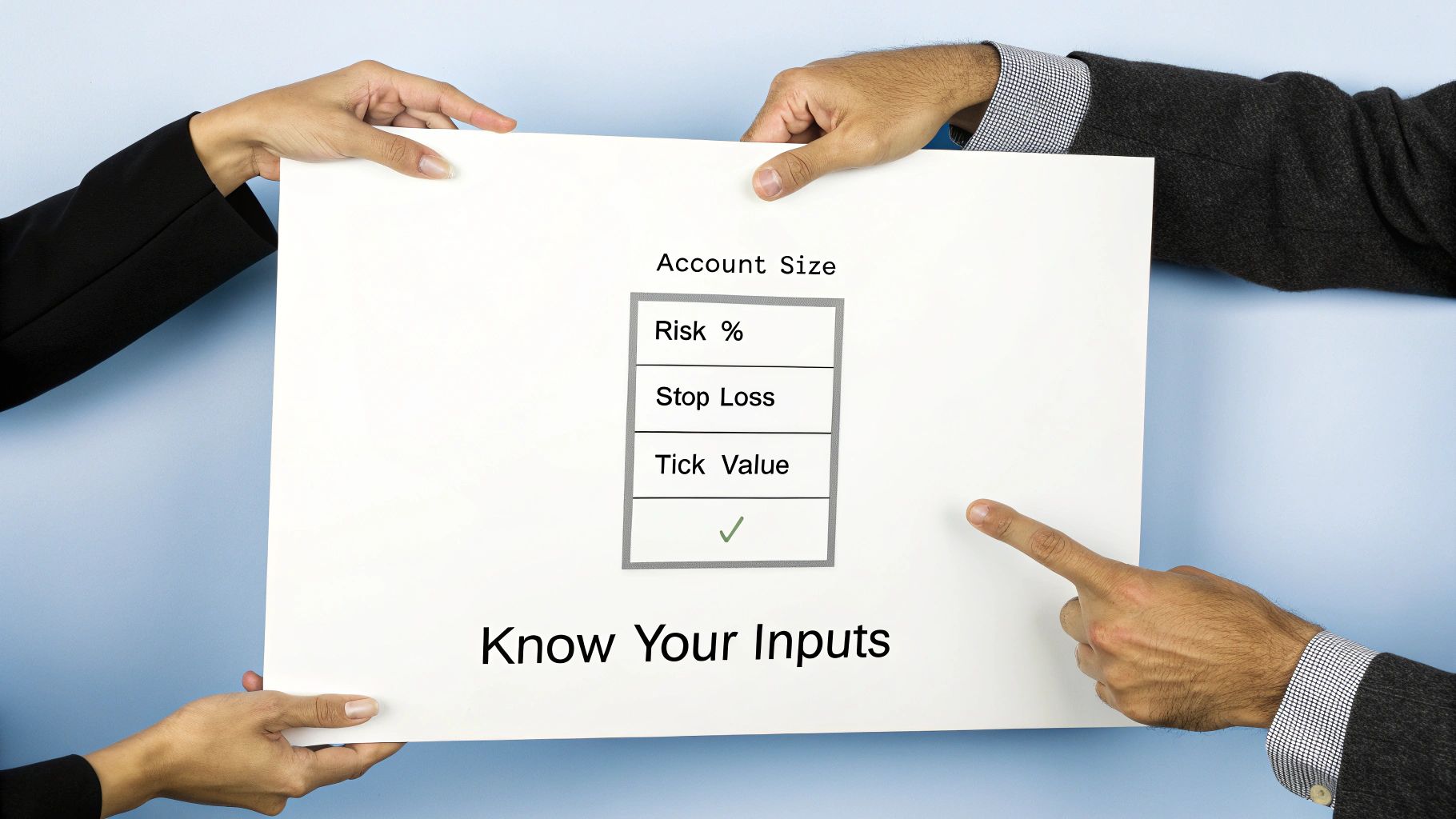
Before you can really put a position size calculator to work, you have to get a handle on the inputs that drive it. These aren’t just abstract numbers; they’re the pillars of your entire risk management plan. Getting them right is the difference between a wild guess and a calculated business decision.
Think of it like building a house. You wouldn’t pour concrete without knowing the dimensions of the foundation. In the same way, you shouldn’t be placing trades without first defining your financial boundaries. Let’s break down each piece of the puzzle so you can approach any calculator with total confidence.
Your Account Size and Risk Percentage
First up is your Account Size, which is simply the total capital you have available for trading. Be honest with yourself here — this isn’t your 401k or your entire net worth. It’s the liquid cash in your trading account you can truly afford to risk.
Next is your Risk Percentage, which is arguably the most important decision you’ll make before any trade. This is the maximum slice of your account you’re willing to lose if a single trade goes south. Most professionals live and die by the 1-2% rule, and for good reason. It provides a crucial financial and emotional cushion.
We all feel the sting of a loss, but risking just 1% means you could suffer a gut-wrenching string of 10 consecutive losses and still have roughly 90% of your capital ready for the next opportunity. That discipline is what keeps you in the game long enough to succeed.
A trader with a $25,000 account risking 1% has a maximum loss of $250 per trade. Even if they hit a rough patch, they survive to trade another day. A trader risking 10% on that same account could be wiped out after just a few bad trades. Survival always comes first.
Defining Your Stop Loss and Instrument Value
Your Stop Loss Distance is your pre-planned exit strategy if the trade turns against you. It’s the line in the sand where you admit the idea was wrong and cut the loss cleanly. This distance is measured in points or ticks. A tick is the smallest price increment for a given futures contract. A point is made up of a certain number of ticks.
A wider stop gives your trade more room to breathe, while a tighter stop is for quick, precise entries where you expect an immediate reaction.
Finally, every futures contract has a specific dollar value attached to its price movements. The Tick Value is how much money you make or lose for every one-tick move. The Point Value represents the value of a full point, which is just a collection of ticks.
These values are what turn your stop loss distance (in points or ticks) into a real dollar risk per contract. For example, a 4-point stop loss on the E-mini S&P 500 (ES) translates to a $200 risk per contract, because each full point in the ES is worth $50.
The real magic of a position size calculator is how it synthesizes all this data instantly. For example, a trader with a $100,000 account and a 1% risk rule ($1,000 max loss) who sees a setup with a 4-point stop on the ES knows they could trade 5 contracts ($1000 max loss / $200 risk per contract). It becomes simple math that builds confidence and consistency.
Studies from brokerages and trading platforms often show that traders who risk a smaller percentage of their capital per trade tend to have better long-term survival rates. If you want to dive deeper, you can explore more on E-mini position sizing strategies to see these principles in action.
Key Values for Popular Futures Contracts
To make things easier, here’s a quick reference table for some of the most popular futures contracts. You’ll want to get familiar with these numbers, as they directly impact your risk calculations.
| Futures Contract (Symbol) | Point Value | Tick Size | Tick Value |
|---|---|---|---|
| E-mini S&P 500 (ES) | $50.00 | 0.25 | $12.50 |
| Micro E-mini S&P 500 (MES) | $5.00 | 0.25 | $1.25 |
| E-mini Nasdaq 100 (NQ) | $20.00 | 0.25 | $5.00 |
| Micro E-mini Nasdaq 100 (MNQ) | $2.00 | 0.25 | $0.50 |
| Crude Oil (CL) | $1,000.00 | 0.01 | $10.00 |
| Gold (GC) | $100.00 | 0.10 | $10.00 |
Knowing these values by heart for the markets you trade will speed up your analysis and help you make quick, yet disciplined, trading decisions.
Putting It All Together: Calculating Position Size With Real Examples
Alright, this is where the theory hits the road. We’re going to walk through the exact, repeatable steps to nail down your position size for any trade. The math itself is surprisingly simple, and once you get the hang of it, you’ll wonder how you ever traded without it.
Here’s the core formula you’ll use:
Number of Contracts = (Account Size * Risk %) / (Stop Loss in Points * Value per Point)
But let’s make it even more intuitive. All you’re really doing is answering two questions:
- What’s my maximum dollar risk for this one trade?
- How much am I risking per contract if my stop gets hit?
Divide the first answer by the second, and you have your position size. This simple calculation strips emotion out of the equation and puts cold, hard risk management in the driver’s seat.
Example 1: E-mini S&P 500 (ES) Trade
Let’s say you’re working with a $50,000 account. You’ve identified a solid long setup in the E-mini S&P 500 (ES) and decided to risk 1.5% of your capital. Your technical analysis puts a key support level 4 points below your entry, making it the perfect spot for your stop loss.
First, let’s figure out your maximum dollar risk:
- $50,000 (Account Size) x 0.015 (Risk %) = $750 Max Risk
Next, calculate the risk tied to a single contract. We know each point move in the ES is worth $50.
- 4 points (Stop Loss) x $50 (Value per Point) = $200 Risk per Contract
Now for the final step — finding your ideal size:
- $750 (Max Risk) / $200 (Risk per Contract) = 3.75 contracts
Since you can’t trade a fraction of a standard contract, you always round down. Trading 3 contracts is the correct move. Why? Because rounding up to 4 would put your potential loss at $800 — exceeding your $750 risk limit. With 3 contracts, your total risk is $600 ($200 x 3), keeping you safely within your plan.
Example 2: Micro E-mini Nasdaq (MNQ) Trade
Now for a smaller account scenario. You have a $10,000 account and want to take a short trade in the Micro E-mini Nasdaq (MNQ). You’re playing it safe with a 1% risk parameter, and your stop loss is 20 points away from your entry.
Let’s run the numbers. First, what’s your total risk in dollars?
- $10,000 (Account Size) x 0.01 (Risk %) = $100 Max Risk
Next, what’s the risk on one MNQ contract? A full point move in the MNQ is worth $2.
- 20 points (Stop Loss) x $2 (Value per Point) = $40 Risk per Contract
With those two figures, you can calculate the right number of contracts:
- $100 (Max Risk) / $40 (Risk per Contract) = 2.5 contracts
Once again, you must round down to protect your capital. Your final position size is 2 MNQ contracts, putting your total risk at $80 for the trade. This disciplined approach is universal; it works just as well whether you’re trading futures or using a stock position sizing calculator. The principles are identical.
Remember, the goal isn’t to get as close to your maximum risk as possible. The goal is to never exceed it. Always round down to protect your capital.
This is the kind of discipline that separates amateurs from professionals. A trader with a modest $10,000 account trading volatile Crude Oil (CL) can feel in control. By setting their risk at 3% ($300) with a 15-tick stop loss ($10 per tick), their risk per contract is $150. The math ($300 / $150) instantly tells them to trade exactly 2 contracts, preventing a single trade from blowing up their account. This simple calculation is a powerful defense against the sizing errors that plague so many retail traders.
Common Position Sizing Mistakes to Avoid
Knowing the math is one thing, but protecting your account really comes down to avoiding the mental traps that trip up even the sharpest traders. These aren’t complex strategic blunders; they’re small, gut-driven lapses in discipline that can quickly compound into major losses.
Let’s break down the big ones.
Sizing Based on Margin Instead of Risk
This is easily the most dangerous mistake a new futures trader can make. It’s so tempting to look at your broker’s low margin requirement and think, “My margin lets me trade 10 contracts, so why not go big?”
That line of thinking is a recipe for disaster.
Margin is just the good-faith deposit your broker requires to let you open a trade. It has absolutely nothing to do with the actual amount of money you are putting on the line. Your true risk is defined by your stop loss, and your number one job as a trader is to be a risk manager first.
Think of it this way: margin gets you the keys to the car, but your stop loss is the speed limit you set for yourself based on the road conditions.
Let’s say a trader with a $20,000 account sees that the intraday margin for an ES contract is just $500. They might figure they can easily handle a bunch of contracts. But if their stop loss is 4 points away, that’s a $200 risk per contract. Trading just 3 contracts puts $600 of their capital at risk on that one idea — far more than the $500 margin figure would suggest.
Sizing with margin alone is a fast track to a blown account.
The Dangers of Emotional Adjustments
The second cardinal sin is moving your stop loss mid-trade just to “give it more room to breathe.” Your stop loss is an analytical decision, something you place with a clear head before your money is at risk.
The moment you move it once the trade is live, you’ve thrown your plan out the window and are now making a purely emotional decision. It’s like yanking the batteries out of the smoke alarm because you don’t like the noise.
Your pre-trade plan is your contract with yourself. Violating it by moving a stop loss turns a calculated risk into an undefined, open-ended gamble. Stick to the plan, even when it’s painful.
This is where having a process becomes so critical. While exact data varies, trading educators and platforms consistently observe that traders who fail to use proper risk management are far more likely to experience significant drawdowns. Tools like a futures position size calculator enforce the discipline needed to avoid this fate. You can learn more about how calculators improve trading discipline and enforce good habits.
Finally, keep an eye out for these other common pitfalls:
- Forgetting Commissions and Fees: They might seem small, but they nibble away at your bottom line. Always factor them into your risk calculation to get a true picture of what’s at stake.
- The “Sure Thing” Trade: After a few nice wins, it’s human nature to get overconfident and risk way too much on that one “guaranteed” setup. Remember, no trade is ever a sure thing.
- Ignoring Volatility: A stop that works perfectly in a slow, grinding market might get taken out instantly during a volatile news-driven session. Wider stops are necessary in volatile conditions, which means your position size must be smaller to keep your dollar risk the same.
Integrating Sizing into Your Trading Journal
A futures position size calculator gives you the right number for every trade, but that number is useless without discipline. We’ve all been there — you know you should only trade two contracts, but the setup looks so perfect that you convince yourself to trade four. A trading journal is the tool that holds you accountable for those decisions.
By connecting your sizing calculations to your trade log, you create a powerful feedback loop. The goal isn’t just to record wins and losses; it’s to uncover the habits that are costing you money. And let’s be honest, the most important habit to track is whether you’re actually following your own risk management rules.
This process turns your trading from a series of isolated events into a data-driven business. You start seeing patterns in your behavior that you would otherwise miss.
Creating a Data-Driven Feedback Loop
To make this work, you have to log three critical data points for every single trade you take. There are no shortcuts here; consistency is everything.
- Planned Risk: The maximum percentage of your account you decided to risk before entering (e.g., 1%).
- Calculated Size: The exact number of contracts your futures position size calculator told you to trade.
- Actual Size: The number of contracts you actually traded.
Over time, comparing the calculated size to the actual size will tell a story. This simple act of tracking is often the first step toward building unbreakable discipline. If you need a starting point, our guide on a trading journal template for Excel can help structure your data collection.
The gap between your plan and your actions is where your biggest trading edge lies. Closing that gap is the secret to consistency. A journal doesn’t just record your past; it helps you build a better future.
Visualizing Your Discipline with Analytics
Modern journaling tools like TradeReview take this a step further by visualizing the impact of your sizing decisions. Instead of just seeing raw numbers in a spreadsheet, you can see how your discipline — or lack thereof — directly affects your bottom line.
This dashboard instantly reveals how your trading habits, including position sizing, translate into your equity curve and win rate.
You might discover that your equity curve shows steady growth on days you stick to your 1% risk rule, but takes a sharp dive whenever you oversize your positions. This visual proof is far more powerful than a gut feeling. It provides undeniable evidence of what works and what doesn’t, forcing you to confront the real financial cost of breaking your rules.
Common Questions on Futures Position Sizing
Got questions? You’re not alone. Let’s walk through some of the most common things traders ask when they’re dialing in their position sizing.
How Much Should a Beginner Risk on a Futures Trade?
If you’re just getting started, the best advice I can give you is to keep your risk to 1% or less of your account balance on any single trade. Seriously.
This isn’t about being overly cautious; it’s about survival. A conservative approach like this gives you the breathing room to make mistakes, learn how the market really moves, and build rock-solid discipline without blowing up your account on a bad day. Many professional traders still don’t risk more than 2%, even with years of experience under their belts. Long-term consistency beats short-term home runs every single time.
Should My Position Size Change with Market Volatility?
Yes, one hundred percent. This is a critical adjustment that separates amateurs from pros. When markets get choppy and volatile, price swings get wider. You’ll naturally need a larger stop loss to avoid getting wicked out of an otherwise good setup.
The key is to keep your dollar risk consistent. A wider stop means you absolutely have to trade a smaller position size to maintain that 1% risk. On the flip side, during quiet, low-volatility periods, you can use tighter stops, which might allow you to trade a slightly larger size for the same risk. Learning to adapt your size to the market’s mood is a game-changer.
What’s the Difference Between Broker Margin and My Actual Risk?
This is a huge one. Getting this wrong is one of the fastest ways to zero out a trading account.
Intraday margin is just the good-faith deposit your broker requires you to have in your account to open a position. It has absolutely nothing to do with your actual risk on the trade.
Never, ever size your position based on how many contracts your margin lets you control. That’s a recipe for disaster. Your position size should always be determined by your risk parameters first — your 1% rule and your stop distance. Margin is just the final gatekeeper; you check it to make sure you can place the trade, not to decide how big it should be.
Ready to put this all into practice? A professional trader tracks everything. With the TradeReview trading journal, you can log every detail — from your planned risk to your actual position size — and see exactly where you’re sticking to your plan and where you’re slipping up.
Start analyzing your performance for free and build the discipline that defines a successful trading career.