Forex trading simulators are practice accounts where you trade with virtual money under real market conditions. Think of it as a flight simulator for traders. It gives you a completely risk-free way to learn the controls, test your strategies, and build confidence before putting your own capital on the line. This is a crucial step for developing the skills and discipline needed for long-term thinking and potential success.
Why Practice Is Non-Negotiable in Trading
Jumping into the live forex market without practice is like trying to fly a jumbo jet after only reading the manual. It’s overwhelming, and the emotional pressure of watching real money fluctuate can lead to disastrous mistakes. We’ve all felt that knot in our stomach when a trade goes against us. A simulator helps you manage that feeling before it costs you money. This is where a professional mindset separates those who last from those who don’t — and that mindset is forged in a simulator.
A forex trading simulator is your personal training ground. It’s a space where you can get a feel for the controls, navigate the turbulence of market volatility, and even “crash” a few times without any real-world financial consequences. This isn’t about finding a shortcut to guaranteed profits; it’s about mastering your craft in a safe, realistic environment before you ever risk a single dollar.
Building Muscle Memory and Emotional Resilience
The real purpose of a simulator is to build two critical assets: technical skill and emotional discipline. Just like a pilot runs through emergency procedures until they become second nature, a trader needs to practice executing their strategy until it becomes an automatic reflex, even under pressure.
Consistent practice in a simulator helps you:
- Master Your Platform: Learn every button, feature, and order type of your trading software until using it feels like an extension of your mind.
- Internalize Your Strategy: Run through your trading plan again and again, so you know exactly what to look for and how to react without hesitation. For example, if your rule is to buy a currency pair when its price crosses above the 50-day moving average, a simulator lets you practice that specific action dozens of times until it’s second nature.
- Understand Market Rhythms: Develop a feel for how different currency pairs behave at different times of the day, recognizing patterns that you just can’t see in a textbook.
The Power of Risk-Free Repetition
The temptation to dive into live trading is powerful, especially when you see others posting big wins. But it’s the disciplined, long-term thinking and repetition in a safe environment that truly prepares you for the psychological gauntlet ahead. When your hard-earned money is on the line, emotions like fear and greed can easily cloud your judgment and push you into making costly errors.
A simulator lets you experience the mechanics of winning and losing without the emotional rollercoaster. This desensitization is key to developing the calm, objective mindset you need to stick to your plan when it really counts.
Forex simulators have become an indispensable tool for traders at all levels. In fact, some studies suggest that traders who dedicate at least three months to simulator practice are 40% more likely to stay profitable in their first year of live trading. You can find more insights on the effectiveness of forex simulators from NPFinancials.
Ultimately, using a simulator is about playing the long game. It’s a commitment to building a sustainable career, not just chasing a lucky win. By treating your simulation time with the same seriousness as live trading, you’re laying the foundation for a disciplined, strategic, and professional approach to the markets.
Choosing Your Ideal Training Ground
Not all forex simulators are created equal. Finding the right one really boils down to your goals and where you are on your trading journey.
Think of it like learning to drive. You wouldn’t jump into a Formula 1 car for your first lesson on the highway, right? You’d start in a safe, controlled environment, get a feel for the basics, and only then move on to more powerful machines. Trading practice tools work the same way.
Knowing the landscape is the first step to building a solid foundation. The tools you need as a complete beginner are very different from what you’ll use as a data-driven strategist. Let’s break down the main types to help you find the perfect fit.
This visual guide shows the simple but critical decision path for a new trader — practice is the only route to potential long-term profitability.
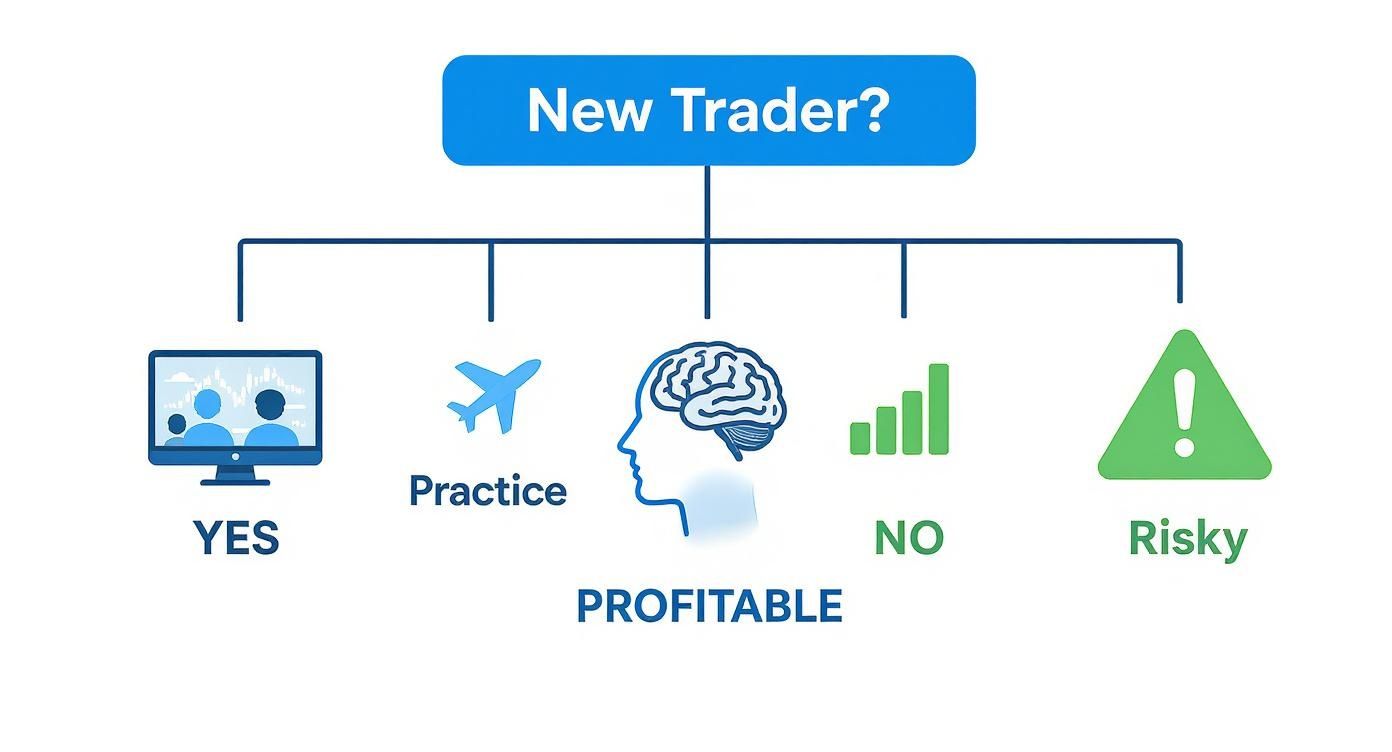
The takeaway here is crystal clear: skipping the practice phase in a simulator is a recipe for early failure.
To make sense of the options, here’s a quick breakdown of the most common types of forex simulators.
Comparing Forex Simulator Types
| Simulator Type | Best For | Key Advantage | Main Limitation |
|---|---|---|---|
| Broker Demo Account | Absolute beginners learning platform mechanics. | Perfect replica of the live trading environment. | Lacks deep analytical and backtesting features. |
| Paper Trading Platform | Traders comfortable with mechanics, now focusing on strategy. | More features and markets than a standard demo. | Still not ideal for rigorous, data-heavy testing. |
| Advanced Backtesting Software | Serious traders validating strategies with historical data. | Rapidly tests strategies over years of data. | Often has a cost and a steeper learning curve. |
Each type serves a distinct purpose, helping you progress from one stage of your development to the next.
Broker Demo Accounts: The Universal Starting Point
For most new traders, the journey kicks off with a broker demo account. These are free, simulated accounts that nearly every forex broker offers. They are the most direct way to get started because they perfectly mirror the broker’s live trading platform. You get access to the exact same charts, tools, and order buttons you’d use with real money.
- Who It’s For: Complete beginners who just need to learn the software. This is where you practice placing buy/sell orders, setting a stop-loss, and adding indicators on a platform like MetaTrader 4 or 5.
- Key Advantage: It costs nothing and is a one-to-one replica of the live environment. This is crucial for getting comfortable with the platform without any financial pressure.
- Main Limitation: While fantastic for learning the software, demo accounts fall short on advanced analytics. They just aren’t built for testing strategies over long stretches of historical data.
Dedicated Paper Trading Platforms
Once you’ve got the hang of placing trades, you’ll probably start wanting more than a basic demo account can give you. That’s where dedicated paper trading platforms come into play. These are specialized services, often independent of any one broker, that offer a much richer simulation.
They typically include better analytics, social trading features (letting you follow other simulated traders), and access to a wider range of markets. Think of them as the perfect intermediate step once you’re ready to focus less on the “how-to” and more on refining your strategy. To get a better sense of what’s out there, checking out a detailed trading platform comparison can help you match features to your specific needs.
Advanced Backtesting Software: The Strategist’s Lab
For serious traders who are all about data-driven decisions, advanced backtesting software is the ultimate tool. Platforms like Forex Tester aren’t just simulators; they’re powerful analytical engines. They let you test a trading idea against years — or even decades — of historical price data in just a few hours.
This isn’t just about practicing your clicks; it’s about systematically validating a strategy’s statistical edge. You can run hundreds of trades on historical data to see how your rules would have performed through different market conditions.
- Who It’s For: Intermediate to advanced traders who have a defined strategy and need to test its long-term viability, profitability, and weak spots with real statistical rigor.
- Key Advantage: The power to rapidly test and tweak strategies on massive datasets. This process uncovers critical metrics like maximum drawdown (the biggest peak-to-trough drop in your account) and profit factor that you simply can’t get from a standard demo account.
- Main Limitation: These platforms usually come with a subscription or one-time cost and can be more complex to learn. You need to come with a clear hypothesis to test, so they aren’t the best fit for traders still figuring out the basics.
How Simulators Recreate Real Market Conditions
Ever wonder what’s actually going on inside a forex trading simulator? It’s not just some random price generator. A good simulator is more like a high-tech flight simulator for traders, designed to recreate the live market with incredible accuracy.
It all starts with historical tick data — a super detailed record of every single price change that ever happened. The quality of this data is everything. The best simulators use top-tier, high-fidelity data to rebuild past market environments so perfectly that practicing on a Tuesday morning from three years ago feels exactly like you were there, making decisions in real-time.
Turning Market Rules into Code
But a simulator does more than just replay old price charts. It has to act like a real broker, which means translating the core mechanics of trading into its programming. This is where the magic really happens.
- Simulated Spreads: The platform creates a realistic bid-ask spread — that tiny gap between the buying and selling price. This is crucial because it forces you to account for this built-in cost on every single practice trade.
- Order Execution Logic: When you hit “buy” or “sell,” the simulator doesn’t just instantly grant your wish. It uses logic based on the historical price data to fill your order, mimicking how a live broker would handle it.
- Commissions and Fees: Many simulators let you plug in your own broker’s commission structure. This gives you an honest, unfiltered look at your potential net profit after all the costs are factored in.
These pieces work together to build a robust and lifelike training ground. It’s no surprise these tools are so popular, especially with platforms like MetaTrader 4 and 5 being used by over 10 million traders worldwide. And with 55% of traders now using mobile devices, simulators have become an essential tool for practicing on the go. You can dig into more of these forex trading statistics and trends on compareforexbrokers.com.
Where Simulation Hits Its Limits
As powerful as simulators are, it’s just as important to understand what they can’t do. Acknowledging their limitations helps you use them like a professional training tool, not a crystal ball.
For instance, a simulator almost always fills your order instantly at the exact price on your screen. But in the real world, things like network delays can cause slippage, where your order gets filled at a slightly worse (or sometimes better) price. If you’ve ever been frustrated by this, you can learn more by reading our guide on what slippage is in trading.
The biggest thing a simulator can never replicate is the gut-wrenching psychological pressure of trading with your own money. The fear of losing and the greed for winning are powerful emotions that only show up when real cash is at stake.
Finally, simulators are backward-looking. They run on historical data, so they can’t prepare you for a true “black swan” event — a sudden geopolitical crisis or a surprise central bank decision that throws all historical patterns out the window.
Knowing both the strengths and weaknesses of simulation is the key. They are absolutely unmatched for building your technical skills and strategic discipline. But the final test — mastering your own emotions — can only happen in the live market.
A Step-by-Step Workflow for Effective Practice

Let’s be honest. Mindlessly clicking buttons in a trading simulator isn’t practice — it’s just gambling with fake money. We’ve all been there, but real skill comes from a disciplined, structured process. Without a plan, you’re just teaching yourself bad habits that will get very expensive when you switch to live markets.
This workflow is designed to turn your simulator time into a proper experiment. It’s about shifting from random trades to a methodical approach that actually builds skills you can rely on. Let’s walk through the exact steps to make every session count.
Step 1: Formulate a Specific Trading Hypothesis
Every single practice session needs to start with a clear, testable idea. A fuzzy goal like “I want to make money” gets you nowhere. You need to create a precise hypothesis you can prove or disprove with the data from your simulator.
Think like a scientist in a lab. You can’t find an answer until you have a very specific question.
- Weak Idea: “I’m going to trade pullbacks.”
- Strong Hypothesis: “If EUR/USD is in an uptrend on the 1-hour chart and pulls back to the 20-period exponential moving average (EMA), I will enter a long position. My stop-loss will be 15 pips below the EMA, and my take-profit will be at the previous swing high.”
See the difference? This hypothesis is specific, measurable, and has crystal-clear rules for entry, stop-loss, and take-profit. This level of detail is absolutely essential for effective practice and long-term discipline.
Step 2: Configure Your Simulator Parameters
Before placing a single trade, set up your simulator to mirror the real world as closely as possible. The goal here is to make the virtual environment feel just like the live market you plan to trade.
Your setup must include:
- Account Size: Use a virtual balance that matches what you’ll actually deposit in a live account. Practicing with a $100,000 demo account when you plan to go live with $1,000 teaches you nothing about real-world risk management.
- Leverage: Set the leverage to the exact same level your broker will offer you.
- Commissions and Spreads: If your simulator allows it, plug in your broker’s typical spread for your currency pair and add the commission costs for each trade. This makes sure your performance metrics are net of costs.
Skipping these details gives you a false sense of security. A strategy that looks amazing without costs can fall apart completely once real trading fees kick in.
Step 3: Execute Trades Based on Strict Rules
Alright, it’s time to trade. This is where your discipline gets put to the test. Your only job is to follow the rules from your Step 1 hypothesis — no exceptions, no excuses. If the market gives you a setup that fits your rules, you take the trade. If it doesn’t, you sit on your hands and do nothing.
This is where the real work begins — the battle against your own emotions. You’ll feel the urge to bend the rules, take a trade that “almost” fits, or get scared and exit early. Resisting these impulses is the practice.
Every trade must be a perfect, textbook execution of your predefined strategy. It’s not about being right on any one trade; it’s about flawlessly executing your system over and over again. This discipline is the foundation of long-term trading.
Step 4: Simulate Across a Meaningful Sample Size
One or two trades mean nothing. They could be luck, good or bad. To find out if your strategy truly has an edge, you need data — and lots of it. Your goal is to execute your hypothesis over a large enough sample of trades to get statistically meaningful results.
A good starting point is at least 50-100 trades for your specific setup. This volume helps smooth out market randomness and shows you whether your edge actually holds up over time. This repetition is also what builds the “muscle memory” you’ll need for live trading.
Step 5: Export and Analyze Your Performance
This is the most important step of all: the review. After you’ve completed your set of trades, export the data from your forex trading simulator. Most platforms can give you a detailed report with every trade’s entry, exit, P&L, and duration.
This raw data is your report card. It delivers an objective, unemotional verdict on your strategy’s performance. The numbers don’t lie, and they will point you directly to your strengths and weaknesses. This feedback loop is what separates amateurs from professional traders who are serious about getting better.
Turning Your Simulation Data into Actionable Insights

Running trades in a simulator is just the first step. The real growth — the kind that builds a career — happens when you stop clicking buttons and start analyzing. Think of your simulator data as a treasure map, but it’s written in a code only you can crack.
This is where you switch gears from trader to detective. Your mission is to look beyond the win/loss column and find the hidden patterns in your strategy and, more importantly, in your own behavior. This post-game review is what turns raw data into real wisdom.
Moving Beyond Simple Profit and Loss
A single winning or losing trade doesn’t tell you much. What really matters are the stats that show up over dozens or hundreds of trades. These metrics give you an honest look at your strategy’s health, revealing its strengths and weaknesses without any emotional bias.
To get started, focus on these three core metrics:
- Profit Factor: This is simply your gross profit divided by your gross loss. A profit factor of 2.0 means you made twice as much on your winners as you lost on your losers. If you can consistently keep this above 1.5, you’re on the right track.
- Maximum Drawdown: This number shows the biggest drop your account took from a peak to a low during your simulation. It’s a raw measure of risk and a gut check — can you really handle the losing streaks this strategy will inevitably produce?
- Average Risk-Reward Ratio: This compares your average winning trade to your average losing trade. If your average winner is $100 and your average loser is $50, your ratio is a solid 2:1.
These numbers paint a clear, unbiased picture. They tell you if the market is actually paying you enough for the risk you’re taking.
The goal of analysis isn’t to feel good about your wins. It’s to understand exactly why you won and, more importantly, why you lost. This objective feedback loop is the fastest way to get better.
The Power of a Trading Journal
Numbers tell part of the story, but they don’t tell the whole thing. To really get it, you need to mix that quantitative data with qualitative insights. And for that, a trading journal is your single most powerful tool.
Logging your simulated trades forces you to write down not just the stats, but your entire thought process. Why did you enter the trade? What were you feeling when it moved against you? What made you exit at that exact moment? Answering these questions is non-negotiable, which is why understanding why every trader needs a trading journal is such a crucial step.
This is how you uncover the subtle habits that are quietly sabotaging your results. You might realize you always cut winners short out of fear, or that you tend to “revenge trade” after taking a loss. No simulator can fix these behavioral flaws for you — only honest self-assessment can.
Accelerating Your Learning Curve
The real magic happens when you pair the hard data from your simulator with the personal insights from your journal. Detailed performance reports can spit out your win rate, profit factor, and max drawdown in seconds. In fact, one study showed that traders who practiced on simulators for 100 hours or more saw a 35% reduction in emotional trading mistakes before even placing a live trade.
By connecting the dots, you can see how your emotional state directly impacts your trading metrics. This integrated approach turns simulation from a simple practice drill into a deep learning experience. It’s what paves the way for a more disciplined and successful transition to the live markets.
Making the Leap to a Live Trading Account
Graduating from a forex simulator is a huge milestone. You’ve put in the hours, you’ve proven your strategy has an edge, and you know you can execute it consistently. But making that leap to a live account needs to be handled with the exact same discipline you used during practice.
The transition from virtual money to real capital is where the psychological battle truly begins. Suddenly, every pip movement feels intensely personal. This isn’t a sign that your strategy is failing; it’s a completely normal human reaction to the risk of real financial loss. The key is to acknowledge this shift and manage it from day one.
Start Small and Stay Focused on the Process
Let’s be clear: your first live account is not about making profits. Its one and only purpose is capital preservation and getting you comfortable with the emotional pressure of having real skin in the game.
This means starting with a micro-lot or cent account, where you can trade with incredibly small position sizes. The goal is to risk just enough to make it feel real — maybe the cost of a few cups of coffee per trade — but not so much that a loss sends you into an emotional tailspin. This approach lets you focus on one thing: flawlessly executing your proven process under live fire.
You are no longer just practicing clicks in a simulator. You are training your mind to remain calm and objective when your own money is fluctuating on the screen. This is the final, most important skill to master.
Think of this initial live trading phase not as a race, but as a deliberate, controlled acclimatization period. The profits and losses are secondary. The primary objective is to stick to your rules without deviation.
Managing the Emotions of Live Trading
The moment your account goes live, the two great enemies of every trader — fear and greed — will show up uninvited. You might feel the fear that a winning trade will turn against you, tempting you to snatch profits too early. Or, after a few wins, you might feel the greed that tempts you to take a much bigger position on the next trade, blowing up your risk plan.
Here’s how to keep them in check:
- Trust Your Data: You’ve tested this. You have hundreds of simulated trades proving your strategy works. Remind yourself that your edge is real and documented. Trust the process, not your fleeting emotions.
- Keep Your Journal Close: Continue journaling every single trade, but now pay extra attention to your emotional state. Writing down how you feel brings awareness to your psychological triggers.
- Focus on Execution: Concentrate only on what you can control: your entries, your exits, and your position sizing. The market will do what it wants. Your job is to execute your plan perfectly.
And remember, your simulator is still your lifelong training partner. Whenever you want to test a new idea or refine your approach, take it back to the simulator first. Never risk real capital on an unproven concept. This professional, gradual transition is how you build a sustainable and successful trading career.
Your Top Questions About Simulators, Answered
Let’s tackle some of the most common questions traders have about forex simulators. My goal here is to cut through the noise and give you straight answers so you can get the most out of these powerful practice tools.
How Long Should I Practice on a Simulator?
There’s no magic number here, but a good rule of thumb is three to six months of consistent, focused practice. But honestly, it’s not about the calendar — it’s about your performance.
The real goal is to prove you can stick to your strategy, without a single deviation, over hundreds of trades. You need to see consistent, positive results in your simulated account, like a profit factor over 1.5, before you even think about putting real money on the line.
Can a Simulator Perfectly Predict My Live Results?
In a word, no. A simulator is absolutely brilliant for mastering the mechanics of your strategy and building the discipline to follow your rules. But it can’t fully prepare you for the gut-wrenching stress of having real money at stake.
Think of it as a flight simulator. It can make you an expert pilot on the ground, but your first solo flight with real passengers — and real consequences — will always feel different.
On top of that, real-world gremlins like slippage and network lag can throw a wrench in things in ways a simulation can’t always account for.
Are Free Broker Demo Accounts Good Enough?
For getting started? Absolutely. A free demo account is the perfect place to learn your way around a broker’s platform, practice placing orders, and just get a feel for the market’s rhythm. There’s zero financial risk, which is exactly what you want at the beginning.
However, when you’re ready for deep historical backtesting and serious strategy analysis, you’ll probably find a dedicated software platform offers more control, cleaner data, and much faster processing.
What Is the Biggest Mistake Traders Make?
By far, the most common and damaging mistake is treating the simulator like a video game. I see it all the time — traders taking wild risks, cranking up the leverage, and completely ignoring their trading plan. All you’re doing then is practicing bad habits.
To get real value, you have to treat every simulated dollar as if it were your own. Trade with the exact same discipline and focus you plan to use when it’s real. This is the only way to build the habits that actually lead to long-term success.
Ready to turn your simulation data into actionable insights? TradeReview is a powerful trading journal designed to help you analyze your performance, identify patterns, and refine your strategy with data-driven confidence. Start tracking your trades for free and accelerate your learning curve.