When it comes to day trading tax deductions, your eligibility really boils down to one thing: how the IRS classifies you. Getting what’s called Trader Tax Status is the golden ticket. It lets you treat your trading like a business, unlocking a whole world of deductions that regular investors can’t even touch. We know that navigating this process can be challenging, but skipping this step means you’re leaving a serious amount of your hard-earned cash on the table.
The Critical First Step: Understanding Trader Tax Status
Trying to figure out trading taxes can feel like a puzzle with half the pieces missing. A lot of traders, especially those who are just starting to hit a consistent stride, get tripped up by the difference between being a “trader” and an “investor” in the eyes of the IRS. It’s a common headache, but getting this right is probably the single most important financial decision you’ll make all year. The journey to consistent profitability is tough enough without giving back more than you have to.
Here’s a practical way to think about it. An investor is like someone who buys a house to live in for 20 years, hoping it goes up in value. A trader is like a house flipper — they buy, fix up, and sell quickly to make a profit on the short-term flip. The IRS sees these two activities completely differently, and only the “flipper” gets to write off all their business expenses.
To get those write-offs, you have to qualify for Trader Tax Status (TTS). This isn’t a form you can just fill out; it’s a status you earn based on your activity. The IRS needs to see that you’re running a real business, not just dabbling in a personal account.
What Does the IRS Look for in a Trader?
The IRS doesn’t give you a neat little checklist for TTS. Instead, the rules have been pieced together from years of tax court cases. To qualify, your trading activity must be substantial, continuous, and regular. That’s pretty vague, so let’s break down what that actually means for you.
- Substantial Activity: This is all about volume. A few trades a week isn’t going to cut it. The IRS wants to see a high frequency of trades that shows you’re deeply engaged in the market, far more than a hobbyist would be.
- Continuous and Regular: This means you’re in the market consistently. You’re actively looking for opportunities and managing your positions almost every day the market is open, not just jumping in when things get exciting. This reflects a disciplined, long-term approach.
- Profit Motive from Short-Term Swings: Your main goal has to be profiting from tiny, daily price movements — not from long-term growth, dividends, or interest. This means your average holding period is short, often just minutes or days, definitely not months or years.
This distinction is everything. It fundamentally changes how you can treat your expenses. An investor gets very limited deductions. But a trader with TTS can deduct all the “ordinary and necessary” costs of running their operation. This is the key that opens the door to powerful day trading tax deductions.
Before we go deeper, let’s put the two tax treatments side-by-side. It’s a night-and-day difference, and seeing it laid out can really highlight why qualifying for TTS is such a game-changer for your bottom line.
Trader Tax Status vs Investor: What It Means For Your Bottom Line
| Tax Treatment Area | Investor Status | Trader Tax Status (TTS) |
|---|---|---|
| Deductible Expenses | Limited to investment interest and certain miscellaneous itemized deductions (which were suspended for individuals from 2018-2025). | Can deduct all “ordinary and necessary” business expenses like software, subscriptions, education, and home office. |
| Mark-to-Market Election | Not eligible. | Eligible for the Section 475(f) election, which avoids wash sale rules and capital loss limitations. |
| Wash Sale Rule | Subject to the wash sale rule, which defers losses. | Can elect out of the wash sale rule, allowing you to claim all losses immediately. |
| Capital Loss Limitation | Limited to deducting $3,000 of net capital losses against ordinary income per year. | With a 475(f) election, losses are treated as ordinary losses and are not subject to the $3,000 limit. |
| Self-Employment Tax | Not subject to SE tax on capital gains. | Not subject to SE tax on trading gains, but may apply to other income. |
As you can see, the benefits of TTS are massive. It’s not just about a few extra write-offs; it’s a complete shift in how your profits and losses are treated, giving you far more control and flexibility.
A Practical Checklist for Self-Assessment
So, how do you know if you’re on the right track to qualify? While every trader’s situation is different and you should always talk to a tax professional, there are some generally accepted benchmarks. To give yourself the best shot at TTS, you should be trading at a high frequency. For instance, tax experts often suggest aiming for at least four trades a day, on more than 15 days a month, for a total of over 720 trades a year. You should also be dedicating at least four hours a day to your trading activities. While there are no guaranteed figures that ensure qualification, these benchmarks are a strong starting point. For more detail, accounting firm Anchin.com offers insights into the criteria.
Key Takeaway: Qualifying for Trader Tax Status isn’t about how much money you make. It’s about the professionalism and consistency of your trading. The IRS wants to see you treating this like a business, not a casual hobby.
Making that mental shift from “investor” to “business owner” is the foundation of a solid tax strategy. It demands discipline in your trading, your record-keeping, and your planning. By meeting these criteria, you put yourself in the best position to maximize every day trading tax deduction available and keep more of your hard-earned profits.
Your Complete Checklist Of Deductible Trading Expenses
Once you’ve cleared the major hurdle of qualifying for Trader Tax Status (TTS), the way you look at your expenses completely changes. Suddenly, every cost that’s directly tied to your trading operation flips from being a personal outlay to a legitimate business write-off.
We’re not just talking about commissions here. A whole world of valuable day trading tax deductions opens up, and learning to track them is a discipline that directly pads your bottom line.
Think of your trading desk as your business headquarters. The IRS lets you deduct expenses that are both “ordinary and necessary” for running it. An “ordinary” expense is just something common in the trading world, while a “necessary” one is anything helpful and appropriate for your business. This simple framework is your guide to figuring out what you can — and absolutely should — be tracking.
The chart below shows that first crucial split in your tax identity. It’s what determines if you can even claim these business expenses in the first place.
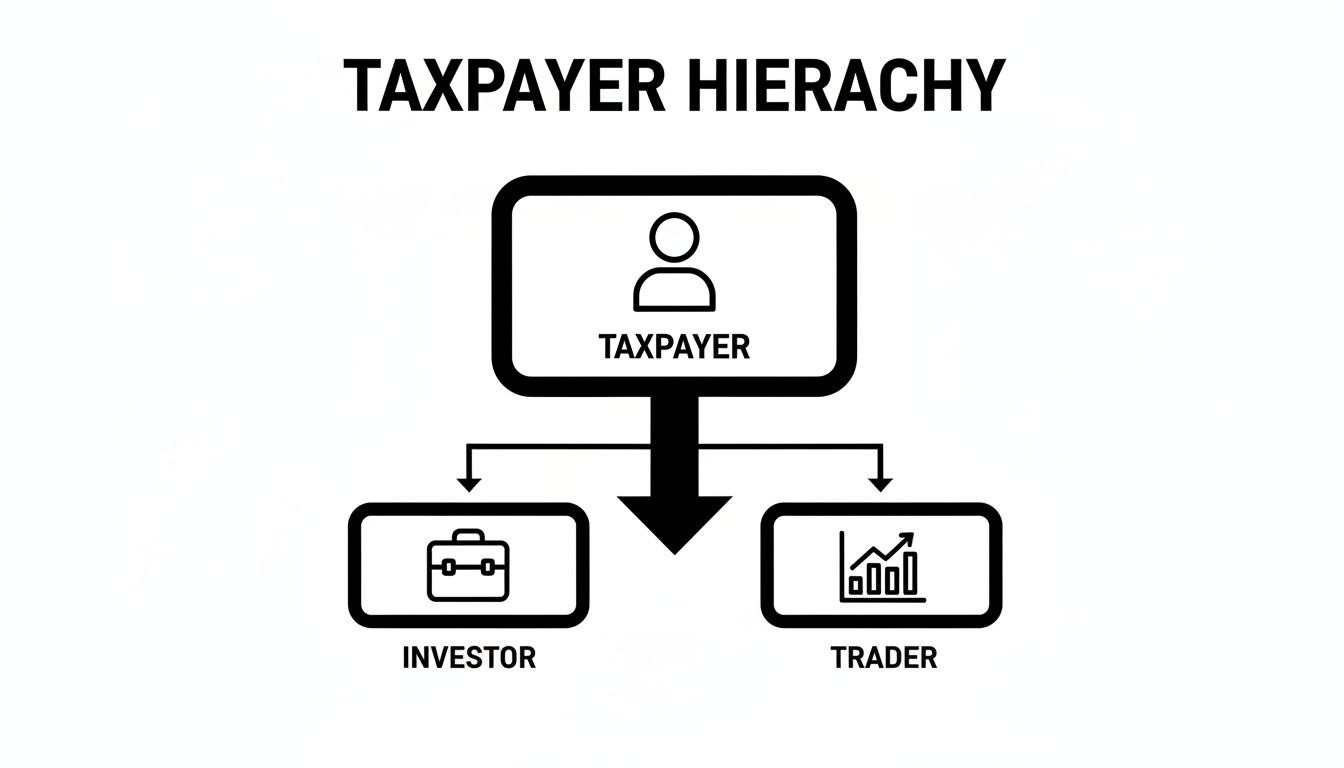
The path is clear: to get access to business-level deductions, you have to qualify as a Trader, not an Investor. Let’s dive into the specific costs that fall under this powerful classification.
Hardware and Software Essentials
Your tech is the lifeblood of your trading business, and you can deduct nearly every piece of it. These are the tools of your trade, making them classic examples of ordinary and necessary expenses.
- Computers and Laptops: The primary machine you use for charting, execution, and research is a direct business expense. If you also use it for personal tasks, you just need to deduct the percentage of time it’s used for business.
- Monitors: Multiple screens aren’t a luxury; they’re standard issue for serious traders. The cost of those extra monitors for tracking charts and news feeds is fully deductible.
- Charting and Trading Platforms: Those fees for platforms like TradingView, Sierra Chart, or your broker’s own software? They are essential operating costs. For example, if you pay $50 per month for your platform, that’s a $600 annual deduction.
- Data Feeds and Subscriptions: Real-time market data is non-negotiable. The monthly fees for these feeds are a clear-cut business expense you can write off.
If you want to go deeper into the technology that gives traders an edge, check out our guide on the best tools for day traders. It’s a detailed look at the platforms and software many pros rely on.
Home Office and Utilities
This is one of the most significant — and often misunderstood — deductions available. If you have a dedicated space in your home used exclusively and regularly for trading, you can claim the home office deduction. You’ve got two ways to calculate it.
The Simplified Method is straightforward. You deduct $5 per square foot for up to 300 square feet of office space. It’s easy, but you might be leaving money on the table.
The Actual Expense Method requires more work but often results in a much larger deduction. With this method, you figure out the percentage of your home your office occupies and apply that percentage to your actual home expenses.
Example: Your home is 2,000 square feet, and your dedicated office is 200 square feet. That means your office takes up 10% of your home’s total area. You can then deduct 10% of your actual home expenses, like:
- Rent or mortgage interest
- Property taxes
- Homeowners insurance
- Utilities (electricity, heat, internet)
- Repairs and maintenance
The key here is meticulous tracking. This requires discipline, but it ensures you can confidently claim every dollar you’re entitled to.
Education and Professional Development
The markets never stand still, and staying sharp is a business necessity. That’s why the costs of education aimed at improving your trading skills are deductible.
This can include things like:
- Courses and Seminars: Workshops on technical analysis or trading psychology. For instance, a $1,000 course on risk management would be a deductible expense.
- Books and Publications: Subscriptions to financial journals or must-read trading books.
- Coaching and Mentorship: Fees you pay a trading coach to help you refine your strategy.
Just remember, the education has to be for improving skills in your current business of trading, not to prepare you for a new career.
Other Key Day Trading Tax Deductions
Beyond the big categories, plenty of other expenses can add up to significant savings. Don’t overlook these:
- Margin Interest: The interest you pay on money borrowed from your broker to trade is deductible as a business expense if you have TTS.
- Professional Fees: Costs for tax prep and any legal advice related to your trading business are also deductible.
- Travel Expenses: If you travel to a trading-related seminar or conference, you can deduct your airfare, lodging, and 50% of your meal costs.
Maximizing these deductions all comes down to disciplined, long-term thinking. Treat every expense as a potential write-off and document it the moment it happens. This simple habit transforms tax season from a stressful scramble into a simple reporting of well-organized facts.
How The Section 475 Mark-To-Market Election Works
Once you’ve qualified for Trader Tax Status (TTS), you unlock one of the most powerful tools in a trader’s tax arsenal: the Section 475(f) mark-to-market election. This isn’t an automatic perk; it’s a strategic decision you have to make, but it can completely change your tax game for the better.
Think of it like hitting a giant “reset” button on your portfolio every December 31st. The IRS lets you pretend you sold all your open positions at their fair market value on the last day of the year. You then “buy” them back at that exact same price on January 1st. This simple act creates a clean slate and has two massive consequences.
First, it changes your trading gains and losses from capital gains and losses into ordinary income and losses. Second, it lets you completely dodge two of the biggest tax headaches that plague most traders.

Bypassing Major Tax Limitations
Making the mark-to-market election is like telling the IRS you’re running a serious business, and in return, they give you some serious advantages.
- No More Wash Sale Rule: That’s right, the incredibly frustrating wash sale rule is gone. You can take a loss on a position and jump right back in without worrying about that loss being deferred. This gives you total freedom to manage your positions as you see fit.
- Unlimited Loss Deductions: The crippling $3,000 annual limit on capital loss deductions? It vanishes. If you have a tough year and rack up a $50,000 trading loss, you can deduct the entire $50,000 against other ordinary income, like a salary. That can save you an enormous amount in taxes.
This isn’t just some minor adjustment. It’s a fundamental shift in how your trading P&L affects your bottom-line tax bill, offering a crucial safety net in down years.
Key Insight: The Section 475(f) election transforms trading losses from a limited capital deduction into a powerful tool for reducing your total taxable income. It’s a strategic safety net for volatile years.
A Tale of Two Traders: An Example
Let’s see how this plays out in the real world. Meet Alex and Ben. They both have TTS, work a part-time job earning $90,000, and unfortunately, both had a rough year, ending with a net trading loss of $40,000.
- Alex (Without the Election): For tax purposes, Alex is still treated like an investor when it comes to losses. He can only deduct $3,000 of his $40,000 trading loss against his salary. His taxable income is $87,000, and the other $37,000 loss gets carried forward to future years.
- Ben (With the Election): Ben was proactive and made the mark-to-market election. His $40,000 loss is treated as an ordinary business loss. He can deduct the entire amount against his salary, bringing his taxable income down to just $50,000.
The difference is night and day. Ben’s smart tax planning means he’ll have a much smaller tax bill, leaving him with more capital to get back in the game next year. That’s the power of thinking ahead.
How to Make the Section 475 Election
This is where you have to be disciplined. The IRS has very strict deadlines, and if you miss them, you’re out of luck for the year.
- For Existing Taxpayers: You have to make the election by the original due date of the prior year’s tax return. For most people, that means getting it done by April 15th of the year you want it to become effective. You do this by attaching a simple statement to your tax return (or your extension filing).
- For New Taxpayers: If you’re a brand-new entity, like a newly formed LLC, the clock starts ticking immediately. You have 2 months and 15 days from the start of your first tax year to make the election by placing a formal statement in your company’s books and records.
These deadlines are non-negotiable. It’s always a good idea to work with a tax professional who gets trader tax rules to make sure you file everything correctly and on time. For the official details, you can read the IRS’s own guide on Topic No. 429, Traders in Securities.
The Unique Tax Advantage For Futures Traders
While stock traders have to qualify for Trader Tax Status and jump through hoops to gain tax advantages, futures traders get a powerful, built-in benefit right from the start. The IRS simply treats futures and other Section 1256 contracts differently, giving them a tax structure that’s often far more favorable than what stock traders face.
This special treatment boils down to the IRS’s 60/40 rule. Think of it as an automatic, default setting for futures traders that can dramatically lower their tax bill — no special elections required. If you’re trading these products, understanding this rule is non-negotiable.
Decoding The Section 1256 60/40 Rule
The 60/40 rule is beautifully simple. It says that 60% of your net gains from trading futures are taxed at the lower long-term capital gains rate, while the remaining 40% are taxed at the higher short-term capital gains rate (your ordinary income tax rate).
Here’s the incredible part: your holding period is completely irrelevant. You could hold a futures contract for ten seconds or ten months, and the 60/40 split still applies. This is a massive advantage, considering that nearly all profits from active stock day trading get slammed with the much higher short-term rate.
This special tax treatment applies to a specific class of investments known as Section 1256 contracts, which include:
- Regulated futures contracts
- Foreign currency contracts
- Non-equity options (like options on futures)
- Dealer equity options
- Dealer securities futures contracts
If you’re just getting started with these products, our guide on learning to trade futures can help you get up to speed. This unique tax benefit is one of the main reasons so many traders are drawn to these markets.
The Financial Impact Of The 60/40 Rule
The savings from this blended tax rate can be huge. Let’s walk through a practical example to see just how much of a difference it makes compared to the standard short-term capital gains that most day traders pay.
Imagine a profitable futures trader, Sarah, who netted $100,000 for the year. Her ordinary income tax bracket is 37%.
-
Under the 60/40 rule:
- $60,000 (60% of her profit) is taxed at the 15% long-term rate, which comes out to $9,000.
- $40,000 (the other 40%) is taxed at her 37% short-term rate, which is $14,800.
- Her total tax on trading profits is $23,800.
-
If she were a stock trader (all short-term gains):
- Her entire $100,000 profit would be taxed at her ordinary income rate of 37%.
- Her total tax bill would be $37,000.
By trading futures, Sarah saves $13,200 in taxes on the exact same profit. This is a clear, mathematical advantage that highlights why it’s so important to think long-term about the products you trade.
Freedom From The Wash Sale Rule
As if the 60/40 rule wasn’t enough, futures traders get another major perk: Section 1256 contracts are completely exempt from the wash sale rule. This isn’t something you need to elect into — it’s automatic.
This gives you immense flexibility. You can close a losing position to lock in a tax loss and immediately re-enter the same or a similar position without worrying about that loss being disallowed by the IRS. This freedom lets you manage risk and capital with far fewer tax-related headaches, making it easier to stick to your trading plan.
Why Meticulous Record-Keeping Is Not Optional
A tax deduction is only as good as the paper trail you have to prove it. We’ve gone over the incredible advantages of Trader Tax Status and the mark-to-market election, but none of that matters if your records are a disaster. This is where theory crashes into reality — and unfortunately, it’s where many traders, new and experienced, can drop the ball.
Think about it: discipline in your bookkeeping is just as critical as discipline in your trading. It’s definitely not the most exciting part of the job, but it’s the professional habit that protects your business, maximizes your day trading tax deductions, and gives you peace of mind when April rolls around. An IRS audit is the last thing you want, and organized records are your absolute best defense.

Building Your Audit-Proof System
Immaculate records are your shield. The goal is to build a system so clear and organized that if the IRS ever came knocking, you could hand over your files without breaking a sweat. This isn’t about buying fancy accounting software; it’s about building consistent, daily habits.
So, what does that actually look like? Here’s a practical breakdown of what you need to track:
- Every Single Trade: This is the bedrock of your records. You need a log of every entry and exit, including the date, security, price, quantity, and commissions. Relying solely on broker statements isn’t enough because they don’t capture the why behind your trades.
- All Business Expenses: Every single subscription, piece of software, hardware purchase, or educational course needs a receipt. Get in the habit of snapping a photo or saving a PDF the moment you spend the money.
- Your Trading Activity Log: To prove you meet the “substantial, continuous, and regular” test for TTS, you need to document your time. A simple log showing the hours you spend researching, executing trades, and reviewing your performance can make all the difference.
From Manual Chore To Automated Habit
Let’s be real — manually tracking all this in a spreadsheet gets old fast and can quickly become overwhelming. This is where a dedicated trading journal stops being a “nice-to-have” and becomes an indispensable business tool. While many traders start with a spreadsheet, you can see how its limitations quickly become a problem in our guide on the Excel trading journal.
Modern journals are built to automate and simplify this whole process, turning a tedious chore into a seamless part of your daily routine.
The Professional Edge: Start thinking of your trading journal as your accounting department, not just a performance tool. It’s the single source of truth for your entire business, giving you the hard evidence needed to claim every legitimate deduction you’re entitled to.
You can use a few key features to build a rock-solid system for your day trading tax deductions.
- Automated Trade Logging: A broker sync feature is a game-changer. It automatically pulls in all your trades, which means no more manual data entry and no more costly errors.
-
Expense Tagging: Get into the habit of tagging every expense as it happens. You can create custom tags like
software,education, ordata-feedto make sorting and totaling your deductions at year-end a simple click. - Capital Tracking: Logging all your deposits and withdrawals helps you maintain a crystal-clear picture of your capital flow, which is vital for accurate profit and loss reporting.
This level of organization does more than just get you ready for tax season; it makes you a better business owner. As one example, data from Europe suggests that successful day traders who meticulously log their expenses often see their net monthly returns jump significantly after deductions. By properly tracking expenses like platform fees and data services, they can preserve more of their hard-earned capital. You can read more about this on Captrader.com.
Common Day Trading Tax Questions Answered
We’ve covered the big pillars — Trader Tax Status, what you can deduct, and the powerful tax elections available. But let’s be honest, the real confusion often pops up in those tricky “what if” scenarios. This is where we tackle the most common questions that can trip up even experienced traders.
Think of this as your field guide for the gray areas. My goal is to clear up that lingering uncertainty so you can build a tax strategy that’s not just solid, but bulletproof.
Can I Pay Myself a Salary From My Trading Business?
This one comes up all the time, especially from traders who’ve set up an LLC or S-Corp. The short answer is, for a pure trading business, no.
Here’s why: The IRS doesn’t see your profits as earned income like you’d get from providing a service. Instead, it views income from trading securities as capital gains. Because of that distinction, you can’t pay yourself a W-2 salary from your trading profits. Your “income” is simply the net profit or loss you end the year with.
On the bright side, this means your trading gains generally aren’t subject to self-employment taxes (Social Security and Medicare), which is a huge win.
What Happens If My Trading Status Changes Mid-Year?
Life gets in the way. Maybe you started the year trading like a machine, but a new job or family commitment forced you to scale back. So, what happens to your tax status?
Unfortunately, you can’t be a part-time trader in the eyes of the IRS. Trader Tax Status (TTS) is an all-or-nothing designation for the entire calendar year. They look at your activity from January 1st to December 31st to decide if you meet the “substantial, continuous, and regular” test. You can’t be a trader for the first six months and an investor for the rest.
Important Takeaway: If your trading activity drops off a cliff, you risk losing TTS for the whole year. This really highlights how crucial it is to stay consistent and disciplined if you’re banking on those day trading tax deductions.
How Do State Taxes for Day Traders Work?
Just when you think you’ve got federal taxes figured out, state taxes add a whole new layer. For the most part, states with an income tax tend to follow the federal government’s lead. If you qualify for TTS on your federal return, you’ll likely qualify at the state level, too.
But there are always exceptions. Some states have quirky rules for capital gains or might not honor every deduction. The biggest advantage, though, comes from living in one of the nine states with no state income tax at all. For a profitable trader, this can be a game-changer.
These states are:
- Alaska
- Florida
- Nevada
- New Hampshire (only taxes interest and dividends)
- South Dakota
- Tennessee
- Texas
- Washington
- Wyoming
My advice? Always talk to a tax professional who knows your state’s specific laws. They’ll make sure you’re compliant and saving every penny you can at both the federal and state levels.
Do I Need an Accountant Who Specializes in Trader Taxes?
You can file your own taxes, but I strongly recommend working with a CPA or tax advisor who lives and breathes trader taxation. The rules around TTS and the Section 475(f) election are incredibly nuanced. They’ve been shaped more by tax court battles than by simple IRS pamphlets.
An expert who specializes in this area can:
- Gauge Your Eligibility: They’ll look at your trading activity with a critical eye and tell you if your case for Trader Tax Status is strong or weak.
- Navigate Elections: They’ll ensure you make critical elections like mark-to-market on time, avoiding mistakes that could cost you thousands.
- Maximize Deductions: They know exactly which expenses are considered “ordinary and necessary” for a trading business and will help you build an audit-proof record.
- Have Your Back: If the IRS ever comes knocking, having a pro who understands the ins and outs of your business is priceless.
The fee for specialized tax advice is a business expense itself, and it often pays for itself many times over in tax savings and peace of mind.
Maximizing your day trading tax deductions all comes down to treating your trading like a real business. And every successful business runs on meticulous records. Don’t wait until tax season to scramble. A tool built for traders can make this effortless. TradeReview helps you log every trade, tag your expenses, and watch your capital, all in one clean dashboard — creating the audit-proof system you need.
Start building a professional foundation for your trading business today by signing up for free at https://tradereview.app.