The fast-paced world of day trading can feel like navigating a storm without a compass. Prices whip up and down, and emotional decisions often lead to costly mistakes. But what if you could learn to read the market’s language? Chart patterns offer a roadmap by visualizing the constant tug-of-war between buyers and sellers, providing structure amidst the chaos.
This isn’t about finding a magic formula for “guaranteed profits.” Instead, it’s about developing a critical skill. Recognizing these formations helps you build a data-driven hypothesis about where the price might move next. We understand the struggle of trying to make sense of volatile charts, and we’ve all felt the sting of a trade gone wrong. This guide is designed to cut through that complexity by focusing on discipline and a long-term perspective.
Here, we will break down 10 of the most common chart patterns for day trading. Our goal is to empower you with practical knowledge, not to sell you a dream. You’ll get clear explanations, actionable examples, and specific tips for identifying and acting on patterns with discipline. By the end, you’ll have a solid foundation for improving your technical analysis skills and applying a long-term perspective to your trading development.
1. Head and Shoulders
The Head and Shoulders is one of the most classic chart patterns, signaling a potential reversal from an uptrend to a downtrend. This bearish formation is recognizable by its three distinct peaks, resembling a silhouette.
Structure of the Pattern
The pattern consists of a left shoulder (an initial peak), followed by a higher peak (the head), and finally, a lower peak (the right shoulder) that is roughly symmetrical to the left one. A “neckline” is drawn by connecting the two low points (troughs) between the three peaks. The pattern is confirmed when the price breaks decisively below this neckline, indicating that sellers have taken control from buyers.
How to Trade It
The classic entry for a short position is after a candlestick closes below the neckline. This confirmation helps avoid false signals, which can be frustrating and costly.
- Entry: Enter a short trade on the candle close below the neckline.
- Stop-Loss: Place a stop-loss order slightly above the peak of the right shoulder to protect against a failed pattern.
- Profit Target: To set a target, measure the vertical distance from the top of the head down to the neckline. Project this same distance downward from the breakout point on the neckline.
Trader’s Insight: Volume often provides a critical confirmation. Ideally, volume should decrease as the right shoulder forms, showing a lack of buying enthusiasm. Then, as the price breaks the neckline, there should be a significant surge in volume, confirming the selling pressure. For example, if you see this pattern form on a 15-minute chart for SPY after a strong morning rally, a neckline break with high volume could signal a reversal for the rest of the session.
For a deeper dive into this and other formations, you can read more about Head and Shoulders chart patterns.
2. Double Top / Double Bottom
The Double Top and Double Bottom are powerful reversal patterns that signal a potential end to the prevailing trend. These classic chart patterns for day trading are easy to spot and indicate that an asset has failed to break through a key support or resistance level after two attempts.
Structure of the Pattern
A Double Top looks like the letter “M” and forms after an uptrend. The price hits a resistance level, pulls back, rallies to the same resistance level again, and fails to break higher before reversing downward. The trough between the two peaks forms a support level.
Conversely, a Double Bottom resembles a “W” and appears after a downtrend. The price finds support, rallies, pulls back to the same support level, and then reverses upward. The peak between the two troughs creates a resistance level.
How to Trade It
Patience is key; wait for confirmation. For a Double Top, the entry is a short position after the price closes below the support level (the trough between the peaks). For a Double Bottom, the entry is a long position after the price closes above the resistance level.
- Entry: For a Double Top, enter a short trade on the candle close below the middle support. For a Double Bottom, enter a long trade on the close above the middle resistance.
- Stop-Loss: Place a stop-loss just above the two peaks for a Double Top, or just below the two troughs for a Double Bottom.
- Profit Target: Measure the height from the peaks down to the support trough (for a Double Top). Project that distance down from the breakout point to find your target.
Trader’s Insight: Volume is a crucial confirmation tool. On the second peak of a Double Top, volume should ideally be lower than on the first, signaling diminished buying momentum. A spike in volume on the breakdown confirms the reversal. The opposite is true for a Double Bottom. Think of a stock hitting $50, pulling back to $48, then failing to break $50 again on lower volume — that’s a classic Double Top setup.
3. Ascending Triangle
The Ascending Triangle is a bullish continuation pattern that suggests a potential breakout to the upside within an existing uptrend. This formation is a favorite among day traders because it clearly illustrates a battle between determined buyers and a fixed supply level.
Structure of the Pattern
This pattern is defined by two key boundaries: a rising trendline connecting a series of higher lows (support) and a horizontal trendline connecting a series of highs at roughly the same price level (resistance). The rising support line shows that buyers are progressively willing to pay higher prices, while the flat resistance line represents a price level that sellers are defending. The pattern is confirmed when the price breaks decisively above the horizontal resistance.
How to Trade It
A breakout above the resistance line, especially on high volume, is the primary signal to enter a long position.
- Entry: Enter a long trade once a candle closes decisively above the horizontal resistance line.
- Stop-Loss: Place a stop-loss order just below the rising support trendline to protect against a false breakout.
- Profit Target: To set a target, measure the vertical distance from the lowest point of the rising trendline to the horizontal resistance line. Project this distance upward from the breakout point.
Trader’s Insight: The most reliable breakouts often occur within the upper two-thirds of the triangle’s formation. As the price gets squeezed closer to the apex (the point where the lines meet), the buildup in pressure often leads to a more explosive move. Look for a volume surge on the breakout candle for stronger confirmation. For example, a hot tech stock forming this pattern on a 5-minute chart during pre-market could be setting up for a strong move at the opening bell.
Understanding how to interpret these structures is a core skill, and you can learn more about how to read stock charts effectively.
4. Descending Triangle
The Descending Triangle is a classic bearish continuation pattern that signals the potential for a significant downward move. This formation is a frequent sight in day trading and indicates that selling pressure is gradually overwhelming a specific support level, making it a key pattern for identifying short-selling opportunities.
Structure of the Pattern
This pattern is formed by two key trendlines: a descending (sloping downward) resistance line and a flat, horizontal support line. The descending resistance is created by connecting a series of lower highs, showing sellers becoming more aggressive at progressively lower prices. The horizontal support line connects a series of similar lows, representing a price floor where buyers are temporarily stepping in. The pattern is confirmed when the price breaks decisively below the horizontal support.
How to Trade It
The most common entry for a short position is after a candlestick closes below the horizontal support line, confirming the sellers have won the battle.
- Entry: Enter a short trade on the candle close below the support level. A more conservative entry is to wait for a retest of the broken support, which now acts as resistance.
- Stop-Loss: Place a stop-loss order slightly above the descending resistance trendline to protect against a reversal.
- Profit Target: To calculate a target, measure the vertical distance at the widest part of the triangle (from the initial high to the support line). Project this distance downward from the breakout point.
Trader’s Insight: Volume confirmation is crucial for avoiding fake breakouts, which can be a major source of frustration. A breakout below support should be accompanied by a significant spike in volume. This surge indicates strong conviction from sellers and increases the probability of a successful trade. Imagine a stock repeatedly bouncing off $100 support while making lower highs; a break of $100 with a big red volume bar is your signal.
5. Flag Pattern
The Flag Pattern is a powerful continuation pattern highly favored by day traders for its reliability and clear signals. It signals a brief pause in a strong trend before the price continues in its original direction. The pattern forms after a sharp, near-vertical price move (the “flagpole”) followed by a short period of consolidation (the “flag”) that slopes against the prevailing trend.

Structure of the Pattern
The pattern begins with the flagpole, a significant price surge on high volume. This is followed by the flag, a rectangular or channel-like consolidation phase where the price moves sideways or slightly downward in an uptrend (or upward in a downtrend). This consolidation represents a brief profit-taking period before the trend resumes. A breakout occurs when the price moves decisively out of the flag’s boundary in the same direction as the initial flagpole.
How to Trade It
The key is to wait for the consolidation phase to complete and for the price to confirm its continuation. A breakout with increased volume is a strong indicator.
- Entry: Enter a trade when a candle closes outside the flag’s trendlines in the direction of the initial trend (buy on an upward breakout, sell short on a downward one).
- Stop-Loss: Place a stop-loss just outside the opposite side of the flag pattern to manage risk if the pattern fails.
- Profit Target: A common technique is to measure the height of the flagpole and project that same distance upward or downward from the breakout point.
Trader’s Insight: Volume is a crucial confirmation tool for the Flag Pattern. The initial flagpole should form on a surge of volume, which then diminishes during the flag’s consolidation. The breakout should be accompanied by another significant spike in volume, confirming strong momentum. This is a classic pattern on 5-minute charts for stocks that gap up on positive news.
For a more detailed guide on this formation, you can discover more about the Flag Pattern.
6. Pennant Pattern
The Pennant is a powerful continuation pattern, signaling a brief pause in a strong trend before it resumes its original direction. Similar to a flag, it forms after a sharp, near-vertical price move known as the “flagpole,” but its consolidation phase is characterized by converging trendlines, forming a small, symmetrical triangle. Its compact and rapid formation makes it a favorite among day traders looking for quick opportunities.

Structure of the Pattern
The pattern begins with a flagpole, a significant price surge or drop on high volume. This is followed by a consolidation period where the price trades within two converging trendlines, creating the pennant shape. The pattern is confirmed when the price breaks out of the pennant in the same direction as the initial flagpole move, ideally accompanied by another spike in volume. A bullish pennant follows a strong uptrend, while a bearish pennant forms after a sharp downtrend.
How to Trade It
Timing is crucial with pennants, as they form and resolve quickly, often on 1-minute to 5-minute charts.
- Entry: Enter a trade as soon as a candle closes outside the pennant’s trendlines, in the direction of the initial flagpole.
- Stop-Loss: Place a stop-loss just on the other side of the pennant’s breakout point to manage risk if the pattern fails.
- Profit Target: The classic method is to measure the height of the flagpole and project that distance from the breakout point to set a profit target.
Trader’s Insight: Volume is your best friend when confirming a pennant. Look for high volume during the flagpole, decreasing volume during the consolidation (the pennant itself), and a significant surge in volume on the breakout. This sequence confirms the market is simply “catching its breath” before continuing the trend. This is a very common setup in volatile cryptocurrencies on shorter timeframes.
7. Wedge Pattern
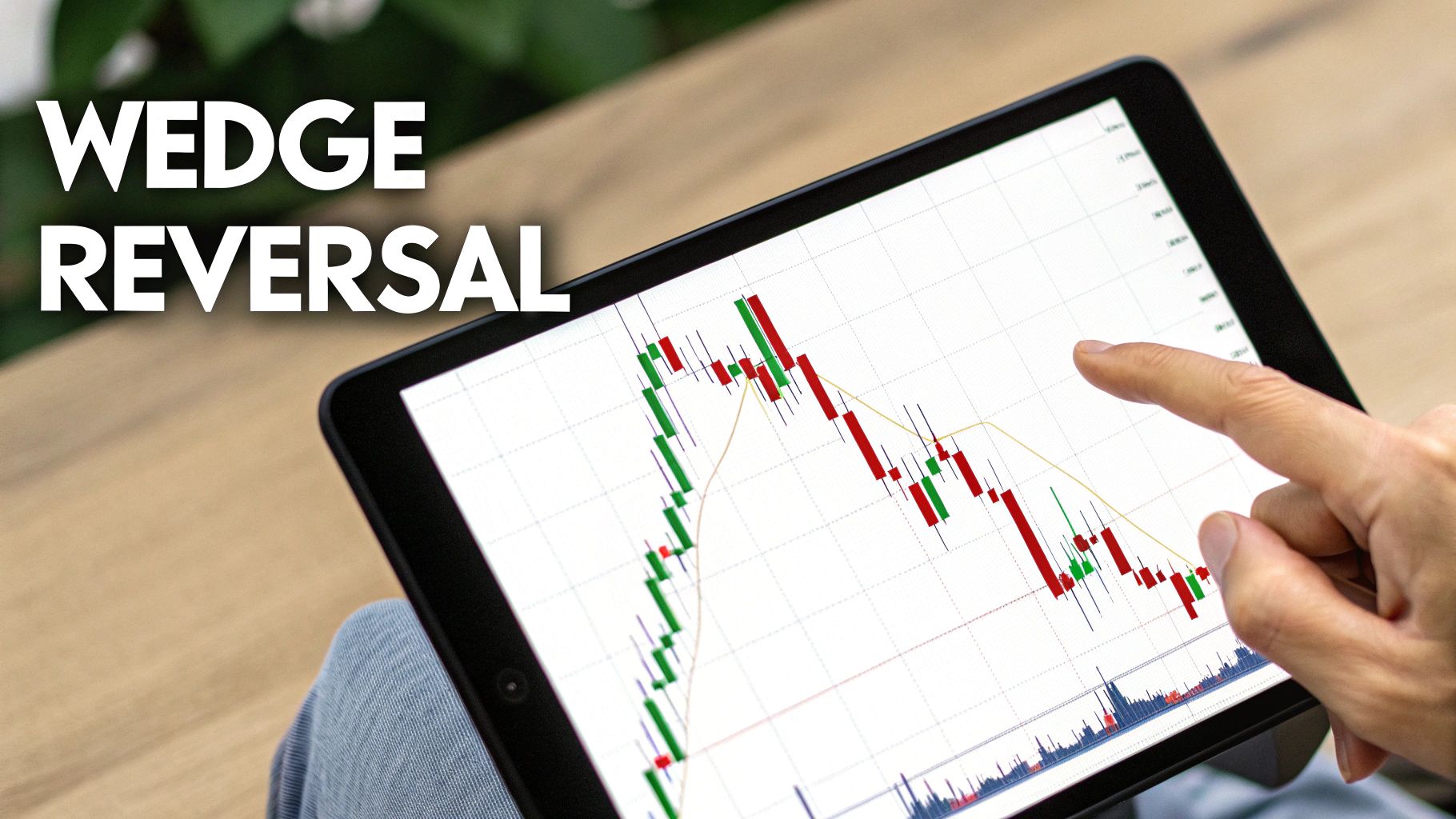
The Wedge pattern is a versatile formation used in day trading that can signal either a trend reversal or continuation. Characterized by two converging trendlines, a wedge shows a progressive tightening of the price range, representing a period of consolidation before a potential breakout.
Structure of the Pattern
Wedges are formed by two trendlines that are sloped either upward or downward. A rising wedge occurs when both lines slope up, with the lower support line being steeper than the upper resistance line. This is typically a bearish reversal pattern, signaling buyer exhaustion. Conversely, a falling wedge has two downward-sloping lines, with the upper resistance line being steeper than the support line, often signaling a potential bullish breakout.
How to Trade It
The trading strategy depends on the type of wedge and the direction of the breakout. A breakout occurs when a candle closes decisively outside one of the converging trendlines.
- Entry: For a falling wedge, enter a long position on a candle close above the upper resistance line. For a rising wedge, enter a short position on a candle close below the lower support line.
- Stop-Loss: Place the stop-loss just outside the opposite trendline of the breakout, providing a buffer against false moves.
- Profit Target: The traditional target is found by measuring the height of the wedge at its widest point and projecting that distance from the breakout point.
Trader’s Insight: Volume is a key confirming factor. In a valid wedge, volume tends to diminish as the price range tightens. A significant increase in volume on the breakout candle provides strong confirmation of the move’s momentum. For example, a stock in a strong uptrend forming a rising wedge with declining volume can be an early warning sign that the rally is losing steam.
8. Cup and Handle
The Cup and Handle is a powerful bullish continuation pattern that signals a potential resumption of an uptrend after a period of consolidation. Its distinct shape makes it a favorite among traders looking for high-probability entries in stocks that are already showing strength.
Structure of the Pattern
The pattern is composed of two main parts. The “cup” forms a “U” shape, representing a gradual price decline followed by an equally gradual recovery back to the initial high. The “handle” is a smaller, shorter price consolidation or slight downward drift that forms on the right side of the cup. A resistance line is drawn across the two peaks of the cup. The bullish signal is confirmed when the price breaks decisively above the handle’s resistance.
How to Trade It
The breakout from the handle is the primary trigger for a long position, as it indicates buyers have absorbed the selling pressure and are ready to push the price higher.
- Entry: Enter a long trade on a candle close above the resistance line of the handle.
- Stop-Loss: Place a stop-loss order slightly below the low of the handle to protect against a failed breakout.
- Profit Target: Measure the depth of the cup from its bottom to the resistance line. Project this distance upward from the breakout point to set a profit target.
Trader’s Insight: Volume is a crucial validator for this pattern. Volume should ideally decrease as the handle forms, showing a lack of selling conviction. A strong surge in volume on the breakout above the handle’s resistance confirms the bullish momentum and increases the trade’s probability of success. Growth stocks like Nvidia (NVDA) often form this pattern on 1-hour to 4-hour charts before significant rallies.
9. Rectangle Pattern (Box Pattern)
The Rectangle Pattern, often called a “Box Pattern” or trading range, is a consolidation pattern that forms when price moves sideways between two parallel, horizontal support and resistance levels. It represents a period of indecision or a temporary pause in a trend, where buyers and sellers are evenly matched. This is one of the most common chart patterns for day trading because it offers clear, defined boundaries.
Structure of the Pattern
The pattern is identified by at least two comparable highs and two comparable lows, creating a box-like shape. The upper line acts as resistance, and the lower line acts as support. The price action within this range indicates a battle between accumulation (buying) and distribution (selling). A breakout from either the top or bottom of the rectangle signals the potential start of a new trend in that direction.
How to Trade It
Traders can either trade the bounces within the rectangle or wait for a decisive breakout.
- Entry: For breakouts, enter a long trade on a candle close above the resistance line or a short trade on a candle close below the support line.
- Stop-Loss: Place a stop-loss just below the breakout level for a long trade, or just above it for a short trade, to manage risk if the breakout fails.
- Profit Target: The classic target is determined by measuring the height of the rectangle and projecting that distance from the breakout point.
Trader’s Insight: Volume is a key confirmation signal. During the formation of the rectangle, volume tends to be inconsistent. However, a valid breakout should be accompanied by a significant increase in volume, confirming the strength of the move. This pattern is common in forex pairs like EUR/USD during the quiet Asian trading session, often breaking out when London opens.
10. Symmetrical Triangle
The Symmetrical Triangle is a neutral consolidation pattern that signals a period of indecision in the market, making it a critical formation for day traders to watch. Characterized by two converging trendlines of similar slope, this pattern indicates that volatility is decreasing, often just before a significant price move.
Structure of the Pattern
This pattern forms as the price makes a series of lower highs and higher lows, creating a contracting range that resembles a triangle. The upper trendline connects the descending peaks, while the lower trendline connects the ascending troughs. Unlike ascending or descending triangles which have a clear directional bias, the symmetrical triangle is neutral; the subsequent breakout can occur in either direction, often continuing the preceding trend.
How to Trade It
Because the breakout direction is uncertain, traders must wait for a decisive move confirmed by a candlestick closing outside one of the trendlines.
- Entry: Enter a long trade on a candle close above the upper trendline or a short trade on a candle close below the lower trendline.
- Stop-Loss: Place a stop-loss just outside the opposite trendline from your entry point to manage risk in the tight consolidation zone.
- Profit Target: Measure the vertical distance at the widest part of the triangle (the “base”). Project this distance from the breakout point to set a profit target.
Trader’s Insight: Volume is your best friend here. Watch for volume to diminish as the triangle forms, showing market indecision. A sharp increase in volume on the breakout candle provides strong confirmation that the move is legitimate. This pattern often appears in major indices right before a high-impact news release, like an FOMC announcement, as the market waits for a catalyst.
Comparison of 10 Day-Trading Chart Patterns
| Pattern | 🔄 Implementation complexity | ⚡ Resource & time requirements | ⭐ Expected outcomes / reliability | 💡 Ideal use cases | 📊 Key advantages / impact |
|---|---|---|---|---|---|
| Head and Shoulders | Medium–High — needs three peaks and neckline confirmation | 15m–4h charts; volume analysis; patience for full formation | ⭐⭐⭐⭐ — highly reliable when neckline breaks | Reversal signaling at market/top turns for day & swing traders | Clear entry/exit and measured profit targets; multi-timeframe utility |
| Double Top / Double Bottom | Low — simple two-peak/trough structure | 15m–4h; volume confirmation helpful; wait for middle level break | ⭐⭐⭐ — effective but prone to false breakouts | Reversal at tested support/resistance; ranging markets or end-of-move trades | Easy identification; precise entries and stops; good for 1–4h setups |
| Ascending Triangle | Medium — requires rising support and flat resistance | 5m–1h+; needs trend context and volume spike on breakout | ⭐⭐⭐⭐ — strong bullish continuation probability | Breakout entries during uptrends; momentum continuation trades | High follow-through on breakout; defined risk and profit projection |
| Descending Triangle | Medium — falling resistance with horizontal support | 15m–1h; needs clear downtrend context and volume on breakdown | ⭐⭐⭐⭐ — strong bearish continuation probability | Breakdown trades in established downtrends; short setups | Clear breakdown entry; defined stop placement and target projection |
| Flag Pattern | Low — quick rectangular consolidation after sharp move | Minutes–hours (5–15m ideal); strong pole volume; volume spike on breakout | ⭐⭐⭐⭐ — ~65–75% success for continuation | Fast intraday continuation trades after impulsive moves | Fast formation, clear entries/stops, works across assets and timeframes |
| Pennant Pattern | Low — compact converging consolidation after pole | 1m–5m to a few hours; pole volume critical; quick execution required | ⭐⭐⭐⭐ — high-probability short-term continuation | Very short-term day trades and scalps after sharp moves | Tight stops, quick setups, strong continuation when confirmed |
| Wedge Pattern | Medium — converging same-direction trendlines (rising/falling) | Intraday to multi-week; watch volume compression and breakout volume | ⭐⭐⭐ — moderate–high (60–65%) depending on context | Reversal or continuation trades; early breakout warnings | Versatile (reversal/continuation); early signal with defined R:R |
| Cup and Handle | High — rounded cup plus handle; needs correct proportions | Hours to weeks (swing setups common); lower volume in handle, spike on breakout | ⭐⭐⭐⭐ — historically ~72% success for continuation | Swing/day entries in uptrends for low-risk entries | Low-risk entry after pullback; strong follow-through and good R:R |
| Rectangle (Box) Pattern | Low — horizontal support/resistance range | 15m–1h+; requires multiple bounces and volume on breakout | ⭐⭐⭐ — reliable for range or breakout strategies | Range trading within box or breakout trades on confirmed exit | Very clear support/resistance; easy to trade both range and breakout styles |
| Symmetrical Triangle | Medium — converging trendlines with neutral bias | 5m–15m to longer; volume compression; breakout unpredictable direction | ⭐⭐⭐ — neutral; breakout direction depends on confluence | Breakout trades in uncertain markets; tight-stop setups | Tight consolidation allows small stops; works across timeframes |
From Theory to Practice: Building Your Trading Edge
We have journeyed through ten of the most prevalent chart patterns for day trading, from the classic Head and Shoulders to the rapid-fire Flag and Pennant formations. Each pattern offers a unique window into market psychology, revealing the ongoing battle between buyers and sellers. But recognizing these shapes on a chart is only the first step; true mastery lies in their disciplined application.
Remember, no chart pattern works 100% of the time. The market is a fluid environment, and losses are an unavoidable part of trading. Your goal is not to find a foolproof system for “guaranteed profits” but to build a statistical edge over time. This edge comes from combining pattern recognition with a comprehensive trading plan that includes strict risk management, clear entry triggers, and pre-defined exit strategies.
Turning Knowledge into Actionable Skill
The transition from a theoretical understanding of patterns to consistent, real-world execution is where most traders struggle. It’s easy to spot a perfect Double Bottom on a historical chart, but it’s an entirely different challenge to execute on one in a live market, with real capital on the line and emotions running high. We’ve all been there.
To bridge this gap, focus on these critical next steps:
- Master One Pattern at a Time: Instead of trying to trade all ten patterns at once, choose one or two that resonate with your trading style. Study them, backtest them, and learn their nuances until you can identify them with confidence.
- Context is King: A chart pattern rarely appears in isolation. Always analyze the broader market context. Is the asset in a strong uptrend or downtrend? Is there a key support or resistance level nearby? A Flag pattern in a strong trend is far more reliable than one appearing in choppy, sideways price action.
- Practice Diligent Record-Keeping: The single most impactful habit you can build is maintaining a detailed trading journal. Document every trade: the pattern you saw, your reason for entry, your stop-loss placement, your profit target, and the ultimate outcome. This log is your personal trading textbook, written by you, for you.
From Emotional Guesses to Data-Driven Decisions
A trading journal does more than just record history; it creates a feedback loop for improvement. By analyzing your documented trades, you can answer critical questions: Which chart patterns for day trading are most profitable for you? Do you perform better with reversal or continuation patterns? At what time of day are your trades most successful?
This data-driven approach is the antidote to emotional trading. Instead of trading based on fear or greed, you begin to operate based on your own verified performance data. This process transforms your trading from a series of isolated gambles into a professional business rooted in statistical analysis and continuous refinement. Your long-term success isn’t defined by a single winning trade but by the disciplined process you build and follow every single day.
Ready to stop guessing and start analyzing? TradeReview automatically syncs with your brokerage account to import your trades and provides powerful analytics on your performance. Discover which chart patterns, setups, and strategies truly work for you with a data-driven trading journal. Sign up for free and turn your trading history into your greatest asset at TradeReview.