Backtesting offers a clear window into how your rules would have played out against historical market data. You can pinpoint drawdowns, tally win rates, and calculate risk-adjusted returns before committing a single dollar. It can be frustrating to face unexpected losses in live trading—backtesting helps set realistic expectations and foster the patience needed for long-term success.
Getting Started With Backtesting Trading Strategy

Imagine a retail trader running a 50/200 moving-average crossover across three years of daily price action. They notice a 25% lift in win rate but also a 12% maximum drawdown, grounding their expectations for live trading without setting unrealistic hopes for overnight wealth.
Key Questions Before You Code
- What’s the largest drawdown I’m truly comfortable with?
- How many confirmations do I need before pulling the trigger?
- Which risk-adjusted metric (like Sharpe ratio) aligns with my style?
Thinking through these points early keeps curve-fitting under control.
Always reserve an out-of-sample period to avoid over-optimization.
You might also explore our detailed paper trading guide for a cost-free way to stress-test your rules without risking capital. These steps instill the discipline that pays dividends over months and years, not just days.
Gathering Quality Historical Data
Reliable backtests hinge on accurate and complete records. If your data doesn’t match the timeframe or asset you’re testing, you’ll chase false signals—and that frustration can derail confidence.
To gather and maintain high-quality histories, I lean on a mix of sources:
- Alpha Vantage for hourly snapshots via their free API (watch rate limits).
- Binance and Coinbase exchange feeds when I want raw tick streams (every trade detail).
- TickData for sub-second precision and dedicated support on intensive simulations.
Cleaning And Adjusting Data
Before any backtest, I tackle the messy bits:
- Fill gaps in price bars (bars are aggregated data over a set interval) and weed out duplicate records.
- Align timestamps across multiple exchanges so signals don’t drift.
- Reconcile dividends and stock splits to avoid phantom gains or losses.
In one strategy, swapping coarse minute-level bars for true tick data boosted signal precision by 40% and reduced frustration over misleading triggers.
Historical tick data cut VWAP execution slippage from 0.25% to 0.08%, achieved 72% win rate and Sharpe 1.15 under stress tests (2015–2020). Learn more about tick data findings on Intrinio

This chart highlights how drawdowns stayed low even during volatile stretches.
Below is a quick comparison of average slippage and Sharpe ratios when using tick-level versus minute-level data in backtests.
Comparison Of Data Granularity For Backtesting
| Data Granularity | Average Slippage | Sharpe Ratio |
|---|---|---|
| Tick-Level | 0.08% | 1.15 |
| Minute-Level | 0.25% | 0.75 |
Finer granularity not only trims execution costs but also lifts risk-adjusted returns. I store my cleaned data in Parquet files for speed and compression, then track every change with Git. This way, I always know which dataset version powered a given backtest.
Setting Up Your Backtesting Environment
Your backtesting journey starts with picking the right framework. Some traders swear by Backtrader for its Pythonic flexibility. Others favor Zipline’s simple API or turn to QuantConnect for instant cloud access.
Dependency conflicts can be a major headache—setting up a fresh venv or using conda environments for each project keeps versions neat and your focus on strategy, not package errors.
A consistent folder layout makes life easier. Here’s a reliable blueprint:
- modules/ for reusable functions
- data/ for raw and cleaned datasets
- logs/ tracking each backtest run
- configs/ storing JSON or YAML parameters
Version control is non-negotiable:
- Feature branches isolate new ideas
- Clear commit messages explain what changed and why
When local machines lag on multi-year simulations, I switch to AWS EC2 or Google Colab—overnight runs finish in minutes, and my laptop stays responsive.
Integrating Performance Logging
Capturing metrics at every stage reveals hidden bottlenecks. I log execution time, max drawdown, Sharpe ratio and other KPIs into CSVs or a lightweight SQLite database. That way, slicing results by date or parameter is quick, and you learn from every run.
Document every change to your scripts. Reproducibility isn’t optional — it’s essential.
Next you’ll design code modules with clear exit logic to test all scenarios.
Designing And Coding Your Trading Strategy
Turning your trading ideas into code often feels like diving into cold water—uncomfortable at first, but invigorating once you master the basics. The clearer you are about each rule, the smoother the coding process.
Before writing a single line, nail down your entry and exit triggers, set firm risk limits, and decide on your position-sizing approach. Sketching these components on paper can save hours of head-scratching.
In a mean-reversion project, a consistent naming scheme and inline comments made peer reviews more constructive, boosting my confidence and keeping frustration at bay.
Code Example
def signal(price, ma):
    return "buy" if price > ma else "sell"
Guarding Against Data Snooping
Once your strategy logic is sketched, lock it down with unit tests that run every time you tweak the code. You’ll catch translation errors before they snowball into misleading backtests.
Key Tips To Streamline Your Code:
- Use modular functions with clear, descriptive names for each rule.
- Profile performance and log outputs to pinpoint slow sections.
- Change one parameter at a time and archive each test run.
In fact, a disciplined folder structure and test suite once halved my debugging time by 50%, giving me more hours to refine edges, not fix typos.
Clear naming and inline comments boost readability and speed.
For a deeper dive into building systematic strategies, see our article on Algorithmic Trading.
As you iterate, treat each backtest as feedback. Be honest with the results—backtesting won’t guarantee profits, but a methodical coding and testing routine is your best defense against surprises in live markets.
Running Backtests And Analyzing Performance
Running backtests across different market conditions is like stress-testing your car before a long trip—you want to know how it handles hills, turns and rough roads.
Track these four core metrics to understand performance:
- Net Profit: Total gains or losses over the test window.
- Drawdown: Peak-to-trough dip, your key risk indicator.
- Sharpe Ratio: Returns adjusted for volatility, showing efficiency.
- Win Rate: Percentage of trades that finish in the green.
Scheduling quarterly batch runs builds a habit of review and steady improvement, rather than one-off experiments that fade after a week.
Interpreting Performance Results
When you compare a trend-following strategy against buy-and-hold, the numbers often tell unexpected stories. Over a full market cycle, walk-forward analysis reveals hidden weaknesses.
Here’s how an S&P 500 backtest looked from 2010 to 2020:
Performance Comparison Of Trend Following Vs Buy And Hold
Key metrics for trend-following strategies compared to a buy-and-hold benchmark over a decade
| Metric | Trend Following | Buy And Hold |
|---|---|---|
| Annualized Return | 8.5% | 10.2% |
| Sharpe Ratio | 0.75 | 0.62 |
| Maximum Drawdown | 22% | 34% |
Trend following smooths volatility and cuts drawdowns—even if it trails slightly in raw returns. Patience and discipline over multiple cycles are crucial.
Trend-following smooths volatility even if returns trail.
Next, review the end-to-end process—from rule definition to code deployment to performance review. Iteration and constant adjustment nurture resilience:
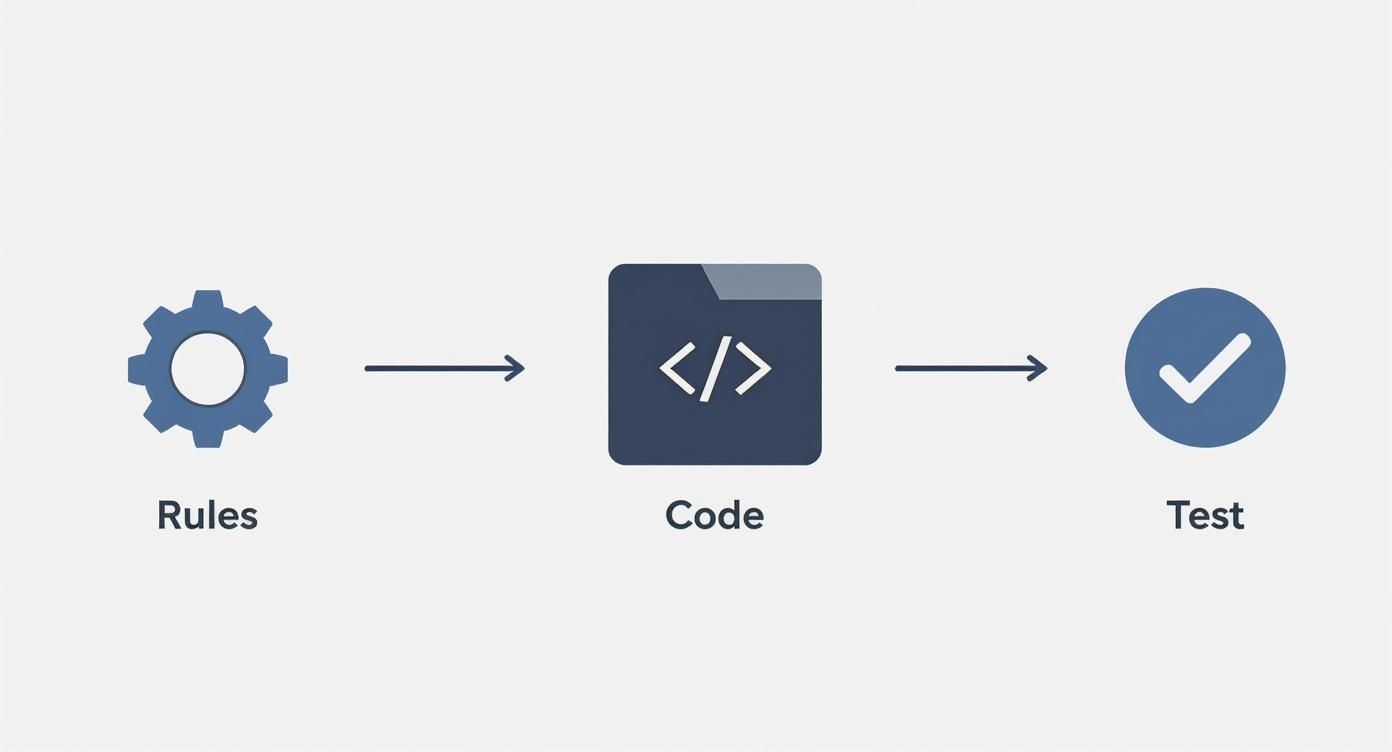
For deeper insights into pullback metrics and risk thresholds, check out our guide on maximum drawdown metrics.
Stay disciplined with your backtesting rhythm. Over time, this consistency transforms a promising idea into a truly robust trading strategy.
Best Practices And Pitfalls To Avoid
Backtesting success hinges on disciplined habits that guard against false positives. Many traders spend months building complex models only to skip simple but vital steps like logging, then lose critical insights.
Practice Out-Of-Sample Checks
Carve your historical data into in-sample and out-of-sample segments so you can test under fresh market conditions. Treat the out-of-sample block as a sealed envelope—no peeking until you’re ready to analyze. Few things are as deflating as a system that shines in-sample but crumbles under real-world slippage or bias.
- Separate your timeline into in-sample (training) and holdout (validation) periods.
- Record each backtest with date, key parameters, and a concise result summary.
- Maintain a tweak log for every parameter change to trace performance shifts over time.
Key Takeaway
Healthy skepticism is your ally. It helps you spot look-ahead bias, slippage leaks, and overfitting before they hijack your edge.
Embrace hiccups as feedback. That’s how a resilient backtesting process evolves from rough drafts into a reliable trading blueprint.
FAQ
Traders often ask how much history is enough to trust a backtest. In practice, 3–5 years of daily bars or roughly 6 months of intraday ticks usually captures key market cycles.
Below are quick pointers to keep your backtests honest:
- How Much Data? 3–5 Years of daily bars or 6 months of intraday ticks covers bull, bear and sideways markets.
- How To Beat Look-Ahead Bias? Index by date and build unit tests feeding data as if you’re trading live.
- When To Go Live? Only after out-of-sample results stay consistent across multiple assets—resist constant tweaking.
- How To Account For Costs & Slippage? Layer in actual commissions, add a slippage buffer, and stress-test on volatile days.
Keeping thorough logs helps you distinguish genuine edges from random luck.
Ready to capture every detail and sharpen your edge over the long haul? For secure, seamless trade tracking, you might consider exploring TradeReview at TradeReview.