Welcome to the world of forex trading. It’s a landscape filled with immense opportunity, but for newcomers, it can often feel overwhelming. Many beginners jump in with high hopes, only to be sidelined by common mistakes like over-leveraging, emotional decision-making, and the absence of a clear, structured plan. This guide isn’t about finding a secret formula for guaranteed profits — because one simply doesn’t exist. Instead, this article provides a foundational roadmap.
We will walk through eight practical, actionable forex trading tips for beginners, designed to help you build discipline, manage risk effectively, and cultivate a long-term mindset from your very first trade. We’ll move beyond generic advice and focus on tangible steps you can take immediately. This includes everything from establishing proper risk management protocols and mastering technical analysis basics to developing the crucial emotional discipline needed to navigate market volatility.
Throughout this guide, we’ll explore how to create a structured approach that replaces guesswork with a data-driven process. You will learn how to use essential tools, such as a trading journal, to turn your experiences — both wins and losses — into invaluable lessons. Our goal is to equip you with the habits and strategies that separate disciplined, methodical traders from the rest. Let’s begin building your framework for navigating the forex market with confidence and a clear plan.
1. Start with a Trading Journal to Track All Your Trades
Before placing a single trade, the most crucial tool you can adopt is a trading journal. Far from being a simple diary, a trading journal is a systematic record of your trading activity. It captures the who, what, when, where, and why of every trade, creating an objective data set you can analyze to improve your performance. It is the single most effective tool for transforming trading from a gamble into a structured, data-driven business.
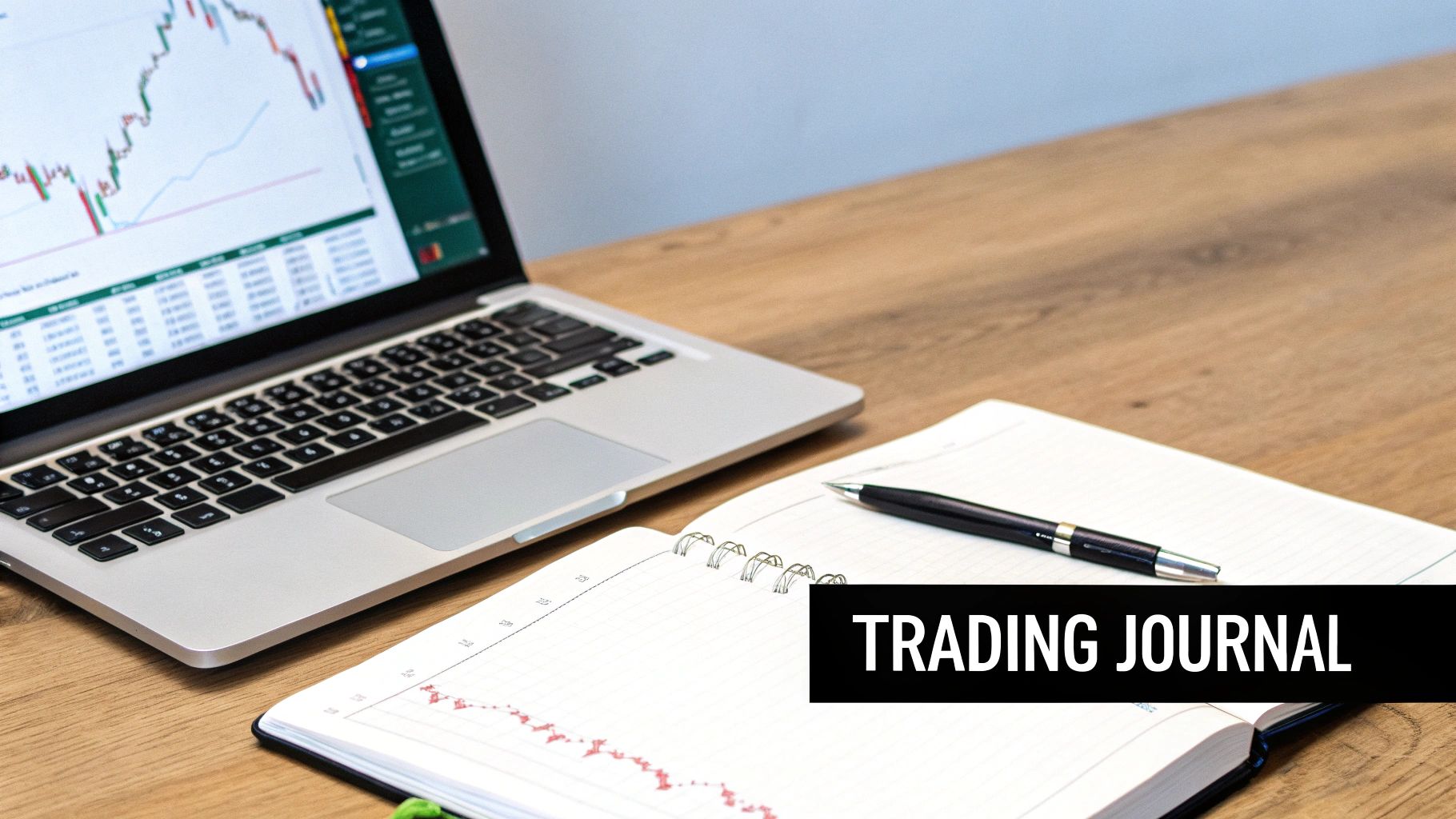
This practice is one of the most vital forex trading tips for beginners because it provides a powerful feedback loop. It forces you to be accountable for every decision, moving you away from emotional, impulsive actions and toward disciplined, strategic execution. By documenting your trades, you can uncover hidden patterns — both good and bad — that are invisible in the heat of the moment. We all struggle with repeating mistakes, and a journal is the mirror that shows you exactly what those mistakes are.
How a Trading Journal Works in Practice
A trading journal creates a detailed log that helps you connect your actions to your results. Instead of vaguely remembering why a trade went wrong, you have concrete data to review.
- Practical Example 1: A new forex trader uses a journaling tool like TradeReview to log 50 trades over two months. During their weekly review, the analytics dashboard reveals a stark pattern: 70% of their losing trades occur on Mondays. They realize they are forcing trades after the weekend, driven by a desire to get back into the action. They adjust their strategy to only observe the market on Monday mornings, significantly reducing their weekly losses.
- Practical Example 2: A day trader consistently documents their entry rationale, screenshots, and exit points. After a month, they discover their most profitable trades consistently happen within the first two hours of the London session open. This insight allows them to focus their energy and capital on their most productive trading window, improving their long-term performance.
Actionable Steps to Get Started:
- Log Every Single Trade: No exceptions. Even small practice trades or trades you feel uncertain about contain valuable data. Consistency is key.
- Record Your “Why”: Beyond the numbers (entry/exit price, size), write down your trading thesis. What was your reason for entering? What did you expect the market to do? What was your emotional state? This helps you understand your psychological triggers.
- Use Tags for Deeper Analysis: Tag each trade by the strategy used (e.g., “breakout,” “range”), market condition (“trending,” “choppy”), or currency pair (EUR/USD). This allows you to filter your data and see which setups work best for you.
- Automate to Stay Consistent: Manually logging trades can be tedious. Use a platform that offers broker auto-sync to import your trade data automatically. This eliminates human error and ensures your journal is always up-to-date, making it a reliable source for analysis.
2. Use Proper Risk Management and Position Sizing
More important than any trading strategy is your ability to manage risk. Risk management is the set of rules you follow to protect your capital from significant losses. It ensures you can survive the inevitable losing streaks that all traders face, allowing you to stay in the game long enough to become consistently profitable. Without it, even a winning strategy can lead to a blown account.

This discipline is non-negotiable for serious traders. By pre-defining how much you are willing to lose on any single trade — typically 1-2% of your total account balance — you remove emotion from the equation. This mathematical approach to capital preservation is one of the most critical forex trading tips for beginners, as it shifts your focus from chasing profits to systematically protecting what you have. This isn’t about preventing losses; it’s about ensuring losses are small and manageable.
How Risk Management Works in Practice
Proper risk management involves calculating your position size before you enter a trade, ensuring that a losing trade costs you a pre-determined, acceptable amount. This prevents one or two bad trades from wiping out your account.
- Practical Example 1: A new trader with a $5,000 account implements a strict 1% risk rule. This means they will not risk more than $50 on any single trade. Even after a tough streak of 10 consecutive losses, their account balance is still $4,500, giving them ample capital to continue trading and wait for their strategy’s edge to play out.
- Practical Example 2: In contrast, another beginner with a $5,000 account risks 10% ($500) per trade, hoping for a big win. A single loss erases a significant portion of their capital. After just three consecutive losses, their account is down to $3,500, a 30% drawdown that is psychologically difficult to recover from.
Actionable Steps to Get Started:
- Define Your Risk Per Trade: Commit to a fixed percentage, such as 1% of your trading capital. This number should never change based on how confident you feel about a trade.
- Calculate Position Size Before Entry: Use the standard formula: Position Size = (Account Size × Risk %) / (Stop Loss Distance in pips × Pip Value). This calculation is mandatory for every trade.
- Never Risk More Than You Can Afford to Lose: This rule is absolute. The money in your trading account should not be designated for essential life expenses.
- Review Your Equity Curve Monthly: Regularly check your performance to ensure your losses align with your 1-2% rule. If you see drawdowns far exceeding this, it is a sign that your risk management has failed, and you need to reassess your discipline immediately.
3. Learn and Master Technical Analysis Basics
While fundamental analysis looks at economic news and data, technical analysis focuses purely on price action. It involves studying price charts, patterns, and indicators to forecast future price movements. For a new trader, mastering the basics of technical analysis provides a structured, repeatable framework for identifying potential entry and exit points, transforming a chart from a random series of lines into a map of market psychology.
This discipline is one of the most essential forex trading tips for beginners because it equips you with the skills to interpret market behavior directly from the source: the price chart. Rather than guessing or trading on gut feelings, you learn to identify objective signals, such as trends, support and resistance levels, and common chart patterns. This data-driven approach builds confidence and helps you make more informed trading decisions.
How Technical Analysis Works in Practice
Technical analysis provides a visual and statistical basis for your trading strategy, helping you to find high-probability setups and manage risk effectively. It allows you to build a system based on historical price behavior.
- Practical Example 1: A new trader learns to identify a “double bottom” pattern on the EUR/USD 4-hour chart, which often signals a potential trend reversal to the upside. They wait for the price to break above the pattern’s neckline (the peak between the two bottoms), enter a long position, and set their stop-loss below the lows of the pattern. They log the trade in TradeReview with the tag “Double Bottom” to track the success rate of this specific pattern over time.
- Practical Example 2: Another trader uses moving averages to identify trends. They notice through their journal analysis that their strategy of buying when the 50-period moving average crosses above the 200-period moving average has a 60% win rate on 4-hour charts but only a 45% win rate on 1-hour charts. This insight helps them focus their strategy on the more profitable, long-term time frame.
Actionable Steps to Get Started:
- Focus on the Core Concepts: Start with the five pillars of technical analysis: understanding trends (uptrend, downtrend, sideways), identifying support and resistance levels, using moving averages to gauge momentum, recognizing basic candlestick patterns, and observing volume. Don’t try to learn 20 indicators at once.
- Tag Every Technical Setup: When you log a trade in your journal, use tags to categorize the technical reason for your entry (e.g., “Moving Average Cross,” “Bollinger Band Break,” “RSI Divergence”). This creates powerful data for analysis.
- Backtest Before You Risk Capital: Use your trading platform’s historical data to manually backtest a strategy. Go back in time on a chart and see how a specific technical signal would have performed before you risk real money.
- Combine Indicators for Confirmation: Avoid relying on a single indicator. A strong signal is often one confirmed by multiple indicators. For example, a bullish candlestick pattern at a key support level is a much stronger signal than either one on its own.
- Practice on a Demo Account: Aim to execute at least 50 trades on a demo account based purely on pattern recognition and technical signals. This builds practical experience without financial risk.
4. Develop, Backtest and Continuously Adapt Your Trading Strategy
Trading without a strategy is like sailing without a map; you might move, but you have no control over your destination. A trading strategy is a documented set of rules that governs your entry, exit, and risk management for every trade. Developing, backtesting, and adapting this plan is what separates methodical traders from gamblers who rely on luck. It provides a framework for making objective, consistent decisions, free from the emotional chaos of live market movements.
This process is one of the most fundamental forex trading tips for beginners because it forces you to validate your ideas with historical data before risking real money. It establishes a performance baseline, allowing you to systematically identify what works, what doesn’t, and when it’s time to adjust to new market dynamics. Without this structured, long-term approach, improvement is nearly impossible, as you have no reliable way to measure your performance or understand the reasons behind your wins and losses.
How a Trading Strategy Works in Practice
A well-defined strategy creates a repeatable process for engaging with the market. Backtesting it on past data reveals its historical performance, while ongoing analysis ensures it remains effective as market conditions change.
- Practical Example 1: A new trader develops a moving average crossover strategy for GBP/USD. Before going live, they backtest it on the last 100 historical setups and find it has a 55% win rate. Satisfied with this baseline, they paper trade for two weeks to confirm they can execute the rules without hesitation, building crucial confidence before risking capital.
- Practical Example 2: A trader uses TradeReview to tag and analyze two different strategies over a quarter: ‘Trend Following’ and ‘Support/Resistance’. The performance analytics reveal that their ‘Support/Resistance’ strategy produced a profit factor of 2.1, while the ‘Trend Following’ strategy only managed 0.8. This data-driven insight prompts them to focus exclusively on the more profitable setup for the long term.
Actionable Steps to Get Started:
- Define Your Rules in Writing: Document your exact entry criteria (e.g., “I will enter long when the 50 EMA crosses above the 200 EMA and the RSI is above 50”). Do the same for your exit rules, including both your profit target and your stop-loss placement.
- Backtest with a Significant Sample Size: Test your strategy on at least 100 historical trade setups to get a statistically relevant idea of its potential performance. This helps validate its edge.
- Paper Trade Before Going Live: After successful backtesting, trade your strategy on a demo account for 20-30 trades. This ensures you can execute the rules mechanically and psychologically under simulated market conditions.
- Review and Adapt Systematically: Market conditions evolve. Use your trading journal to conduct a monthly or quarterly strategy health check. If you notice a significant drop in performance (e.g., win rate falls below 50% for 30 trades), analyze the recent market behavior and test potential adjustments.
5. Understand Leverage and Avoid Over-Leveraging
Leverage is one of the most powerful and misunderstood tools in forex trading. It allows you to control a large position size with a relatively small amount of capital, effectively amplifying your potential profits. However — and this is critical — this amplification works both ways, meaning it can magnify your losses just as quickly and dramatically. Understanding and respecting leverage is a non-negotiable survival skill for any new trader.
This concept is one of the most critical forex trading tips for beginners because misuse of leverage is the single fastest way to deplete a trading account. High leverage offered by brokers (sometimes up to 500:1 or more) can be tempting, but it drastically reduces your margin for error. A small market movement against your position can trigger a margin call or a stop-out, wiping out your account before your strategy has a chance to work.
How Leverage Works in Practice
Using leverage responsibly means you can stay in the game long enough to learn and grow, whereas over-leveraging turns trading into a high-stakes gamble. The difference in outcomes is stark.
- Practical Example 1 (High Leverage): A trader with a $1,000 account uses 50:1 leverage. This means each 1% move against their position results in a 50% loss of the margin used. A few consecutive small losses can quickly consume their available equity, leading to a catastrophic account blow-up. They might not even survive a normal market drawdown.
- Practical Example 2 (Low Leverage): A trader with the same $1,000 account uses a conservative 10:1 leverage. A losing trade of the same size now has a much smaller impact on their overall capital. After three consecutive 5% losses on their positions, they still have plenty of capital remaining, giving them ample runway to wait for better opportunities, learn from their mistakes, and recover.
Actionable Steps to Get Started:
- Start with Low Leverage: As a beginner, limit your effective leverage to a maximum of 10:1. For your first 100 trades, consider using 5:1 or even less to focus on your strategy without the intense pressure of amplified risk.
- Calculate Your Margin: Always know how much margin (the collateral required for a trade) is being used. This helps you understand how much of your capital is being tied up as collateral for each trade.
- Log Your Leverage: When you journal a trade, make a specific note of the leverage used for that position. Over time, you can analyze in your journal whether your bigger losses correlate with instances of higher leverage.
- Prioritize Survival: Never use so much leverage that a few consecutive losing trades could wipe you out. A good rule of thumb is to ensure you can survive at least 10-20 consecutive losses (based on your risk per trade) without blowing your account. Remember, many professional traders use very low leverage to ensure long-term consistency.
6. Practice on a Demo Account Before Trading with Real Money
Before risking a single dollar of your hard-earned capital, you must learn to navigate the markets in a risk-free environment. This is where a demo account comes in. A demo account, or paper trading account, allows you to practice with simulated funds in real, live market conditions. It is an indispensable training ground for mastering your trading platform’s mechanics, testing your strategy, and building procedural confidence without any financial consequences.
This step is one of the most fundamental forex trading tips for beginners because it bridges the gap between theory and practice. It exposes you to the speed and volatility of the forex market, allowing you to make mistakes and learn from them when the stakes are zero. While a demo account cannot fully replicate the emotional pressure of trading real money, it is the perfect environment to build the discipline and consistency required for live trading. Don’t be in a rush to trade real money; the markets will be there when you are ready.
How a Demo Account Works in Practice
A demo account gives you a sandbox to refine your process, from placing orders to managing risk, until it becomes second nature. It provides a baseline performance metric you can compare against when you eventually go live.
- Practical Example 1: A new trader practices on a demo account for three months, developing a strategy that achieves a consistent 65% win rate. When they switch to a live account, their performance plummets. By comparing their live trades to their demo trades in a journal, they realize fear and greed are causing them to close winning trades too early and let losing trades run — a purely emotional problem they can now work to solve.
- Practical Example 2: A trader logs their first 50 demo trades in TradeReview, tagging them as “Demo.” They then log their first 50 live trades. The analytics show that their live trades have a 15% lower win rate. The data reveals a pattern of hesitation on live entries, causing them to miss optimal price points they were catching perfectly in the demo environment.
Actionable Steps to Get Started:
- Trade Like It’s Real: Use the same position sizes, leverage, and risk management rules on your demo account that you plan to use with real money. This builds realistic habits.
- Set Clear Goals: Don’t just trade randomly. Aim to place a minimum of 50-100 trades and achieve a specific goal, like two consecutive profitable months, before even considering a live account.
- Journal Your Demo Trades: Treat your practice seriously by logging every demo trade. Use a tag like “Demo” to separate this data. This allows you to track your progress and prove your strategy is profitable before you risk capital.
- Don’t Skip This Step: Rushing to a live account is one of the biggest mistakes beginners make. Demo trading is a critical learning phase, not an optional one.
- Transition Smartly: Once you are consistently profitable on a demo account for at least two months, transition to a small live account to get a feel for real-money trading psychology with manageable risk.
7. Master Emotional Discipline and Avoid Impulsive Decisions
The most significant barrier to long-term success in forex trading is not a flawed strategy but a lack of emotional control. Emotions like fear, greed, frustration, and hope are powerful forces that can compel you to abandon your well-researched trading plan. Mastering emotional discipline means learning to execute your strategy mechanically — like a pilot running through a pre-flight checklist — regardless of how you feel about the market’s unpredictable moves.

This practice is one of the most critical forex trading tips for beginners because your psychological state directly impacts your bottom line. An impulsive decision, such as revenge trading after a loss or holding a losing position out of hope, can erase weeks of disciplined gains in a single moment. By developing rules to manage your emotions, you build a protective barrier between your feelings and your trading capital, ensuring longevity in the market. Every trader struggles with this; the key is having a system to manage it.
How Emotional Discipline Works in Practice
Emotional discipline involves creating a rules-based framework that dictates your actions, especially during high-stress situations. This framework prevents in-the-moment feelings from overriding your logic and strategy.
- Practical Example 1: A trader experiences two consecutive losses that followed their rules. Feeling frustrated, they spot another potential setup but break their position-sizing rule, risking 5% of their account instead of their standard 1%. This “revenge trade” also results in a loss, amplifying their drawdown significantly and turning a manageable bad day into a disastrous one.
- Practical Example 2: An investor holds a losing trade for three weeks, hoping it will “come back” to their entry price. Instead of accepting a planned 2% loss, they watch it deteriorate to an 8% loss before finally closing the position. Their inability to accept a small, managed loss resulted in a loss four times larger than their strategy allowed.
Actionable Steps to Get Started:
- Set Pre-Session Rules: Before you start trading, write down a simple commitment: “I will only take trades that meet every single rule in my strategy.” This reinforces discipline before emotions can take over.
- Implement a “Cool-Down” Period: After any losing trade, step away from your charts for at least 30 minutes. This break prevents you from immediately jumping back into the market to chase your losses.
- Use a “Circuit Breaker” Rule: If you experience a losing streak (e.g., three consecutive losses), stop trading for the rest of the day. This is a non-negotiable rule that protects your capital and mental state from further damage.
- Tag Your Emotional Trades: In your trading journal, create a tag for “Emotional” or “Impulsive.” Apply this to any trade where you deviated from your plan. Over time, your analytics will reveal the exact financial cost of these emotional mistakes.
- Never Add to a Losing Position: This common mistake, often called “averaging down,” violates sound risk management. It is a decision driven by hope, not strategy, and can lead to catastrophic losses.
8. Focus on High Probability Setups and Quality Over Quantity
Many beginners feel the need to be constantly in the market, believing more trades equal more profits. However, successful trading is about precision, not volume. Focusing on high-probability setups means you only risk capital when market conditions align perfectly with your pre-defined, backtested trading strategy. It’s a shift from being a busy trader to being a patient and effective one.
This discipline is one of the most impactful forex trading tips for beginners because it dramatically improves your win rate and reduces stress. Instead of chasing every minor price movement, you act as a sniper, waiting for the perfect moment. This approach minimizes exposure to market noise, lowers commission costs, and prevents the emotional burnout that comes from overtrading. This is about working smarter, not harder.
How Focusing on Quality Works in Practice
Prioritizing quality setups forces you to be selective, only engaging with trades that meet a strict checklist of criteria. This systematically filters out weak or impulsive ideas, leaving only the strongest opportunities.
- Practical Example 1: A trader typically takes 20 trades a week with a 45% win rate. Their net profit might look decent, but the process is stressful and prone to drawdowns. By switching to a quality-first approach, they now only take 5 highly selective trades per week. Their win rate jumps to 70% because the setups are stronger, leading to a similar net profit but with 75% fewer trades and significantly less anxiety.
- Practical Example 2: A trader uses their journal to tag every trade based on its quality. A “Grade-A” setup requires the price to be at a key support level, show a bullish candlestick pattern, and have a MACD crossover. A “Grade-B” setup might only have one or two of these signals. After a month, their analytics clearly show that Grade-A trades are profitable 72% of the time, while Grade-B trades are only profitable 45% of the time. They decide to stop taking Grade-B trades altogether.
Actionable Steps to Get Started:
- Define “High Probability” in Writing: Create a non-negotiable checklist for your ideal trade setup. For example, a trade is only valid if it has at least three confirming signals (e.g., trend alignment, key price level, and a specific indicator signal).
- Tag Setups in Your Journal: Use a journaling tool like TradeReview to create tags such as “Grade-A Setup” or “Multi-Confirmation.” This allows you to filter and analyze the performance data to prove which setups actually work best.
- Measure Profit Per Trade, Not Trades Per Day: Shift your metric for success. A successful day isn’t one with many trades; it’s one where you followed your plan, avoided bad setups, and capitalized on any Grade-A opportunities that appeared.
- Embrace Doing Nothing: If no setups meet your strict criteria on a given day, the correct action is to do nothing. Preserving your capital for a better opportunity tomorrow is a winning strategy in itself. It’s an active decision, not a missed opportunity.
Your Journey Starts Now: Trade Smarter, Not Harder
You’ve just navigated a comprehensive guide filled with actionable forex trading tips for beginners. The journey from novice to a consistently profitable trader is not a short one; it’s a marathon built on discipline, continuous learning, and meticulous execution. The eight core principles we’ve explored are your foundational pillars. They are not merely suggestions but the very architecture of a sustainable trading career.
From the moment you start, documenting every action in a trading journal establishes a bedrock of accountability. Coupling this with strict risk management and proper position sizing protects your capital, ensuring you stay in the game long enough to learn and succeed. These are not the most glamorous parts of trading, but they are undeniably the most critical for survival and long-term growth.
As you build these defensive habits, you can focus on the offensive side: developing your edge. This involves mastering the basics of technical analysis to read market sentiment and identify potential opportunities. However, an indicator or a chart pattern alone is not a strategy. True competence comes from building, backtesting, and relentlessly refining a complete trading plan that dictates your exact entry and exit criteria. This process separates hopeful gambling from methodical trading.
From Theory to Consistent Practice
Understanding the concepts we’ve discussed is the first step, but consistent application is what creates lasting results. Let’s recap the most important takeaways and how to turn them into daily habits:
- Embrace Data, Not Drama: Your trading journal is your single source of truth. Every trade, win or lose, is a data point. By analyzing this data, you replace emotional reactions with objective, evidence-based decisions. You start to see what works and, more importantly, what doesn’t.
- Risk Is Your Only Certainty: You cannot control the market, but you can always control your risk. The 1-2% rule isn’t just a guideline; it’s a non-negotiable law for your trading business. It’s what separates traders who have long careers from those who blow up their accounts in a few reckless trades.
- Patience Pays: The market will always be there tomorrow. The urge to constantly be in a trade is a recipe for disaster. Focusing only on high-probability setups, even if it means taking fewer trades, dramatically improves your win rate and reduces stress. Quality over quantity is the mantra of professional traders.
- Discipline Is Your Superpower: Emotional discipline is the glue that holds everything together. It’s the force that makes you stick to your trading plan when fear or greed tries to take over. Practicing on a demo account is the perfect training ground to build this mental fortitude without financial risk.
Your Actionable Next Steps
The path forward can feel overwhelming, but progress is made one step at a time. Do not try to implement everything at once. Instead, pick one area and commit to mastering it.
Start today. Open a demo account and make your first priority journaling every single practice trade. Focus solely on the process, not the profit or loss. Did you follow your plan? Did you manage risk correctly? Did you record the outcome and your thoughts? This single habit will build the foundation for everything else. As you become consistent with your journal, you can then focus on refining your strategy or mastering your emotional responses. Each tip builds upon the last, creating a powerful system for continuous improvement.
Remember, the goal is not to be right on every trade. The goal is to have a system that gives you a positive expectancy over a large series of trades. This journey will test you, but the skills you build — discipline, analysis, and emotional control — will serve you far beyond the trading charts. You are not just learning to trade; you are learning to become a more objective, patient, and resilient decision-maker.
Ready to stop guessing and start analyzing? TradeReview automates the tedious parts of journaling, providing you with powerful analytics and insights so you can focus on what truly matters: making better trading decisions. Turn these forex trading tips for beginners into a professional, data-driven system by starting your free trial at TradeReview today.