Think of a forex trading simulator as a professional-grade flight simulator, but for traders. It’s a piece of software that mirrors the live foreign exchange market, letting you practice buying and selling currencies with virtual money. You get a risk-free environment to learn the controls, navigate market turbulence, and build crucial skills before putting your own capital on the line.
Your First Step into Forex Trading
Stepping into the forex market for the first time can feel like trying to navigate a storm without a map. We’ve all been there — flashing numbers, zigzagging charts, and the nagging fear of a costly mistake. That feeling is completely normal; the market is complex and unforgiving to the unprepared.
This is exactly where a forex trading simulator becomes your most valuable ally. It’s the bridge between knowing the theory and actually applying it, giving you a hyper-realistic environment to develop the muscle memory you need for live trading. It’s not about getting rich quick; it’s about building a sustainable, long-term skill set.
From Theory to Confident Practice
A simulator lets you stop just reading about strategies and start doing them. Instead of passively watching videos about risk management, you can actively set stop-losses on virtual trades. For example, you can practice executing a trade on EUR/USD with a 20-pip stop-loss and see how the market respects — or blows through — that level. You can feel the psychological pull when a trade moves against you, all without the financial sting.
The goal is to build a solid foundation of skills in a completely controlled setting. This means focusing on:
- Learning the Platform: Mastering the nuts and bolts of placing orders, setting stop-losses, and taking profits so you aren’t fumbling under pressure when real money is at stake.
- Testing Strategies: Trying out different trading styles — like scalping, day trading, or swing trading — to see what genuinely clicks with your personality and risk tolerance.
- Building Discipline: Practicing the patience to wait for your setup and the mental toughness to stick to your plan, especially when emotions like fear or greed start creeping in.
A trading simulator doesn’t offer guaranteed profits, but it provides something far more valuable: the chance to make mistakes and learn from them for free. Every simulated loss is a lesson bought at no cost, preparing you for the real psychological demands of the market.
Ultimately, a forex simulator isn’t a game. It’s a serious training ground designed to forge the habits, discipline, and resilience you need to think long-term in the markets. By treating your practice with the same seriousness you would a live account, you turn the simulator from a simple tool into a powerful launchpad for your trading career. This guide will show you exactly how to do that, making sure your practice time is both focused and effective.
Identifying a Truly Realistic Forex Simulator
Let’s be honest: not all forex simulators are created equal. A basic tool might show you where the buy and sell buttons are, but a genuinely realistic forex trading simulator does something far more important — it teaches you how to think, act, and react like a seasoned trader.
It’s the same difference between a simple video game and the high-tech flight simulators pilots use for training.
Imagine a pilot practicing in a simulator that never models turbulence or engine trouble. They’d step into a real cockpit with a dangerous sense of overconfidence, completely unprepared for the real world. A trading simulator that gives you instant, perfect fills and impossibly tight, fixed spreads does the same thing. It builds bad habits that will crumble the second you face a live, unpredictable market.
To avoid that trap, you need a platform that mirrors the actual challenges you’ll face when real money is on the line. The goal isn’t just to practice clicking buttons; it’s to practice making sound decisions under authentic market pressure.
This is where a simulator fits into your development as a trader — it’s the critical bridge between theory and practice.
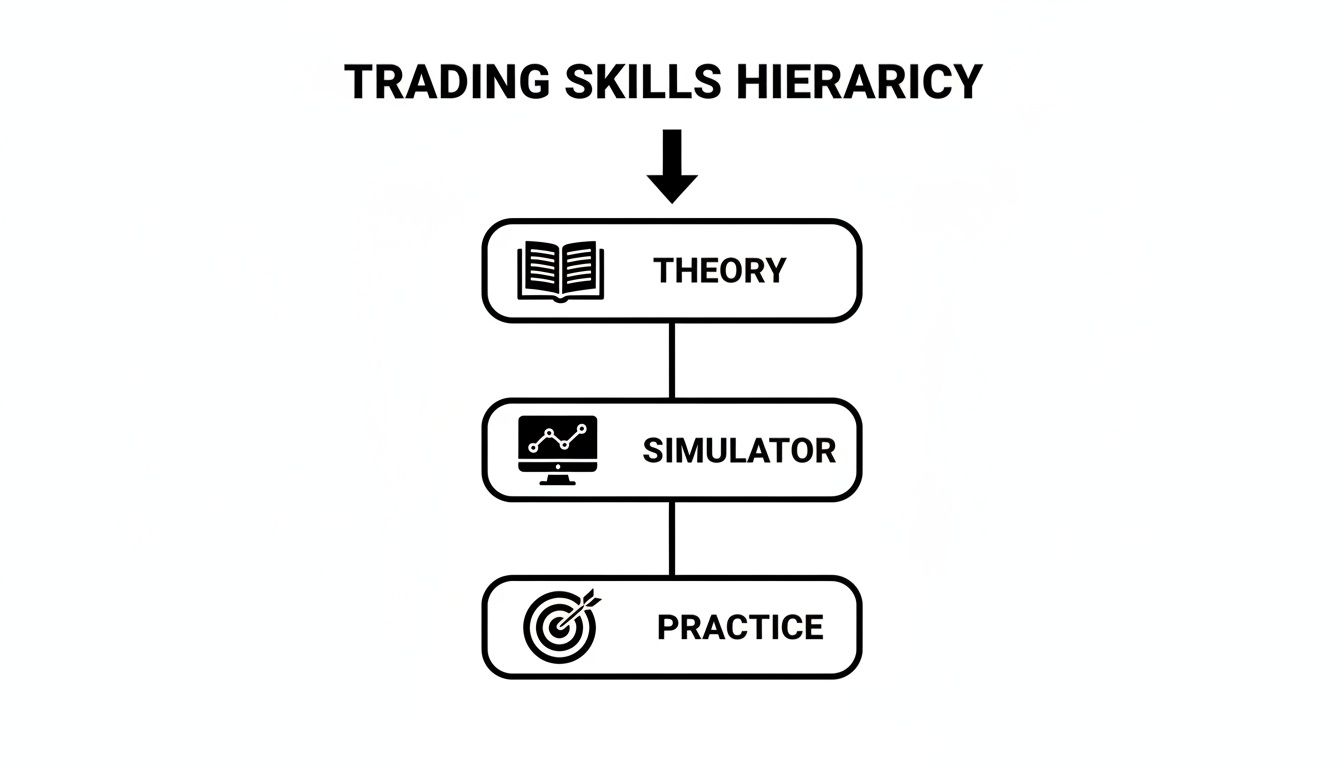
As you can see, a simulator is the hands-on workshop where you turn what you’ve learned into skills you can actually use.
What to Look For in a High-Fidelity Simulator
A powerful training tool has a few non-negotiable features. Without them, you’re not really preparing for the live market — you’re just playing a game. Think of these as your must-have checklist when you’re evaluating any simulator.
Here’s what you absolutely need:
- Real-Time Data Feeds: The simulator has to be plugged into live, streaming data straight from the market. Any delays or pre-packaged data means you aren’t learning to react to real price action and news events as they happen.
- Variable Spreads: In a real trading environment, the spread (the gap between the bid and ask price) is always in flux. It widens during volatile news events and shrinks when things are calm. A simulator with a fixed, narrow spread gives a false sense of profitability and makes entries look way too easy.
- Accurate Commission Models: Trading costs money. Your simulator must let you input your broker’s commission structure. Forgetting to account for these costs is a classic rookie mistake that can flip a “profitable” strategy into a losing one overnight.
The single most important element is realism. Your practice environment has to replicate the friction and unpredictability of live trading. Perfect conditions create bad habits; realistic challenges build resilience and skill.
This demand for realism is a big reason why the trading tech industry is booming. According to a report from Research Nester, the global online trading platform market size is anticipated to grow from USD 9.95 Billion in 2022 to around USD 18.33 Billion by 2033 (source). A huge part of that growth comes from integrating the advanced tools needed to power these high-fidelity simulators for traders.
Simulators vs. Basic Paper Trading Accounts
It’s also crucial to know the difference between a robust simulator and a standard “paper trading” account. While they both use virtual money, their capabilities are worlds apart. For a deeper look, check out our guide on what paper trading is and how it works.
A basic paper trading account, the kind your broker probably gives you for free, might only let you place simple market orders under perfect conditions. A dedicated forex trading simulator, on the other hand, is built for deliberate, focused practice.
Look for these more advanced features:
- Historical Data Playback: This is a game-changer. It lets you “rewind” the market to a specific date and time to practice trading through major past events, like an NFP release or a central bank announcement.
- Customizable Scenarios: A great simulator lets you set up specific market conditions. You can test how your strategy holds up in a strong trend versus how it performs in a choppy, sideways market.
- Advanced Order Types: You need access to the full suite of order types, not just “market” and “limit.” This includes stop-limits, trailing stops, and one-cancels-the-other (OCO) orders that professionals use to manage risk and entries.
By making sure these features are included, you’re ensuring your time in the simulator is a productive investment. You’ll build skills that are directly transferable to your live account, preparing you not just to place trades, but to navigate the complexities of the forex market with discipline and confidence.
A Step-By-Step Guide to Effective Practice
Just having a forex trading simulator isn’t going to cut it. Meaningful practice is all about the process — not just firing off random trades and crossing your fingers. We’ve all seen traders treat a simulator like a video game, but that just builds bad habits that will cost you real money down the line.
This guide gives you a solid framework to turn your simulation time from a mindless activity into a powerful, skill-building exercise. We’re going to move beyond just clicking buttons and get you into a professional training routine that actually prepares you for the live markets. The whole point is to build the discipline and analytical mindset of a pro.

Step 1: Set Up a Realistic Trading Environment
First things first: treat your simulator exactly like a live account. This means setting up your trading environment to mirror the conditions you’ll face when real capital is on the line. Getting reckless with fake money just builds dangerous “demo-account heroism.”
Start by setting your initial capital to a realistic amount. If you plan to start your live account with $2,000, then your simulator balance should be $2,000. Practicing with an imaginary million dollars teaches you nothing about the psychological pressure of risking a real chunk of a smaller account.
Next, lock in your risk parameters. If your live plan is to risk no more than 1% per trade, then you need to enforce that rule without exception in the simulator. For a $2,000 account, that means your max loss on any single trade is just $20. This immediately forces you to get serious about position sizing and stop-loss placement.
Step 2: Define Your Trading Plan
Trading without a plan isn’t trading — it’s gambling. Before you place a single simulated trade, you need a simple, clear set of rules that dictates your every move. A plan is what pulls emotion out of the equation and replaces it with a consistent, repeatable process.
Your initial plan doesn’t need to be some 50-page thesis. It just needs to clearly outline three core components:
- Entry Criteria: What specific technical or fundamental conditions must be met for you to enter a trade? An example might be: “I will go long on EUR/USD only when the 50-period moving average crosses above the 200-period moving average on the 1-hour chart, and the RSI is below 70.”
- Exit Criteria (Profit): How will you take your profits? This could be a fixed risk-to-reward ratio, like aiming for twice your risk (a 2:1 ratio), or maybe exiting when the price hits a key resistance level.
- Exit Criteria (Loss): Where is your stop-loss going? This has to be a predefined level based on your analysis, not an emotional decision you make while a trade is going against you. For instance: “My stop-loss will be placed 5 pips below the most recent swing low.”
The goal isn’t to create a “perfect” plan right away. The goal is to create a testable plan. You can only improve what you can measure, and having fixed rules is the only way to measure your performance objectively.
Step 3: Execute and Journal Every Trade
With your environment set and your plan in hand, it’s time to trade. This is where you forge real discipline. Your only job now is to follow your plan perfectly. No second-guessing your rules or deviating because of a “gut feeling.”
For every single trade you take, you absolutely must keep a detailed trading journal. This is non-negotiable. A journal turns your trading from a series of random events into a rich dataset about your own behavior and decision-making.
Your journal entry for each trade should include:
- The Setup: Why did you take the trade? Snap a screenshot of the chart at your entry.
- Your Rationale: Briefly explain how the setup met your trading plan’s rules.
- Emotional State: Were you feeling confident? Anxious? Impatient? Be brutally honest with yourself.
- The Outcome: Note the profit or loss, and add a screenshot of the chart when you exited.
- Performance Review: Did you follow your plan to the letter? If not, where did you slip up and why?
Step 4: Schedule Weekly Performance Reviews
At the end of each week, block out some time to review your journal and analyze your performance. This is where the real learning kicks in. You’re no longer a trader; you’re an analyst looking for patterns in your own process.
During your review, ask yourself some tough questions:
- What was my win rate this week? What was my average risk-to-reward ratio?
- Which of my rules seems to be working well? Which ones might need a tweak?
- Did I stick to my risk management rules on every single trade?
- Are any emotional patterns showing up? For example: “I tend to cut my winning trades short on Fridays.”
This disciplined cycle of Plan -> Execute -> Journal -> Review is what separates amateurs from professionals. It transforms your forex trading simulator into a personal lab for skill development, making sure every hour you spend practicing is a deliberate step toward becoming a more consistent and disciplined trader.
How to Analyze Your Simulated Trades for Real Improvement
Placing trades in a forex trading simulator is only the first step. The real magic happens after a trade closes. This is where you dig into the data, turning simple wins and losses into a clear roadmap for getting better. You’re not just looking at your profit and loss; you’re uncovering the patterns behind your decisions.
Think of it as becoming your own trading coach. Start by asking honest questions. Did you follow your plan, or did you let fear and greed take the wheel? Did you cut a winner short? Did you let a loser run too long? Answering these questions turns your trading history into a powerful feedback loop.
Moving Beyond Profit and Loss
A single winning or losing trade doesn’t mean much — it’s mostly noise. What you’re after is consistent performance, and that comes from analyzing the metrics that show how healthy your strategy really is. It’s like a doctor checking your vital signs; one reading isn’t the whole story, but the trends over time tell you everything.
Here are the key metrics you need to start tracking:
- Profit Factor: This is your total profit divided by your total loss. A number above 1.0 means you’re profitable, but you should really be aiming for 1.5 or higher. It’s a quick way to see if your wins are truly covering your losses and then some.
- Average Risk-to-Reward Ratio: This compares the size of your average winning trade to your average losing trade. If your average winner is $100 and your average loser is $50, your ratio is a solid 2:1. A ratio above 1:1 is absolutely essential for long-term survival in the markets.
- Maximum Drawdown: This measures the biggest drop your account has taken from a peak to a trough. It’s a gut check on how much risk your strategy is really exposed to. Knowing this number helps you stay sane and manage your emotions when you inevitably hit a losing streak.
The greatest gift a simulator gives you is data about your own habits, with zero financial risk. Every trade you place is a data point. Your job is to connect those dots to see the bigger picture of who you are as a trader.
A Framework for In-Depth Trade Analysis
With your core metrics in hand, it’s time to zoom in on individual trades. A structured review process helps you catch the subtle habits that are secretly holding you back. This is where a dedicated trading journal becomes your most important tool. Keeping detailed records creates a rich dataset you can learn from, a topic we cover more in our guide on why every trader needs a trading journal.
Here’s a practical checklist to run through after each trading session:
- Rule Adherence Check: Go through each trade and give it a simple “Yes” or “No.” Did I follow my entry rules? Did I honor my stop-loss? Did I take profits where my plan said to? This simple, black-and-white analysis will quickly show you where your discipline is breaking down.
- Emotional Audit: How were you feeling when you opened and closed the trade? Make a note of any anxiety, impatience, greed, or overconfidence. More often than not, our worst trades are driven by emotion, not a sound strategy.
- Market Condition Analysis: What was the market doing? Was it a strong trend, a choppy range, or a volatile breakout? Over time, you’ll start to see which conditions your strategy loves and which ones you should probably sit out.
This is the kind of detailed analysis that separates a truly realistic forex trading simulator from a simple game. According to the Bank for International Settlements’ 2022 Triennial Survey, foreign exchange market turnover reached $7.5 trillion per day (source). A good simulator has to model this complex world with reasonable accuracy to give you data that’s actually worth analyzing.
By systematically reviewing both the numbers and the feelings behind your trades, you build a complete picture of your performance. You’ll see your strengths and weaknesses with total clarity, allowing you to turn practice into real, measurable progress.
Common Pitfalls to Avoid in Simulated Trading
A forex trading simulator is an incredible tool for sharpening your skills, but if you’re not careful, it can quietly build some seriously destructive habits. Learning to navigate these psychological traps is just as important as learning your trading strategy itself.
The biggest and most common trap is “demo-account heroism.” This is where traders take massive, reckless risks just because the money isn’t real. You might slap on a huge position size or trade without a stop-loss, thinking, “Who cares? It’s just fake money.” This mindset is poison.
While you won’t lose any real capital, you’re throwing away your most valuable asset: the opportunity to practice discipline. Every reckless trade you make reinforces the idea that your rules are optional, a habit that will absolutely crush you in a live account.
Treating Practice Like a Game
Right alongside demo heroism is the danger of becoming emotionally numb to risk. When simulated losses don’t sting, it’s easy to stop taking your practice seriously. You might skip your trade review, forget to journal, or just place trades out of boredom.
You have to fight this by consciously attaching real meaning to your simulated results. Treat every virtual loss as a genuine lesson. Ask yourself what went wrong and how you could have managed the risk better.
The point of a simulator isn’t to rack up a high score. It’s to forge the mental and emotional toughness you need for live trading. If you don’t feel the sting of a simulated loss, you are not preparing for the psychological gut punch of a real one.
The Impatience Trap and Strategy Hopping
So many developing traders get derailed by impatience. They expect lightning-fast progress and get frustrated when it doesn’t happen. This frustration often leads to another huge mistake: strategy hopping. After just a few losing trades, they ditch their entire plan and jump to some new “holy grail” strategy they found online.
This cycle is a dead end. It prevents you from ever gathering enough data to know if a strategy actually has an edge. Real skill is built slowly and methodically. You have to give your plan enough runway to perform across different market conditions to see if it truly works.
A simple way to avoid this is to commit to testing one strategy for a specific number of trades — say, 50-100 trades — before you even think about making major changes. This builds confidence and the long-term mindset of a professional.
Ignoring Realistic Market Conditions
Finally, a massive pitfall is forgetting about real-world trading friction. Most basic simulators give you perfect, instant fills on every order, which is a fantasy. In the live markets, things like the bid-ask spread, execution delays, and slippage (where the price you get is different from the price you clicked) can make a huge difference.
It’s critical to use a simulator that models these real-world factors. To get a better handle on this, you can learn more about what slippage is in trading and how it can eat into your profits.
By keeping these common pitfalls in mind, you can make sure the habits you’re building in your forex trading simulator are the same ones that will protect you when your real money is on the line. Treat your practice with respect, focus on building discipline, and remember that you’re training for the real thing.
Making the Transition from Simulator to Live Account
Moving from a forex trading simulator to a live account is the final hurdle — and for many, the scariest one. The trick is to see this not as a huge jump but as a slow, deliberate walk. Going all-in from day one is a surefire way to make emotional mistakes and burn through your capital.
Instead, the real goal is to carefully manage both your risk and your emotions. You need to make sure the discipline you hammered out in the simulator holds up in the live market. All that practice is about to pay off, but only if you approach this next step with a conservative and patient mindset.
Knowing When You Are Ready
Before you risk even one dollar of real money, you need cold, hard proof that your strategy is solid and you have the discipline to follow it. A gut feeling isn’t enough. You need to trust the data you’ve collected from your simulated trades.
Set some clear, non-negotiable rules for yourself on when you’ll go live. A good starting point for most traders looks something like this:
- Consistent Profitability: You need to show a positive net P/L for at least three consecutive months in the simulator. A single good month could just be luck; three shows you’ve got a real edge.
- Strict Rule Adherence: Your trade journal needs to prove you followed your trading plan on at least 90% of your trades. This is the ultimate test of your discipline.
- Positive Profit Factor: Maintain a profit factor of 1.5 or higher. This shows that your winning trades are substantially bigger than your losing ones, which is critical for long-term success.
Going live isn’t a prize for finishing your training; it’s just the next phase of your education. The objective isn’t to get rich overnight but to prove you can handle risk and emotion when real money adds real pressure.
Starting Small to Manage Psychology
Once you’ve hit your benchmarks, don’t jump straight into a standard trading account. The biggest shock when you start live trading isn’t technical — it’s psychological. The emotional punch of even a tiny loss feels completely different when the money is yours.
To ease into it, start with a micro-account. Fund it with an amount you are truly okay with losing — maybe $100 to $250. This lets you feel the genuine pressure of live trading without risking a catastrophic loss.
Think of it as a test of your mental game. Can you stick to your stop-loss when you see real money disappearing from your account? Can you resist chasing a trade because of FOMO (fear of missing out)? A micro-account is the perfect, low-stakes environment to answer these questions and lock in the habits that build a lasting career.
A Few Common Questions About Trading Simulators
Jumping into a forex trading simulator for the first time usually sparks a few questions. Let’s clear them up so you can start practicing with confidence and know exactly what to expect.
How Long Should I Use a Forex Simulator Before Going Live?
There’s no magic number, but a solid benchmark is to aim for at least 3-6 consecutive months of consistent profitability.
The key word here is consistency. It’s proof that you can follow your trading plan through wins and losses, manage your risk properly, and keep your emotions from driving your decisions. Too many traders get impatient and rush this part, which is easily one of the most common — and expensive — mistakes you can make.
Are Free Forex Trading Simulators Good Enough?
Absolutely. Many free simulators from reputable brokers are more than enough to build a solid foundation. The good ones give you all the core features you need, like real-time market data and a full suite of standard order types.
The one non-negotiable feature? Make sure the simulator uses realistic, variable spreads, not fixed ones. Fixed spreads (where the gap between the buy and sell price never changes) don’t exist in the live market and will give you a false sense of security. While some paid platforms might offer fancier analytics or backtesting tools, a quality free simulator is perfect for building the habits that actually matter.
Can You Lose Real Money on a Forex Trading Simulator?
Nope. You’re trading with virtual money, so there is zero financial risk. You can’t lose a single cent of your own cash.
But — and this is a big but — you have to treat your virtual losses like they’re real. If you get into the habit of shrugging off simulated losses because “it’s not real money,” you’re building a disastrous approach to risk management. That mindset will come back to haunt you with very real financial consequences when you finally switch to a live account.
Ready to turn your simulated trades into actionable insights? TradeReview helps you analyze your performance, identify patterns, and build the discipline needed for the live markets. Start journaling your trades for free and see the difference data-driven decisions can make.
Get Started with TradeReview for Free