A forex trading simulation is your personal trading sandbox. It’s a risk-free environment where you can buy and sell currencies with real market data but without putting a single dollar of your own money on the line.
Think of it as your most powerful defense against the expensive mistakes that trip up almost every new trader. This practice — often called paper trading — is an absolute game-changer for building skills and confidence.
Why Simulation Is Your Most Underrated Edge
Jumping into the live forex market unprepared is like trying to fly a plane after just skimming the manual. It rarely ends well. We’ve all felt the pull of quick profits — it’s a powerful motivator — but the market is a complex beast that is indifferent to our hopes and dreams.
A forex trading simulation isn’t just a “practice mode.” It’s your personal laboratory — a place to forge your skills, test your theories, and build discipline without paying the high tuition of inexperience.
Too many traders, eager for returns, dive headfirst into live trading and learn a swift, painful lesson. It’s a common struggle; a strategy that looked brilliant on paper crumbles under the pressure of real-time price action and emotional heat. Simulation is the bridge that closes this critical gap.
The Real Cost of Skipping Practice
Here’s a hard truth: the biggest challenge for most traders isn’t finding a strategy. It’s executing that strategy consistently, especially when things get tough.
Without the muscle memory you build through repetition, it’s all too easy to second-guess your plan. For example, you might see a 50-pip profit and cut the winning trade short out of fear of giving it back, even though your plan was to aim for 100 pips. Or, you might cling to a loser, hoping it’ll magically turn around. These aren’t technical failures; they’re failures of discipline.
Simulation throws you into these psychological battles in a controlled setting. It gives you the space to:
- Make mistakes without financial fallout. Every single trader makes bad calls. It’s infinitely better to make them with virtual money and learn the lesson than to watch your hard-earned capital evaporate.
- Stress-test your strategy. How does your plan hold up during a surprise news event? What about in a slow, sideways market? A simulator lets you find the breaking points before they cost you real money.
- Build unshakable discipline. Following your rules on every single trade — especially when it’s hard — is what separates the pros from the amateurs. Simulation is where you train this essential skill.
A simulation is where you turn theoretical knowledge into practical wisdom. It’s the process of deliberately practicing your system until execution becomes second nature, free from the emotional noise of fear and greed.
Ultimately, using a forex trading simulation reframes your entire approach. You stop chasing quick profits and start focusing on what actually matters: a consistent, repeatable process. This disciplined, long-term mindset is what separates traders who last from those who quickly burn out.
Building Your Professional Simulation Lab
Think of your trading simulation not just as practice but as your own professional laboratory. A standard demo account is a decent first step, but it often glosses over the harsh realities of the live market, like slippage and true spreads. To get real, actionable insights, you need a controlled environment built for serious testing.
Your first decision is picking the right tool for the job. Not all simulators are built the same, and what you choose depends on what you’re trying to accomplish.
- Demo Accounts: These are your entry point, offered by most brokers. They’re fantastic for getting a feel for the trading platform’s interface and how to place orders. Just remember, they often run on idealized conditions you won’t find when real money is on the line.
- Manual Simulators: These tools let you “replay” the market, moving through historical price action bar by bar. You can place trades and manage them just like you would in real-time, which is perfect for drilling the mechanics of your strategy without the wait.
- Backtesting Software: This is where serious strategy development happens. This software lets you unleash your trading rules on years of historical data in an instant, giving you a powerful statistical breakdown of how your strategy would have performed. You can find some incredibly powerful back-test software out there to fit your needs.
This simple flow — from theory to simulation to live trading — is the cornerstone of a disciplined approach. It’s all about validating your ideas before you put a single dollar at risk.
This methodical progression helps keep you grounded, prioritizing practice over impulsive, costly decisions.
Sourcing High-Quality Data
Here’s a hard truth: your test results are only as good as the data you use. Garbage in, garbage out. Using low-quality or incomplete historical data can give you a dangerously false sense of confidence in a strategy that’s doomed to fail.
This isn’t a new problem. A decade ago, traders using platforms like MetaTrader 4 were constantly battling data gaps in their backtests. These missing chunks of price data could give a misleadingly optimistic view of a strategy’s performance. This is exactly why sourcing clean, tick-by-tick data is non-negotiable for any serious simulation.
Mirroring Real-World Trading Conditions
Got your software and data? Great. Now for the most crucial part: making your simulation environment as realistic as possible. This is where so many traders fall short, practicing with settings that have no bearing on their future live account.
Configure your simulator with the same starting capital, leverage, commissions, and spreads you plan to use in your live account. The goal is to eliminate as many variables as possible between your testing and live execution.
Set your account balance to what you’ll actually start with — not $100,000 if you’re planning to fund with $1,000. Match the leverage to what your broker offers. Manually plug in the typical spread and commission for the currency pairs you trade. For example, if your broker typically has a 1.2 pip spread on EUR/USD during the London session, use that in your settings.
This level of detail ensures the performance metrics you generate are a true reflection of your strategy’s potential. It prepares you for the realities of the live market, not a fantasy version of it.
Designing Trading Scenarios That Reflect Reality
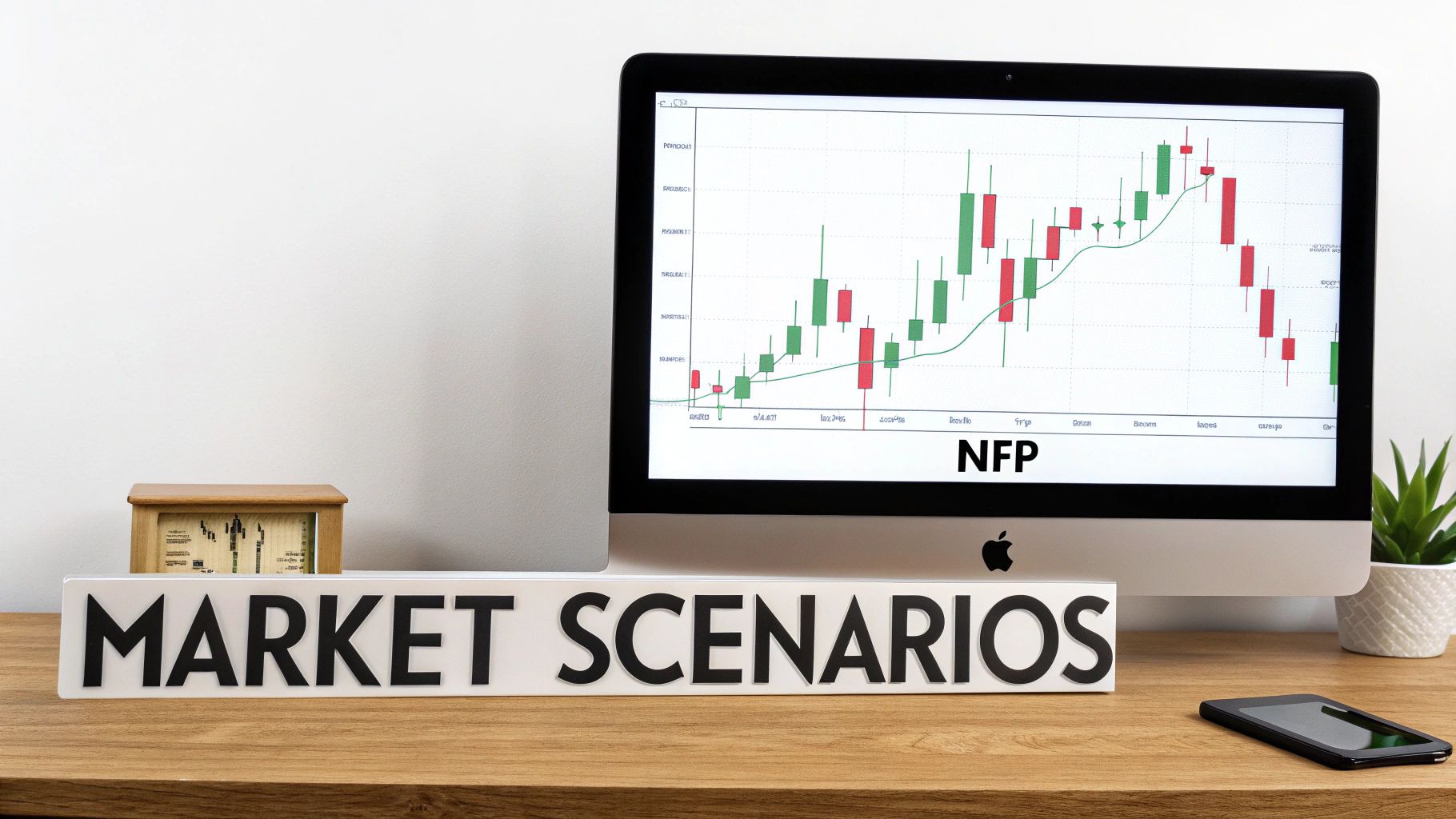
A forex trading simulation is only as good as the scenarios you throw at it. Just clicking “buy” and “sell” randomly won’t build any real skill. To get true value, you need to design purposeful experiments that mimic the messy, chaotic, and sometimes unpredictable conditions of the live market.
The idea here is to shift from generic practice to methodical, almost scientific testing. We aren’t just replaying history; we’re putting it under a microscope to see how our strategy holds up under very specific kinds of pressure.
Simulating Different Market Conditions
The forex market isn’t one big, monolithic thing. It’s a collection of totally different environments, each with its own rhythm and personality. A strategy that crushes it during the volatile London open might get chewed up and spit out during the sleepy, range-bound Asian session. Your simulations have to account for that.
Try creating targeted tests for scenarios like these:
- High-Volatility News Events: Find historical data for a Non-Farm Payroll (NFP) release and run your strategy right through it. Can your system handle the insane spikes, widening spreads, and potential slippage that always come with major news? If you’re not sure what that means, our guide on what slippage is in trading breaks it all down.
- Low-Volume Ranging Markets: Test your strategy during the Tokyo session, when a pair like EUR/USD often just drifts sideways. This is a great way to find out if your setup generates false signals or gets you “chopped up” when there’s no real trend to follow.
- Strong Trending Environments: Go back and find a period where a currency pair like GBP/JPY made a clean, sustained move over several days. How does your strategy do at riding a winner and managing a trailing stop? Does it get you out too early?
High-quality historical data is the fuel for all of this, allowing you to simulate different conditions with accuracy. You can find more insights on the importance of Forex historical data on forextester.com.
Isolating and Testing Strategy Variables
If you want clear, actionable feedback, you have to test one variable at a time. It’s that simple. If you change your entry trigger, your stop-loss placement, and your take-profit rules all at once, you’ll have absolutely no idea which change actually made a difference.
Think of yourself as a scientist in a lab. Form a hypothesis (e.g., “Using a wider stop-loss will improve my overall win rate”), test it across a big sample of trades, and then analyze the data to see if you were right.
First, establish a baseline. Run your core strategy as-is to see how it performs. Then, you can start tweaking it with focused experiments:
- Entry Triggers: Is your entry based on a moving average crossover? Try testing the 9/21 EMA crossover versus the 20/50 EMA crossover on the same dataset to see which one improves your timing.
- Stop-Loss Placement: Run one simulation on AUD/USD with a 20-pip stop and a completely separate one with a 40-pip stop. The results will tell you a ton about your strategy’s tolerance for drawdown.
- Profit-Taking Rules: Compare a fixed 2:1 risk-to-reward target against a dynamic trailing stop. Over 100 trades, which method consistently squeezed more profit out of the market?
This methodical approach is what turns your forex simulation from a simple practice tool into a powerful engine for building a better strategy. It’s how you develop a robust system that’s backed by hard data, not just wishful thinking.
Analyzing Performance Metrics That Actually Matter
After you’ve run dozens, maybe even hundreds, of trades in your forex trading simulation, it’s so tempting to just glance at the final profit and loss (P&L). But that single number can be incredibly misleading.
A positive P&L — and even a high win rate — can easily hide a strategy that’s a ticking time bomb. To really know if you’ve got something robust, you have to dig into the metrics that reveal the how and why behind your results.
Winning 70% of your trades feels amazing, but it’s a vanity metric if your few losses are so catastrophic they wipe out every one of those wins and then some. This is a classic trap. It’s easy to get hooked on the dopamine hit of being right while being completely blind to broken risk management.
The real goal here is to build a complete, honest picture of your strategy’s behavior. It’s time to move past simple wins and losses and focus on what truly matters: consistency, risk, and long-term survivability.
Looking Beyond Profit and Loss
Think of these advanced metrics as a diagnostic check-up for your trading system. They’re designed to expose the hidden weaknesses that a simple P&L statement will always miss. A professional trader treats this analysis with the same focus they give to executing a trade.
Here are the essential metrics you need to track in your simulation.
- Maximum Drawdown: This is the big one. It measures the largest peak-to-trough drop your account equity took. It’s a raw measure of pain. A 50% drawdown means at one point, you’d lost half your capital. Could you psychologically stomach that with real money on the line? Be honest with yourself.
- Profit Factor: This is your total gross profit divided by your total gross loss. A profit factor of 2.0 means you made twice as much money as you lost. Anything under 1.0 is a losing strategy, period. Many traders look for at least 1.5 to feel confident.
- Average Risk-to-Reward Ratio: This compares the size of your average winner to your average loser. A 2:1 ratio means your average winning trade is double the size of your average losing trade. This tells you if your winners are powerful enough to carry the inevitable losses.
What The Numbers Really Tell You
To help you understand the power of these metrics, here’s a breakdown of what they reveal and why they are so critical for any trader serious about success.
| Metric | What It Measures | Why It Matters for a Trader |
|---|---|---|
| Profit Factor | The ratio of gross profits to gross losses. | It’s a quick indicator of overall profitability. A number well above 1 shows your wins are outweighing your losses. |
| Maximum Drawdown | The largest percentage drop from an account peak to a subsequent low. | This is your gut-check metric. It reveals the maximum pain your strategy will inflict and helps you decide if you can emotionally survive the downturns. |
| Win Rate | The percentage of trades that were profitable. | While important, it’s meaningless without context. A high win rate with poor risk management is a recipe for disaster. |
| Average Risk/Reward | The ratio of your average profit on winning trades to your average loss on losing trades. | This shows if your strategy’s edge is strong enough. You want winners to be significantly larger than losers to stay profitable long-term. |
| Sharpe Ratio | A measure of risk-adjusted return. In simple terms, it shows how much return you get for the amount of risk taken. | A higher Sharpe ratio indicates a better-performing strategy relative to its volatility. It’s a favorite of institutional traders for a reason. |
Ultimately, these numbers force you to confront the reality of your strategy. They strip away the emotion and ego, leaving you with a clear, data-driven picture of what you’re working with.
Let’s put this into a practical scenario. Imagine two traders testing their strategies over 100 simulated trades.
Strategy A:
- Win Rate: 80%
- Average Win: $50
- Average Loss: -$250
- Max Drawdown: 45%
Strategy B:
- Win Rate: 45%
- Average Win: $200
- Average Loss: -$80
- Max Drawdown: 15%
On the surface, Strategy A’s 80% win rate looks unbeatable. But dig deeper. The average loss is five times bigger than the average win. That terrifying 45% drawdown means the strategy nearly blew up the account. It’s a classic example of picking up pennies in front of a steamroller.
Strategy B, while winning less than half the time, is vastly superior. Its winners are much larger than its losers, and the small 15% drawdown makes it a much smoother, psychologically manageable ride. This is the kind of system you can actually stick with when you hit an inevitable losing streak.
This level of analysis is what separates the pros from the amateurs. It forces you to confront the true risk profile of your system, ensuring you’re building something that can not only generate profit but also withstand the brutal reality of the markets.
Turning Simulation Data Into Trading Wisdom
Running a forex trading simulation is really only half the job. The raw data — all your wins, losses, and performance stats — is just noise until you give it some context. To turn that data into actual trading wisdom, you need a disciplined review process. And that’s where a detailed trading journal becomes your most important tool.
A good journal is so much more than a simple P&L log. It’s the story of your decision-making. The real goal is to get past what happened and dig into why it happened. This kind of disciplined reflection is what builds a powerful feedback loop, turning all that practice into real progress.
Without this step, it’s way too easy to repeat the same mistakes over and over, blaming the market instead of your own process. It’s a common trap, but one a meticulous journal will help you sidestep.
Capturing What Truly Matters in Your Journal
To squeeze every bit of value out of your simulation, your journal entries need to be thorough. The numbers alone don’t tell the full story; you have to capture the qualitative data that shines a light on your behavioral patterns.
For every single simulated trade, your log should include:
- The ‘Why’ Behind the Trade: Don’t just jot down the setup (e.g., “head and shoulders pattern”). Explain why you felt that specific setup was a high-probability move at that exact moment. What was the broader market context?
- Your Emotional State: Were you confident? Impatient? Maybe a little fearful? Be brutally honest here. Your emotions are often the real reason you deviate from a solid plan.
- Deviations from Your Plan: Did you follow your rules to the letter? If not, where did you go off-script? Maybe you moved your stop-loss or cashed out a winning trade too early because of anxiety.
- A Post-Trade Grade: Grade your execution, not the outcome. A perfectly executed trade that ends up as a loss still deserves an ‘A’. An impulsive, rule-breaking win? That gets an ‘F’.
This process forces you to become an objective observer of your own trading behavior. It shifts the focus from chasing profits to perfecting your process—which is the only sustainable path to long-term consistency.
Analyzing Your Journal to Find Your Edge
Once you’ve logged a solid number of trades — let’s say 50 to 100 — it’s time to start the analysis. This is where you connect the dots and start seeing the patterns that are either helping or hurting your performance.
Look for the recurring themes. Are your biggest losses consistently happening on Friday afternoons? Do you tend to break your rules right after a string of wins (a classic sign of overconfidence)? These insights are pure gold.
For example, after reviewing your journal, you might discover that your strategy performs poorly on USD/JPY during the Asian session but does exceptionally well on GBP/AUD during the London open. This isn’t just a guess; it’s a data-driven insight you can use to refine your approach.
This feedback loop — test, analyze, iterate, and re-test — is the engine of improvement. It’s a slow, deliberate process, but it’s what separates speculators from traders who build lasting careers.
Frequently Asked Questions About Forex Simulation
Even with a solid game plan, questions always pop up when you first dive into a forex trading simulation. Let’s run through some of the most common ones to clear up any confusion and get you moving forward.
Think of this as your final briefing before hitting the simulation floor. These answers are here to reinforce the disciplined mindset that truly separates professional traders from the rest.
How Long Should I Use A Forex Trading Simulator Before Going Live?
There’s no magic number here. The goal isn’t to hit a specific date on the calendar; it’s all about achieving consistency. A solid benchmark to aim for is executing at least 100–200 trades with a single, unwavering strategy across different market conditions.
You’ll know you’re getting close to live trading when you can:
- Follow your trading plan to the letter without emotional slip-ups.
- See a stable, upward-trending equity curve across that large set of trades.
- Hit key performance metrics, like a profit factor that stays consistently above 1.5.
If you’re still bending your own rules — chasing trades, moving your stop-loss out of fear, or jumping into impulsive setups — you just need more time in the simulator. It’s the perfect training ground to build the discipline that will protect your real capital down the road.
Can A Simulator Perfectly Replicate Live Trading?
Honestly, no simulator is 100% perfect, but the good ones get incredibly close, especially with high-quality tick data. The biggest gap isn’t technical, though. It’s psychological.
In a simulation, you don’t feel that gut-wrenching fear when a trade goes south or the rush of greed when it takes off. When your own hard-earned money is on the line, those emotions are powerful and can make you ditch a perfectly good strategy in a heartbeat.
The point of a simulation isn’t to perfectly mimic every aspect of the live market. It’s to build a robust, data-backed strategy and—more importantly—the discipline to stick with it. That discipline is your best defense against the emotional pressures of real trading.
Things like slippage are also tough to model perfectly. A big news event can cause your live order to fill at a much worse price than what the simulator showed. Just be ready for these small differences.
What Are The Biggest Mistakes To Avoid In Simulation?
By far, the most destructive mistake is treating your simulation like a video game. This is what happens when you trade with an unrealistic account size, take huge risks you’d never dream of with real cash, and don’t bother keeping a detailed trading journal.
Another classic error is “strategy hopping.” So many traders will ditch a system after just a handful of losses, which means they never gather enough data to know if it actually has an edge. You need a decent sample size to make that call.
Finally, watch out for poor-quality data. A strategy might look like a gold mine on incomplete data but will completely fall apart in a live environment. You have to approach your forex trading simulation with the exact same seriousness and focus you would bring to a live account.
Ready to turn simulation data into real-world wisdom? TradeReview gives you the analytics and journaling tools you need to track your performance, pinpoint your mistakes, and build a professional trading process. Stop guessing and start analyzing.
Create your free trading journal at https://tradereview.app today!