When you close a trade in the red, that number staring back at you from the screen feels final. But it almost never tells the whole story. We’ve all been there — feeling the sting of a loss and wanting to just move on. But taking a moment to understand the real numbers is a critical step toward building discipline.
Figuring out your actual loss of profit isn’t as simple as subtracting your exit price from your entry. To get to the real number — your true net loss — you have to factor in all the little costs that chip away at your capital. Getting this right is the first step toward building the discipline every successful trader needs for the long term.
The True Cost of a Losing Trade

The simple formula of (Entry Price - Exit Price) x Position Size gives you the surface-level loss, but the real damage to your account is almost always a bit worse. This isn’t about making you feel bad; it’s about giving you the clarity needed to improve.
This gap between the obvious loss and the actual hit to your bottom line is where many traders slowly bleed capital. It’s caused by hidden costs that are easy to brush off on any single trade but can be devastating when they compound over time. To truly understand your performance, you have to confront these expenses head-on.
Beyond the Obvious Numbers
Think of it this way: your trading platform might show a -$100 loss on a trade. But after commissions and other fees, the actual debit from your account could easily be closer to -$110. It seems small. But over hundreds or thousands of trades, those “small” costs are often the difference between a profitable strategy and a failing one.
To get the full picture, you need to account for a few key factors that often go ignored.
To help you keep track of all the moving parts, here’s a quick checklist of everything that shapes your real profit and loss on a trade.
Beyond the Price: Your Complete P&L Checklist
| Component | What It Is | How It Affects Your Bottom Line |
|---|---|---|
| Brokerage Commissions | The fee paid to your broker for executing the trade, both on entry and exit. | A direct cost that reduces profits and increases losses. Always double it (for open and close). |
| Slippage | The difference between your expected execution price and the actual fill price. | Can unexpectedly increase your entry cost or decrease your exit price, worsening a loss. |
| Financing Costs | Fees for holding leveraged positions overnight (e.g., in forex or with futures). | An ongoing expense that erodes your capital the longer you hold a position. |
| Platform/Data Fees | Monthly or annual charges for using a specific trading platform or accessing real-time data. | Not a per-trade cost, but it’s an overhead that must be overcome by your trading profits. |
| Taxes | Capital gains taxes owed on your net trading profits at the end of the year. | A significant cut of your final profits that must be planned for. |
Ignoring these elements gives you a dangerously distorted view of your performance. It’s an easy trap to fall into because looking at the smaller, pre-fee loss feels better. But long-term success in trading is built on a foundation of brutal honesty and meticulous record-keeping. Slippage, for example, can be a silent account killer if you’re not paying attention — you can learn more about what is slippage in trading and how to manage it.
Facing the true, all-in cost of a losing trade isn’t about punishing yourself. It’s about empowerment. When you know your real numbers, you can make smarter decisions, refine your strategy, and protect your capital with precision.
Ultimately, mastering the calculation of your net P&L is a non-negotiable discipline. It forces you to be accountable for every single dollar and gives you the clear, hard data needed to find the weak spots in your trading plan. When you embrace this detailed approach, you stop just reacting to losses and start actively managing them.
Realized vs. Unrealized Loss: Why It Matters
Before you can accurately calculate a loss, you need to grasp a concept that trips up a surprising number of traders: the difference between a paper loss and a real one. It’s a distinction that hits both your account balance and your trading mindset.
An unrealized loss is the floating red number you see on a position that’s still open. Think of it as hypothetical — a temporary figure on your screen that bobs and weaves with every market tick. It isn’t real money gone from your account just yet, but the emotional weight it carries is very, very real.
A realized loss, on the other hand, is what hits your account the second you close the trade. This is the final score. The paper loss becomes a permanent, irreversible debit from your trading capital.
The Psychological Battle of an Open Loss
Let’s run through a quick, all-too-common scenario. Imagine you buy 100 shares of a stock at $50 per share, putting $5,000 on the line. Shortly after, the market sours, and the stock drops to $45.
At this point, your position is worth $4,500. You’re now staring at a $500 unrealized loss.
This is the moment of truth. That -$500 blinking on your screen can be incredibly stressful and kicks off a nasty psychological battle. We’ve all felt that knot in our stomach. Your mind starts spinning with questions:
- Will it bounce back if I just hold on a little longer?
- Should I have listened to that other analysis I blew off?
- What if this is just the beginning of a much bigger slide?
This is where bad, emotional decisions are born. The urge to “wait and see” can be overwhelming, usually fueled by the hope of avoiding a realized loss entirely. But hope isn’t a trading strategy. Without a solid plan, an unrealized loss can quickly spiral into a much larger, more painful realized one.
The goal isn’t to avoid losses — they’re an inevitable part of the game. The goal is to control them. A small, planned, realized loss is infinitely better than an uncontrolled, catastrophic one.
From Unrealized Hope to Realized Discipline
Handling the pressure of a drawdown is what separates disciplined traders from the rest. The trick is to have your exit plan locked in before you even click the buy button. You need to know the exact point where that “paper” loss becomes too big, triggering your rule to get out and accept a manageable, realized loss.
This proactive approach flips the script from reacting emotionally to executing a logical plan. When you decide your exit point in advance, you protect your capital and, just as importantly, your mental clarity for the next opportunity. It’s a discipline that is absolutely fundamental to long-term survival in the markets.
Uncovering the Hidden Costs of Trading
That big red number your platform flashes after a losing trade? That’s just the tip of the iceberg. If you really want to understand your performance and protect your capital, you have to dig deeper and account for the small, sneaky expenses that can bleed an account dry. These are the hidden costs of trading, and ignoring them gives you a false — and dangerous — sense of security.
So many traders, especially when they’re starting out, just look at the difference between their entry and exit price. But the reality is, a handful of other factors are constantly chipping away at your balance. Getting serious about tracking these costs isn’t just a good habit; it’s a non-negotiable discipline for anyone who wants to last in this game.
The journey from a “paper loss” to a real one is a critical moment. Think of it like this:
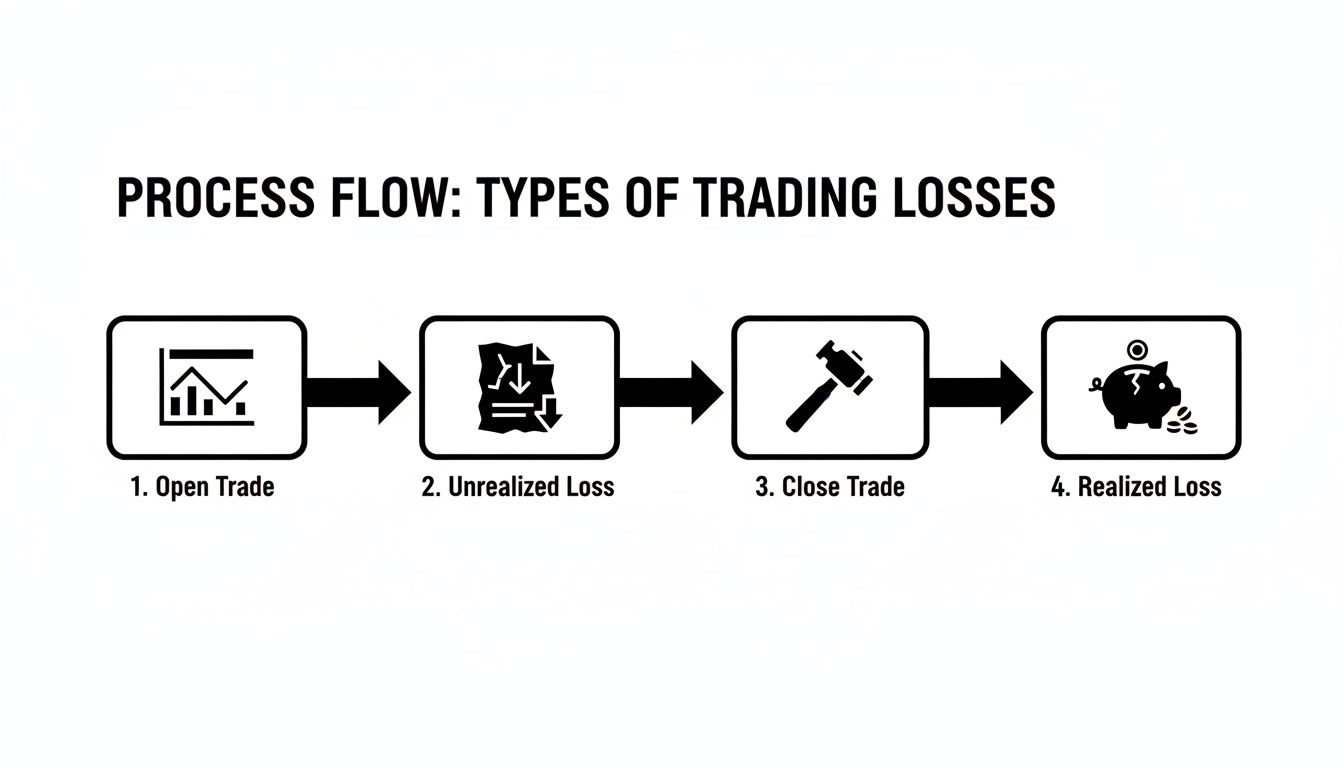
When you close that trade, the loss becomes permanent. But to know the true damage to your account, you have to factor in the costs most people forget.
Brokerage Commissions
Commissions are the most obvious hidden cost, but they still sting. Whether your broker charges a flat fee per trade — say, $5 to get in and $5 to get out — or a per-share rate, that expense is tacked directly onto your loss.
Practical Example: Imagine a trade shows a -$50 loss based on price movement alone. If your round-trip commission is $10, your actual loss is now -$60. That’s a 20% bigger hit than you thought, and those small amounts compound into a massive drag on your account over hundreds of trades.
Slippage: The Silent Killer
Slippage is that frustrating gap between the price you wanted and the price you got. It’s a classic problem in fast-moving, volatile markets or when you’re trying to move a large order.
Practical Example: Let’s say you set a stop-loss on a stock at $99.50. But the market tanks so fast that your order doesn’t get filled until the price hits $99.30. That extra $0.20 per share is slippage, and it goes straight to your bottom line, widening your loss. It’s subtle, but it’s a powerful force that can quietly destroy your edge.
Financing and Leverage Costs
This is a big one for anyone using leverage or holding positions overnight, especially in forex or futures. These are often called swap or rollover fees, but they’re really just interest payments on the money you’ve borrowed from your broker.
They might seem tiny on a day-to-day basis, but for swing traders holding a position for weeks or even months, these financing costs can pile up and turn a potentially profitable trade into a loser.
It’s a hard truth of trading: The market doesn’t care about your breakeven price. Your only job is to be brutally honest with yourself about your all-in costs. When you track every fee, you gain true clarity on your performance.
This idea of calculating the real financial impact isn’t just a trading concept. In business litigation, for example, courts sometimes use methods to calculate lost profits that rely on historical data and projections. As one legal resource notes, these calculations often involve comparing a company’s performance before a damaging event to its performance after, giving a clearer measure of the loss. You can see how courts calculate business profit loss on bpbcpa.com for more detail on these business-focused methods.
Ultimately, building the discipline to account for every single cost transforms you from a hobbyist into a professional who treats trading like a business. It’s the only way to get the clean data you need to refine your strategy, manage risk properly, and actually build a sustainable career.
Calculating Losses Across Different Assets
Knowing the theory behind loss calculation is one thing. Applying it in the heat of the moment — when the market is moving against you — is where real trading discipline is forged.
So, let’s move past the concepts and get into some concrete, practical examples. We’ll break down how to calculate a loss of profit across different assets, because each one comes with its own quirks.
The core principles don’t change, but the specific costs you need to bake into your math will. It’s tempting to just glance at your platform’s P&L and call it a day, but the real work — and the real edge — comes from dissecting each trade yourself. This process gives you a brutally honest look at your performance.
A Standard Stock Trade Example
Let’s walk through a classic scenario. Imagine you buy 100 shares of Company XYZ at $50.00 per share, making your initial investment $5,000. The trade doesn’t go your way, so you decide to cut your losses and sell all 100 shares when the price drops to $48.50.
Here’s how the numbers really stack up:
- Gross Loss on Price: ($50.00 – $48.50) x 100 shares = $150.00
- Commissions: Let’s say your broker charges a flat $5 fee to open the trade and another $5 to close it. That’s $10 in total commissions.
Your true net realized loss isn’t just the $150 from the price drop. It’s the gross loss plus all those little costs.
$150 (Gross Loss) + $10 (Commissions) = $160 Net Realized Loss
That extra $10 might seem small, but it just added over 6% to your total loss. Over a year of active trading, ignoring these fees can easily be the difference between a profitable strategy and a losing one.
An Options Trade Example
Options bring a different dynamic to the table. With a simple long call or put, your maximum loss is capped at the premium you paid to enter the trade.
Let’s say you buy one call option contract for ABC stock, paying a premium of $2.50 per share. Since one contract controls 100 shares, your total cost is $250 ($2.50 x 100). We’ll add a small $1 commission on top of that.
Your total upfront cost is $251.
If the stock price tumbles and the option expires worthless, the calculation is painfully simple: you’ve lost the entire amount you paid. Your net realized loss is $251.
A Leveraged Forex Trade Example
Now for a forex trade, where things can get a bit more complex thanks to leverage, spreads, and financing fees.
Suppose you buy 1 mini lot (10,000 units) of EUR/USD at 1.0750. You hold the position for two days, but it moves against you, and you finally close it out at 1.0710.
- Pip Difference: 1.0750 – 1.0710 = 40 pips.
- Gross Loss: On a mini lot, each pip is worth about $1. So, your 40-pip loss translates to $40.
- Bid-Ask Spread: The spread is a built-in cost. If the spread was 1 pip when you entered, that’s an instant $1 cost right there. You can get a full breakdown of how the bid-ask spread works in our detailed guide.
- Overnight Financing: If your broker charges $0.50 per night to hold the position (a swap or rollover fee), that’s another $1 for the two nights you held it.
When you add it all up, the real damage is:
$40 (Gross Loss) + $1 (Spread) + $1 (Financing) = $42 Net Realized Loss.
This same detailed logic applies in other fields, too. For instance, when large businesses face interruptions, analysts may use various methods to estimate lost profits by comparing performance to similar, unaffected businesses or historical trends. This dedication to using reliable data is a mark of a professional, whether you’re trading stocks or analyzing a business.
Building Discipline Through Automation
Manually calculating your true profit and loss after every single trade is a noble idea. In theory, it keeps you honest. But let’s be real — relying on willpower and spreadsheets is a recipe for disaster for most traders.
This manual approach almost always breaks down when you need it most. Think about it: a stressful drawdown, a chaotic market open, or just a long, tiring day. That’s when mistakes happen.
Discipline in trading isn’t about brute force. It’s about building systems that make the right choices the easy choices. This is where automation changes everything. When you take the tedious manual work off your plate, you free yourself up to focus on what actually matters: analysis and execution.
The Pitfalls of Manual Tracking
Spreadsheets might seem like the obvious free solution, but they carry a heavy hidden cost. One misplaced decimal or a broken formula can completely throw off your performance data. Suddenly, you’re convinced a losing strategy is a winner or, even worse, that a solid strategy is failing.
Worse than the math errors is the procrastination it encourages. We’ve all been there. You have a bad day and tell yourself you’ll log those losing trades “later.” This injects emotional bias directly into your records, creating a skewed, overly optimistic picture of your actual performance.
The whole point of a trading journal is to get an unfiltered, brutally honest look at your results. Automation rips away the temptation to sugarcoat bad days, ensuring your data is a reliable foundation for improvement, not just an echo chamber for your biases.
The Power of Dedicated Journaling Tools
This is exactly why dedicated trading journal software is so essential for anyone serious about trading. These tools hook directly into your broker, automatically pulling in every trade with all the critical details intact.
All at once, the entire process of calculating your loss of profit becomes both effortless and dead-on accurate.
Here’s what a dedicated tool can handle for you:
- Automated Data Import: Trades are synced automatically, which means zero risk of manual entry errors and hours of your life given back to you.
- Accurate P&L Calculation: The software instantly factors in all commissions, fees, and other costs to give you the true net P&L on every trade. No guesswork.
- Powerful Analytics: With clean data, you can finally generate reports that matter. Find your win rate by setup, pinpoint your most profitable times to trade, or see just how often you’re letting losers run.
This leap from manual grunt work to automated insight is a lot like the evolution of algorithmic trading, where systems execute rules without emotional baggage. For a deeper dive, check out our guide on what is algorithmic trading.
When you automate your performance review, you take the emotional sting out of a loss and turn it into just another data point. That’s the bedrock of long-term discipline and consistent growth.
Got Questions About Calculating Losses?
Even when you think you have a handle on calculating profit and loss, some questions always pop up when you start applying it to your own trades. Let’s run through a few of the most common ones I hear from other traders. Getting these right will help you build a much more disciplined approach.
What’s the Single Biggest Mistake Traders Make?
Hands down, the most common and costly mistake is getting fixated on just the entry and exit price. It’s an easy trap to fall into because the math is simple, and frankly, it often makes a loss feel smaller than it really is.
But that narrow view ignores the real-world costs — commissions, fees, slippage — that chip away at your account balance. Your gross P&L is a vanity metric. The only number that truly matters for survival in this game is your true net loss. Ignoring it is like trying to run a business without ever looking at your expenses. It just doesn’t work long-term.
How Often Should I Be Calculating My P&L?
The right answer here really depends on how you trade. Your review schedule should match the speed of your trading.
- Active Day and Swing Traders: You absolutely need to be doing this daily and weekly. This is the only way to catch bad habits or failing strategies before they snowball into major problems.
- Long-Term Investors: If you’re holding positions for months or years, a monthly or quarterly check-in is probably fine. The goal isn’t to react to market noise but to make sure you’re still on track with your bigger financial goals.
Can I Use Trading Losses to Lower My Taxes?
In many places, yes, but the rules can be a maze. Generally, capital losses can be used to offset capital gains, which is a great way to lower your overall tax bill. Sometimes, you can even deduct a certain amount of net capital losses against your regular income.
It’s crucial to remember that tax laws are incredibly specific and always changing. For example, the Tax Cuts and Jobs Act of 2017 suspended miscellaneous itemized deductions for individuals through 2025, which affected how some traders could deduct expenses.
Because of how tricky this all is, my best advice is to talk to a qualified tax professional. Find someone who understands the rules for traders in your area. They can give you advice that actually applies to your situation and make sure you’re taking advantage of every deduction you’re entitled to without getting into trouble. Trying to DIY this can end up costing you a lot more than you save.
Stop letting hidden fees and guesswork distort your real performance. TradeReview syncs directly with your broker to give you a crystal-clear, all-in view of your net P&L. You can finally track your analytics, find your true edge, and build the discipline needed to succeed.
Start journaling for free and see what your real numbers look like today.