Calculating your risk reward ratio is a simple, non-negotiable step before putting any capital on the line. It’s just your potential profit divided by your potential loss.
The result is a clean number — like 2:1 or 3:1 — that tells you instantly if a trade is even worth considering. Think of it as the first filter every disciplined trader runs before clicking “buy” or “sell.”
The Foundation of Smart Trading
Before we get into the weeds, let’s talk about the one metric that truly separates consistently profitable traders from everyone else. This isn’t some abstract theory; it’s a practical tool for survival and growth. We’re going to demystify the risk reward ratio and break down exactly what it represents: the potential profit for every single dollar you risk.
Why This Ratio Is Your Anchor
We’ve all felt that gut-wrenching feeling of watching a position move against you. It’s tempting to bend the rules, to hold on “just this once,” hoping it turns around. The risk reward ratio is your logical anchor in those emotional moments. It’s the voice of reason that helps you stick to your plan when fear or greed tries to take over.
When you define your risk and potential reward before you even enter a trade, you force a mindset shift. You stop chasing wins and start managing risk methodically.
A disciplined approach to risk reward is the bedrock of long-term success. It forces you to think like a casino, not a gambler — focusing on probabilities and favorable odds over the outcome of any single event.
Quantifying Your Trade’s Potential
At its core, the risk reward ratio measures your expected profit against your potential loss. It’s usually expressed as the ratio of reward to risk. For example, a 3:1 ratio simply means you stand to gain $300 for every $100 you risk.
This quick calculation helps you decide if the potential upside truly justifies the risk, a process that’s central to any solid risk management plan, like the one detailed by IG.com.
Ultimately, mastering this isn’t about predicting the future with perfect accuracy. It’s about building a framework that ensures your winning trades are meaningful enough to more than cover your inevitable losses. This mathematical edge, applied over and over, is what gives you a fighting chance to stay profitable over hundreds or thousands of trades.
Consider this: a trader who consistently takes trades with a 2:1 risk reward ratio can be wrong more often than they are right and still come out ahead. If you win 40% of your trades, you can still be profitable. That’s a powerful concept that can completely change how you view your trading performance.
The Core Formula for Calculating Your Risk Reward Ratio
Let’s cut through the theory and get right to the practical stuff. The math behind the risk reward ratio is incredibly simple — you definitely don’t need to be a Wall Street quant to figure it out. It all boils down to three key numbers you need to lock in before you even think about hitting the buy or sell button.
These three components are the bedrock of any solid trade plan:
- Entry Price: Where you get into the trade.
- Stop-Loss Price: Your pre-planned exit if things go south. This is where you admit the trade isn’t working and cut your losses.
- Take-Profit Price: Your target for cashing out with a win.
Once you have these three figures, you have everything you need to understand a trade’s real potential.
Putting the Formula into Action
The formula itself is as straightforward as it gets: you just divide your potential reward by your potential risk.
For a long trade (buying), the math looks like this:
Potential Reward = Take-Profit Price – Entry Price
Potential Risk = Entry Price – Stop-Loss Price
Then, you just plug those numbers into the main formula: Risk Reward Ratio = Potential Reward / Potential Risk
Let’s run through a practical example. Say you’re looking at NVIDIA (NVDA) and you spot an opportunity to go long. Your charting tells you where to get in, where to place your safety net, and where a logical target might be.
- You decide to buy 10 shares of NVDA at an Entry Price of $120.
- You set your Stop-Loss at $115, just a tick below a recent support level.
- Your Take-Profit Target is aimed at $135, right around a known resistance area.
Now, let’s do the math.
Your risk per share is the distance from your entry to your stop-loss: $120 – $115 = $5 per share.
Your potential reward per share is the gap between your target and your entry: $135 – $120 = $15 per share.
To get the ratio, you divide that reward by the risk: $15 / $5 = 3. This gives you a clean 3:1 risk reward ratio. In plain English, for every single dollar you’re putting on the line, you stand to make three dollars back.
This quick calculation gives you a clear, immediate picture of whether a trade’s upside is worth the potential downside.
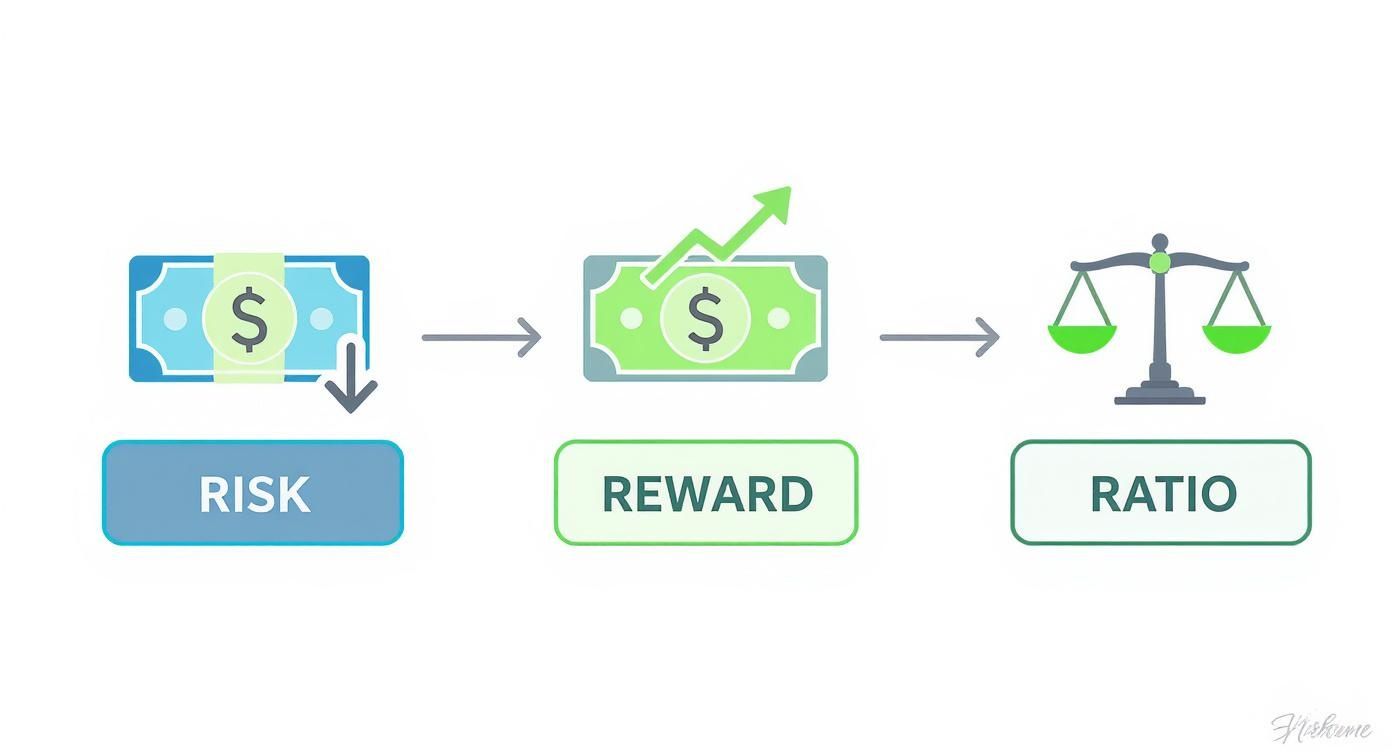
As the infographic shows, it’s a simple three-step process: define your risk, define your reward, and then weigh them against each other to see if the trade makes sense.
How Stop-Loss and Take-Profit Levels Impact Your Risk Reward Ratio
The real magic happens when you see how tiny tweaks to your stop or target can completely change a trade’s attractiveness. This is where you can turn a mediocre setup into a great one, or realize a “great” setup is actually not worth your capital.
Let’s revisit that NVDA trade from earlier, but this time we’ll play with the exit points to see what happens.
| Scenario | Entry Price | Stop-Loss Price | Take-Profit Price | Risk per Share | Reward per Share | Risk Reward Ratio |
|---|---|---|---|---|---|---|
| Original Trade | $120 | $115 | $135 | $5 | $15 | 3:1 |
| Tighter Stop | $120 | $118 | $135 | $2 | $15 | 7.5:1 |
| Wider Stop | $120 | $110 | $135 | $10 | $15 | 1.5:1 |
| Lower Target | $120 | $115 | $125 | $5 | $5 | 1:1 |
| Higher Target | $120 | $115 | $145 | $5 | $25 | 5:1 |
See how dynamic that is? Simply by moving your stop-loss from $115 to $118, you dramatically improve your ratio from 3:1 to an incredible 7.5:1. On the other hand, if your analysis suggests a less ambitious profit target of just $125, the ratio drops to 1:1, meaning you’re risking the same amount you hope to gain. For many traders, that’s just not a good enough reason to put money to work.
This illustrates why your exit points are so critical. If you want to dive deeper into this, our guide on how to set stop losses breaks down how to place them based on actual market structure, not just random percentages.
Running the ratio calculation before you trade isn’t just a box-ticking exercise; it’s a powerful decision-making filter. It forces you to justify every trade based on its potential, shifting you from a passive market participant to a proactive risk manager.
Connecting the Ratio to Your Trading Strategy
Figuring out the math behind a risk reward ratio is the easy part. The real challenge — and where so many traders struggle — is actually connecting that simple calculation to a living, breathing trading strategy.
A fantastic 5:1 ratio means absolutely nothing if your stop-loss and take-profit levels are just arbitrary numbers plucked from thin air.
This is a tough lesson, and one that often comes with a painful tuition fee paid to the market. When you’re starting out, it’s so easy to get fixated on the ratio itself, completely forgetting that it’s only as strong as the logic behind it. Your trade exits have to be rooted in real technical evidence, not just wishful thinking.
Setting Stops and Targets Based on Market Structure
So, how do you fix this? You stop picking random prices and let the chart dictate your stop-loss and take-profit levels. This means basing your exits on tangible market structure — clear support and resistance levels, trend lines, or recent highs and lows — which gives them a much higher degree of validity and takes the guesswork out of the equation.
Here’s what that looks like in practice:
- Going long (buying)? Your stop-loss might go just below a recent swing low or a key support level. Your take-profit could then target a well-defined resistance area or a previous swing high.
- Going short (selling)? The stop-loss would be placed just above a recent swing high or a clear resistance level. Your take-profit could aim for a strong support zone below where you entered.
By anchoring your exits to these technical landmarks, you’re no longer guessing. You’re letting the market’s own behavior define your risk and potential reward, which instantly makes your entire approach more robust.
The Critical Link Between Win Rate and Reward
Now we get to the psychological hurdle that trips up so many traders: the relationship between your risk reward ratio and your win rate. Think of it like a seesaw — as one goes up, the other often goes down. You have to find a balance that actually works for you.
Consider two completely different trading styles:
- High Win Rate, Low Ratio: A scalper might aim for small, quick profits. Their strategy could easily have a 70% win rate, but their average risk reward ratio might be only 0.6:1. They win often, but their losing trades are larger than their winners.
- Low Win Rate, High Ratio: A trend follower, on the other hand, might endure a string of small losses while waiting for a massive market move. Their win rate could be just 35%, but their successful trades might average a 4:1 risk reward ratio. They lose often, but a single big win can cover multiple losses and then some.
Neither approach is inherently “better”; they simply represent different paths to potential profitability. The key is understanding which one aligns with your personality and your strategy. This is also where knowing how your choice of a trading time frame influences this relationship becomes a critical piece of the puzzle.
You do not need to win most of your trades to be a profitable trader. Internalizing this fact is a massive step forward. It allows you to accept small, necessary losses as the cost of doing business in pursuit of much larger wins.
Ultimately, your goal is to find your personal sweet spot. Are you comfortable with frequent small losses for the chance at a home run? Or do you need the psychological comfort of frequent wins, even if they’re smaller?
Answering this question honestly is fundamental to building a trading plan you can actually stick with for the long haul. This is how you move from simply calculating risk reward ratio as a math problem to making it a core component of your identity as a trader.
Avoiding Common Pitfalls and Emotional Decisions

Knowing the formula for calculating risk reward ratio is one thing. Actually sticking to it when your money is on the line? That’s a whole different game. This is where the real psychological battle begins, and it’s where most traders stumble. The biggest mistakes rarely come from bad math — they come from emotion.
We’ve all been there. A trade starts ticking against you, and suddenly that stop-loss you so carefully planned feels way too tight. The little voice in your head starts whispering, “Just give it a little more room to breathe.” That’s the classic trap of letting a loser run, and it completely blows up the risk side of your ratio equation.
On the flip side, what happens when a trade moves in your favor? The fear of giving back those hard-earned profits can be just as powerful. You get that itch to bank the win early, long before your target is hit. This habit of choking your winners is just as destructive, as it crushes the potential reward you planned for.
The Lure of the Lottery Ticket Trade
Another pitfall is getting seduced by a setup that promises a massive reward with a tiny chance of success. It’s easy to get excited about a potential 10:1 risk reward ratio. Who wouldn’t be?
But if your strategy only gives that trade a 5% chance of working out, you’re not making a calculated business decision. You’re buying a lottery ticket.
Real discipline means understanding that not all high-reward trades are good trades. The goal is to find setups where a solid risk reward ratio meets a reasonable probability of success. Anything else is just gambling.
Your pre-trade plan is a contract with yourself. When you move your stop or take profit early out of fear or greed, you’re breaking that contract. You’re invalidating the entire reason you took the trade in the first place.
Thinking Like an Investor, Not Just a Trader
To build that long-term discipline, it helps to zoom out and think about risk on a bigger scale. Investors, for example, look at historical market performance to put risk into context. A fascinating CFA Institute report here on the classic 60/40 portfolio highlights just how different risk profiles can be across global markets and timeframes.
While the US stock market has shown strong historical returns, it has also experienced significant drawdowns, which are declines from a peak. For example, during the 2008 financial crisis, the S&P 500 fell over 50%.
This long-term perspective forces you into a more disciplined, business-like mindset. It’s a powerful reminder that sticking to your planned risk reward ratio isn’t about being rigid — it’s about managing your capital intelligently so you can stay in the game long enough for your edge to play out.
How to Log and Analyze Your Trades for Improvement
You’ve probably heard the old saying, “What gets measured gets managed.” It might sound like a business cliché, but it’s the absolute truth when it comes to mastering risk in your trading. The whole exercise of calculating your risk reward ratio is purely academic if you don’t actually track how it pans out in the real world, trade after trade.
This is where a good trading journal becomes your most valuable weapon. It’s not just a place to scribble down a few notes; it’s how you build a data-driven blueprint of your actual performance. For every single trade, you need to be logging your planned risk reward ratio and comparing it to the actual outcome. Did you stick to the plan, or did fear or greed take the wheel?

Moving From Guesswork to Data
By consistently tracking this information, you can finally move past gut feelings and start spotting the patterns that matter. A solid journal helps you ask — and answer — the tough questions that separate breakeven traders from consistently profitable ones.
Are you actually hitting your profit targets on your winners? Do those high-ratio setups really work for your strategy, or do they just fail more often?
You might find that trades you planned with a 4:1 ratio only have a 20% win rate, which is a losing proposition over time. At the same time, your 2.5:1 ratio setups might be winning 45% of the time, pointing you directly to your statistical sweet spot. This is the kind of insight that drains the emotion out of your decisions and lets you make objective improvements. If you’re just getting started, using a structured format can make a world of difference, like the one we detail in our guide to building a trading journal template in Excel.
Visualizing Your Risk Performance
Modern journaling tools like TradeReview go a step further. They automatically digest all your trade data and serve it back to you in clear, visual charts. Suddenly, you can see your risk and reward distributions at a glance, making it incredibly easy to spot trends and outliers you’d otherwise miss.
This kind of visual feedback is priceless. It can instantly show you if you’re habitually cutting winners short or letting losers blow past your planned stop-loss.
A trading journal transforms your trading from a series of disconnected events into a powerful feedback loop. Every trade, win or lose, becomes a data point that sharpens your edge for the next one.
Ultimately, this data-driven process is the highest form of accountability. It forces you to confront the gap between your plan and your execution — and closing that gap is where real, lasting improvement is born.
Your Top Questions Answered
Let’s dig into some of the most common questions traders have when they start working with risk reward in their own strategies.
What’s a Good Risk-Reward Ratio for a Beginner?
This is a classic question, but there’s no single “best” ratio that works for everyone. It all comes down to your strategy’s win rate. That said, a great rule of thumb for any new trader is to never take a trade where you’re risking more than you stand to gain. Anything below a 1:1 ratio is a tough game to win.
Many traders find their sweet spot by aiming for a minimum of a 2:1 ratio. This setup means you’re targeting at least $2 in profit for every $1 you put on the line. The beauty of this is that it gives you a mathematical edge — you can be profitable even if you only win a third of your trades.
The goal isn’t to find a “magic” ratio. It’s to find one that aligns with your strategy’s win rate and your psychological tolerance for losses, creating a sustainable path to potential profitability.
Should I Move My Stop Loss Just to Improve the Ratio?
Absolutely not. You should never force a trade by artificially tightening your stop-loss just to make the numbers look better on paper. A stop-loss has to be placed at a logical point based on the market’s structure — think just below a key support level on a long trade or above a clear resistance on a short.
If you place your stop too close to your entry simply to beef up the ratio, you’re just asking to get knocked out by normal market noise. The right way to do it is to first identify your technical stop-loss location, then calculate the risk reward from there. If the resulting ratio doesn’t meet your minimum criteria, the professional move is to just pass on the trade. Don’t force it.
How Does My Win Rate Affect the Risk-Reward I Need?
Win rate and risk reward are two sides of the same coin. You can’t talk about one without the other; they’re completely intertwined.
A strategy that has a very high win rate, say 70%, can actually be profitable even with a low ratio, like 0.7:1. On the flip side, a strategy with a much lower win rate — maybe 35% — needs a much higher ratio, like 3:1 or even 4:1, to be profitable over hundreds of trades.
Understanding this balance is crucial for long-term survival. If you know your strategy is a low-frequency winner, then you have to be patient. You must wait for the A+ setups that offer a big enough potential reward to make up for the more frequent small losses.
Ready to stop guessing and start analyzing? TradeReview provides the tools you need to log every trade, visualize your risk-reward performance, and discover your statistical edge. Track your ratio, win rate, and equity curve with a powerful trading journal designed for data-driven improvement. Sign up for free and take control of your trading performance at https://tradereview.app.