At the absolute core of trading, it all boils down to two simple formulas: Profit = Selling Price – Cost Price and Loss = Cost Price – Selling Price. These aren’t just abstract equations; they are the bedrock of financial analysis, giving you a crystal-clear way to measure the outcome of every single trade.
Your Essential Profit and Loss Formula Cheat Sheet
To have any hope of long-term success in the markets, you must understand your financial performance. We’ve all been there — it’s incredibly easy to get swept up in the adrenaline rush of a big win or feel the sting of a loss. But without precise calculations, those are just feelings, not hard data.
Applying profit and loss formulas turns those emotional reactions into objective, actionable insights. This is what empowers you to stop guessing and start making smarter, data-driven decisions. So many traders stumble here, overlooking small fees or miscalculating percentages, which gives them a completely skewed view of their actual performance. Nailing these foundational formulas from day one builds the discipline you need for a sustainable trading career.
Core Concepts Explained
At the heart of every P&L calculation are two key figures:
- Cost Price (CP): This is the total amount you paid to get into a position. Critically, this includes not just the purchase price but also any commissions or fees you paid to enter the trade.
- Selling Price (SP): This is the total amount you received when you closed the position, after any exit commissions or fees have been taken out.
The relationship between these two numbers is what determines whether you made money or lost it. It’s a simple dynamic, as shown in the flowchart below.
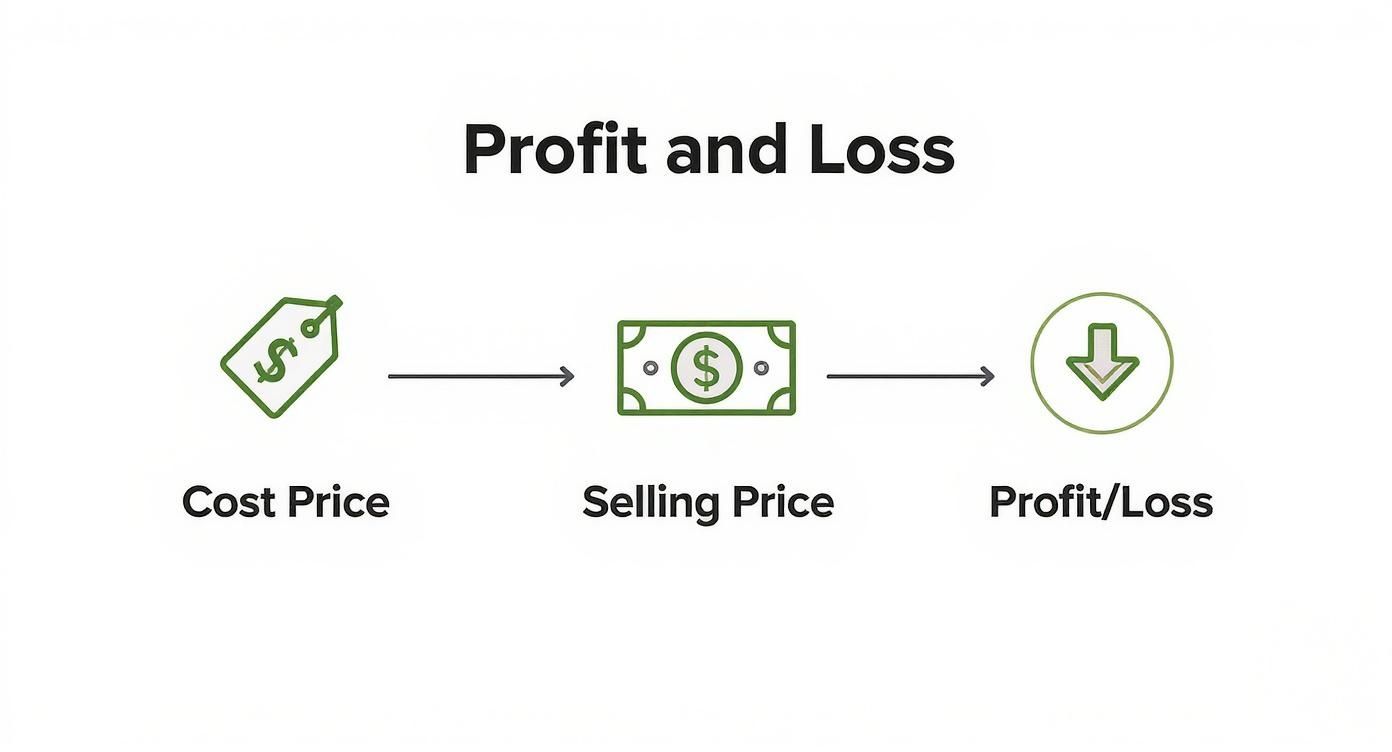
When your selling price is higher than your cost price, you’ve got a profit. When it’s the other way around, it’s a loss. This fundamental principle isn’t just for individual traders; it’s the same one that has driven economies for centuries. Think about it: corporate profit margins in the U.S. have grown significantly over the decades, a trend that is tracked by applying these exact P&L principles on a massive scale. If you’re interested in the bigger picture, you can explore this historical data on the U.S. Bureau of Economic Analysis website.
To make things even easier, here is a quick-reference table with the most critical formulas you’ll be using daily.
Key Profit and Loss Formulas at a Glance
| Formula Name | Calculation | Purpose | Quick Example (100 cost, 120 sale) |
|---|---|---|---|
| Basic Profit | Selling Price – Cost Price | To find the absolute monetary gain. | 120 – 100 = 20 |
| Basic Loss | Cost Price – Selling Price | To find the absolute monetary loss. | N/A (Profit in this case) |
| Profit Percentage | (Profit / Cost Price) * 100 | To understand the gain relative to the initial investment. | (20 / 100) * 100 = 20% |
| Loss Percentage | (Loss / Cost Price) * 100 | To understand the loss relative to the initial investment. | N/A (Profit in this case) |
Bookmark this table or keep it handy. These calculations are the language of trading, and becoming fluent in them is your first step toward consistent performance analysis.
If you’re serious about building a sustainable trading career, you have to move beyond gut feelings. Your decisions need to be anchored in cold, hard numbers. That process starts with mastering the two most fundamental formulas in trading: profit and loss. These calculations are the bedrock for every piece of performance analysis you’ll ever do.
These formulas give you an objective measure of success or failure on any given trade. They strip away the emotion that can so easily cloud your judgment. Without that clarity, it’s impossible to figure out what’s working, what isn’t, and why.
The Profit Formula Explained
Let’s start with the basics. The formula for calculating a profitable trade is simple and serves as your primary measure of a successful outcome. It just compares your exit price to your entry price.
The basic Profit Formula is:
Profit = Selling Price (SP) – Cost Price (CP)
You use this when your Selling Price is higher than your Cost Price. Think of it as the reward you get for making the right call in the market.
- Practical Example: Let’s say you buy 10 shares of a stock at $150 per share. Your total Cost Price (CP) is $1,500. The stock moves in your favor, and you sell all 10 shares at $175 each, giving you a total Selling Price (SP) of $1,750.
- Calculation: $1,750 (SP) – $1,500 (CP) = $250 Profit
That $250 is your gross profit before you account for any trading fees or commissions.
Understanding the Loss Formula
Just as important is knowing how to calculate a loss. This isn’t about dwelling on negativity; it’s about accurately quantifying the trades that didn’t go your way so you can learn from them. In fact, facing losses with analytical rigor is the hallmark of a disciplined trader.
The basic Loss Formula is:
Loss = Cost Price (CP) – Selling Price (SP)
This one comes into play when your Cost Price is greater than your Selling Price, signaling an unprofitable trade.
- Practical Example: Imagine you buy 5 shares of another stock at $100 per share, for a total Cost Price (CP) of $500. The price unfortunately drops, and you decide to exit the position at $80 per share to manage your risk. Your Selling Price (SP) is now $400.
- Calculation: $500 (CP) – $400 (SP) = $100 Loss
Consistently applying these two core formulas is non-negotiable. Meticulous and honest record-keeping of every single Cost Price and Selling Price is the absolute cornerstone of reliable performance tracking and the foundation for long-term improvement.
Calculating Performance with Profit and Loss Percentages
Sure, knowing the exact dollar amount you won or lost on a trade is important, but it hardly tells the whole story. A $100 profit feels great, but what if you had to risk $5,000 to get it? That context changes everything. This is exactly why percentage-based formulas for profit and loss are such indispensable tools for any serious trader.
Percentages are the great equalizer. They standardize your results, letting you compare a small win against a massive one on a level playing field. It’s how you shift your mindset from “how much did I make?” to “how well did my capital actually perform?” This is the key to understanding your real trading efficiency and figuring out which strategies are truly working for you.
The Profit Percentage Formula
The profit percentage formula is your go-to metric for measuring the success of a winning trade. It shows you the gain relative to the capital you put on the line.
The calculation itself is incredibly simple:
Profit Percentage = (Profit / Cost Price) x 100
By dividing your profit by the original cost, you can see the return generated by every single dollar you invested. This metric is absolutely crucial for spotting which of your setups deliver the most “bang for your buck.”
-
Practical Example 1: You book a $50 profit on a trade that had a $100 cost price.
- Calculation: ($50 / $100) x 100 = 50% Profit
-
Practical Example 2: You make a $100 profit on a trade with a $1,000 cost price.
- Calculation: ($100 / $1,000) x 100 = 10% Profit
Right away, you can see the first trade was five times more efficient with your capital, even though the dollar profit was smaller. Tracking these percentages in your trading journal helps you pinpoint high-performance patterns over time. To dig deeper into this, check out our guide on how to calculate return on investment, which explores this concept in much greater detail.
The Loss Percentage Formula
On the flip side, calculating your loss as a percentage of your initial capital is non-negotiable for solid risk management. So many traders get stuck focusing on the dollar amount lost, which can be paralyzing and lead to bad decisions.
Viewing losses in percentage terms helps you stay objective and stick to your risk rules — like the classic “1% rule” where no single trade ever risks more than 1% of your total account.
The formula is a mirror image of the profit calculation:
Loss Percentage = (Loss / Cost Price) x 100
Using this formula consistently helps you quantify your risk without emotion getting in the way.
-
Practical Example: You take a $75 loss on a trade with a $1,500 cost price.
- Calculation: ($75 / $1,500) x 100 = 5% Loss
That 5% figure is way more useful for analysis than the raw $75 number. It tells you instantly whether you’re respecting your predefined stop-loss levels. Mastering these simple percentage calculations is a fundamental step toward becoming a long-term, disciplined trader.
Finding Your Net Profit in Real-World Trading
A profitable trade on paper can look a whole lot different once the money actually hits your account. It’s a tough lesson many new traders learn when they forget about the small but mighty costs that eat away at their gains. Getting a handle on the difference between gross and net profit is absolutely essential if you want an honest look at your trading business.
It all boils down to two key formulas on profit and loss. Gross profit is the simple, straightforward gain before any expenses are factored in. But net profit? That’s what you actually get to keep. Focusing only on gross profit gives you a dangerously incomplete picture of your real performance.

From Gross Profit to Your Actual Take-Home Pay
To find out how profitable you really are, you have to account for every single cost that comes with making a trade. These often-overlooked expenses can easily be the difference between a winning and a losing strategy over the long run.
Here’s the formula for Net Profit:
Net Profit = (Selling Price – Cost Price) – Trading Costs
Think of trading costs as the cost of doing business in the markets — they’re not optional. These usually include:
- Commissions: The fee your broker charges for executing the trade.
- Exchange Fees: Costs levied by the exchange where the asset is traded.
- Slippage: The sneaky difference between the price you expected and the price your order actually filled at.
Let’s see how this plays out with a real trade. Imagine you buy 100 shares at $50 and sell them at $51. On the surface, your gross profit is ($51 – $50) x 100 = $100. Not bad.
But now, let’s factor in a realistic $10 in total trading costs.
- Net Profit Calculation: $100 (Gross Profit) – $10 (Trading Costs) = $90 Net Profit
That $10 might seem small, but it just erased 10% of your gross profit in an instant. This is a simple but powerful example of how crucial it is to calculate your net profit, not just your gross.
Gross Profit vs. Net Profit Calculation
This table drives home just how much of an impact those “small” fees can have on your bottom line.
| Metric | Calculation | Example Trade ($1000 buy, $1100 sell, $10 fees) |
|---|---|---|
| Gross Profit | Selling Price – Cost Price | $1100 – $1000 = $100 |
| Net Profit | (Selling Price – Cost Price) – Trading Fees | ($1100 – $1000) – $10 = $90 |
As you can see, ignoring fees gives you an inflated sense of success. The only number that truly matters for your performance review is the net profit.
Realized vs. Unrealized P&L
Another critical distinction for maintaining financial clarity is knowing the status of your profits and losses. This helps you separate the actual, banked gains from the potential gains that are still on the table and at risk.
- Realized P&L: This is the profit or loss from trades that you have closed. The money is either in your account or has been taken out. It’s a final, locked-in number.
- Unrealized P&L: This refers to the current profit or loss on your open positions. This number is always moving with the market and is purely theoretical until you hit the “sell” button.
It’s a common psychological trap to start mentally “spending” your unrealized profits. But a disciplined trader knows that until a position is closed, that P&L is just a fluctuating number on a screen. The only figure that truly matters for analyzing your performance is your realized net profit. Adopting this mindset is a huge step toward long-term thinking and emotional control in your trading.
Using P&L Formulas for Proactive Risk Management
The best traders I know don’t just use profit and loss formulas to see how a trade went after it’s closed. They use them as predictive tools to manage their risk before they even think about hitting the “buy” button. This shift in thinking — from reactive to proactive — is what separates traders who build lasting careers from those who just gamble.
By using these formulas to set clear boundaries for every single position, you transform trading from an emotional rollercoaster into a structured, business-like activity. And it all starts with one simple question: where do I break even?
Calculate Your Break-Even Point
Before you can even dream about a profit target, you have to know the exact price where you won’t make or lose a single cent. This is your break-even point, and it’s critical because it forces you to account for trading costs — the small fees that so many traders forget in the heat of the moment.
The formula itself is pretty straightforward:
Break-Even Price = Entry Price + (Trading Costs / Position Size)
Knowing this number is incredibly freeing. It takes all the guesswork out of the equation and lets you set your profit targets and stop-losses with real precision. It’s the only way to be sure your potential reward truly justifies the risk you’re taking.
- Practical Example: Let’s say you buy 50 shares of a stock at $20. Your total commissions and fees come out to $5.
- Calculation: $20 + ($5 / 50 shares) = $20 + $0.10 = $20.10
- Conclusion: You need that stock to hit $20.10 just to cover your costs. Anything above that is pure, clean profit.
Connecting P&L Percentages to Disciplined Risk
Beyond just one trade, P&L percentage formulas are the absolute backbone of a solid capital protection plan. Most successful traders I’ve met live by a simple but powerful rule: never risk more than 1% or 2% of their total account on any single trade. This disciplined approach is a cornerstone of effective risk management for traders and is mathematically designed to help you survive the losing streaks that are an inevitable part of trading.
This principle is all about staying in the game long enough for your strategy to work. It ensures that a handful of bad trades won’t knock you out, giving you the time and capital needed to perform over the long haul.
The importance of applying formulas correctly goes way beyond our individual trading accounts. On a global scale, corporations have historically used complex P&L accounting to shift profits. Research shows that a significant percentage of multinational profits are funneled into tax havens, resulting in an estimated loss of global corporate tax revenue each year. A paper from the National Bureau of Economic Research explores these economic dynamics in depth. This just goes to show how critical accurate and ethical formula application is for financial stability at every level. By mastering these formulas in your own trading, you’re building the discipline needed to not just survive, but thrive.
Integrating Formulas into Your Trading Journal
Knowing all the formulas on profit and loss is one thing, but actually putting them to work consistently is what really separates hopeful traders from disciplined ones. This is where your trading journal comes in. It’s the place where theory meets reality, turning raw trade data into the powerful insights you need for long-term growth.
Many traders get tossed around by the emotional highs and lows of the market. A well-kept journal, however, acts as your objective business partner. It forces you to look at the hard numbers, cutting through the noise of euphoria or despair and replacing it with cold, hard data.
Essential Data Points to Log for Every Trade
Discipline in your record-keeping is just as crucial as discipline in your execution. For your journal to be a truly effective tool, you have to capture the right data for every single trade, without fail.
Here are the non-negotiable fields to include:
- Entry and Exit Prices: The exact prices where you bought and sold.
- Position Size: The number of shares, contracts, or units you traded.
- Gross P&L: The simple profit or loss before any costs are factored in.
- Trading Costs: The total of all commissions, fees, and estimated slippage.
- Net P&L: Your actual take-home profit or loss after all costs are subtracted.
- P&L Percentage: The net P&L shown as a percentage of your initial cost.
Tracking these metrics is what allows for powerful analysis over time. It helps you pinpoint your most profitable setups, uncover costly mistakes, and find clear areas where your strategy needs improvement.
Turning Data into Actionable Insights
Once you start logging this data consistently, your journal becomes an absolute goldmine. You can begin asking critical questions that drive improvement, like, “What is my average net profit on winning trades?” or “Are my trading costs eating up more than 10% of my gross profits?” This is how you move from just placing trades to actively sharpening your edge.
If you’re looking to get started, you can find plenty of templates online. For those comfortable with spreadsheets, our guide on creating an Excel trading journal is a great resource to build your own from the ground up. The most important thing is to start now — your future self will thank you for the data you begin collecting today.
Frequently Asked Questions About Trading P&L
As you get deeper into trading, you’ll run into situations that don’t quite fit the simple buy-low, sell-high formula. This is totally normal. Understanding the nuances of how to calculate your P&L in these moments is what separates a good trader from a great one, ensuring your records are always spot-on.
Here are some direct answers to the most common questions traders have when they start applying formulas on profit and loss to real-world scenarios.

We’ll clear up the tricky stuff so you can apply these formulas with confidence, no matter what the market throws at you.
How Do I Calculate Profit and Loss for a Short Sale?
When you short a stock, you’re essentially reversing the usual process. You make money when you buy the asset back for less than you sold it for. A loss happens when you’re forced to buy it back at a higher price.
The formula for a winning short sale is:
Profit = Short Sale Price - Buy to Cover Price - Trading Costs
It’s just as important to log these trades in your journal as your standard “long” positions. If you don’t, your performance metrics won’t give you the full picture of your trading strategies.
What Is the Difference Between ROI and Profit Percentage?
Honestly, for individual trades, these two terms are often used to mean the same thing. The Profit Percentage formula we talked about earlier — (Profit / Cost Price) * 100 — is basically the Return on Investment (ROI) for that one specific trade.
While you might see ROI annualized for long-term investments in a big portfolio, when we’re breaking down single trades day-to-day, the ideas and the math are practically identical.
Why Is My Net Profit So Different from My Gross Profit?
This is a classic — and often frustrating — moment for every developing trader. The gap between your gross and net profit almost always comes down to one thing: trading costs.
These little fees can feel invisible on a single trade, but they add up fast. They include:
- Commissions: The fee your broker charges for placing the trade.
- Exchange Fees: Charges from the actual exchange where the trade happens.
- Slippage: The difference between the price you expected to get and the price you actually got filled at.
Over dozens or hundreds of trades, these costs can quietly eat away at your returns. The first and most critical step to getting them under control is to diligently track every single fee in your journal. It’s the only way to understand — and eventually minimize — their impact on your bottom line.
Stop letting hidden costs surprise you. Take control of your trading performance by turning these formulas into actionable insights. The TradeReview trading journal makes it easy to log every detail, from your entry and exit to commissions and net P&L. Stop guessing and start analyzing with a free journal at https://tradereview.app.