A stock position sizing calculator is a deceptively simple tool. At its core, it just tells you how many shares to trade based on your account size, how much you’re willing to risk, and your specific trade setup. You plug in your total capital, risk percentage, entry price, and stop-loss, and it spits out a number. But that simple calculation is the bedrock of disciplined risk management — it pulls guesswork and emotion right out of the equation.
The Single Skill Separating Winning Traders from the Rest
Trading can feel like an emotional battlefield. The fear of a big loss can be just as paralyzing as the fear of missing out on a huge win (FOMO, anyone?). Both feelings lead to impulsive decisions that quietly sabotage your long-term goals. Every single trader, from beginners to seasoned pros, has faced this. The ones who succeed have a secret weapon: discipline.

Why Position Sizing Is Your Pre-Flight Checklist
Position sizing is the disciplined system that quiets all that internal noise. It’s not about complex calculus; it’s a simple, repeatable process built to protect your most valuable asset — your trading capital.
Think of a stock position sizing calculator as your pre-flight checklist. It forces you to make objective, logical choices before putting a single dollar on the line. Mastering this one habit has a far greater impact on your long-term success than constantly hunting for the “perfect” stock entry. It’s what ensures you can weather the inevitable losing streaks and stay in the game long enough to build a profitable track record.
Adopting a Proven Framework
The most widely adopted method is known as fixed fractional position sizing. The concept is straightforward: you risk a small, fixed percentage of your total equity on every single trade.
Imagine a professional poker player who never bets their entire stack on a single hand, no matter how strong it looks. They know the game is a marathon, not a sprint. This approach is the trader’s equivalent, creating uniformity and taking the guesswork out of risk control.
The goal of a successful trader is to make the best trades. Money is secondary.
— Alexander Elder
By focusing on a consistent process rather than the outcome of any one trade, you shift your mindset from gambling to operating a business. This is the absolute core of effective risk management for traders, a concept that allows you to survive market volatility and build your account methodically over time.
Inside the Calculator: The Three Core Sizing Models
Ever wonder what’s going on behind the curtain of a position sizing calculator? It’s far simpler than you might think. These tools aren’t running some black-box algorithm; they’re just applying one of three foundational models to turn your risk tolerance into a specific number of shares.
Getting a handle on these models demystifies the whole process. It gives you the confidence to know why the calculator is giving you a certain number, so you can trust the output and trade with conviction.
Let’s break them down with practical examples.
The Percent Risk Model
This is the classic, and for good reason — it’s the most intuitive model out there. You simply decide to risk a small, fixed percentage of your total account equity on any single trade. It’s a powerful approach because it scales dynamically with your performance.
When your account grows, your position sizes can grow with it. If you hit a rough patch, your sizes automatically shrink, acting as a built-in brake to protect your capital.
Let’s say a trader with a $25,000 account decides to risk just 1% on a new trade in Apple (AAPL).
- Maximum Risk: 1% of $25,000 = $250
- Entry Price: $175
- Stop-Loss Price: $170
- Risk Per Share: $175 – $170 = $5
- Position Size Calculation: $250 / $5 = 50 shares of AAPL
With this method, you know a single bad trade will never deal a catastrophic blow to your account. It’s all about longevity.
The Fixed Dollar Risk Model
Instead of thinking in percentages, this model has you risk a specific, predetermined dollar amount on every single trade. It doesn’t matter if your account balance is up or down on the day; the risk stays the same.
This approach really appeals to traders who crave absolute consistency. It removes the mental math of recalculating your risk based on a fluctuating account balance. For example, a trader might decide they are psychologically comfortable risking exactly $500 per trade, period. This creates a steady, predictable benchmark during both winning and losing streaks.
Defining your risk in concrete dollar terms before you enter a trade is a simple act of discipline that separates professional-minded traders from gamblers. It’s about process over profits.
That kind of consistency can be incredibly grounding. When you know the exact dollar figure on the line, it helps you manage the emotional rollercoaster of trading and make more objective decisions.
The Volatility-Based (ATR) Model
Now we’re getting a bit more sophisticated. This model sizes your position based on the stock’s own recent behavior. It uses a popular indicator called the Average True Range (ATR), which measures how much a stock typically moves over a set period (usually 14 days).
Why is this so useful? A quiet, stable utility stock might only move a dollar per day, while a high-momentum stock like Tesla (TSLA) could swing $50 or more in the same period. Applying the same risk logic to both just doesn’t make sense. The ATR model helps you adapt your risk to the unique personality of the stock.
For instance, if TSLA’s 14-day ATR is $35, you might set your stop-loss 1.5x ATR below your entry. This gives the trade room to breathe and helps you avoid getting knocked out by the stock’s normal daily “noise.”
Of course, a wider stop means you have to buy fewer shares to keep your risk constant. This is the model intelligently adapting your size to the stock’s volatility. It’s a key part of building a robust trade plan, which ties directly into how you define your entries, exits, and overall trade management. You can learn more about how this connects to your risk reward ratio calculation in our detailed guide.
Choosing Your Position Sizing Method
Not sure which model fits you best? This table should help you decide. Each has its place, and the right one often comes down to your personality and trading style.
| Sizing Method | Best For | Key Advantage | Potential Drawback |
|---|---|---|---|
| Percent Risk | Most traders, especially beginners and those focused on long-term growth. | Automatically scales with your account, promoting compounding and protecting capital. | Requires recalculating size on every trade as your account balance changes. |
| Fixed Dollar Risk | Traders seeking psychological consistency and simplified risk management. | Creates emotional stability; your risk is the same regardless of recent performance. | Doesn’t automatically adjust for account growth or drawdowns. |
| Volatility (ATR) | Discretionary and systematic traders who want to adapt to market conditions. | Adjusts for each stock’s unique volatility, reducing premature stop-outs. | More complex, as it requires monitoring the ATR and setting multipliers. |
Ultimately, the goal is to find a method you can stick with. Consistency in your risk management is far more important than picking the “perfect” model.
Putting a Position Sizing Calculator to Work
Theory is great, but let’s be honest — confidence comes from seeing how it all works in the real world. So, let’s ditch the abstract and walk through a stock position sizing calculator with a practical, step-by-step example.
Imagine you’re eyeing a swing trade in NVIDIA (NVDA). The stock has a history of strong trends, but it can also be volatile. You’ve spotted a potential entry, but before you even think about hitting the ‘buy’ button, you have to define your risk. This is the moment a calculator becomes your best friend.
This diagram shows the main ways traders approach position sizing, from simple percentage risk to more dynamic, volatility-based models.
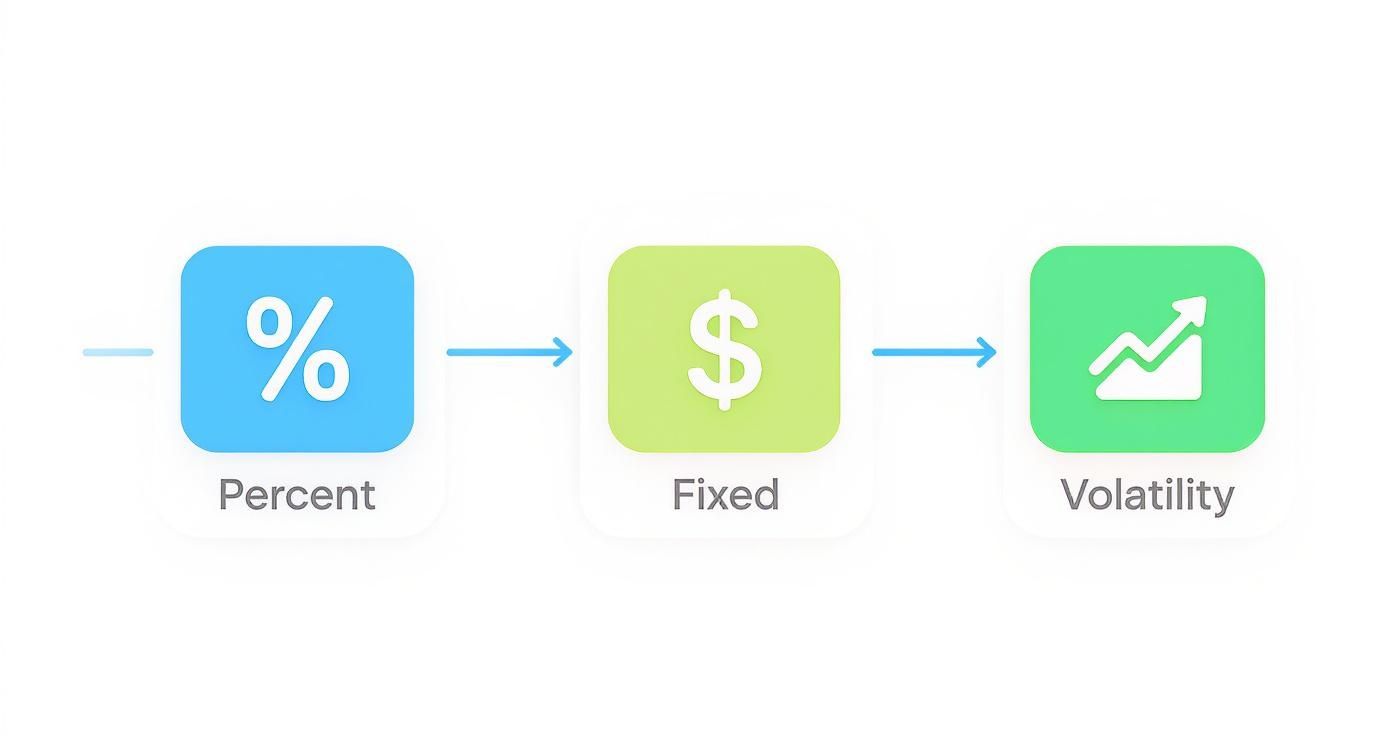
While each method uses slightly different logic, they all answer the same critical question: “How many shares can I actually buy?”
Breaking Down the Calculator Inputs
Most online calculators are designed to be simple and clean. Let’s plug the numbers for our hypothetical NVDA trade into a typical one. The fields are pretty straightforward, but they force you to think through your entire trade plan before a single dollar is on the line.
Here are the key inputs and the thinking that goes into each one:
- Account Size: Let’s say your total trading equity is $50,000. Be honest with this number. Use your actual liquid capital, not the balance you wish you had.
- Risk Percentage: As a disciplined trader, you stick to a strict 1.5% risk rule per trade. This means the absolute most you’re willing to lose on this idea is $750 ($50,000 x 0.015).
- Entry Price: Your analysis points to a solid entry if NVDA pulls back to $125.00. This is your planned buy price.
- Stop-Loss Price: You’ve found a key support level at $120.00. If the stock drops below this point, your trade thesis is invalidated. This sets your stop-loss, making your risk per share exactly $5.00 ($125 – $120).
Once you’ve entered these values, the calculator does the simple math for you.
Interpreting the Output
The calculator spits out the answer almost instantly:
$750 (Total Risk) / $5.00 (Risk Per Share) = 150 Shares
That’s it. Your position size is 150 shares. You now have an exact, actionable number for your order. You can confidently go to your broker and place an order to buy 150 shares of NVDA, knowing that your maximum potential loss is capped at $750.
This kind of process is fundamental to building a solid strategy. It’s also an essential step when you’re backtesting trading strategies, as it ensures your historical results are grounded in sound risk management.
But what if you’re trading a high-priced stock and the calculation suggests buying a fractional share? Many brokers support this now. If yours doesn’t, you simply round down to the nearest whole share. Always round down — never up — to ensure you don’t accidentally exceed your risk limit. This disciplined, unemotional process is what builds longevity in trading.
Making Position Sizing a Non-Negotiable Trading Habit
Knowing how to calculate your position size is one thing. Actually doing it, every single time, before you even think about hitting the “buy” button? That’s what separates disciplined traders from everyone else.
We’ve all been there — staring at a chart, feeling that rush as a stock looks ready to break out, and wanting to jump in right now. That moment of temptation is precisely when a solid, repeatable process saves you from your worst impulses.
The goal is to turn this calculation from a chore into a source of confidence. When you know your absolute maximum loss before you enter a position, you gain a level of psychological freedom that’s hard to overstate. The fear of a catastrophic loss just disappears, replaced by the calm acceptance of a small, manageable risk you’ve already defined.
Creating a Powerful Feedback Loop
This is where your trading journal becomes your most valuable tool. It’s how you turn every trade — win or lose — into a powerful learning opportunity. By consistently logging not just your entries and exits but your specific risk parameters, you build an incredible feedback loop.
This isn’t about just scribbling down a few numbers. You’re building a dataset on your own behavior. In your journal, make sure you have dedicated fields for these metrics:
- Planned Risk ($): The exact dollar amount you calculated and were willing to lose.
- Planned Risk (%): Your intended risk as a percentage of your account.
- Actual Position Size (Shares): The final share count you got from your calculator.
This simple act keeps you honest. Over time, reviewing this data will show you patterns you’d otherwise completely miss. You might discover you’re consistently risking too much on a certain setup or not sizing up properly on your best trades.
Position sizing is the bridge between a good trading idea and sound risk management. Without it, even the best strategy is just a gamble.
By making this a ritual, you shift your focus from chasing profits to executing a flawless process. You start taking pride in your discipline, knowing you’re protecting your capital and giving your strategy the best possible chance to work over the long haul.
Integrating Sizing into Your Trading Plan
A trading plan is more than a set of vague rules; it’s a living document that guides your every move. Position sizing needs to be a written, non-negotiable part of that plan. Don’t just keep it in your head.
Here’s a simple way to formalize it:
- Define Your Risk Rule: “I will risk no more than 1% of my total account equity on any single trade.”
- Mandate the Calculation: “Before entering any trade, I will use a stock position sizing calculator to determine the exact number of shares based on my entry and stop-loss.”
- Log the Data: “Immediately after executing the trade, I will log my Planned Risk ($) and Actual Position Size in my TradeReview journal.”
This three-step process removes guesswork and emotion from the equation. It ensures that when the market is moving fast and adrenaline is pumping, you have a clear, objective system to fall back on. This structure is what separates consistent traders from the crowd. It turns a reactive, emotional activity into a proactive, business-like operation.
Advanced Sizing Strategies for Growing Your Edge
Once you’ve nailed down the fundamentals of consistent risk management, you can start exploring more dynamic sizing models. These aren’t for traders just starting out, but for those with a solid track record who want to sharpen their edge with a more statistical approach. We’re moving beyond a simple fixed percentage and into methods that actually adapt to your unique performance data.
Think of it this way: a basic stock position sizing calculator helps you survive the markets. These advanced methods are designed to help you thrive. They introduce a layer of optimization that, when applied over hundreds of trades, can make a meaningful difference in your equity curve. The catch? You absolutely need a good amount of reliable trade data to make them work.
https://www.youtube.com/embed/-mKJ2zIhopg
The Kelly Criterion Demystified
One of the most famous (and often misunderstood) advanced methods is the Kelly Criterion. At its core, it’s a formula designed to calculate the “optimal” position size by looking at your strategy’s historical win rate and your average reward-to-risk ratio. The goal is to tell you the precise fraction of your capital to risk on any given trade to maximize your account’s long-term growth.
But that word, “optimal,” comes with a huge asterisk. The pure Kelly formula is notoriously aggressive. If your stats are strong, it might suggest risking 5%, 10%, or even more of your entire account on a single trade.
While mathematically sound for maximizing growth over an infinite number of trades, the Kelly Criterion can produce gut-wrenching drawdowns that very few traders can psychologically handle.
Because of this, most traders who use the concept apply what’s known as a “Fractional Kelly” approach. They simply take the size the formula suggests and use only a fraction of it — say, 25% or 50%. This lets you benefit from the core logic without taking on the extreme risk.
Stress-Testing Your System with Monte Carlo Analysis
Another incredibly powerful technique is Monte Carlo analysis. Instead of just giving you a single number for position size, this method stress-tests your entire trading system. It works by running thousands of computer simulations using your historical trade data, showing you a whole range of possible futures for your equity curve.
This is where it gets interesting. You can see how different position sizing rules impact your potential drawdowns. A simulation might show that your current 2% risk model gives you a 10% chance of hitting a 40% drawdown sometime in the next year. Armed with that knowledge, you can decide if you’re comfortable with that risk or if you’d rather scale back to a more conservative 1.5% risk to sleep better at night.
Advanced methods like these are all about using performance data and probability to find your sweet spot. Studies on Kelly-based strategies have even shown they can outperform fixed fractional methods by balancing risk and reward more efficiently. You can explore more about these findings and the principles behind them to really deepen your understanding.
A Few Common Questions on Position Sizing
When you first commit to a disciplined risk management process, a few questions always seem to pop up. Here are some of the most common ones I hear from traders getting started with a stock position sizing calculator.
What Is the Best Risk Percentage to Use Per Trade?
There’s no single magic number, but the 1% to 2% rule is a time-tested industry standard for a reason. It’s an excellent starting point for most traders. Following this guideline helps ensure that an inevitable losing streak won’t completely derail your account.
Ultimately, your ideal percentage comes down to your personal risk tolerance, your strategy’s historical performance, and how comfortable you are with drawdowns. The real key is to pick a number that allows you to execute a trade without emotion taking over.
Should I Adjust My Position Size for Volatile Stocks?
Absolutely. This is exactly where a smart position sizing strategy shows its true value. With a highly volatile stock, you’ll naturally need to set a wider stop-loss to avoid getting shaken out by its normal, choppy price action.
To keep your dollar risk the same (that 1% of your account, for example), you simply have to buy fewer shares. This is a non-negotiable adjustment that protects you from taking an oversized loss on an unpredictable stock. A volatility-based model using ATR is tailor-made for these scenarios.
By pre-defining your maximum loss on any single trade, you remove the in-the-moment fear and greed that cause bad decisions. It builds discipline and turns trading into a systematic process, not an emotional gamble.
Can I Use This Calculator for Crypto or Forex?
Yes, you can. The core principles of risk management are universal, no matter what you’re trading. The inputs — your account size, risk percentage, entry price, and stop-loss price — are the same for any asset.
The only real difference is the unit of measurement. For stocks, the output is “shares.” For forex, it would be “lots,” and for crypto, it would be the specific coin amount. The fundamental logic of controlling your risk remains exactly the same.
Ready to make position sizing a non-negotiable part of your trading routine? TradeReview provides the tools you need to log, analyze, and perfect your risk management. Track every trade, monitor your performance analytics, and build the discipline of a professional trader. Start journaling for free and take control of your trading today.