To consistently trade the plan means executing your pre-defined trading strategy with unwavering discipline, no matter what your emotions are screaming at you or how chaotic the market gets. It’s the critical skill that separates methodical, long-term traders from those stuck in a cycle of impulsive, account-draining decisions.
Why Most Traders Struggle to Follow Their Own Rules

Let’s be honest — you probably have a solid trading plan. You’ve done the research, explored different strategies, and laid out clear rules for entries, exits, and managing risk.
But when the market starts ripping and real money is on the line, that well-crafted plan can suddenly feel more like a suggestion than a hard-and-fast rule. Sound familiar? We’ve all been there.
This is one of the most common and frustrating hurdles for traders at every level. The gap between what you know you should do and what you actually do in the heat of the moment is where most trading accounts slowly bleed out. It’s rarely a lack of knowledge; it’s a battle against your own human psychology.
The Psychological Traps We All Face
The market is an arena perfectly designed to test your emotional limits. When you deviate from your plan, it’s usually because of powerful psychological triggers that feel completely rational at the time.
These are the usual suspects:
- Fear of Missing Out (FOMO): You see a stock taking off without you and jump in late, completely ignoring your entry criteria because you can’t stand the thought of missing those potential gains.
- Revenge Trading: After a frustrating loss, you immediately force another trade — often bigger and riskier — to “make your money back,” throwing your entire strategy out the window.
- Analysis Paralysis: A perfect setup appears, ticking all your boxes. But you hesitate, overthink it, and wait for just one more confirmation… until the opportunity is long gone.
These emotional responses hijack your decision-making, turning a cool, objective strategy into a hot, emotional reaction.
The core challenge isn’t finding a profitable strategy; it’s developing the discipline to execute that strategy flawlessly, trade after trade, day after day. This is a marathon, not a sprint.
A Relatable Scenario
Imagine you enter a trade with a clear stop-loss set at a 2% risk. The price moves against you and inches toward your stop. Instead of just taking the small, planned loss, you think, “It’s just a quick dip, it will bounce back.” So you move your stop-loss further down.
A few minutes later, the price drops again. Now you’re down 5%, and that small, manageable loss has turned into a significant one. The emotional pressure builds, and rational thought evaporates.
This single decision — to ignore one simple rule — snowballs into a major setback. Learning to trade the plan isn’t about being a robot; it’s about protecting yourself from your worst impulses. It’s the foundation of long-term consistency.
Building a Trading Plan You Can Actually Trust
You can’t follow a plan you don’t fully believe in. It’s that simple.
If your rules are fuzzy or just borrowed from some guru you follow online, you’ll start second-guessing them the second a trade moves against you. To consistently trade the plan, you have to build one that’s so objective and personal that it becomes your anchor in a volatile market.
This isn’t about theory. It’s about creating a practical, black-and-white rulebook for your trading. The entire point is to kill ambiguity and force objectivity, making sure every single decision is made before the market opens and your emotions are running high. A trustworthy plan leaves zero room for interpretation when the pressure is on.
What’s Your Trading Identity?
Before you even think about writing a rule, you need to know who you are as a trader. Are you a scalper chasing tiny, rapid-fire profits, or a swing trader comfortable holding positions for days or even weeks? Your strategy has to fit your personality, your stomach for risk, and your daily schedule.
- Trading Style: What’s your core method? Are you a breakout trader, a trend-follower, or do you hunt for mean-reversion setups (trades that bet on price returning to its average)?
- Timeframe: Which charts are your charts? The daily? The 4-hour? The 5-minute? Nail it down.
- Market Focus: What are you trading? Be specific. Is it U.S. large-cap stocks, major forex pairs, or something like crude oil futures?
Trying to be a jack-of-all-trades is a guaranteed path to frustration. Pick a niche. It’s how you develop real expertise and, more importantly, build unshakeable confidence in your approach.
Core Components of a Trading Plan
To make this tangible, every solid trading plan should have a few key elements. Think of this table as your blueprint for creating a plan that’s clear, comprehensive, and built to last. It breaks down what you need, why you need it, and what it looks like in the real world.
| Component | Description | Example |
|---|---|---|
| Trading Identity | Defines your overall approach, personality, and niche in the market. | “I am a swing trader focusing on trend continuation in large-cap tech stocks (e.g., AAPL, MSFT) using the 4-hour and daily charts.” |
| Entry Criteria | Specific, non-negotiable conditions that must be met to enter a trade. | “Enter long only if the price closes above the 20-day EMA on above-average volume, and the RSI is below 70.” |
| Exit Criteria (Stop-Loss) | A pre-defined point where you exit a losing trade to protect capital. | “Place initial stop-loss 1 ATR below the entry candle’s low. Never risk more than 1% of my account.” |
| Exit Criteria (Profit Target) | A pre-defined point or condition for taking profits on a winning trade. | “Take partial profits at a 2:1 risk/reward ratio and trail the remaining position with the 20-day EMA.” |
| Position Sizing | The formula used to determine how many shares or contracts to trade. | “Calculate position size by dividing the max dollar risk (1% of account) by the per-share risk (entry price – stop-loss price).” |
With these components clearly defined, you’re no longer reacting to the market’s chaos. Instead, you’re executing a well-thought-out strategy, which is the hallmark of a professional trader.
Your Non-Negotiable Entry and Exit Rules
This is where your plan gains its real power. Your entry and exit rules need to be so precise that ten different traders could look at your plan and all point to the exact same entry. Vague rules like “buy when it looks strong” are completely useless when you’re under pressure.
You need specific, measurable conditions.
The real purpose of a detailed trading plan is to do your thinking ahead of time. When a setup appears, your only job is to execute — not to think, hesitate, or hope. All the hard thinking was done when you wrote the plan.
For instance, a swing trader hunting for breakouts might define their entry like this:
“I will only enter a long trade on NVDA if all the following conditions are met:”
- The daily chart shows a clear uptrend (price is above the 50-day simple moving average).
- The stock price closes above a key resistance level on higher-than-average volume.
- The MACD indicator is crossed above its signal line, confirming bullish momentum.
That level of detail strips away all the guesswork. Either the setup meets every single one of those conditions, or you don’t touch it. Period.
Ironclad Risk Management Rules
Finally, your plan must spell out exactly how you will protect your capital. This is, without a doubt, the most critical part of your entire plan because it’s what keeps you in the game long enough to find success.
Your risk rules should cover:
- Position Sizing: How much are you putting on the line? A hard rule like risking no more than 1-2% of your account balance on any single trade is standard for a reason. It prevents any one trade from causing catastrophic damage.
- Stop-Loss Placement: Where does your initial stop-loss go? Define it based on something technical, like just below a recent swing low or a key moving average — not on a whim.
- Profit Targets: How and when are you getting paid? This could be a fixed risk-to-reward ratio (like 2:1 or 3:1) or a dynamic approach like trailing your stop to lock in gains as a trade moves your way.
These aren’t suggestions; they’re non-negotiable laws. They are your only defense against emotional blunders like revenge trading or letting a small loser turn into an account-killer. With this framework, you’re no longer just hoping for success — you’re building a repeatable process designed for long-term consistency.
Mastering the Art of Flawless Execution
A brilliant plan is just a document if you can’t follow it when the pressure’s on. This is where the real work begins — closing the gap between knowing your rules and actually doing what they say. Flawless execution isn’t about becoming a robot; it’s about building repeatable systems that shield you from your own emotional reactions.
One of the best ways to make sure you trade the plan is to lock in a pre-market routine. This is more than just glancing at charts. Think of it as a ritual that gets you into a peak mental state for trading. Before the market opens, your job is to prepare for battle, not decide if you feel like fighting.
Your Pre-Market Mental Warm-Up
A solid routine cuts through the noise and sharpens your focus, so you can start the day with clarity instead of chaos.
- Review Your Plan: Read your core rules out loud. Seriously. Remind yourself what kind of trader you are, what your non-negotiable entry signals are, and how you manage risk.
- Scan for Setups: Find potential trades that fit your plan before the opening bell rings. Jot them down on a notepad. If a setup isn’t on that list, you don’t touch it.
- Visualize Scenarios: Run through a few potential trades in your mind. Picture yourself hitting the buy button at the perfect entry, honoring your stop-loss without a second thought, and taking profits at your target. This mental rehearsal builds the muscle memory for discipline.
This whole process ensures that by the time the market opens, you’re ready to execute. The hard thinking is already done.
Here’s a key mental shift: Stop judging your success by the P/L of a single trade. Instead, judge your success by how perfectly you followed your process. A winning trade that broke your rules is a failure. A losing trade that followed your rules perfectly is a success.
This image breaks down the core pillars of building a plan you can actually trust and execute.
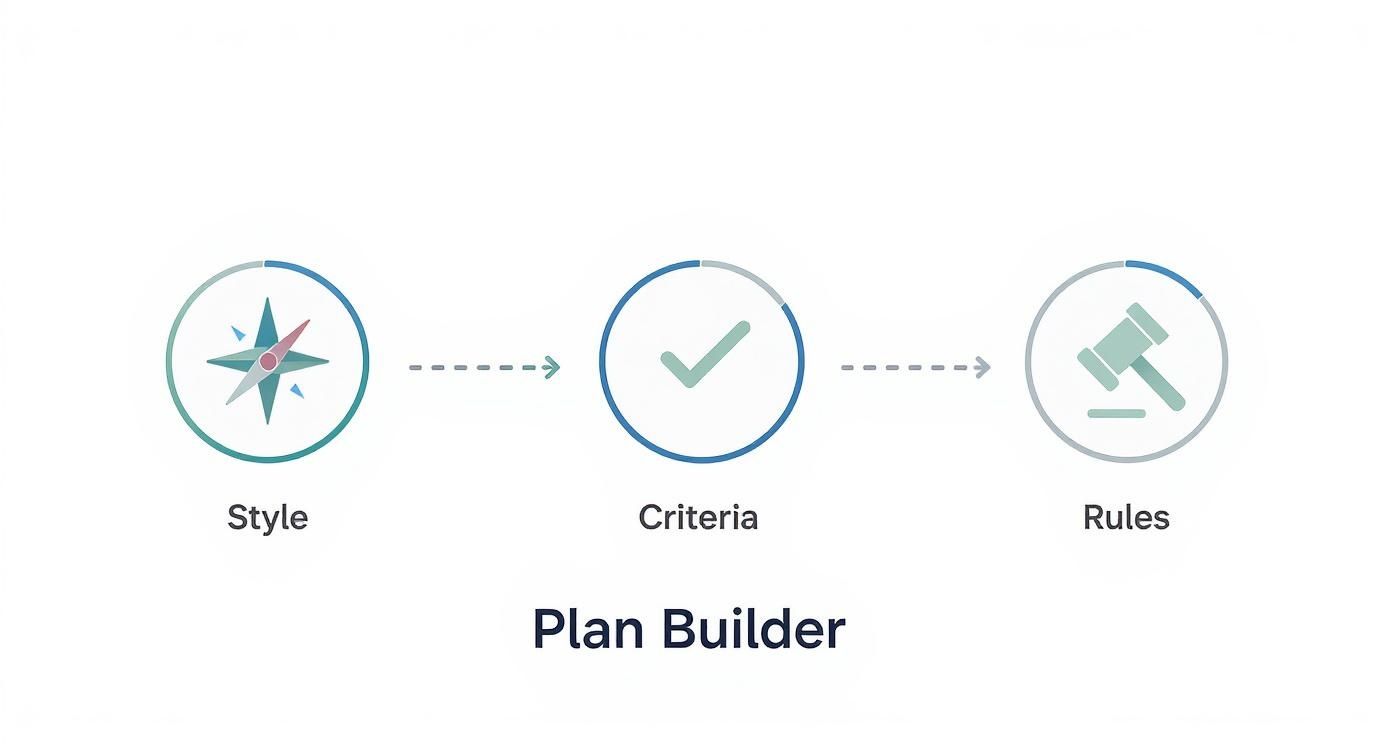
This shows how a clear trading identity (Style), objective signals (Criteria), and strict guidelines (Rules) come together to form the foundation for consistent action.
The Power of a Simple Checklist
Before you place any trade, run it through a simple, physical checklist. This final step forces a moment of objective confirmation, pulling you out of the emotional heat of the moment. It can be as simple as three questions on a sticky note slapped on your monitor.
- Does this setup meet every single one of my entry criteria? (Yes/No)
- Do I know my exact stop-loss and profit target levels? (Yes/No)
- Is my position size calculated according to my risk rule? (Yes/No)
If the answer to any of these is “No,” you don’t take the trade. End of story. It’s a simple but incredibly powerful tool for enforcing discipline and making sure every action is deliberate.
Of course, even with perfect execution on your end, outside factors can still affect a trade’s outcome. If you want to dive deeper into how market mechanics can affect your entries and exits, you can learn more about what slippage is in trading and how to plan for it. Ultimately, managing your emotions mid-trade and sticking to the plan is what turns a reactive gambler into a methodical operator.
Using a Journal to Reinforce Trading Discipline

Your trading journal is the single most powerful tool you have for building unwavering discipline. But let’s be honest — most traders treat it like a simple receipt book, just logging wins and losses. That’s a huge missed opportunity.
The real magic happens when you turn your journal into an honest feedback loop that holds you accountable to your own rules. This is where you diagnose the hidden patterns that are quietly sabotaging your efforts to consistently trade the plan.
Think of it as your personal data lab. It’s for understanding not just what happened in a trade, but why it happened. Without that raw, objective data, you’re just guessing. With it, you can pinpoint the exact moments your discipline falters and make changes that actually stick.
Moving Beyond Just Wins and Losses
If you want your journal to be effective, you have to record more than just the numbers. The context and your mental state are often far more revealing than the final P&L. Each entry needs to capture the full story of the trade, forcing you to confront your in-the-moment decisions.
Try adding these data points to every trade you log:
- Your Mental State: Were you feeling focused, anxious, bored, or maybe a little too confident? A quick note like “Feeling rushed after missing the morning move” can reveal a ton.
- Reason for Entry: Why did you take this specific trade? Jot down the exact criteria from your plan that were met. If they weren’t, you must write that down, too.
- Your Plan Adherence Score: This is a total game-changer. Grade yourself on a scale of 1 to 5 on how well you followed your plan, completely independent of the outcome.
This simple practice shifts your focus from luck to process. A winning trade where you scored a “2” is a problem to fix. A losing trade with a “5” is a successful execution you can build on.
Uncovering Your Hidden Trading Flaws
Over time, this detailed log will expose your personal trading demons. You’ll start seeing patterns you never knew existed. You might discover that you tend to bend your rules more often after a big winning streak, letting arrogance creep in.
Or maybe you’ll notice a cluster of unplanned trades taken around midday, revealing you’re trading out of boredom, not genuine opportunity. These insights are pure gold because they show you exactly where to focus your energy.
Your journal’s primary job isn’t to track profits; it’s to track behavior. Fix the behavior, and the potential for profits can follow. The data doesn’t lie, even when your emotions do.
A modern trading journal, whether it’s a dedicated platform or a custom spreadsheet, can help bring these patterns to life. For those just starting out, building your own can be a great first step. There are plenty of resources explaining how to create an Excel trading journal that tracks these crucial metrics.
The right tool can organize your data to give you instant feedback on both performance and adherence.
This kind of visual data immediately flags where things are going right and where they’re going wrong, turning your trade history into actionable intelligence.
By reviewing this information regularly, you shift from being a reactive trader to a proactive one. You’re no longer a victim of your own bad habits; you’re an analyst systematically identifying and eliminating them. This data-driven approach is the bedrock of discipline and the key to finally mastering your trade plan.
How to Review and Refine Your Plan Like a Pro
A trading plan carved in stone is a trading plan that’s destined to crack. The market is a living, breathing thing — it shifts, changes, and evolves. A plan that felt unbeatable six months ago might start showing weaknesses today.
If you want to trade the plan for the long haul, you have to treat it like a living document. It needs to be reviewed, refined, and adapted based on cold, hard data, not the emotions of a tough trading day.
This isn’t about frantically changing your rules after one or two losses. That’s just emotional tinkering, and it’s a quick way to lose confidence in a solid strategy. This is a structured, professional process of figuring out if you had a bad outcome or a bad process. Your journal is the key here, giving you the objective evidence needed to make smart, calculated adjustments.
Without a formal review process, you risk two terrible outcomes: abandoning a winning strategy during a completely normal drawdown, or worse, sticking with a broken one until it’s too late.
Structuring Your Performance Review
To make this work, you need a rhythm — a consistent schedule for checking in on your performance. Setting aside dedicated time for weekly and monthly reviews creates a powerful feedback loop, letting you spot problems long before they become account-threatening disasters.
- Weekly Review (The Tactical Check-In): This is your quick, 30-minute gut check. The focus is purely on execution quality. Go through your journal and look at your plan adherence. Did you follow your rules on every single trade? If not, where did you slip up, and why?
- Monthly Review (The Strategic Deep Dive): Now it’s time to zoom out. Dig into your performance stats over a much larger sample size, like your last 50-100 trades. This is where you assess the actual effectiveness of your strategy’s rules in the current market.
This two-tiered approach stops you from making knee-jerk changes based on a tiny, statistically irrelevant handful of trades. It forces you to trust the data, not your feelings.
The goal is to learn to love a losing trade that perfectly followed your rules and be deeply suspicious of a winning trade that broke them. The first reinforces good habits; the second rewards bad ones.
Asking the Right Questions
Your review is only as good as the questions you ask. The answers are all there in your journal data, but you have to know what you’re looking for. During your monthly deep dive, get critical and start validating your plan’s core assumptions.
Here are a few powerful questions to get you started:
- Are my entry signals still effective? Filter your trades by setup. Is one particular pattern consistently underperforming or failing in the current market environment?
- Is my risk-reward ratio holding up? What’s your average winning trade versus your average losing trade? If your winners aren’t significantly larger than your losers, your edge might be shrinking.
- Am I exiting trades properly? Be honest. Are you consistently letting winners run to your profit targets, or are you snatching profits early out of fear? On the flip side, are you always, always respecting your stop-loss?
This whole process of systematic review is a lot like the detailed work that goes into backtesting a trading strategy, since both rely on historical data to prove a strategy’s worth.
Remember, refining your plan isn’t a sign of failure. It’s the mark of a professional trader who is truly committed to continuous improvement.
Your Questions, Answered
Let’s tackle some of the most common questions that come up when traders start getting serious about discipline and consistently trading the plan.
How Long Does It Take to Actually Build Discipline?
There’s no single answer here — it’s different for everyone. Building trading discipline is a process, not a destination you arrive at overnight. For most people, it takes at least a few months of deliberate, focused effort to make following a plan feel like second nature.
The real key is consistency. A trader who journals and reviews their performance every single day for three months is going to build that mental muscle much faster than someone who only glances at their stats once a month. It’s about building a new habit, and that only happens through intentional, repeated action.
What Do I Do If My Plan Stops Working?
First, take a breath. Before you blow up a perfectly good strategy, you have to figure out if the plan is truly broken or if you’re just experiencing a normal, expected drawdown. A string of five or six losses doesn’t automatically mean your edge is gone; that could be a completely normal statistical bump in the road.
Your trading journal is your best friend here. Go back and analyze the hard data from your last 50-100 trades. If your core metrics — like your profit factor or win rate — have dropped off a cliff, it might be time to investigate.
Don’t make emotional, knee-jerk changes. Use a structured review to diagnose the real problem. Maybe a specific entry signal isn’t performing well in the current market, or perhaps your risk management rules need a tiny adjustment. Let the data guide you.
Can I Ever Break the Rules?
For anyone still developing as a trader, the answer has to be a hard no. Your one and only job is to build the foundational skill of discipline. Every time you deviate — even if you get lucky and it turns into a winning trade — you’re just reinforcing bad habits that will bite you later.
Now, highly experienced, consistently profitable traders might earn the discretion to make small, calculated adjustments based on unique market context. But that’s an advanced skill built on thousands of hours of screen time and a deep, intuitive understanding of their edge. Until you’ve proven you can be profitable over a long period by following your rules, your plan is the law.
Ready to stop guessing and start analyzing? TradeReview gives you the powerful analytics you need to track your plan adherence, spot hidden patterns in your trading, and finally build the discipline of a professional.
Sign up for free and see your performance with total clarity at TradeReview.