To really learn how to do a journal entry right, you need to see it as more than just a list of wins and losses. We’ve all been there — staring at a P&L that doesn’t make sense, wondering why a winning strategy suddenly stopped working. A truly powerful entry captures the full story — the market context, how you were feeling, and how you executed the trade. This transforms it from a chore into your single greatest analytical tool for long-term growth.
Why Your Trading Journal Is Your Greatest Edge
Let’s be honest — most traders ditch their journals within a month. It feels like homework, and when you’re struggling, the last thing you want to do is document another mistake. This happens because too many people view journaling as just another task, not the core discipline that separates amateurs from the pros. The trick is to change how you look at it.
Think of each entry not as a dry log, but as a crucial piece of data that reveals your decision-making process under pressure. It’s your personal performance review, showing you exactly where you shine and where bad habits are holding you back. This isn’t about finding a magic formula for “guaranteed profits” — it’s about building a real, sustainable edge in the markets by understanding yourself.
From Manual Logs to Smart Analysis
The idea of journaling has come a long way from simple pen and paper. Just like automation has changed accounting by cutting down on errors and boosting efficiency, modern trading journals now come with powerful analytical tools. As hubifi.com explains, this shift from manual data entry to smart analysis saves time and uncovers insights you’d otherwise miss.
A well-designed digital journal, like the one we’ve built at TradeReview, helps you see your progress and zero in on recurring mistakes without getting bogged down in spreadsheets.
The TradeReview dashboard, for example, gives you a clear, at-a-glance overview of your performance metrics.

This kind of visual feedback is vital. It connects your day-to-day actions to your long-term results, making the benefits of journaling feel real and tangible.
The goal isn’t to just record trades; it’s to understand the trader. A disciplined journal is the only tool that gives you an honest look at the person making the decisions.
Ultimately, committing to this process is an investment in yourself. Every entry you log is a step toward mastering your strategy, controlling your emotions, and finding the consistency you’re aiming for. It’s about building the discipline to make better decisions, trade after trade, year after year.
Recording the Essential Trade Data

Before you can ever hope to understand the why behind your wins and losses, you have to get brutally honest about the what. Every meaningful insight you’ll ever have starts with clean, consistent data. This is all about creating a frictionless habit of capturing the cold, hard facts of every single trade.
This goes way beyond just noting your entry and exit price. A truly valuable journal entry captures the full picture. Without this solid foundation, any analysis you try to do later is just guesswork built on shaky ground. The discipline to log these details, especially when you don’t feel like it, is what separates the pros from the hobbyists.
The Core Data Points
Your mission here is to build an objective record of your actions in the market. Think of yourself as a lab technician logging an experiment — no emotion, just the facts. This is the stuff that absolutely has to be in every entry.
Essential Data Fields for Every Journal Entry
To make sure your journal is a powerful tool for analysis, there are a few non-negotiable data points you need to record for every single trade. This table breaks down the essentials.
| Data Field | Description | Example |
|---|---|---|
| Instrument | The specific asset you traded. | NVDA, QQQ, EUR/USD |
| Date & Time | The exact timestamp for your entry and exit. | 10/26/2023 9:35 AM EST |
| Direction | Whether you were buying (long) or selling (short). | Long |
| Position Size | How many shares, contracts, or lots you traded. | 50 shares |
| Entry & Exit Prices | The precise prices where you opened and closed the trade. | Entry: $415.50, Exit: $421.00 |
| Strategy/Setup | The specific technical pattern or reason for the trade. | Bull Flag Breakout |
Consistently logging these details creates an incredibly powerful dataset over time. You could start with a basic spreadsheet — we even have a guide on building an Excel trading journal — but dedicated tools like TradeReview are built to make this process faster and far more insightful.
A trade that isn’t logged is a lesson lost. Your data is the raw material for every single insight you will ever gain about your own trading.
Let’s make this real. Say you just jumped into an NVDA trade on a breakout pattern. Your immediate, no-frills journal entry should look something like this:
- Instrument: NVDA
- Date: October 26, 2023
- Direction: Long
- Position Size: 50 shares
- Entry Price: $415.50
- Strategy: 5-minute Opening Range Breakout
Getting this down right away makes the trade real and measurable. This simple, factual record becomes the bedrock for all the good stuff — the context, screenshots, and psychological notes — that you’ll add later on.
Adding the Context That Numbers Miss

The raw numbers of a trade — your P&L, your entry price, your exit — only scratch the surface. A profitable trade you stumbled into by sheer luck is a bad habit in the making, while a perfectly executed trade that hits your stop-loss is a priceless lesson. The real growth happens when you dig into the context behind those numbers.
This is where your journal transforms from a simple logbook into your most powerful feedback tool. It’s where you capture the “why” behind every click of the mouse. The discipline to actually write down your thought process is what separates traders who consistently improve from those who just spin their wheels.
Defining Your Trade Thesis
Before you risk a single dollar, you need a “why.” Your trade thesis is just that — it’s the specific reason you’re entering the market, the hypothesis you’re testing with your capital. Was it a clean technical pattern? A reaction to a news catalyst? Or a shift in broader market sentiment?
Writing this down forces you to think clearly. Here’s what you should aim to capture:
- The Setup: What specific signal caught your eye? (e.g., “Price broke above a key resistance level on high volume.”)
- The Catalyst: Was there a news event or data release that gave your idea a tailwind? (e.g., “Positive earnings report created a gap up at the open.”)
- Market Condition: What was the bigger picture? (e.g., “SPY was in a strong uptrend, which confirmed my bullish bias.”)
A well-defined thesis turns every trade into a mini-experiment. You aren’t just gambling; you’re testing a clear idea against the market and collecting data, win or lose.
Plan vs. Reality: Your Pre-Trade Plan
This is where you keep yourself honest. Before you enter any trade, you absolutely must know your exits — both for a win and for a loss. Documenting your plan upfront lets you see the difference between your intentions and what actually happened in the heat of the moment.
Your plan should clearly state two things:
- Your Profit Target: Where will you take profits? This needs to be based on your strategy, not a gut feeling. (e.g., “Target is the next major resistance level at $425.”)
- Your Stop-Loss: At what price is your thesis clearly wrong? This is your pre-defined escape hatch. (e.g., “Stop-loss is just below the recent swing low at $412.50.”)
Journaling is becoming more efficient in every field. Take the accounting world, for example — a market projected to hit $735.94 billion by 2025, largely because of tools that streamline data entry. As you learn how to do a journal entry for your trading, think of it the same way: you’re building a smarter, more efficient process for tracking your own performance. You can find more details on this growth over at linkmybooks.com.
By consistently comparing your plan to your actions, you’ll quickly discover where your true edge lies and, just as importantly, the conditions where you tend to make mistakes.
Documenting Your Psychological State
This is the part of the journal entry most traders skip. I get it. But honestly, it holds the key to long-term consistency. Your strategy can be flawless, but if your mindset is a mess of fear or greed, you’re eventually going to blow up your own account. It’s just a matter of time.
Learning how to do a journal entry that truly captures your psychological state is how you start to master yourself — not just the market.
We’ve all been there. You moved a stop-loss out of fear, only to watch the trade go even further against you. You took profits way too early because you got impatient. Or maybe you jumped right into a reckless revenge trade after a frustrating loss. These aren’t strategy problems; they’re emotional ones. Ignoring them is like trying to fix an engine by polishing the hood.
A Framework for Honest Self-Reflection
To get started, try adding a simple scoring system and some notes to your journal entries. It gives you a quick, measurable snapshot of your head-space during a trade.
- Discipline Score (1-5): How well did you actually stick to your plan? Be honest. (1 = threw the plan out the window, 5 = followed my rules perfectly)
- Emotional State: What was the main emotion driving your decisions? (e.g., Confident, Anxious, Greedy, Patient, Fearful)
- Post-Trade Notes: A practical example might be: “I felt anxious when the price pulled back, so I cut the trade for a small gain even though it never hit my stop. My plan was to hold to my target, so my discipline score is a 2/5.”
This simple act of scoring creates some seriously powerful data. After a month, you might look back and see your win rate is a solid 60% when your discipline score is a 4 or 5, but it craters to 20% when your score is a 2. That’s not a coincidence. That’s a pattern you can finally fix.
Your P&L is a byproduct of your decisions, and your decisions are a byproduct of your psychological state. Logging your mindset is the only way to get to the root cause of your performance.
The point here isn’t to beat yourself up for feeling anxious or greedy. The goal is just to acknowledge it. Once you see the hard data connecting your impatience to your losses, it becomes so much easier to build the discipline you need for consistent results.
This process of self-review is fundamental to growth. If you want to go deeper on this, I’d highly recommend checking out some of the best books about trading psychology, which offer incredible frameworks for mastering your mental game.
Turning Your Journal Entries into Actionable Insights
A journal that just sits there collecting digital dust is worthless. The real magic happens when you build a simple, disciplined review process that turns all that raw data into powerful, actionable insights. This is how you stop being a passive trader and start acting as your own performance coach.
The whole point is to zoom out from individual trades and see the bigger picture. When you set aside time each week and month to go over your journal, you finally start connecting the dots. You’ll begin to see clear patterns emerge from the noise of day-to-day market action.
This is where you find answers to your most important questions. Which of your setups consistently perform best? What time of day are you most likely to make an emotional mistake? By using your own data, you can double down on what’s working and systematically fix what isn’t.
Creating a Simple Review Routine
Your review routine doesn’t need to be some complicated, hours-long affair. Consistency is far more important than intensity.
Start by blocking out 30 minutes every weekend just to look over your trades from the week. Ask yourself a few key questions:
- What was my best trade? Figure out why it worked so well. Was it the setup, your patience, or just perfect execution?
- What was my worst trade? And I don’t just mean the biggest loss. Was it a moment of impatience? A total breakdown in discipline?
- What’s the one pattern — good or bad — that stands out most? Look for those recurring emotional triggers or strategic missteps that keep popping up. For example: “I noticed that on 3 out of 4 losing trades this week, I entered before my setup fully confirmed because I had FOMO (Fear Of Missing Out). My action item for next week is to wait for a candle close before entering.”
This infographic gives a great breakdown of how to track your psychological state before, during, and after a trade.
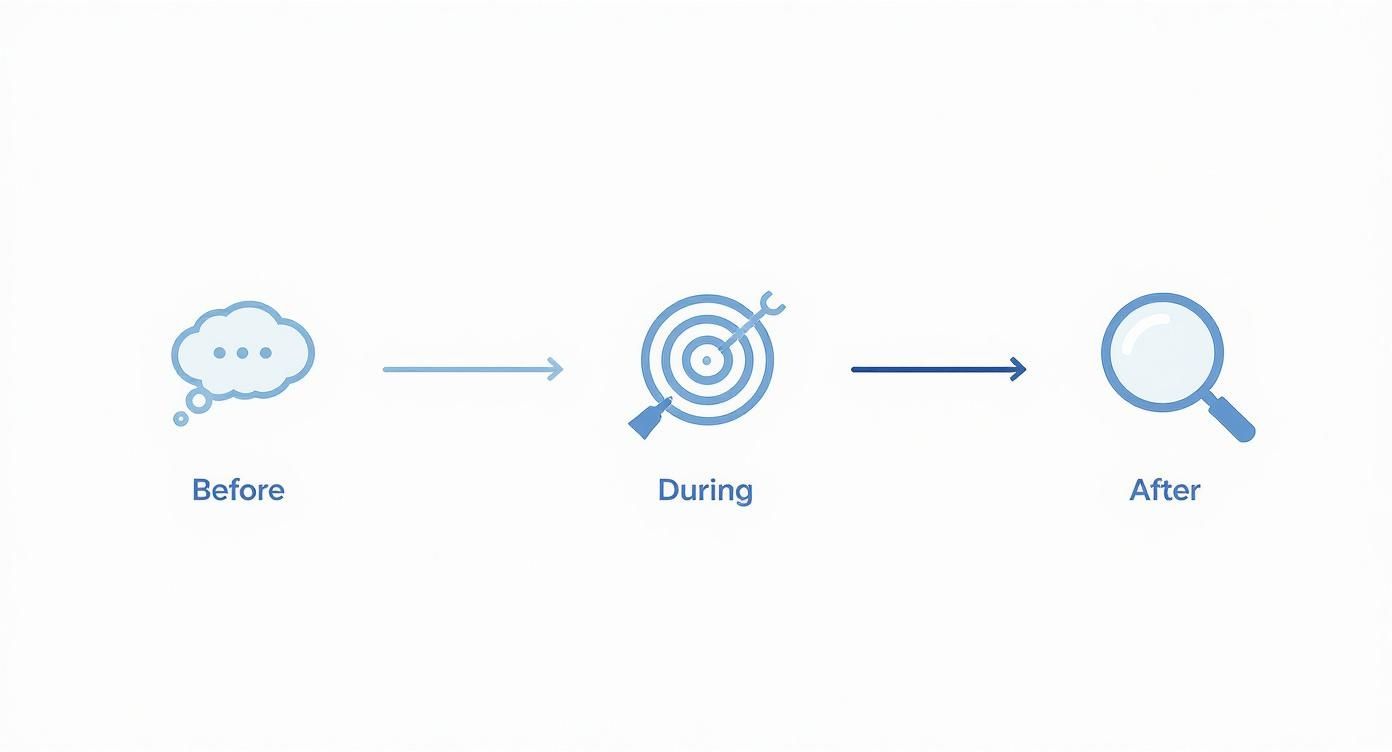
This visual really hammers home the importance of checking in with your mindset at each stage — from the initial idea, to pulling the trigger, and finally to an honest reflection after the fact.
The purpose of a review isn’t to beat yourself up over past performance. It’s to inform your future actions. Every single insight you gain is a direct instruction on how to get better next week.
The tools for this kind of analysis are getting better all the time. Just look at the cloud accounting market, which is on track to hit $69.3 billion by 2033, all because platforms are automating analysis and giving real-time feedback. In the same way, a good trading journal uses tech to help you find your edge faster. You can learn more about these powerful accounting trends on startus-insights.com.
Common Journaling Questions Answered
We get it — starting a new discipline like journaling always brings up a few questions. It’s easy to get hung up on doing things the “right way,” but trust me, consistency will always beat perfection.
Here are some quick answers to the most common hurdles I see traders face.
How Often Should I Make a Journal Entry?
You need to create a journal entry for every single trade you take. No exceptions.
The real power of a trading journal comes from having a complete, unbiased dataset. If you only log your winners, you’re just stroking your ego and creating a useless record. Make it a non-negotiable part of your routine to log the trade immediately after you close it.
What Is the Most Important Part of an Entry?
While every piece of data has its place, the most impactful is almost always your Psychological Notes.
Most traders blow up their accounts because of emotional mistakes — fear, greed, impatience — not because their strategy is broken. Documenting your mindset and, most importantly, whether you actually followed your plan helps you spot the exact behavioral patterns that are costing you money.
For a deeper look, exploring a detailed trading journal example can show you how all these components come together to tell the full story of a trade.
Ready to turn those insights into action? TradeReview gives you the tools to analyze your performance, track your metrics, and build the discipline you need for long-term success. Start your free journal today at https://tradereview.app.