Ever heard the term portfolio rebalancing? It’s a fancy way of saying you’re periodically hitting the reset button on your investments to bring them back to your original game plan. We’re not talking about a high-risk trading strategy, but a disciplined practice of buying and selling assets to maintain your desired mix and, most importantly, manage risk over the long term.
Understanding the Core of Portfolio Rebalancing

Let’s make this real with a practical example. Imagine you start with $10,000 and set up a portfolio for balanced growth with a classic 60% in stocks ($6,000) and 40% in bonds ($4,000). This is your target allocation — the perfect blend you decided on based on your long-term goals and how much risk you’re comfortable with.
Fast forward a year. The stock market had a fantastic run, and your stocks soared in value to $9,000. Your bonds did okay, but their value only grew to $4,200. You check your account, and your total portfolio is now worth $13,200. Suddenly, your mix is 68% stocks and 32% bonds. This is what’s known as “portfolio drift,” and it often happens so quietly you might not have even noticed.
Without realizing it, your portfolio just got a lot riskier. You’re now far more exposed to a stock market dip than you ever intended to be. This is exactly where the discipline of rebalancing steps in. It’s not about second-guessing your winners; it’s about restoring the balance you thoughtfully chose from the start.
The Garden Analogy for Investors
Think of your portfolio like a well-planned garden. You plant some fast-growing flowers (your stocks) and some steady, reliable vegetables (your bonds). Before you know it, the flowers have a great season and start taking over, crowding out the veggies.
Portfolio rebalancing is like pruning those overgrown flowers and making sure the vegetables still have space to thrive. You sell a bit of what’s done really well (the flowers) and use that money to buy more of what hasn’t (the vegetables).
It can feel a little strange at first. Why would you sell your best performers? We get it, it’s tough. But the goal isn’t to get rid of your winners. It’s to lock in some gains, stick to your plan, and manage risk. This is a core practice for staying diversified and in control. For a deeper dive into how this kind of disciplined approach works, check out this research on investment discipline and risk control.
To see how this works with numbers, let’s look at our 60/40 portfolio.
How Portfolio Drift Happens and How Rebalancing Fixes It
This table shows how quickly a portfolio can get out of whack and how a simple rebalancing brings it right back to your target.
| Asset Class | Target Allocation | Allocation After Market Drift | Rebalancing Action | Allocation After Rebalancing |
|---|---|---|---|---|
| Stocks | 60% | 68% | Sell 8% of the portfolio’s stocks | 60% |
| Bonds | 40% | 32% | Buy 8% more bonds | 40% |
As you can see, rebalancing systematically encourages you to sell high and buy low, restoring your portfolio’s original risk profile.
Why Rebalancing Matters for Every Trader
It’s so easy to get swept up in the excitement of a hot stock or a booming sector. We’ve all been there — watching an asset climb and feeling like we should just let it run forever. But that’s emotion talking, and emotion can be a trader’s worst enemy. A long-term plan is your best defense.
Rebalancing takes the guesswork and feeling out of the equation. It creates a simple, rules-based system for taking profits and putting that capital back to work.
The biggest benefits are:
- Risk Management: It’s your automatic defense against letting your portfolio’s risk level creep up without you noticing.
- Forced Discipline: It makes you do what every trader knows they should do: “sell high and buy low.” It’s easy to say but tough to do without a system.
- Long-Term Focus: It keeps you anchored to your original financial goals, so you don’t get distracted by short-term market noise.
At the end of the day, understanding what portfolio rebalancing is gives you a powerful tool for building a more resilient and sustainable investment strategy.
The Three Core Goals of Rebalancing Your Portfolio
Portfolio rebalancing might sound like just another chore on your financial to-do list, but it’s actually a powerful strategy driven by three critical goals. When you get the “why” behind it, rebalancing shifts from a maintenance task to a core part of your long-term success.
It’s not about chasing sky-high returns or promising guaranteed profits. It’s about building a resilient, disciplined framework for your investments.
First and foremost, the primary goal is simple but crucial: risk management. Over time, your best-performing assets will naturally grow to become a larger slice of your portfolio pie. While it’s exciting to watch a stock or crypto asset soar, its growth also means more of your capital is tied to the fate of that single asset, quietly ramping up your risk.
Rebalancing acts as a built-in safety valve, making sure you don’t accidentally become over-concentrated and vulnerable in one area.
This leads us straight to the second goal, which is arguably the toughest for any trader to master: enforcing discipline.
A Built-In Emotional Circuit Breaker
It’s just human nature to let winners run and feel hesitant about buying assets that are down. We’ve all felt that sting of regret after selling a hot stock, only to see it climb even higher. This emotional rollercoaster is a recipe for poor decisions, like buying at the peak of a bubble or panic-selling during a market dip.
Portfolio rebalancing forces you into a systematic, unemotional routine. By setting the rules ahead of time, you pre-commit to taking profits from assets that have done well and reinvesting into those that are lagging — a textbook “buy low, sell high” strategy, but without all the emotional baggage.
This disciplined process is a key part of building a solid plan. If you’re looking to structure your investments effectively, our guide on how to diversify an investment portfolio offers more foundational strategies that pair perfectly with rebalancing. The whole point is to create a system that protects you from your own worst instincts when the market gets chaotic.
Seeking Consistent Long-Term Growth
Finally, rebalancing is all about keeping you on the path toward your long-term financial goals. By consistently trimming gains and buying undervalued assets, you smooth out your returns over time and avoid the dramatic peaks and valleys that can completely derail a portfolio.
While this isn’t a guarantee of higher profits, it helps you stick to the asset allocation you originally designed to meet your objectives. It’s a strategic response to the market’s natural ebbs and flows.
In fact, studies on international equity funds show that pronounced rebalancing is a common tactic used to manage risks from asset price volatility and currency fluctuations. Investors systematically adjust their holdings to stay aligned with their targets. You can discover more about this global rebalancing behavior to see how this plays out on a massive scale.
At the end of the day, these three goals all work together:
- Managing Risk: Prevents you from being unintentionally over-exposed to a single asset or sector.
- Enforcing Discipline: Takes emotion out of the equation by automating sell-high, buy-low actions.
- Staying on Track: Keeps your portfolio aligned with the long-term financial plan you started with.
By making rebalancing a regular habit, you build a much stronger and more predictable foundation for your entire investing journey.
Choosing Your Portfolio Rebalancing Strategy
Alright, you get why we rebalance, but now comes the real question: how do you actually do it? There’s no single “right” way, and the best method is always the one you’ll stick with consistently. It really boils down to your trading style, your schedule, and what feels right for you.
Most traders land on one of two paths — one based on the calendar, the other on market shifts.
Time-Based Rebalancing: The Set-It-and-Forget-It Approach
Time-based rebalancing is as straightforward as it gets. You simply pick a schedule and rebalance your portfolio on those dates, no matter what the market is doing. Think of it like a routine check-up for your financial health.
You could do it quarterly, semi-annually, or annually. The key is consistency. This hands-off system is perfect if you want to tune out the daily market noise and turn a complex task into a simple, recurring event on your calendar.
- Quarterly: This is a popular rhythm. It keeps you proactive without getting bogged down in over-trading.
- Annually: Many align this with tax season, making it a convenient time for a portfolio review. It’s a great fit for long-term investors who prefer minimal intervention.
The biggest win here is simplicity. You set a date, and when it arrives, you get to work. It completely removes the guesswork of when to act, which is a huge mental hurdle for anyone trying to time the market perfectly.
Threshold-Based Rebalancing: The Responsive Approach
If a fixed schedule feels too rigid, threshold-based rebalancing might be your speed. This approach is more dynamic. Instead of relying on the calendar, you only rebalance when an asset class drifts away from its target allocation by a specific percentage.
For example, you could set a 5% threshold. If your goal is to have 60% in stocks, you’d only step in if that allocation climbs above 65% or dips below 55%.
This method ensures you only act when it’s genuinely needed, which can cut down on transaction costs and taxable events. It forces you to respond to significant portfolio drift, not just an arbitrary date on the calendar.
The trade-off? It demands more attention. You need to keep a closer eye on your allocations to spot when a threshold is crossed. For traders who want a strategy that reacts to volatility, this active involvement is a major plus.
Time-Based vs. Threshold-Based Rebalancing
So, how do these two methods stack up against each other? Here’s a side-by-side look at how they work, which should help you decide which approach fits your style.
Let’s imagine you start with a target of 60% Stocks and 40% Bonds.
| Feature | Time-Based Rebalancing | Threshold-Based Rebalancing |
|---|---|---|
| Trigger | A specific date (e.g., the last day of each quarter). | An asset class drifting past a set percentage (e.g., 5% from its target). |
| Example Action | On June 30th, you see your stocks are at 67%. You rebalance back to 60/40. | In May, stocks hit 65.1% of your portfolio, triggering a rebalance back to 60/40. |
| Pros | Simple, predictable, and requires less monitoring. Enforces discipline automatically. | More responsive to market moves, potentially lower transaction costs if markets are stable. |
| Cons | Might rebalance unnecessarily or miss significant market shifts between reviews. | Requires constant monitoring and can lead to inaction if thresholds are never met. |
Ultimately, your choice really comes down to your personality. Do you thrive on a disciplined, automatic routine, or do you prefer a more flexible, responsive one? Both get you to the same goal: managing risk effectively.
Some traders even mix the two, reviewing their portfolio quarterly but only acting if a threshold has been crossed. This hybrid approach can be paired with other disciplined investment techniques. In fact, you can learn more about dollar-cost averaging in our guide to see how regular, systematic actions can build a stronger portfolio over time.
A Step-by-Step Guide to Rebalancing Your Investments
Diving into your portfolio to rebalance can feel like a chore, but it’s really just a simple, scheduled tune-up for your investments. When you follow a clear process, you take the emotion and guesswork out of the equation.
Let’s walk through the five essential steps to get your investments back where you want them.
Step 1: Confirm Your Target Asset Mix
Before you touch a single thing, you need to know your destination. Go back to the target allocation you originally set for your portfolio. Is that classic 60/40 stock-and-bond split still the right move for your financial goals and how much risk you’re comfortable with?
Life happens. A new job, a growing family, or getting closer to retirement can completely change your investment needs. Take a second to confirm that your target mix still makes sense for you today. This is your anchor, so make sure it’s solid before moving on.
Step 2: Assess Your Current Portfolio Allocation
Now it’s time for a quick snapshot. Log into your investment account and see what percentage each asset class actually holds. The market has almost certainly shifted these numbers since the last time you looked.
For example, your target might be 60% stocks and 40% bonds. But after a great year for stocks, you might find your portfolio has drifted to 70% stocks and 30% bonds. This is totally normal, but it’s also your cue to take action.
The whole point of rebalancing is to close this gap between where you want to be and where the market has taken you. Spotting this drift is the first step toward getting back in control of your risk.
Step 3: Pinpoint Overweight and Underweight Assets
With your target and current numbers in hand, this next part is easy. Just identify which parts of your portfolio have grown too big (overweight) and which have gotten too small (underweight).
Using our example from before:
- Stocks: Are now at 70%, which is 10% overweight compared to your 60% target.
- Bonds: Are now at 30%, which is 10% underweight compared to your 40% target.
This simple comparison tells you exactly what to do next: sell some stocks and buy some bonds.
The infographic below breaks down the two main ways to decide when to do this check — either on a set schedule or when things drift too far.
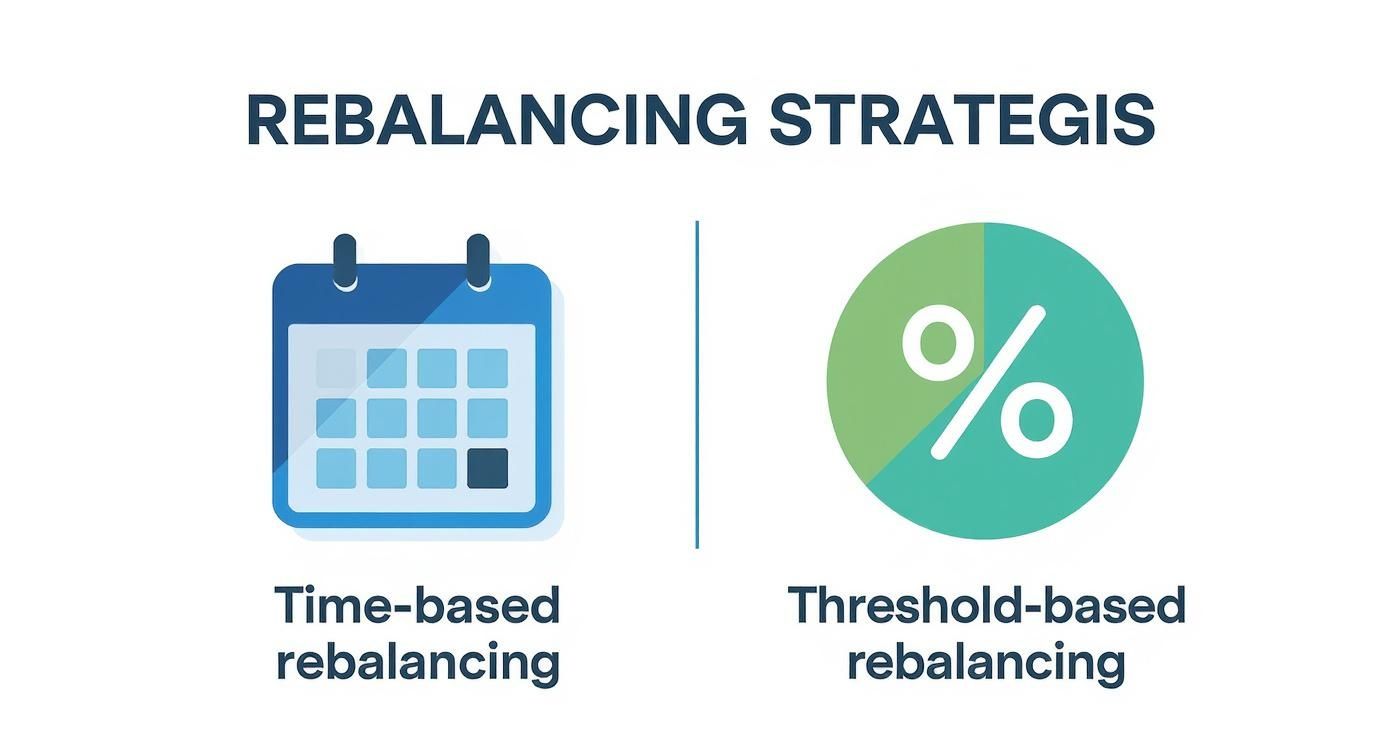
As you can see, a time-based approach is all about consistency, while a threshold-based approach is more reactive to what the market is doing.
Step 4: Execute the Trades
This is where the magic happens. To get your portfolio back to that 60/40 target, you’d sell off the extra 10% in stocks and use that money to buy more bonds.
This simple action forces you to follow one of investing’s golden rules: sell high and buy low. It’s a discipline that’s incredibly hard to stick to without a solid plan in place.
Just a quick tip: keep an eye on transaction costs and taxes. If you can, try to rebalance inside tax-advantaged accounts like a 401(k) or IRA first. That way, you can avoid a surprise capital gains tax bill.
Step 5: Record and Review
Finally, write it down. A trading journal like TradeReview is perfect for this. Make a note of the date you rebalanced, the exact trades you made, and what your portfolio looked like afterward.
This record keeps you accountable and gives you a clear history to look back on during your next review. It’s a simple step that helps you stay disciplined and focused on your long-term strategy.
How Rebalancing Becomes Your Anchor in a Volatile Market

When the markets get chaotic, it’s easy to feel like you’re on a ship in a storm. Your gut instinct might scream to either jump overboard (panic-sell everything) or climb the highest mast for a better view (chase the euphoric highs).
This is precisely when a disciplined rebalancing strategy becomes your most valuable tool. Think of it as an anchor holding you steady when the waves get choppy.
Human emotion is often the biggest enemy of long-term returns. We’ve all felt that pit in our stomach during a market downturn and the intense FOMO during a bull run. Rebalancing acts as a powerful guardrail against these impulses, forcing you to act with logic instead of emotion.
It gives you a clear, pre-determined plan of action, so you aren’t left making desperate decisions when the headlines are screaming doom and gloom.
Turning Volatility into a Strategic Advantage
Instead of seeing market swings as a threat, rebalancing helps you flip the script and see them as an opportunity. It builds a systematic “buy low, sell high” mechanism right into your investment process — something that’s incredibly difficult to pull off when emotions are running high.
Here’s how it works in the real world:
- During a Downturn: The market drops, and suddenly your stock allocation has shrunk below your target. Your rebalancing rule kicks in, prompting you to sell some of your more stable assets (like bonds) and buy more stocks while they’re effectively “on sale.”
- During a Bull Run: The market soars, and your stocks are now a much bigger piece of the pie than you planned. Rebalancing forces you to trim those high-flying winners, lock in profits, and reallocate that cash to assets that haven’t performed as well.
This counter-intuitive discipline is the whole secret. Without it, most investors do the exact opposite: they pile in at the top out of excitement and sell at the bottom out of fear. A solid rebalancing strategy helps you stick to the plan when it matters most.
For more on navigating these market swings, check out our guide on what is market volatility.
Rebalancing isn’t just about numbers and percentages. It’s a behavioral tool that encourages rational thinking when irrationality is all around you. It helps you stay the course, turning market turbulence from a source of stress into a strategic advantage.
A Global Perspective on Market Stress
This idea of rebalancing as a stabilizing force isn’t just a theory; we see it play out on a global scale.
During periods of major financial stress, like sharp currency devaluations, professional investors often rebalance to manage risk. Historical analysis shows that when faced with price shocks, global investors tend to sell equities in the affected countries to bring their portfolios back to their target weights. This systematic selling can actually act as a counter-force, helping to dampen the initial shock.
Ultimately, portfolio rebalancing gives you the structure you need to navigate the inevitable ups and downs of investing. It’s a commitment to long-term thinking that empowers you to stay disciplined, manage risk, and systematically act on the opportunities created by the market’s own emotional swings.
Common Questions About Portfolio Rebalancing
Once you wrap your head around the concept of rebalancing, a few practical questions almost always pop up. It’s one thing to understand the theory; it’s another to actually put it into practice.
Let’s tackle the most common questions to help you get started with confidence.
How Often Should I Rebalance?
This is probably the most frequent — and most important — question traders have. And the honest answer is: there’s no single perfect schedule. The right frequency really depends on your trading strategy, how you feel about transaction costs, and how much time you’re willing to spend on it.
Here are the most common approaches traders take:
- Quarterly: This is a popular middle ground. It’s often enough to keep your portfolio from drifting too far off course but not so frequent that you’re constantly in the market making trades.
- Annually: Many investors just rebalance once a year, often tying it to tax season. This is a great “set it and forget it” method that keeps trading costs and time commitment to a minimum.
- Threshold-Based: Instead of following a calendar, you only act when an asset class moves by a specific amount, like 5%. This approach is much more responsive to big market swings but requires you to keep a closer eye on your portfolio.
At the end of the day, the best schedule is the one you can actually stick to. Consistency is far more important than trying to perfectly time your rebalancing.
Does Rebalancing Guarantee Better Returns?
It’s really important to be clear on this: rebalancing is a risk management tool first and a return-enhancement tool second. Its main job isn’t to guarantee you’ll make more money. It’s to keep your portfolio aligned with your original risk tolerance and goals. We’ve all seen traders get burned by letting a single hot stock take over their portfolio, only to watch it crash. Rebalancing is your built-in defense against that.
While the disciplined “buy low, sell high” rhythm of rebalancing can sometimes lead to better long-term returns, its real power is in preventing catastrophic losses. You’re systematically taking profits off the table and reinvesting in assets that are temporarily down, building a more resilient portfolio over time.
Thinking of it this way helps keep expectations realistic. Rebalancing is about staying in the game for the long haul by smoothing out the ride and enforcing discipline — which, more often than not, is the real key to lasting success.
What Are the Tax Consequences?
This one is a big deal. Every time you sell an asset for a profit in a standard brokerage account, you could be looking at a capital gains tax bill. It’s just an unavoidable part of rebalancing that you need to plan for.
But there are smart ways to handle it. A great strategy is to do your rebalancing inside tax-advantaged accounts first, like a 401(k) or IRA. Since you can buy and sell within these accounts without immediate tax consequences, you can get your allocations back in line without a surprise tax bill. If you have to rebalance in a taxable account, you can also look for opportunities to offset your gains by selling other assets at a loss — a tactic known as tax-loss harvesting.
Keeping up with a rebalancing schedule is much easier when you have the right tools. With TradeReview, you can track your portfolio’s performance, log your trades, and review your strategy with clear analytics. See how your decisions are paying off and stay on track with your long-term goals. Start journaling your trades for free today at https://tradereview.app.